Currently, the world is undergoing a profound change unseen in a century, with frequent black swan events and a significant increase in uncertainty. However, it is undeniable that innovation opportunities are emerging, and industrial revolutions are beginning. We are also at an era when the agricultural food industry holds the most abundant opportunities. Based on this,2022year12month16day-17day2022The International Top 100 Future Agriculture & Food Companies & Yangling Summit was held at the Yangling Demonstration Zone in Xianyang City, Shaanxi Province.35The event was launched by the Shaanxi Provincial Department of Commerce and the Yangling Demonstration Zone Management Committee, and organized by the Yangling Demonstration Zone Industrial Investment Promotion Bureau and the Yangling Food Engineering Innovation Center.
The content of this summit focuses on topics such as digital agriculture, modern seed industry, bio-agriculture, future food, and international cooperation. Starting from three major directions: the overall trend, curve overtaking, and underlying transformation, discussions are carried out closely around technological change, industrial application, and value realization, aiming to reach new industrial consensus and jointly build a new engine for the innovative development of future agricultural food in the new era. Frost & SullivanFrost & Sullivan,Mr. Zhang Jian, Partner and Managing Director of Frost & Sullivan's Greater China Region, was invited to attend the conference. And delivered a speech on the current development status and future trends of the Chinese potted vegetable market.
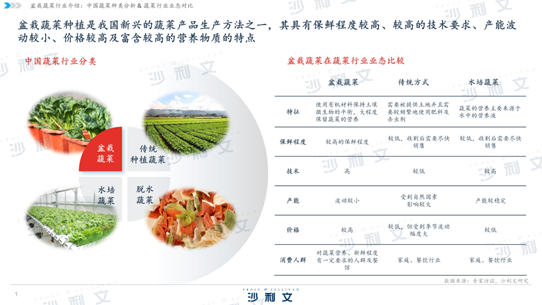
According to Zhang Jian, potted vegetable cultivation is one of the emerging vegetable product production methods in China. Compared to traditional vegetable cultivation and hydroponics, potted vegetable cultivation uses organic materials to maintain soil microbial balance, retaining a high level of vegetable nutrition. It has characteristics such as high preservation, high technical requirements, less fluctuation in production capacity, and higher prices. Its consumers are mainly those with certain requirements for vegetable nutrition and freshness, as well as restaurants.
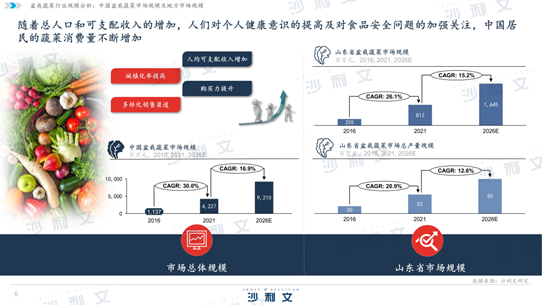
as With the increase in total population and disposable income, the urbanization rate continues to rise, sales channels are diversifying, and people's awareness of personal health has heightened along with their concern for food safety issues. As a result, the vegetable consumption of Chinese residents has been continuously increasing. and Potted vegetable products, as a direct way to obtain high-quality fresh vegetables, are becoming increasingly popular among consumers and restaurants due to their year-round supply, efficient production, fresh harvesting, and low content of harmful substances. According to a study by Frost & Sullivan, the market scale of potted vegetables in China has shifted from2016year1,137Rise from one million to2021year4,227One million yuan, with a compound annual growth rate of30%, is expected to arrive2026The number of annual users will grow to9,210One million yuan.
In the production process of potted vegetable products, seedling cultivation, substrate preparation, transplanting, and field management are the four key steps. Zhang Jian pointed out that the product production of potted vegetables is located in the midstream of the industrial chain. There are high requirements for producers' planting experience, technology, scale, and expertise. Potted vegetable producers with long-term management experience, advanced planting techniques, larger scale operations, and employees with professional knowledge can achieve higher productivity.
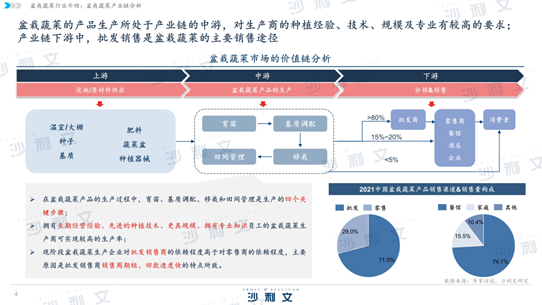
Looking at the downstream of the potted vegetable market industry chain, China's potted vegetable market is mainly composed of wholesale and retail channels, with wholesale sales being the primary sales channel. At the current stage, potted vegetable production enterprises rely more on wholesalers than retailers, mainly due to the characteristics of wholesalers such as shorter sales cycles and faster payment collection.
"However, with the rise of online platforms in recent years, the distribution channels for potted vegetable products have expanded from traditional wholesalers and offline stores to online platforms. The sales volume of retail channels for potted vegetable products has shifted from2016year19.6Growth from one million boxes to2021year72.8One million boxes, with a compound annual growth rate of30.0%"Zhang Jian said."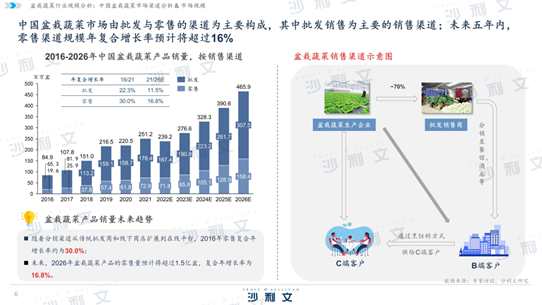
In addition, apart from people The emphasis on the concept of 'healthy diet' has been a factor, along with the impact of related factors such as the pandemic and natural disasters. In recent years, vegetable prices have continued to rise. Additionally, due to the recurrence of the pandemic, urban residents have begun to engage in a trend of hoarding vegetables. Potted vegetables, as a suitable method for home cultivation, have also attracted widespread attention from urban residents. Considering all these factors, Frost & Sullivan expects that the retail scale of the potted vegetable market will gradually exceed that of wholesale within the next five years.2026The retail volume of annual potted vegetable products will exceed1.51000 million pots, with a compound average annual growth rate of16.8%.
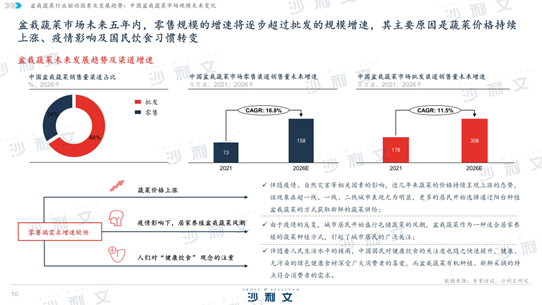
Zhang Jian stated that the Chinese potted vegetable market is mainly composed of four major driving factors, including urbanization and rising per capita income levels in China, national concerns about food safety, population aging, and the expansion of online distribution channels:
1Urbanization and rising income levels
- With the steady growth of the macroeconomy, the income level of Chinese residents has significantly improved in recent years;
- More and more people are beginning to pay attention to their personal health and seek healthy eating habits.
2) Worries about food safety
- Chinese residents pursue a higher standard of living, so they pay more attention to food quality;
- People's desire for a higher standard of living and the improvement of suboptimal health conditions have led to an increased consumption of healthier foods.
3) The ever-growing elderly population
- China has entered an aging society.65The proportion of the population aged over [X] years has maintained an upward trend;
- Elderly people have a high preference for fresh and healthy foods such as vegetables, and it is expected that they will become the main consumer group.
4) Expand online distribution channels
- Due to the characteristics of low prices and diverse choices, online distribution channels are becoming increasingly popular among customers;
· Major manufacturers have expanded their distribution channels from traditional wholesalers and retailers to online platforms such as Taobao and WeChat.
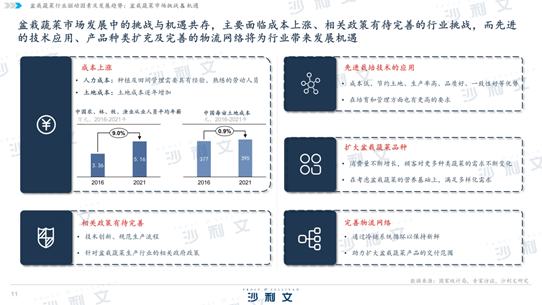
"As one of the important components of the agricultural ecosystem, the revitalization and development strategy for rural potted vegetable cultivation will provide favorable support for the growth and expansion of China's potted vegetable market." Zhang Jianjian further explained that the current potted vegetable market faces development pain points such as deteriorating ecological environment, weak industrial chain, and lack of financial support. In the future, with the country advocating and supporting modern green smart agriculture, implementing industrial strategies, and strengthening financial support, the potted vegetable market is expected to develop rapidly under policy support, prompting more high-quality enterprises to join this sector, unblocking the upstream and downstream of the industrial chain, realizing resource sharing, and developing together.
Zhang Jian believes that the development of the potted vegetable market faces both challenges and opportunities. Currently, although costs are continuously rising and relevant policies need to be improved, The application of advanced cultivation techniques, the expansion of product varieties, and the continuous improvement of the logistics network will bring development opportunities to the industry.
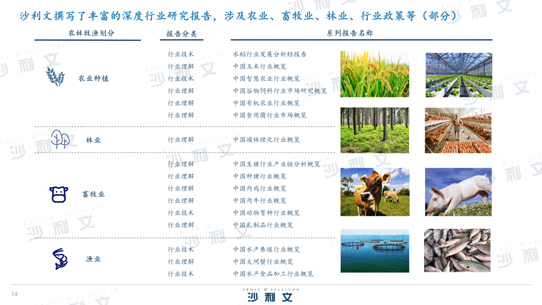
Finally, Zhang Jian introduced briefly to the guests present the business coverage of Frost & Sullivan in the agriculture, forestry, animal husbandry and fisheries sector. Frost & Sullivan acts as a bridge connecting Chinese enterprises in these sectors with global capital markets. In recent years, it has assisted nearly a dozen enterprises in this area to successfully list on international capital markets and provided diversified consulting services for many industry players. At the same time, Frost & Sullivan has authored a wealth of in-depth industry research reports covering agriculture, animal husbandry, forestry, and industry policies.