 The First Shanghai International Digital Arts Expo
In the internet era, digital artworks are highly susceptible to replication and dissemination, making copyright protection extremely challenging. Moreover, with the development of emerging industries such as metaverse and digital collectibles, the ownership of rights for digital artworks has become more complex. The rapid and large-scale authorization of massive amounts of works will face challenges. Therefore, China urgently needs to establish a more complete digital art copyright protection mechanism, build a good digital copyright ecosystem, enhance the copyright awareness of society as a whole, and better protect the interests of producers, operators, and consumers at all nodes of the digital art copyright industry chain.
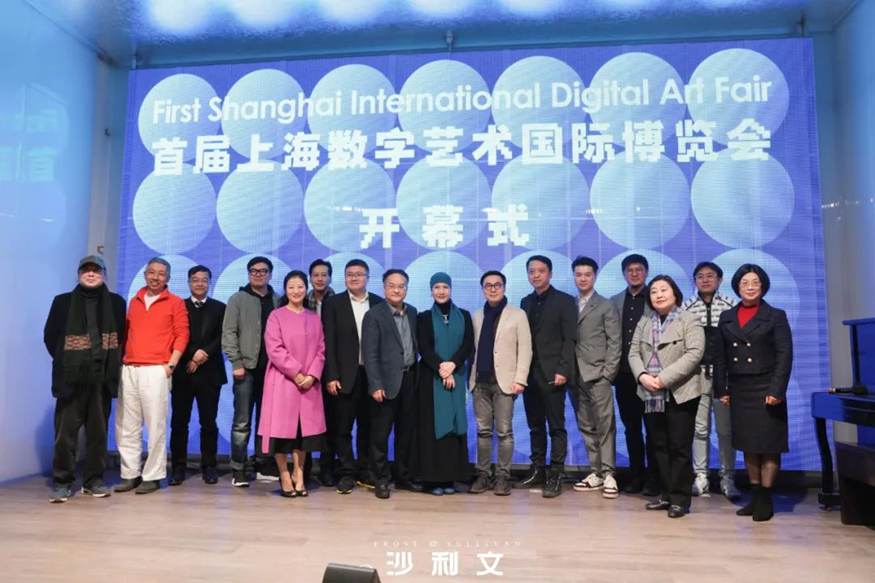
2month10On the day of the opening forum of the first Shanghai International Digital Arts Expo, held at the Wang Xiaohui Art Museum, as a strategic partner of this expo, Frost & Sullivan (Frost & SullivanWang Chenhui, Managing Partner and Executive Vice President of Frost & Sullivan Greater China Region, was invited to attend this event and delivered a keynote speech titled2022China Digital Art Copyright White Paper 2019 (hereinafter referred to as the 'Report').

The report is jointly released by Frost & Sullivan, LeadLeo Research Institute, Shanghai International Digital Arts Expo, National Copyright Trade Base (Shanghai), and Taihe Tai (Shanghai) Law Firm. The core goal of the report is to clarify the definition of digital art copyright in China, the copyright protection process, and copyright protection technologies. It also explores the copyright regulations for the emerging business format 'digital collectibles', aiming to help creators of digital art, distribution platforms, consumers, and relevant government and enterprises enhance their understanding of digital art copyright, thereby further promoting the healthy development of China's digital art industry.
Wang Chenhui stated that from the perspective of digital art creators, the enhancement of copyright awareness helps to promote the creation of excellent digital art works; from the perspective of digital art-related enterprises, the improvement of copyright awareness is conducive to enhancing the management and operation capabilities of the entire copyright chain; from the government perspective, recognizing the value and significance of digital art copyrights, standardizing regulatory policies, can maximize the release of market value and play an important supporting role of digital copyrights in the cultural industry.

01
Why is the digital art copyright industry worthy of attention?
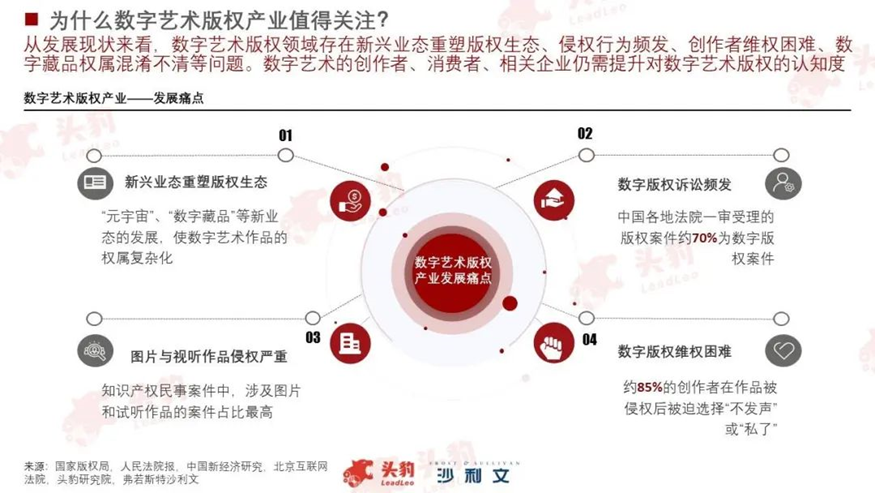
Wang Chenhui pointed out that, from the perspective of current development, there are four major pain points in the field of digital art copyright, namely: reshaping the copyright ecosystem with emerging business forms, frequent digital copyright litigation, serious infringement of images and audio works, and difficulties for creators to safeguard their rights.
Firstly, the birth of the metaverse and digital collectibles is reshaping the copyright ecosystem: With the development of metaverse platforms, the way digital content is created may undergo significant changes. For example,AIGCAI-generated content will become one of the main productive forces in the future industry. Low-code, zero-code, and automated content generation will become important development trends. Against this backdrop, the attribution of rights to digital works will become more complex, and the rapid large-scale authorization of massive amounts of works will face challenges.
Secondly, China's digital art industry is facing the frequent issue of digital copyright litigation: Intellectual property cases accepted by courts at the first instance across China approximately70%It's a copyright case, and about70%It is also related to the internet. It can be seen that the protection of digital works' copyrights in the future will be a focus of national copyright protection efforts.
In addition, in terms of the types of infringing works, currently, copyright infringement involving images and audiovisual materials accounts for a high proportion: 2021In [year], among the cases accepted by the Beijing Internet Court, copyright cases accounted for nearly77%Among them, picture-related cases account for the highest proportion, followed by audio-visual works, and there is a continuous growth trend in this area.
Finally, it is important to note that current art creators are facing difficulties in protecting their digital copyrights: According to data statistics from the China New Economy Research Institute, approximately85%The creators of these works are forced to choose 'not to speak out' or 'resolve privately' after their work is infringed upon. The main reason lies in the complexity of the traditional evidence collection and rights protection process, which is time-consuming and costly, costing about60%The compensation for image infringement cases only accounts for a fraction of the litigation costs20%.
02
What are digital art copyright works?
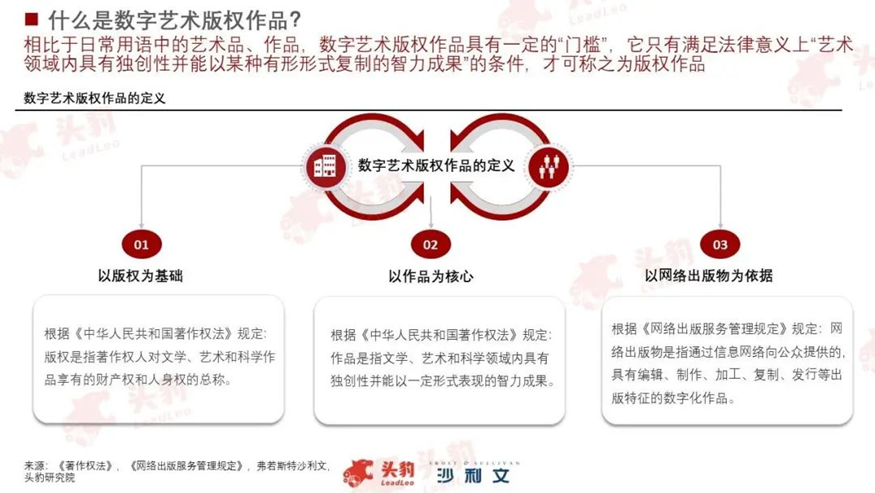
According to Wang Chenhui, at the legal level, digital art copyright works are based on copyright, centered around the work itself, and supported by online publications.
(1Definition of digital art copyright works: Compared to artworks and works in everyday language, digital art copyright works have a certain 'threshold'. Digital art works can only be called digital art copyright works if they meet the legal definition of 'intellectual achievements within the field of art that are original and can be reproduced in some tangible form'. In China, copyright refers to the right of authorship. Digital art copyright works are protected by copyright law.
(2Characteristics of digital art copyright works: According to legal provisions, digital art copyright works must satisfy two major elements: originality and replicability.
Originality: A work must be created independently by the author through conception and creation, and only works with originality are protected by copyright law. To determine whether a digital art work is original, one can refer to the following three key points: ① The work was completed independently by the author, not plagiarized or copied from others; ② The work needs to reflect the author's personality and possess a certain level of creative height. For example, in the case of fine arts, originality is usually manifested in the use of lines and colors. In music, originality lies in the combination of notes, the arrangement of scales, and the choreography of rhythms; ③ The work can clearly express the author's thoughts in a certain form.
Replicability: It refers to the ability to produce one or more copies of a work through methods such as printing, photocopying, tracing, rubbing, recording, video recording, transcription, or photographing, without any change in the content of the work.
(3Basis for digital art copyright works: Digital art copyright works must comply with the 'Regulations on the Administration of Online Publishing Services'. An online publication refers to a digital work that is provided to the public through information networks and has publishing characteristics such as editing, production, processing, reproduction, distribution, etc.
03
How to protect digital art copyrights?
Wang Chenhui further pointed out that the copyright protection process for digital art works typically involves three major stages: copyright registration and preservation, copyright distribution, and copyright enforcement.
In the cross-examination phase of rights protection litigation, judges need to verify and confirm that evidence is accurate and unaltered, providing strong support for the parties' rights protection efforts. However, from the current development situation, a large number of original authors in China lack awareness of retaining evidence during the creation process and after the completion of their works, often facing difficulties in presenting original evidence when dealing with copyright infringement or authorization issues. Therefore, original authors must establish the awareness of retaining original evidence as soon as possible.
Currently, there are mainly two methods of digital copyright authentication in China: traditional copyright registration and blockchain copyright authentication. Both methods have legal effect, but blockchain copyright authentication is more convenient and can effectively solve the pain points of long service cycles and high costs associated with digital copyright registration.

04
How is blockchain evidence storage technology applied to commercial copyright protection?
Wang Chenhui stated that compared to traditional copyright protection models, a trusted blockchain platform can effectively improve the efficiency of resolving copyright disputes, reduce rights protection costs, and reshape the value of copyrights.
Confirmation of Rights and Evidence Preservation: (1The traditional method for copyright registration of works usually involves offline applications, which are cumbersome and require one to travel between multiple departments to prove ownership./Between organizations, an appointment is usually required30Obtaining a copyright registration certificate within a working day does not enable quick confirmation of rights for works; (2Ant Blockchain can provideSaaSPlatform services andAPIAccess services enable individuals and organizations to achieve "publish and get a certificate" instantly. A digital certificate is generated online with one click, which can be verified by the judiciary.
Dissemination Monitoring: (1Facing the hundreds of millions of new media original works produced daily on online platforms, traditional manual monitoring and comparison methods are difficult to manage the vast amount of data across the entire network, making it challenging to control content distribution and ensure dissemination security;2Ant Blockchain uses the feature value extraction of content to generate specific digital fingerprints as its technical feature. It identifies and monitors based on the graphic, text, audio, and video content itself, with an identification accuracy precise to each frame, and a comparison accuracy rate that can reach99%Above.
Evidence collection for infringement: (1Due to the strong concealment of online infringement and the characteristics of electronic evidence being easily tampered with and lost, original authors often find it difficult to obtain effective evidence of infringement;2Using blockchain electronic evidence collection tools, it is possible to promptly discover and self-solidify infringement evidence at any time. Online evidence collection can be carried out through methods such as web page screenshots and video recordings, and the data is recorded on the blockchain.,Provide reliable judicial evidence for rights protection.
Judicial Rights Protection: (1The traditional rights protection model is time-consuming, typically taking3 - 8Months, and the rights protection cost is as high as hundreds of thousands/piece; (2Based on the evidentiary validity of evidence witnessed by authoritative nodes on the chain, blockchain platforms can introduce authoritative law firms, arbitration institutions, and judicial appraisal institutions to provide more efficient rights protection services throughout the process. The time limit is usually20Within 1 day, the cost is only a few hundred yuan/piece.
Intelligent Trading: (1) Traditional digital copyright often adopt an offline matchmaking transaction model, lacking industry-standardized services. During the copyright transaction process, information is not interconnected, making it difficult to fairly and effectively distribute copyright revenues among original authors and relevant institutions;2) Through a trusted copyright alliance chain, associated information is shared after being uploaded to the chain. Integration and data exchange can be achieved within smart contracts and business application layers, with fair and real-time revenue distribution realized through smart contracts.

05
In which art fields is blockchain evidence storage technology applied?
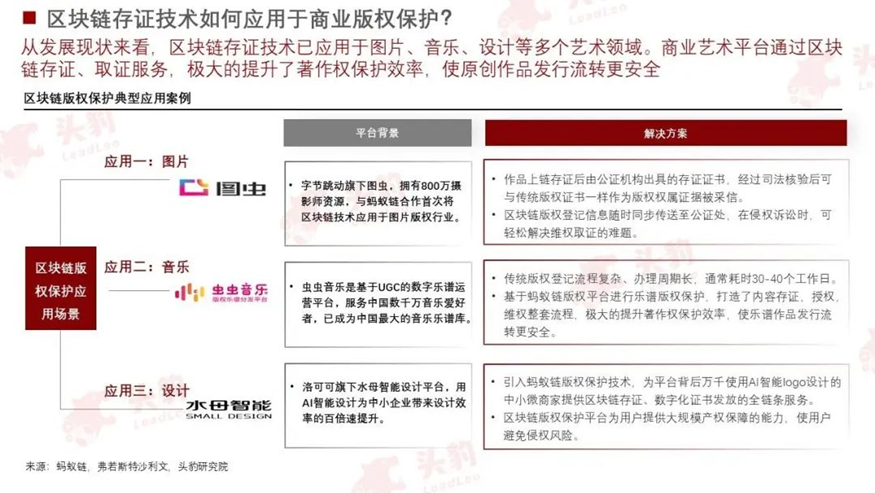
From the perspective of current development, Wang Chenhui stated that blockchain authentication technology has been applied in multiple art fields such as images, music, and design. Commercial art platforms have greatly improved the efficiency of copyright protection through blockchain authentication and evidence collection services, making the distribution and circulation of original works safer.
(1) Image domain case: ByteDance's subsidiary Toutiao, which owns800Wanphotographer provides a vast array of photographers' resources. In collaboration with AntChain, it has applied blockchain technology to the picture copyright industry for the first time. After a photographer's work is uploaded to the blockchain platform and authenticated, they will receive an authentication certificate issued by a notary institution. This certificate can be accepted as evidence of copyright ownership just like traditional copyright certificates after judicial verification. In addition, the copyright registration information on the blockchain platform can be transmitted to the notary office in real-time. When photographers file infringement lawsuits, this can easily solve the problem of obtaining rights protection evidence.
(2) Music domain case: Insect Sounds is based onUGCThe digital music score operation platform currently uses the Ant Chain copyright platform for music score copyright protection, creating a complete set of processes including content authentication, authorization, and rights protection. This has greatly improved the efficiency of copyright protection and made the distribution and circulation of music score works safer.
(3) Design domain case: The Jellyfish Intelligent Design Platform has introduced Ant Chain copyright protection technology, benefiting tens of thousands of users behind the platform.AIIntelligentlogoThe designed blockchain-based services for small, medium and micro businesses provide a full-chain service including blockchain document storage and digital certificate issuance. The blockchain copyright protection platform enables users to obtain large-scale property rights protection, helping them avoid infringement risks.
06
How should the copyright of digital art collections be regulated and applied?
Wang Chenhui believes that the standardized application of digital art collection copyrights mainly involves three major aspects. Platforms should conduct copyright and authorization reviews during the collection issuance process; clarify copyright ownership during the collection trading process; and specify the usage scenarios and derivative applications for collections during the collection utilization phase.
I. Collection Issuance Phase: Platform andIP addressWhen signing the agreement, copyright and authorization reviews should be conducted.
(1When signing an agreement with the rights holder, the platform party should confirm that the rights holder indeed has complete copyright over the relevant work, and that there are no defects such as plagiarism or exclusive authorization.
(2) When granting permissions, the platform provider should choose exclusive authorization as much as possible to prevent other platforms or brands from having the same digital collectibles.
II. Collection Transaction Phase: When the platform conducts transactions with users, it should clearly define the copyright ownership after the collection transaction
(1The platform should draft a user agreement to clarify the ownership of intellectual property and copyrights of digital collectibles after transactions.
(2The platform should draft a user agreement that clarifies users' infringement behaviors and the consequences they bear.
III. Collection Usage: The platform should specify the usage scenarios and derivative application scenarios for collections
(1The platform should draft a user agreement specifying the use scenarios and derivative application scenarios for digital collectibles.
(2The platform should clarify that after users purchase digital collectibles, they are not allowed to engage in speculation, money laundering, tokenization, financialization, securitization, or other illegal trading and circulation on public exchanges or privately.

07
How to address the issue of copyright compliance for digital art collections?
Finally, Wang Chenhui also stated that behind the popularity of digital art collections, there is an urgent need to standardize copyright compliance issues, which requires the joint efforts of multiple parties to promote the healthy development of the market.
(1museumIP addressFangji Collection Issuance Platform: The platform should assume the responsibility for content and copyright review of digital collectibles, clarify the ownership of intellectual property rights for collectibles, and comply with regulatory requirements such as compliance limits, chain uniqueness, and prevention of speculation.
(2Collection Designer: The People's Court adopts a proactive and open attitude towards blockchain evidence collection and storage, encouraging digital art creators to use trusted blockchain platforms for evidence storage and presentation.
(3Collection Issuance Platform: The distribution platform for digital collectibles should assume legal responsibilities for technical security, network information security, and financial security, and establish a set of intellectual property review mechanisms.
(4Collection Consumer: Consumers of digital collectibles should pay attention to identifying the type and rights of their purchases, strictly abide by platform trading rules, and avoid speculation, off-exchange trading, fraud, and other behaviors.

Recommended Reading