 FoodtalksOffline Salon
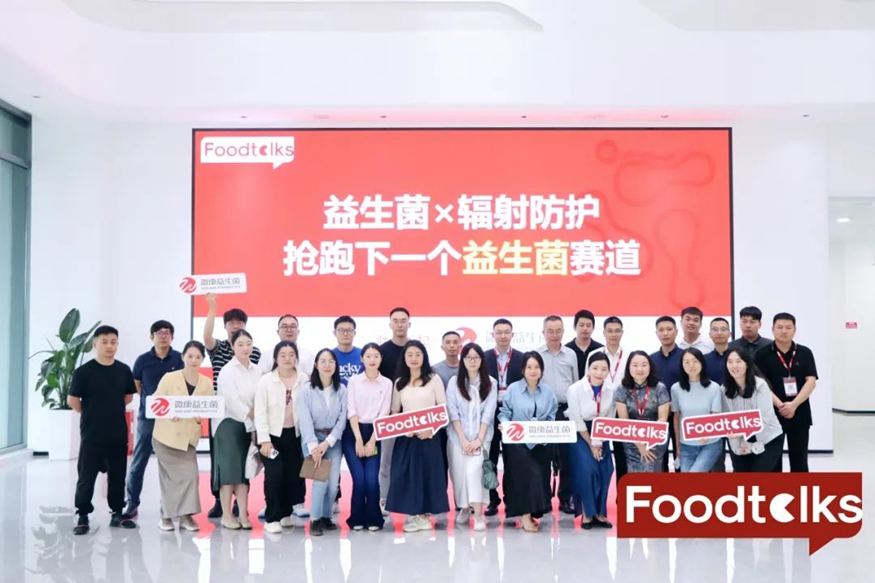
9month22Today, with “Probiotics × Radiation Protection |Racing to the Next Probiotic Frontier"FoodtalksThe offline salon was successfully held at the Weikang Probiotics Research Institute. At the event, representatives from Weikang and Frost & Sullivan (Frost & SullivanFrost & Sullivan, abbreviated as 'Frost & Sullivan', Yili, Daily Bacillus, and experts from Jinduoduo jointly discuss the latest trends in the probiotic market, share the latest achievements of probiotics in radiation protection functions, analyze the pain points in probiotic product development, and explore product forms and concepts more suitable for consumers from a future perspective.
Probiotics is a track full of opportunities. However, the continuous changes in market demand, the emergence of new technologies, and the constant adjustment of competitive landscape have all placed higher demands on industry professionals. To stand out, it has become particularly important to understand the development trends and competitive dynamics of the market.
Mr. Zhang Jian, Partner and Managing Director of Frost & Sullivan Greater China, was invited to attend the event with the following presentation: Delivered a speech titled "Exploring the Next Growth Point in the Billion-Royale Probiotic Market," offering attendees a comprehensive insight into the probiotic industry from a global perspective. Through analysis of outstanding domestic and international cases, the speaker highlighted the standout tracks in the probiotic industry and analyzed its future development trends.

Partner and Managing Director of Frost & Sullivan Greater China Region Zhang Jian
Zhang Jianjun first pointed out that, currently, China adopts a list management system for edible mushroom strains. At present, group standards related to probiotic products have been released, but there are still no national standards for probiotics in a strict sense. In the future, the standard framework related to probiotics will become more standardized and perfect.
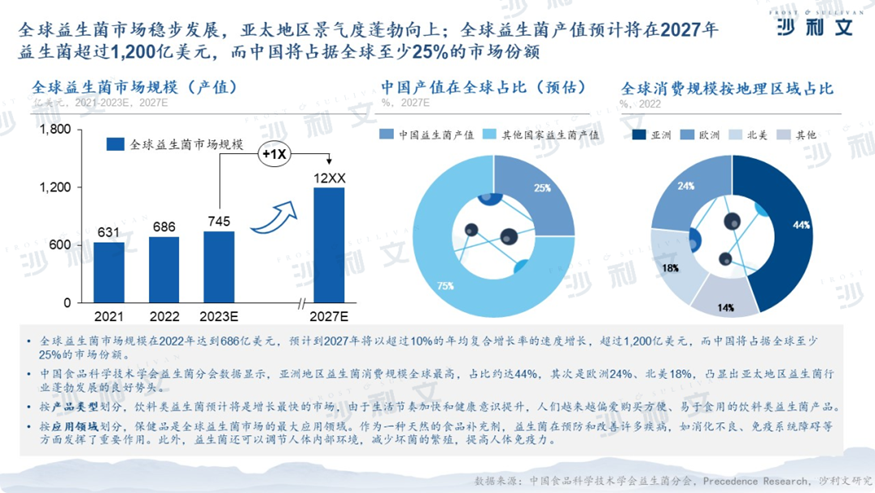
According to a study by Frost & Sullivan, the global probiotic market size is in2022Annual achievement686billions, expected to2027The year will exceed10%The average annual compound growth rate is accelerating, exceeding1,200billions, while China will account for at least25%market share. Data from the Probiotics Branch of the Chinese Institute of Food Science and Technology show that Asia has the highest global consumption scale of probiotics, accounting for approximately44%Second is Europe24%North America18%Highlighting the vigorous development momentum of the probiotic industry in the Asia-Pacific region.
Among them, By product type, beverage probiotics are expected to be the fastest-growing market. Due to the accelerating pace of life and the increasing awareness of health, people are increasingly preferring to purchase convenient and easily consumable probiotic beverages; By application area, health supplements are the largest segment in the global probiotic market. As a natural food supplement, probiotics play an important role in preventing and improving many diseases, such as indigestion and immune system disorders.
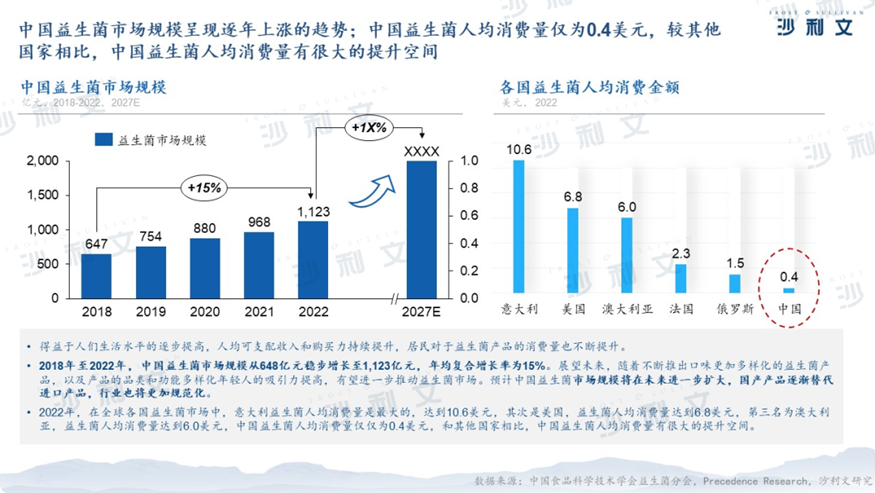
Zhang Jian stated that thanks to the gradual improvement in people's living standards, per capita disposable income and purchasing power have continued to rise, and residents' consumption of probiotic products has also been continuously increasing.
2018Year-end2022In [year], the market scale of probiotics in China was from648RMB 10 billion, steadily increasing to1,123Yuan, with an average annual compound growth rate of15%Looking ahead, with the continuous introduction of more diverse probiotic products and the increasing appeal of younger consumers due to the variety of product categories and functions, the probiotic market is expected to be further driven. It is anticipated that the market size of probiotics in China will further expand in the future, with domestic products gradually replacing imported ones, and the industry will become more standardized.
In terms of per capita consumption,2022In the year, in the global probiotic market, Italy had the highest per capita consumption, reaching10.6US dollars, followed by the United States, with per capita consumption of probiotics reaching6.8US dollar, ranked third is Australia, with per capita consumption of probiotics reaching6.0US dollar. "The per capita consumption of probiotics in China is only0.4The US dollar, compared to other countries, has significant room for improvement in per capita consumption of probiotics in China." Zhang Jian said.
From the perspective of major application markets, food and beverages are the largest application area for probiotics, mainly used in the fields of food, beverages (including dairy products), etc.; health supplements, which include probiotics, are the second largest area, including infant health products.
"The public health demand and the increased efforts in popular science promotion have stimulated and driven the consumption of probiotic health foods, which still hold great potential for development in the future." Zhang Jian added. On the other hand, probiotics have a very bright prospect in modern pharmaceutical industry and agricultural applications related to animals and plants, with rapid growth in recent years. 2022In China, probiotics in food and beverages accounted for approximately63.0%Probiotics in health care account for about [X]% of the entire market15.0%Probiotics for pharmaceutical use account for about half of the market10.0%Probiotics in other fields such as animal feed, daily necessities, etc., account for about the entire market12.0%.
Zhang Jian pointed out that the segmentation of the probiotic market is gradually increasing, and in the future, it can be expanded and applied in many niche areas such as scientific research services, clinical nutrition, ecological agriculture, and more.
Looking at the entire probiotic industry, the industrial chain can be clearly divided into three parts: upstream, midstream, and downstream. The upstream of the probiotic industry mainly revolves around the sales of probiotic raw materials and is closely related to probiotic patent applications and technical solutions for probiotic products. The downstream, on the other hand, mainly produces products such as food and beverage probiotics, dietary supplements, pharmaceuticals, and probiotics for animals and plants.

Subsequently, Zhang Jian analyzed the four major development trends in China's probiotic industry:
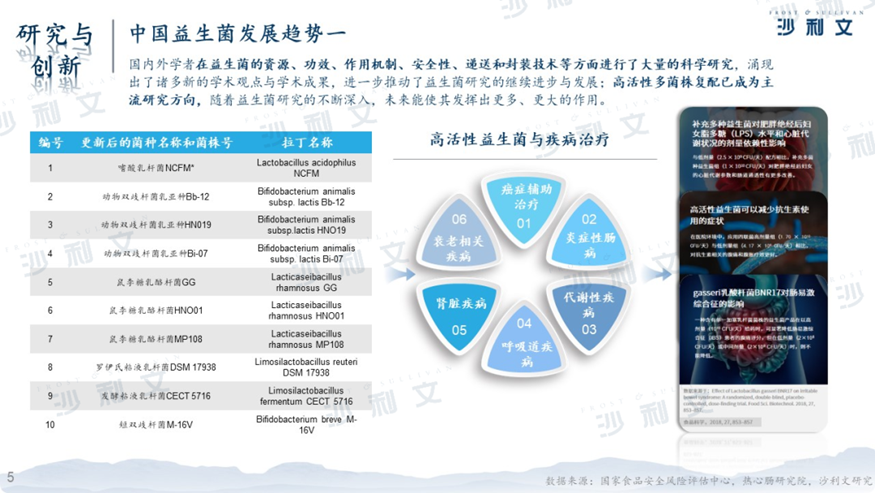
· Trend 1: Research and Innovation
Domestic and international scholars have conducted extensive scientific research on probiotics in terms of resources, efficacy, mechanism of action, safety, delivery, and encapsulation technology. This has led to the emergence of many new academic viewpoints and achievements, further promoting the continuous progress and development of probiotic research. The combination of highly active multi-strain strains has become the mainstream research direction. With the continuous deepening of probiotic research, it is expected that they will play more and greater roles in the future.
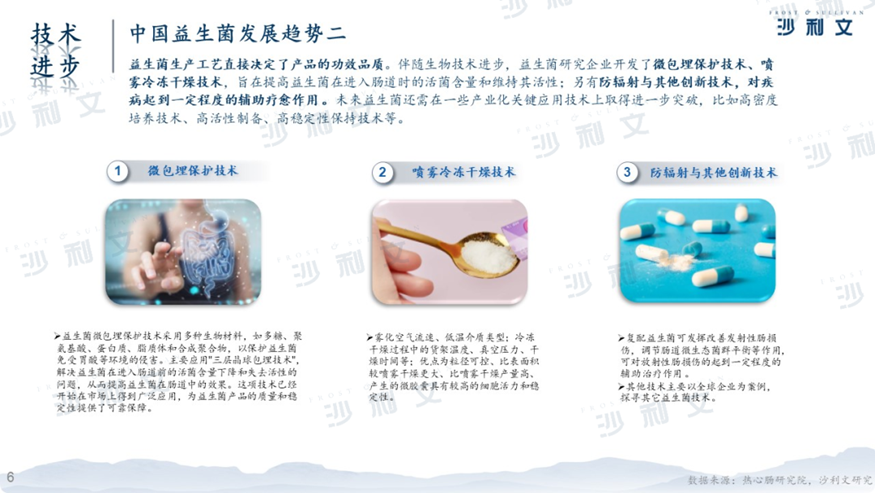
· Trend 2: Technological Progress
The production process of probiotics directly determines the efficacy and quality of the product. With the advancement of biotechnology, probiotic research companies have developed microencapsulation protection technology and spray freeze-drying technology, aiming to increase the viable bacterial content of probiotics when they enter the intestine and maintain their activity; there are also radiation protection and other innovative technologies that play a certain role in assisting in the healing of diseases. In the future, probiotics still need to make further breakthroughs in some key industrial application technologies, such as high-density culture technology, high-activity preparation, and high-stability maintenance technology.
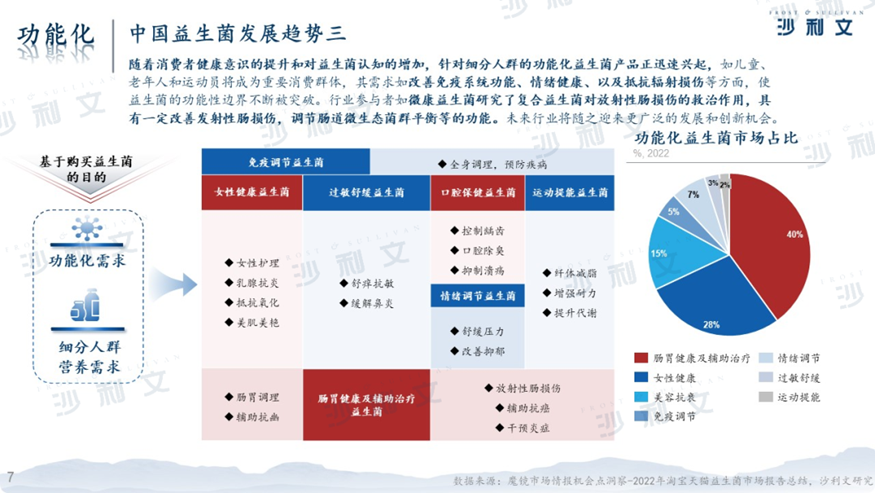
· Trend 3: Functionalization
With the increasing health awareness of consumers and their understanding of probiotics, functional probiotic products targeting specific demographics are rapidly emerging. Children, the elderly, and athletes are becoming important consumer groups. Their needs, such as improving immune system function, emotional health, and resistance to radiation damage, continuously push the boundaries of probiotic functionality. Industry participants like Weikang Probiotics have studied the therapeutic effects of composite probiotics on radioactive intestinal injury, showing certain functions such as improving radiation-induced intestinal injury and regulating the balance of intestinal microecological flora. In the future, the industry will embrace broader development and innovation opportunities.
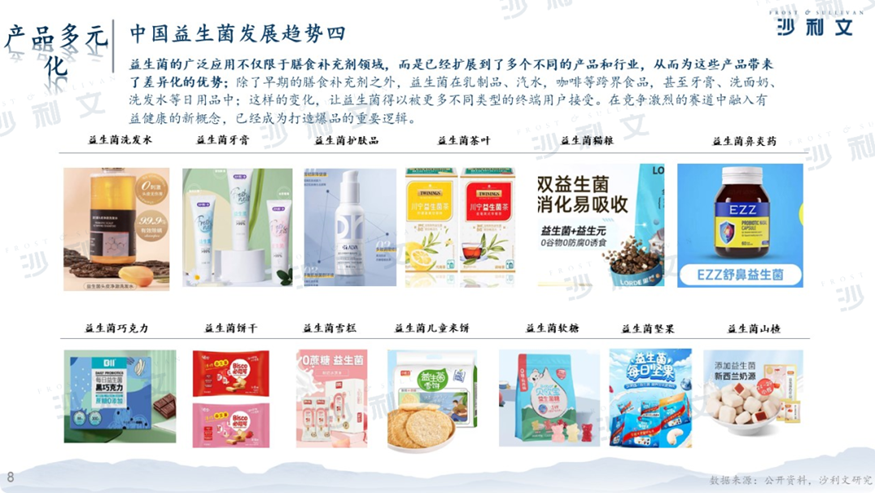
· Trend 4: Product diversification
The widespread application of probiotics is not limited to dietary supplements but has expanded to multiple different products and industries, bringing differentiated advantages to these products. In addition to early dietary supplements, probiotics are found in cross-category foods such as dairy products, soda, coffee, and even in daily necessities like toothpaste, facial cleanser, and shampoo. Such changes have enabled probiotics to be accepted by more diverse types of end-users. Incorporating new health concepts into the highly competitive market has become an important logic for creating blockbuster products.
As the best growth partner with industry depth and breadth, Frost & Sullivan serves leading industry participants across various sectors, covering stages from market strategic positioning to promotional assistance. The Greater China Consumer Goods Industry Group of Frost & Sullivan serves leading enterprises in various sub-sectors and industries related to the consumer goods industry (including clothing, food, housing, transportation, culture, education, entertainment, etc.), dedicated to exploring growth strategies for both industries and businesses together with industry leaders.