The 3rd Power Supply Summit
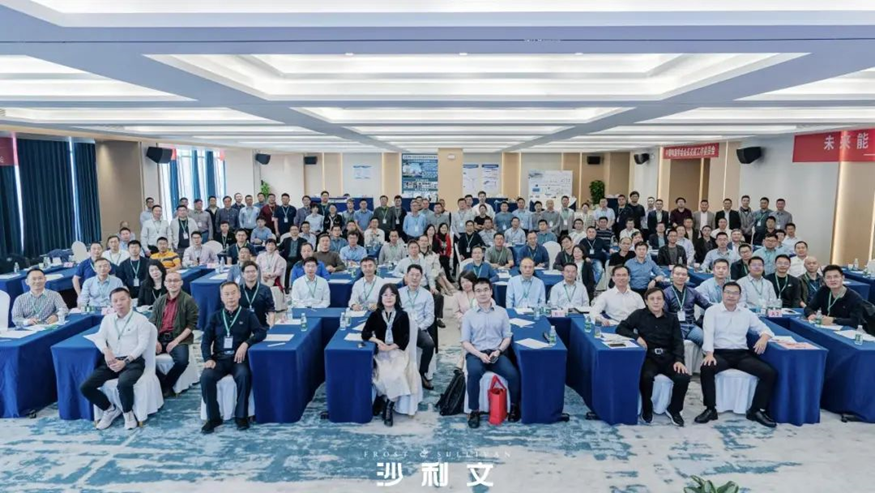
Recently,2024The 3rd Annual Power Supply Summit Forum was held at Pengrun to Plaza in Nanshan, ShenzhenECOHeld at the International Convention Center, exceeding150More than a hundred people participated in this forum.
This forum mainly focuses on the theme of "Future Energy Hubs", grasping the industry's development pulse, exploring energy development directions, concentrating on the development trends of new energy industries in the new era, integrating the new three-electric systems (electrochemistry, power electronics, and power grids), and from investment and capital marketsIPO listingFrom the perspective of listing, discussions were held on the opportunities and challenges for industry development. Over a hundred representatives from academia, domestic new semiconductor materials, magnetic materials, battery materials, new energy photovoltaic energy storage companies, as well as those in the fields of investment and financing and securities gathered together to offer suggestions and pool wisdom for promoting industry openness and integration, as well as healthy and rapid development.
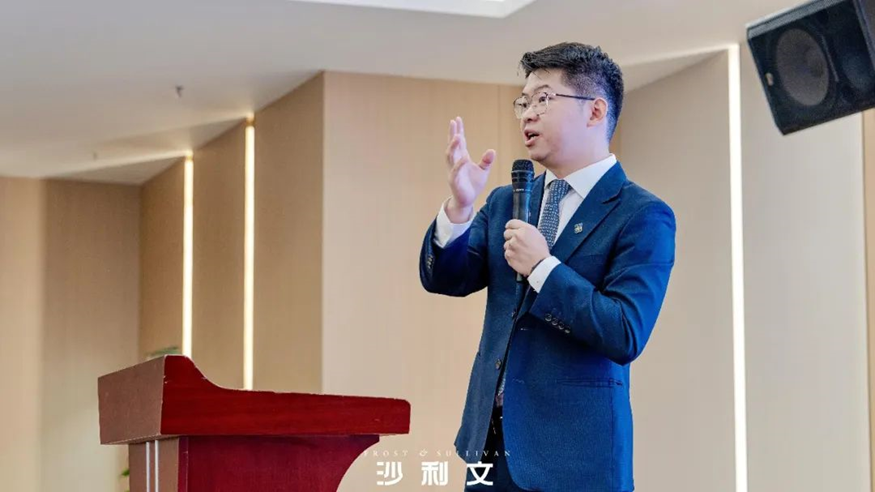
Frost & SullivanFrost & SullivanXiang Weili, Executive Director of Frost & Sullivan Greater China, was invited to attend the event and delivered a keynote speech on the current development status and trends of the new energy vehicle industry.

Executive Director, Greater China, Frost & Sullivan To power
Xiang Weili first briefly introduced the global and Chinese new energy vehicle industry overview to the attendees. He pointed out that under the 'dual carbon' backdrop, many countries and automakers have set timeframes for transitioning from traditional fuel vehicles to new energy vehicles, and the new energy transformation in the automotive industry has become an inevitable trend.
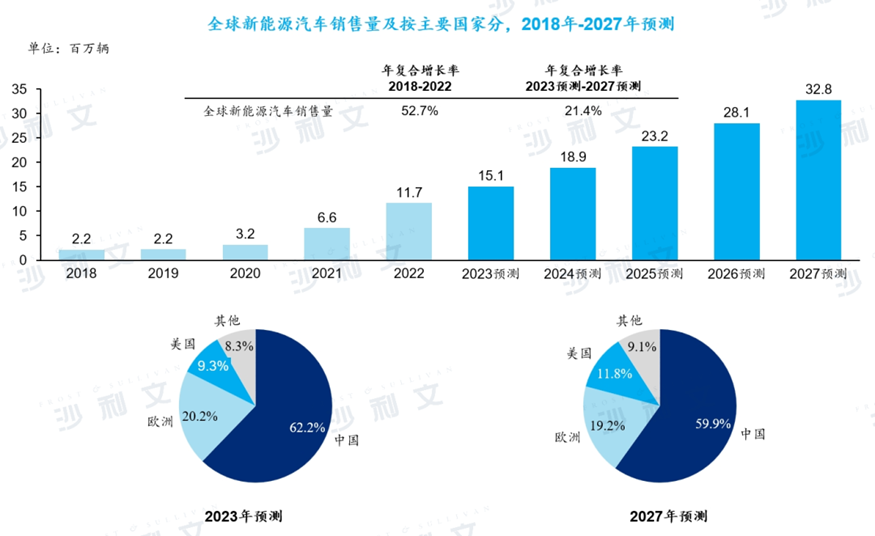
2023In [year], global new energy vehicle sales were approximately1,51010,000 units, an increase of about29.0%, with consistent growth worldwide. Among them, China's new energy vehicle sales have grown the strongest, with sales expected to be about93810,000, accounting for approximately62.2%Under the wave of global new energy vehicle development, countries around the world are accelerating their pace of electrification transformation, with rapid development occurring in regions such as China, Europe, and the United States. "Since2018Since the beginning of this year, China's new energy vehicle sales have long maintained the top position globally and are the largest new energy vehicle market in the world.
Source: Analysis by Frost & Sullivan
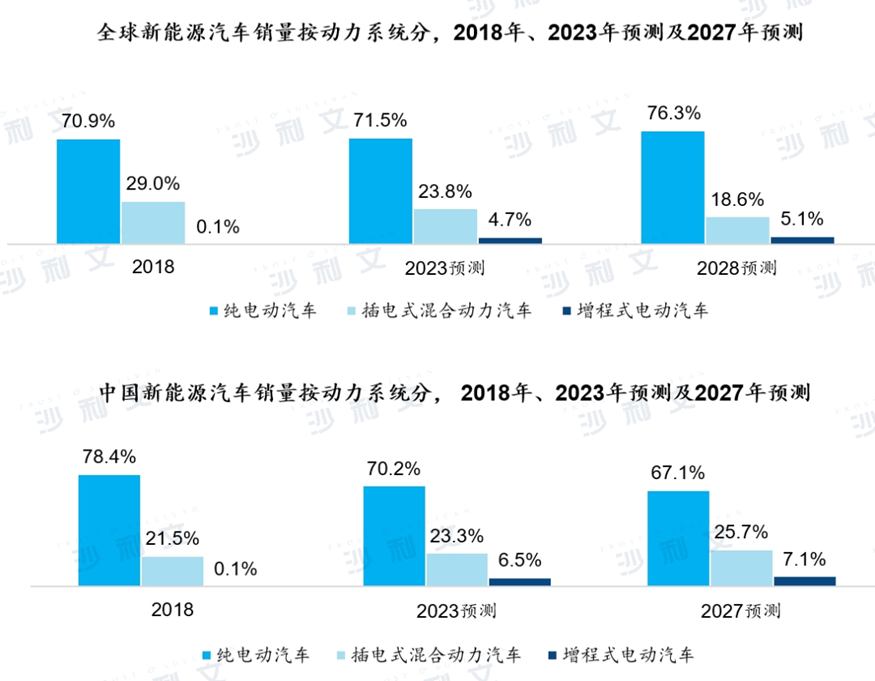
since2018Since [start year], pure electric vehicles have always been the most popular type of new energy vehicle in both the global and Chinese new energy vehicle markets, accounting for70%Market share on the left and right. Benefiting from the increasing consumer awareness of new energy vehicles, support from relevant policies, the improvement of charging infrastructure, and the advancement of advanced technologies, pure electric vehicles will continue to be favored by consumers. In the future, the new energy vehicle industry will develop around the three major aspects of 'energy, intelligence, and connectivity'.
Source: Analysis by Frost & Sullivan
Subsequently, analyses were conducted on new energy passenger vehicles and new energy commercial vehicles by Wei Li respectively.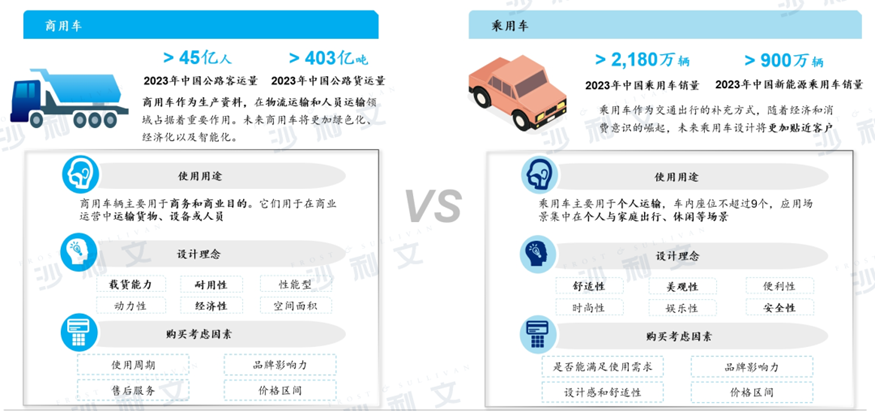
Source: Analysis by Frost & Sullivan
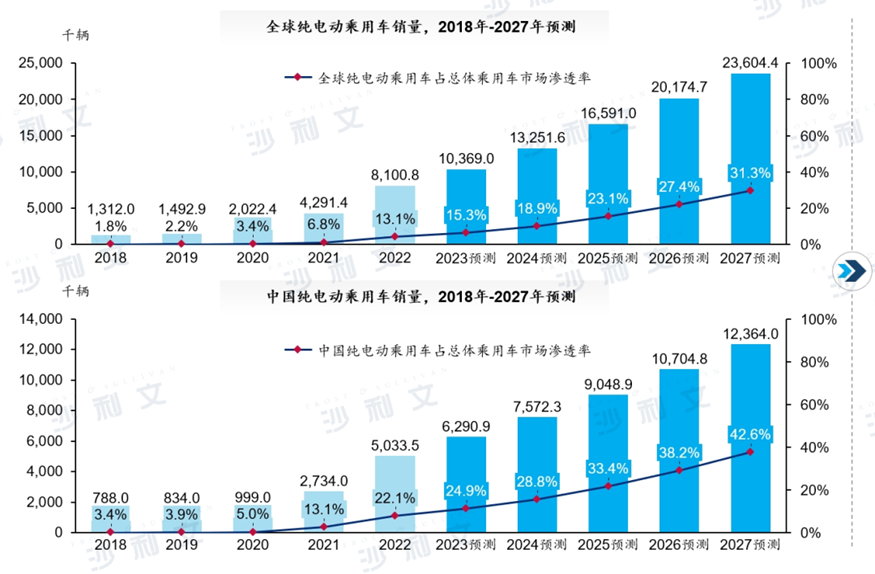
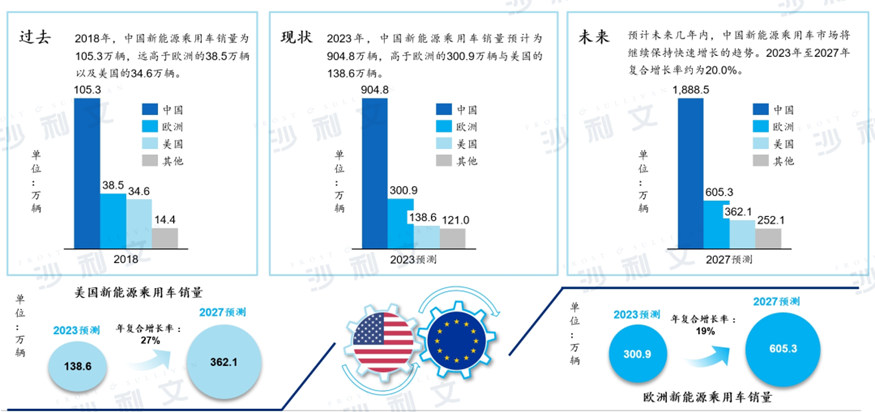
In recent years, with the enhancement of environmental awareness and government policy support, consumers' demand for new energy passenger vehicles that are environmentally friendly and energy-efficient has been continuously increasing. Along with further improvements in the comprehensive performance, intelligent technology, ownership cost, product quality, reliability, value-added services, and environmental benefits of global new energy passenger vehicles,2023Global new energy passenger vehicles accounted for21.6%Among them, the sales volume of new energy passenger vehicles in China accounted for more than60%Continuously leading the development of the global new energy passenger vehicle market.
Data shows that under the 'dual carbon' strategy, the automotive industry is accelerating its development towards low-carbon and zero-carbon emissions. The sales volume of pure electric passenger vehicles has risen rapidly, with a continuous increase in penetration rate.2022In [year], the sales volume of pure electric passenger vehicles in China exceeded500Ten thousand units, and China's pure electric passenger vehicles account for more than22%, is expected to arrive2025In [year], the sales volume of pure electric passenger vehicles will exceed900Ten thousand, market penetration rate exceeds33%. In the future, Chinese new energy passenger vehicle enterprises will continue to expand overseas markets on the basis of consolidating their domestic market advantages. The continuous development of related new energy passenger vehicle technologies will bring consumers a more intelligent, safe, and convenient travel experience.
Source: Analysis by Frost & Sullivan
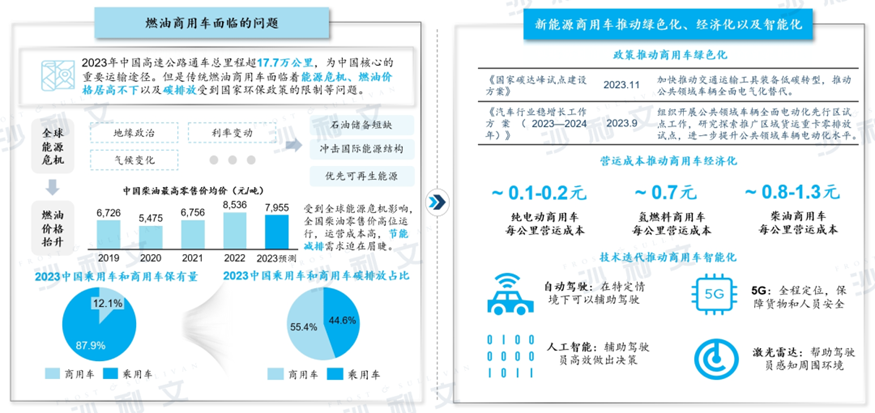
Looking at the commercial vehicle sector,2023In China, the total mileage of expressways opened to traffic exceeded17.7Ten thousand kilometers are an important transportation route at the core of China. However, traditional fuel-powered commercial vehicles face issues such as the energy crisis, persistently high fuel prices, and carbon emissions being restricted by national environmental protection policies. New energy commercial vehicles are currently developing towards greener, more economical, and intelligent directions, helping China's transportation industry achieve the 'dual carbon' goal at an early date through energy conservation and emission reduction.
Source: Analysis by Frost & Sullivan
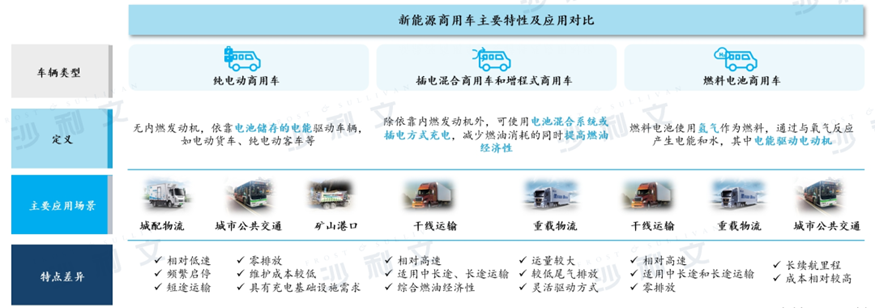
New energy commercial vehicles, depending on different scenarios, ensure economic feasibility and operational efficiency while combining different types of new energy commercial vehicles (pure electric commercial vehiclesBEVPlug-in hybrid commercial vehiclesPHEVRange extender commercial vehiclesEREV) and fuel cell commercial vehiclesFCEV) The product features empower various scenarios such as urban distribution logistics, trunk transportation, and public transportation. Xiang Weili stated that with continuous technological progress and the maturation of the industrial chain, new energy commercial vehicles are expected to bring greater economic benefits to users, and their penetration rate in the commercial vehicle sector is expected to continue to increase.
Source: Analysis by Frost & Sullivan
Pointing out to Wei Li that the development of the new energy commercial vehicle industry requires more consideration of differences in vehicle models and usage scenarios. To meet the needs of different application scenarios, it is necessary to promote the research and development of different technical routes, product innovation, and marketing in a targeted manner. For example, light commercial vehicles are suitable for urban distribution and short-distance transportation with pure electric lines, while heavy commercial vehicles may be more suitable for long-distance transportation with hybrid power and closed-loop logistics transportation with pure electric lines. Industry participants can customize solutions according to different usage scenarios, including vehicle configuration and technical route selection, charging infrastructure construction, operational model design, and other aspects of support.
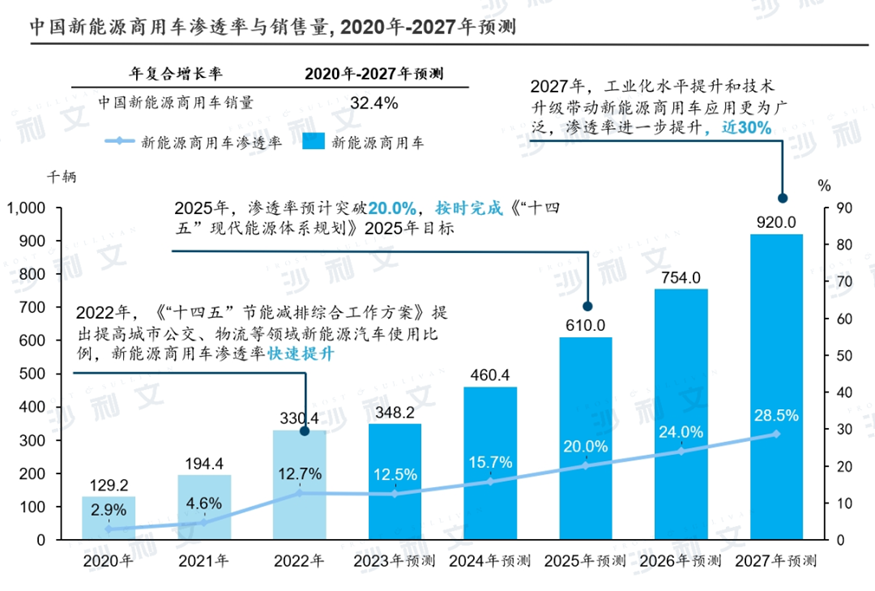
According to a study by Frost & Sullivan, the penetration rate of new energy commercial vehicles in China has been steadily increasing in recent years.2020Only in the year2.9%reach2021year4.6%, and then to2022year12.7%This rapid growth indicates that the effective policy support from the government and the driving force of market demand are at work. With the continuous maturation and popularization of new energy technologies and the increasing emphasis on environmentally friendly modes of transportation, it is predicted2027The penetration rate of the new energy commercial vehicle market in the year will further increase to28.5%.
Source: Analysis by Frost & Sullivan
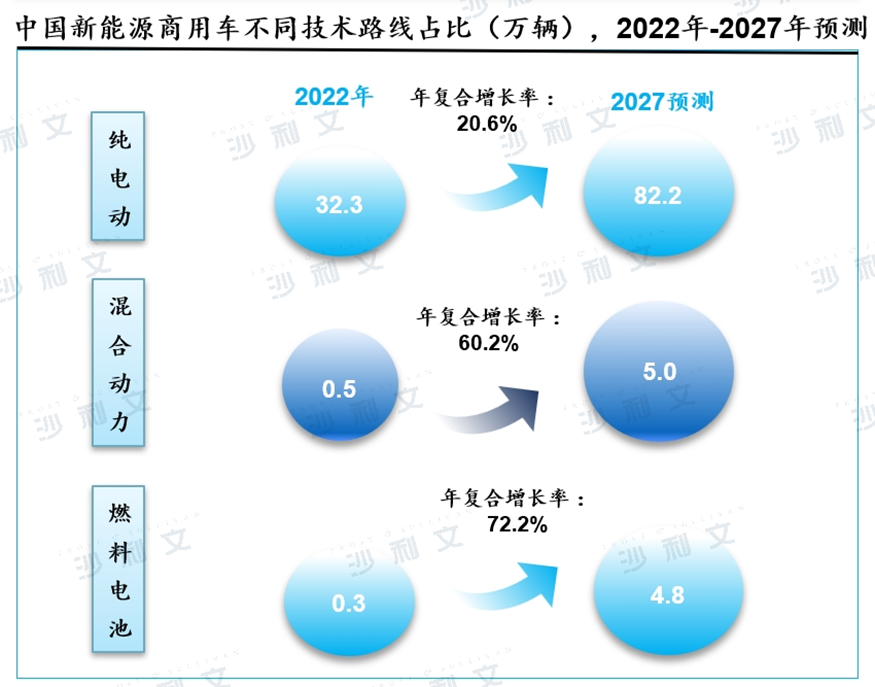
"With the continuous development of technology and changes in market demand, multiple new energy technology routes will coexist in the future, with different emphases depending on the application scenarios," Xiang Weili further explained. "Currently, pure electric technology is the most mature and feasible power technology route in China's new energy commercial vehicle industry; hybrid technology can provide longer driving ranges and stronger power output; while fuel cell technology has advantages such as environmental friendliness, rapid refueling, and long cruising ranges. For some specific commercial vehicle types, such as heavy-duty long-distance transport vehicles, it may become a promising alternative."
Source: Analysis by Frost & Sullivan
In recent years, the Chinese government has introduced a series of policy measures to promote the popularization of new energy commercial vehicles in various fields such as logistics transportation, public transportation, public services, and specific scenarios. Driven by these policies, the application of new energy commercial vehicles in these fields is accelerating. It is predicted that by2023At the end of the year, the number of new energy commercial vehicles insured in China will be close to4010,000 units.
Xiang Weili stated that in the future, with further improvement in the intelligence level of new energy commercial vehicles and the completion of digital platform construction, new energy commercial vehicle manufacturers will provide customers with full life cycle fleet solutions. It includes comprehensive solutions such as after-sales service and transportation services. It also provides targeted solutions to customers' problems in single or complex scenarios, helping them reduce initial capital investment, alleviate cash flow pressure, and enable them to focus on the development of their own business areas.
"Industry participants need to draw on mature technologies in the development of new energy commercial vehicles, accelerate energy efficiency improvements, and provide intelligent and user-friendly configurations to meet user needs and drive industrial progress. At the same time, by integrating autonomous driving and intelligent connected technologies, they should create digital products to achieve comprehensive digital management, improve vehicle safety and intelligence levels. Finally, industry participants also need to pay attention to the scenario adaptability of new energy commercial vehicles, including customizing vehicle designs and functions according to different usage scenarios, to meet users' needs in different industries and environments." Xiang Weili summarized.
Recommended Reading