 9th Retail Logistics and Supply Chain Summit
In recent years, China's retail consumer market has shown strong momentum. Despite the changing macro environment, multiple pressures such as the rise of new consumption models, technological innovations that bring about new indicators of change, and 'carbon neutrality' becoming a focus of regulations and social responsibility, the retail industry's logistics supply chain has delivered excellent results in digitalization.
During the industry's inflection point, demand-side and retail enterprises need to optimize logistics distribution and transportation planning, enhance supply chain response speed and flexibility, and improve green ratings to meet consumers' growing demands for product quality and delivery speed. Most retail fast-moving consumer goods (FMCG) companies are actively seeking supply chain transformation and upgrading solutions, designing and deploying a series of logistics technology applications, but some are still struggling to survive amidst the digital transformation of the logistics supply chain. The development of supply-side logistics technology has also accumulated some excellent cases and provided fertile ground for industry transformation.
2024year3month15day,LogtalkThe 9th Retail Logistics and Supply Chain Summit was successfully held in Shanghai. Centered around core sectors such as food, beverages, beauty products, shopping malls, and daily chemicals, the summit brought together hundreds of retail enterprises and200The head of digital logistics supply chain and technology experts held a synchronous dialogue, focusing on the new model of comprehensive innovation and transformation in logistics and supply chains. They addressed the pain points of retail cost reduction, collaborated to optimize brand efficiency, and empowered enterprises to improve quality and achieve new growth.
Frost & SullivanFrost & SullivanZhou Mingzi, Executive Director of Frost & Sullivan's Greater China Region, was invited to attend the event and share insights on China's digital logistics and supply chain industries.


Executive Director, Greater China, Frost & Sullivan Zhou Mingzi
Zhou Mingzi stated that with the continuous development of the economy, the demand for logistics services in China is expanding day by day. With the continuous improvement of infrastructure and industry development in the logistics sector, the total social logistics volume has been climbing steadily. Driven by various factors such as policies, demand, technology, and capital, the market scale of China's logistics industry is continuously expanding.2022Total national social logistics volume347.6trillion yuan2018till2022In the year, the annual compound growth rate of total social logistics in China reached5.3%estimated2027In [a certain year], China's total social logistics volume can reach445.8trillion yuan.
The logistics industry spans the entire process of enterprise procurement, manufacturing, and sales, involving a vast industrial chain and serving as an important bridge connecting various industries and sectors. As a fundamental, strategic, and leading industry supporting the development of the national economy, China's logistics sector has a high degree of synergy with macroeconomic growth and is an important tool for the country to stimulate economic development.
As an indispensable part of the logistics industry, retail logistics plays a crucial role in connecting suppliers, retailers, and consumers, directly affecting the supply and sales of goods. The continuous changes in consumer demand and the rapid development of e-commerce have driven the continuous development of the retail logistics industry.
Zhou Mingzi pointed out that in recent years, China has successively introduced a number of policies to encourage the development of the logistics industry. From a policy perspective, China's logistics industry is moving towards digital transformation. Multiple policies such as the '14th Five-Year Plan' for digital economy development and the '14th Five-Year Plan' for the development of a modern comprehensive transportation system indicate that intensification, intelligence, platformization, and greening are becoming new characteristics of the current development stage of the logistics industry.
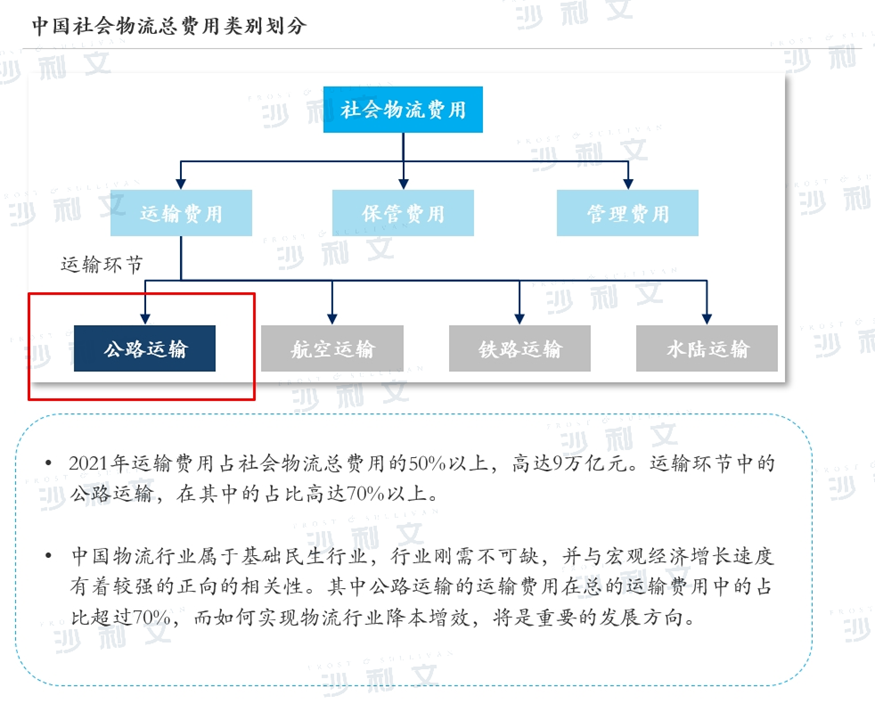
The data shows, 2016In [Year], China has become the world's largest logistics market. From the perspective of the composition of the logistics industry, social logistics costs in our country mainly include transportation costs, storage costs, and management costs. Among them, transportation costs account for the largest proportion of total social logistics costs.50%As mentioned above, Gao Da9trillion yuan. In logistics transportation, there are various forms of transportation, including road transportation, air transportation, etc. Among them, the transportation cost of road transportation accounts for more than70%.
Source: Analysis by Frost & Sullivan
Highway freight is divided into three main forms based on the weight of the goods: express delivery, less-than-truckload (LTL), and full truckload (FTL) transportation.2026In [year], the scale of China's highway freight market will exceed8trillion yuan, of which less-than-truckload (LTL) and full-truckload (FTL) transportation account for90%. "With the flexibility of social production, transportation methods are gradually shifting towards multi-batch and small-batch parcel delivery, expanding the profit margin of the express delivery market. It is expected that the market share of parcel delivery will continue to grow at a relatively rapid pace."
In addition, with the development of e-commerce retailing, the number of daily active users of merchants and customers on multiple e-commerce platforms such as Taobao, Tmall, Pinduoduo, Douyin, Kuaishou, and Rednote has been steadily increasing, driving the development of the express delivery industry, a sub-sector of road transportation in China.2021The annual highway freight market scale is about5.9trillion yuan, expected2026The year will grow to8.2trillion yuan.
Subsequently, Zhou Mingzi briefly analyzed the pain points in the logistics industry and further shared on how technology empowers this sector. He pointed out that the logistics industry faces issues such as information asymmetry, unreasonable transportation routes, dispersed capacity, and insufficient coordination of data elements, which lead to persistently high transportation costs. In addition, under the backdrop of carbon neutrality, the green transformation of the logistics industry has become a topic that industry players need to take seriously.
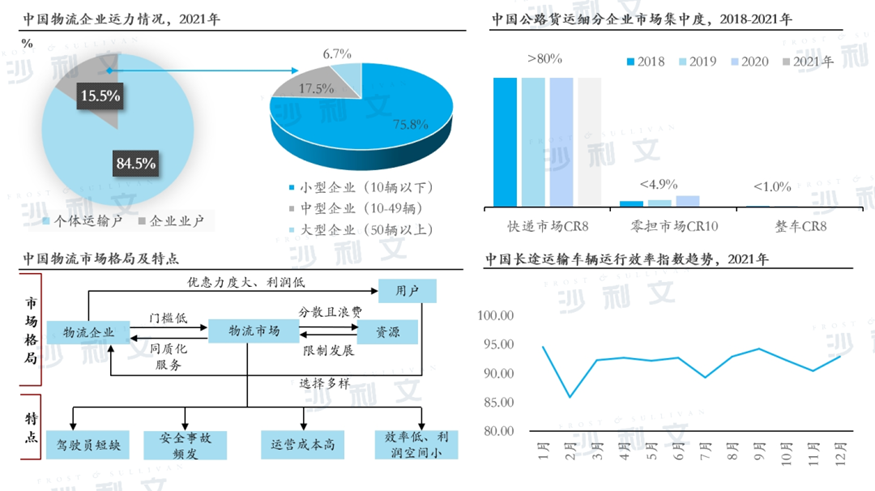
Data shows that there is80%The above transportation capacity is in the hands of individual transporters, with a majority being small transport enterprises. In terms of market concentration by sub-sectors, the concentrations in the parcel and full truckload markets are insufficient.5%The overall logistics market has dispersed capacity with low concentration. At the same time, due to the low threshold for entering the logistics industry, a surge in enterprises has led to serious homogenization of services. Moreover, logistics companies compete by increasing discounts and overloading transportation, squeezing profit margins and causing disorderly competition. This has resulted in lower overall transport efficiency and limited profit margins for the industry.
Source: Analysis by Frost & Sullivan
Zhou Mingzi pointed out that the digital and intelligent transformation will greatly empower the logistics industry. Through underlying technical support, it will promote the traditional logistics transportation industry to achieve digital operational capabilities, digitize logistics-related businesses, automate logistics processes, and make logistics operations more intelligent. This will achieve strong connectivity among people, vehicles, goods, and money, helping the industry reduce costs, increase efficiency, and undergo a green transformation.
"Digital transformation has created value for all participants in the logistics industry." Zhou Mingzi further explained, For truck owners, Digital logistics infrastructure helps truck owners quickly acquire customers through digital operations, reducing the idling rate of vehicles. At the same time, the platform's core technologies such as big data algorithms, location platforms, and communication can quickly assist truck owners in planning reasonable routes, saving transportation costs, and reasonably scheduling time. For retail enterprises, The digital logistics infrastructure enables the full online process of transportation through the logistics transportation trading platform, helping enterprises track goods at any time, plan comprehensively, and improve their control over transportation; For the logistics industry, Through digital operations and implementing measures such as rational route planning in the logistics industry, unnecessary carbon emissions can be reduced, facilitating a comprehensive green transformation of the logistics sector.
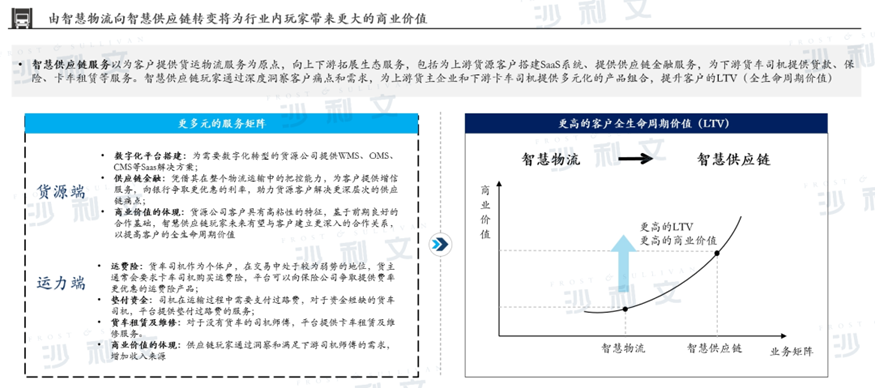
Finally, Zhou Mingzi concluded that in addition to digital and intelligent transformation, the industry will also exhibit two trends in the future:1Industry players will transform from a single smart logistics business to a smart supply chain business;2Achieve the low-carbon greening of logistics.
On one hand, comprehensive enterprises that focus on serving supply chain companies will become the mainstream of the industry in the future. Smart supply chain enterprises, by deeply understanding customer pain points and needs, provide diversified product portfolios to upstream retail businesses and downstream truck drivers, thereby enhancing the customer's full lifecycle value.
Source: Analysis by Frost & Sullivan
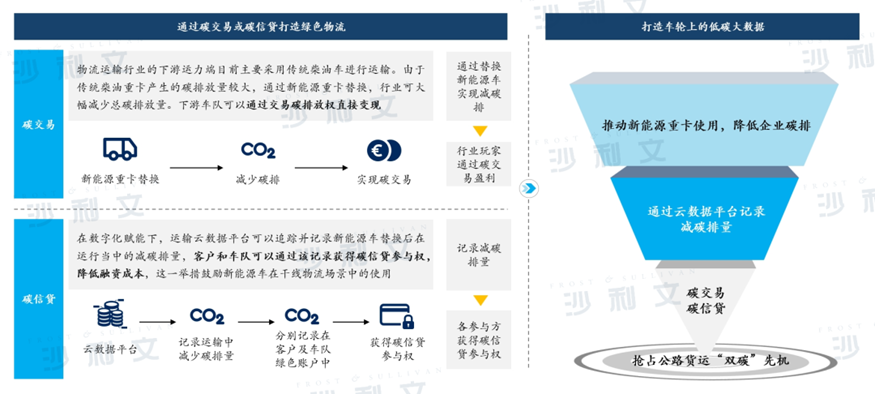
On the other hand, controlling energy production and consumption carbon emissions is key to achieving the national carbon peak goal. The transportation sector is one of the main carbon emission scenarios, and China's transportation sector accounts for about a certain proportion of the total carbon emissions.9%Logistics industry players are actively promoting the use of green energy and the replacement of new energy heavy trucks. Through cloud data platforms for data statistics, all parties involved in the industry can directly profit from carbon trading or reduce financing costs through carbon credit, ultimately leading to a green transformation of the industry.
Source: Analysis by Frost & Sullivan