Total word count: 2991 words | Reading time: 5 minutes
Offline music venues refer to physical locations that use music as a medium to provide multi-scenario music experiences. Depending on the scenario, offline music venues can be divided into four forms: bars, KTVs, music festivals, and mini-singing pavilions. Bars are physical gathering places that offer various alcoholic beverages and meals, including Lounge, dining bar, and nightclub types; KTVs are entertainment venues that provide karaoke and alcohol services mainly at night, which can be categorized into volume-based KTVs and business-oriented KTVs, with volume-based KTVs being more common; music festivals are celebrations that last for several days or weeks and are themed around music, usually held outdoors; mini-singing pavilions are mobile singing devices that typically appear in shopping malls, high-speed rail stations, and other places, allowing users to connect online and offline for music interactions.
Classification of Offline Music Venues in China
Source: Drawn by Frost & Sullivan Research
The diversified development of offline music venues and the maturation of business models are helping to drive continuous industry scale growth
After the reform and opening up, Guangzhou Oriental Hotel was born as the first music teahouse on the Chinese mainland, representing the rise of the offline music venue industry in China. With the deepening of reform and opening up and the continuous improvement of living standards in China, richer entertainment options such as cocktail bars, nightclubs, and volume-based KTVs were gradually promoted nationwide and experienced a period of rapid development. After 2013, the rise of the electronic music market in China drove the prosperity of Livehouses and music festivals, while the rapid expansion of the offline singing pavilion market impacted volume-based KTVs, leading to a fierce competition among offline music venues and an industrial upgrading challenge for enterprises. Music festivals have undergone a transformation from initial small group planning to current commercial organization participation, maintaining a rapid growth momentum. The midstream offline music venue industry generally tends towards diversified development. The upstream industries involved in the offline music venue industry include foreign liquor and soft drink industries, decoration industries, as well as bands, singers, and DJs providing musical performances. The intense competition brought about by the diversified development trend has made midstream enterprises tend to choose higher-end upstream customers to create more distinctive and stylish venues to attract downstream C-end customers mainly composed of young people; at the same time, they improve the quality of drinks and meals to attract downstream B-end customers such as hotels and banquet venues.
Analysis of the Industrial Chain of the Offline Music Venue Industry in China
Source: Drawn by Frost & Sullivan Research
As the downstream demand of the offline music venue industry tends towards diversified development, the business models of midstream enterprises have become more diversified and personalized and are gradually maturing. For example, bars obtain new sources of income through screen interactions such as screen dominance, red envelopes, and bullet screens, and the revenue sources of music festivals are no longer limited to box office revenue; brand sponsorship, live streaming copyright distribution, and derivative sales are also major channels for organizers to earn income.
Business Model of the Offline Music Venue Industry in China
Source: Drawn by Frost & Sullivan Research
Under the general trend of diversified development in the types of business and business models of offline music venue industry enterprises, the scale of the offline music venue industry continues to expand. In 2014, the market scale of offline music venues in China was 269.3 billion yuan, and by 2018, the market scale reached 333.6 billion yuan, with a compound annual growth rate of 5.5%. In the next five years, various offline music venues are expected to gradually penetrate into second, third, and fourth-tier cities, and the scale of the offline music venue industry will continue to grow steadily.
Market Scale of Offline Music Venues in China, Forecast from 2014 to 2023
Source:Compiled by fsTEAM software and Frost & Sullivan data center
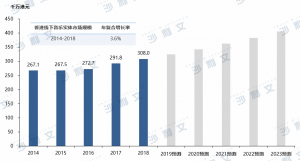
The market scale of offline music venues in Hong Kong has maintained relatively stable growth over the past five years. In 2015, due to economic downturns and a decrease in the number of mainland tourists visiting Hong Kong, the market scale experienced a certain degree of stagnation. By the end of 2018, the market scale in Hong Kong reached HK$3.08 billion, with a compound annual growth rate of 3.6% from 2014 to 2018. Its market scale is mainly driven by the growth of single-store revenue and the increase in various characteristic boutique bars in Hong Kong. It is expected that the market scale of offline music venues in Hong Kong will continue to grow from 2019 to 2023.
Market Scale of Offline Music Venues in Hong Kong, Forecast from 2014 to 2023
Source:Compiled by fsTEAM software and Frost & Sullivan data center
Consumers of offline music venues are mainly young people under 30 years old, relying on word-of-mouth recommendations to obtain information![]() In terms of gender, consumers of offline music venues are mostly women (54.8%); in terms of age distribution, consumers of offline music venues are under 30 years old (72.4%); in terms of urban distribution, consumers of offline music venues are basically distributed in first- and second-tier cities (80%); in terms of consumer occupation, consumers of offline music venues are mainly company employees (57.8%); in terms of income distribution, consumers of offline music venues have an average monthly income mainly concentrated between 5,000 yuan and 15,000 yuan (75.2%).
In terms of gender, consumers of offline music venues are mostly women (54.8%); in terms of age distribution, consumers of offline music venues are under 30 years old (72.4%); in terms of urban distribution, consumers of offline music venues are basically distributed in first- and second-tier cities (80%); in terms of consumer occupation, consumers of offline music venues are mainly company employees (57.8%); in terms of income distribution, consumers of offline music venues have an average monthly income mainly concentrated between 5,000 yuan and 15,000 yuan (75.2%).
Consumer Portrait of the Offline Music Venue Industry in China
Source:Compiled by fsTEAM software and Frost & Sullivan data center
Frost & Sullivan data shows that consumers of offline music venues mainly rely on word-of-mouth recommendations from friends to obtain information about offline music venues and consider environmental and equipment configuration as important reference factors when choosing offline music venue locations. Therefore, they prefer chain brands with larger scales and better quality control. In terms of price preference, consumers' average consumption per visit to KTVs and bars is mainly concentrated between 301 yuan and 600 yuan, far exceeding the average consumption of mini-singing pavilions (between 51 yuan and 100 yuan).
Multiple factors such as policy, economy, society, and environment drive the continuous development of the offline music venue industry
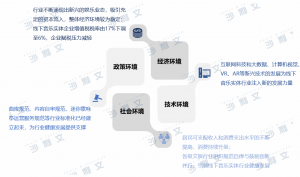
The offline music venue industry has multiple environmental supports including policy, economy, society, and technology. In terms of the policy environment, industry standardization such as library specifications, content self-review specifications, and mini-singing pavilion operation service specifications for offline music venues has been established, bringing huge development opportunities to offline music venues and further supporting the healthy development of the industry. In terms of the economic environment, emerging entertainment formats have continuously emerged in the offline music venue industry, attracting sufficient capital inflows, and the overall economic environment of the industry is relatively stable; at the same time, the value-added tax rate for offline music venue enterprises has been reduced from 17% to 6%, reducing the tax burden on offline music venue enterprises and bringing huge development opportunities to the industry.In terms of the social environment, the continuous improvement of residents' disposable income and consumption expenditure levels has led to continuous upgrading of consumption, driving an increase in per capita cultural and entertainment consumption; the standardization, self-discipline, and encouragement of innovation of various cultural and entertainment industry organizations are parallel, leading to the healthy development of the offline music venue industry. The superposition of these two factors promotes industrial upgrading of the offline music venue industry and lays a foundation for rapid industry development.
In addition, the development of Internet technology and emerging technologies such as big data, computer vision, VR, and AR has injected new development momentum into the offline music venue industry, helping it continuously launch new formats and services, promote business model innovation, and carry out deeper transformation and upgrading.
PEST Analysis of the Offline Music Venue Industry in China
Source:Drawn by Frost & Sullivan Research
The high input costs, serious content homogenization, and shortage of management talent have prompted offline music venues to undergo strategic transformation![]() With the promising development of the economic and social environment, residents' diversified entertainment needs are increasing, and offline music venues have an advantage in development due to their stronger sense of participation and interaction; the support of policy and technical environments brings opportunities for innovative growth to offline music venues. With the growth of people's multi-faceted needs and the continuous development of Internet technology, the form of offline music venues is expected to be more flexible and diverse. In the future, under the influence of a series of policies targeting the cultural and entertainment industry and technological innovation, the transformation and upgrading of the cultural and entertainment industry will promote the healthy and orderly development of the offline music venue industry. The overall development environment of the offline music venue industry in China is favorable, but there are still disadvantages such as high upfront investment costs (fixed assets, entry fees, advertising marketing). At the same time, serious content homogenization, large investment in music copyrights, and many litigation disputes have become major threats to the development of the offline music venue industry. The operation of offline music venues often requires many aspects, and the shortage of management talent is also one of the major obstacles to industry development. These factors have restricted the development of the industry to a certain extent. With the development of the music industry, offline music venues are gradually paying more attention to consumers' sense of participation, increasing various online and offline interactive forms, and the content form of the industry will be further enriched in the future; in addition, with the improvement of music copyright awareness in China and the increase in original music content, it is expected that the service quality and original content of offline music venues will become higher in the future. The shortage of management talent will continue to increase the market demand for one-stop services, and it is expected that this type of service provider with rich one-stop operation and management experience will become an important emerging force in the industry in the future.
With the promising development of the economic and social environment, residents' diversified entertainment needs are increasing, and offline music venues have an advantage in development due to their stronger sense of participation and interaction; the support of policy and technical environments brings opportunities for innovative growth to offline music venues. With the growth of people's multi-faceted needs and the continuous development of Internet technology, the form of offline music venues is expected to be more flexible and diverse. In the future, under the influence of a series of policies targeting the cultural and entertainment industry and technological innovation, the transformation and upgrading of the cultural and entertainment industry will promote the healthy and orderly development of the offline music venue industry. The overall development environment of the offline music venue industry in China is favorable, but there are still disadvantages such as high upfront investment costs (fixed assets, entry fees, advertising marketing). At the same time, serious content homogenization, large investment in music copyrights, and many litigation disputes have become major threats to the development of the offline music venue industry. The operation of offline music venues often requires many aspects, and the shortage of management talent is also one of the major obstacles to industry development. These factors have restricted the development of the industry to a certain extent. With the development of the music industry, offline music venues are gradually paying more attention to consumers' sense of participation, increasing various online and offline interactive forms, and the content form of the industry will be further enriched in the future; in addition, with the improvement of music copyright awareness in China and the increase in original music content, it is expected that the service quality and original content of offline music venues will become higher in the future. The shortage of management talent will continue to increase the market demand for one-stop services, and it is expected that this type of service provider with rich one-stop operation and management experience will become an important emerging force in the industry in the future.
SWOT Analysis of the Offline Music Venue Industry in China
Source: Frost & Sullivan Research
The level of consumer expenditure in Chinese families is increasing day by day, and consumers have higher requirements for their daily spiritual life. Various cultural and entertainment activities have gradually become an indispensable part of the lives of Chinese residents. Compared with the music experience on online platforms, offline music venues bring stronger sense of participation and interaction to consumers. Offline music scenes provide consumers with a more three-dimensional and immersive music experience through excellent visual, auditory, and tactile aspects. Currently, offline music venues have development shortfalls such as serious content homogenization, large investment in music copyrights, many litigation disputes, and shortage of management talent. However, under the background of continuous breakthroughs in information technology and continuous improvement of policy standards, and the comprehensive influence of factors such as the continuous exploration of new businesses and business models in the music entertainment industry, there is broad development and expansion space in the offline music venue market in China in the future.