Yesterday (July 1st), the 13th Annual New Leaders Conference of the World Economic Forum 2019 and the Summer Davos Forum kicked off in Dalian, China. On the first day of the forum, at the space conference and topic sharing session, representatives from politics, business, academia, and technology communities from over 100 countries discussed various themes. Among them, topics such as the Chinese economy, opening up to the outside world, and fintech became hot topics of discussion on the first day. At the opening ceremony this morning (July 2nd), Premier Li Keqiang of the State Council of the People's Republic of China delivered an opening speech. Mr. Aroop Zutshi, Global President and Global Partner Leader of Frost & Sullivan, Dr. Wang Xin, Global Partner, Vice President of Global Market Strategy Planning and President of Greater China, and Ms. Neeta Joshi, Executive General Manager of Strategy, were invited to attend the opening session of this forum.
Li Keqiang delivered the opening speech
In today's opening speech, Premier Li delivered relevant remarks on hot topics that have received wide attention from all sectors, including China's opening up to the outside world, the Chinese economy, the global economy, and the process of globalization. Regarding China's market opening up, Li Keqiang pointed out that ChinamanufacturingIt has been fully liberalized, and further deepening of manufacturing industry openness will continue thereafter. Measures such as relaxing the foreign share ratio in the automotive sector will be implemented to encourage foreign investment in the development of the manufacturing industry; key areas that attract foreign attention, such as finance,modern service industryThe sector is accelerating its pace of opening up, advancing the previously stipulated cancellation of the foreign share ratio limit for securities, futures, and life insurance to 2020, implementing a policy where non-prohibited items on the negative list for foreign investment are allowed in; in conjunction with the opening-up process, efforts are being made to improve related opening-up measures.Laws and regulationsRegarding the system, efforts should be made to promptly formulate supporting regulations and rules for the Foreign Investment Law, and accelerate the cleanup of laws and normative documents that are not suitable for opening up. In terms of the Chinese economy, Li Keqiang stated that China's economy has generally operated smoothly in the first half of this year, with development speed remaining within a reasonable range. Against the backdrop of gradually expanding financial sector openness, the Chinese economy and finance will remain stable and improve over the long term, maintaining the RMB exchange rate at a reasonably balanced level without engaging in competitive devaluation.Regarding the world economy and globalization, Li Keqiang believes that we should view the problems arising from globalization objectively, not simply attribute them to globalization itself. In the context of a slowing world economy, we should actively respond, negotiate equally, and adhere to openness and cooperation.
Premier Li Keqiang of the State Council delivered a speech
Learn from advanced experiences, and China's finance and fintech industries move forward with openness
Under the guidance of the reform and opening-up policy, China actively participates in the globalization process, continuously increasing the openness of financial markets to foreign entities. It introduces participation from different ownership entities to enhance market vitality. At the same time, it adopts an inclusive attitude to learn from the financial market construction experiences of advanced economies, developing a financial market system that meets the needs of China's economic development. China's fintech industry possesses an open ecological culture gene and has overcome core technical challenges through global collaboration in the internet era. Based on an open fintech ecosystem platform, Chinese fintech enterprises integrate cross-border, cross-industry, and cross-scenario data resources and technical service capabilities to establish mutually beneficial fintech service circles, promote a shortened financial technology upgrade cycle, and accelerate the iterative update speed of core fintech technologies.
Mr. Aroop Zutshi, President and Global Partner at Frost & Sullivan, and Dr. Wang Xin, Partner at Frost & Sullivan and President of Greater China
As a leading industry consultant in Hong Kong and overseas listed companies, Frost & Sullivan continuously monitors the development of China's politics, economy, culture, technology, and other aspects. It has conducted in-depth research on multiple fields such as business services, intelligent technology, and fintech, and has accumulated rich research results. Among these, the research on fintech includes core technologies such as blockchain, cloud computing, and big data, covering multiple areas including infrastructure, payment and settlement, financing and credit.
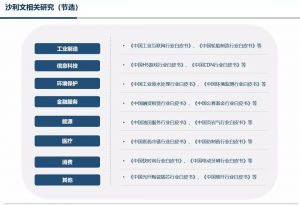
Frost & Sullivan-related research
Source: Drawn by Frost & Sullivan Research
As of the end of June 2019, the Frost & Sullivan Greater China office has assisted more than 20 fintech companies such as WeBank, TradeGo and Tenpay in going public. In the future, Frost & Sullivan will continue to leverage its rich research findings to contribute to the development and popularization of fintech in China.
Focusing on financial topics at Davos, Frost & Sullivan releases an excerpt from its China fintech white paper
Definition and Classification of the Fintech Industry
Fintech is centered around technologies such as big data, artificial intelligence, cloud computing, and AI, innovating in areas such as business models, product applications, and service processes of the financial industry. It provides new types of financial product services for enterprises and individuals. The aim of fintech is to provide technical services for licensed financial institutions, regulatory bodies, etc., to explore high-value product service models, and promote the sustainable development of financial business. According to application areas, fintech in China can be divided into five major types: market infrastructure, payment and settlement, financing credit, wealth management, and bank-securities-benefit innovation.
Classification of China's Financial Technology Industry
Source: Developed by Frost & Sullivan Research
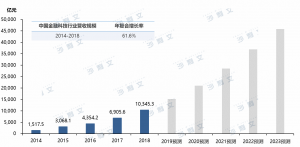
Revenue scale of China's fintech industry
Driven by favorable policies, core technology upgrades, and other factors, the market scale of China's fintech industry experienced rapid growth from 2014 to 2018. In 2018, the revenue scale of China's fintech industry exceeded one trillion yuan, with an average annual compound growth rate of 61.6% from 2014 to 2018. Benefiting from the continuous release of demand for transformation and upgrading by traditional financial institutions, the optimization and upgrade of key technologies in the fintech industry, and the introduction of a series of supportive policies, the market scale of China's fintech industry is expected to further grow in the next five years.
Revenue scale of China's fintech industry, 2014 - 2023 forecast
Source: Software compilation by fsTEAM, prepared by Frost & Sullivan's data center.
Analysis of Driving Forces for China's Financial Technology Industry
★ Core technology innovation and development
The fintech industry is technology-driven. Against the backdrop of continuous innovation and development in distributed technologies represented by cloud computing and blockchain, security technologies such as biometric technology, modern cryptography, and quantum computing technology, the application capabilities of fintech are constantly enhancing. It reduces the development cycle of financial industries empowered by fintech, making financial institutions' businesses more diversified and their service capabilities rapidly improving.
★ >Transformation needs of traditional financial institutions
Against the backdrop of rapid development in internet technology, innovative models such as mobile payment, internet crowdfunding, and connected insurance have continuously emerged with short iteration cycles. Internet finance companies are rapidly seizing market share in the financial industry. The rapid development of internet finance companies has brought new challenges and competitive pressure to traditional financial institutions. Under strong competitive pressure, traditional financial institutions have sought new strategic layouts to gain more growth space. Financial technology, through the efficient integration of new technical means and business operations, maximizes the upgrade of existing financial service products and can assist in the vertical development of financial services, thereby enhancing user experience and increasing user stickiness. The rise and development of financial technology aligns with the operational strategic needs of transformation and upgrading for traditional financial institutions.
★ Continuous capital support
Driven by technological innovations such as artificial intelligence and blockchain, fintech has helped traditional financial institutions improve operational efficiency, optimize service quality, expand the types of financial business products, and enrich customer experiences. Many companies in the fintech industry have received capital favor. As of the end of May 2019, Ant Financial had received a total of 7 rounds of financing, with the highest amount reaching $14 billion; Tongdun Technology has received 6 rounds of investment, accumulating a total financing amount of up to $240 million. Fintech enterprises need to continuously enhance their product research and development and service upgrading capabilities to better meet the fintech service needs of customers. The intervention of capital has supported the R&D investment in fintech, accelerating enterprise product innovation and technological transformation, optimizing enterprise service capabilities, thereby enhancing the competitiveness of core technologies, products, services, etc., of enterprises.
Driving factors of China's fintech industry
Source: Developed by Frost & Sullivan Research
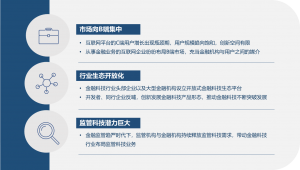
Development Trends of China's Financial Technology Industry
★ The market is concentrating on the B-side
In recent years, financial industry regulation has become increasingly stringent. The operational compliance costs of financial services such as payments and credit have been rising. Financial technology companies engaged in financial business are facing the dilemma of continuous pressure on their profit margins and urgently need to find new operational strategies, including new service models and new service industries, to alleviate operational pressure. Additionally, after 20 years of development, the growth of C-end users on major internet platforms has gradually reached a bottleneck, with user scale tending towards saturation and limited room for innovation. Therefore, some internet companies engaged in financial business have been deploying in the B-end market, acting as intermediaries between financial institutions and users, and obtaining market share in the fintech industry through technology output services.
★ Open industry ecosystem
The open and integrated development of fintech will become one of the important ways to solve the bottleneck of core technologies. Currently, leading fintech companies with technical strength and banking institutions are establishing open fintech ecosystem platforms, opening up some industry's technology research achievements, business forms, data scales, etc., to developers, peer enterprises, etc. This aims to innovate the form of fintech products and promote continuous breakthroughs in fintech development. At the same time, based on fintech development platforms, participants can leverage the platform's advantages to strengthen their comprehensive capabilities, such as application scenario extension ability and data scale expansion ability.
★ Regulatory technology has great potential
The successive implementation of favorable policies has motivated fintech companies to focus on the regulatory technology business area. For example, in 2018, Hefinuo joined hands with China Merchants Bank to layout the regulatory technology field; in February 2019, Ant Financial Services cooperated with the Beijing Municipal Financial Regulatory Bureau, empowering the financial regulatory capabilities of Beijing based on Ant Financial's 'Ant Risk Brain', thereby enhancing the technological supervision capability. The deep integration and development of fintech and regulatory services will assist regulatory agencies in strengthening their supervision capabilities, improving efficiency, and reducing costs in aspects such as risk data integration, risk models, analysis, and prediction. In an era where financial regulation is becoming stricter, regulatory agencies and financial institutions continue to release demand for regulatory technology, driving the fintech industry to deploy regulatory technology businesses. At the same time, they attract new entrants to enter the fintech market through regulatory technology, thus promoting the development of regulatory technology and bringing significant development opportunities to the industry.
Development Trends of China's Financial Technology Industry
Source: Developed by Frost & Sullivan Research
Dr. Wang Xin, Global Partner at Frost & Sullivan, Vice President of Global Market Strategy Planning and President of the China Region, pointed out that China has achieved rich results in fintech applications such as financial institution back-office information systems and internet technology-driven online financial business platforms, entering the era of fintech 2.0 with a globally leading stance. Against the backdrop of supportive policies and the maturation of new-generation technologies such as blockchain and big data, China's fintech industry will further develop, with market scale continuously expanding.