



Frost & Sullivan
Hubei Xiangjiang Electric Appliance Co., Ltd. (Stock Code: 2619.HK) successfully listed on the Hong Kong Stock Exchange on June 25, 2025. The company is a leading manufacturer of home furnishing products in China, focusing on the research, development, design, production, and sales of electrical and non-electrical household appliances. Frost & Sullivan (hereinafter referred to as 'Frost & Sullivan') provided exclusive industry advisory services for Hubei Xiangjiang Electric Appliance Co., Ltd.'s listing on the Hong Kong market, and we hereby extend our warm congratulations on its successful listing.

Hubei Xiangjiang Electric Appliance Co., Ltd. (hereinafter referred to as 'Xiangjiang Electric Appliance') successfully listed on June 25, 2025. The company plans to issue 68,220,000 H shares, of which 61,398,000 shares will be issued internationally and 6,822,000 shares will be issued in Hong Kong. The issue price per share is HK$2.860, and the net proceeds from the fundraising are approximately HK$195 million.
During the process of listing in Hong Kong this time, Frost & Sullivan mainly undertook the following tasks: helping the issuer accurately and objectively understand its positioning in the target market, using objective market data to discover, support, and highlight the issuer's competitive advantages, assisting the issuer, investment banks, and other intermediaries in completing the relevant parts of the prospectus (such as overview, competitive advantages and strategy, industry overview, business, and other important chapters), helping the issuer complete communication with the Hong Kong Stock Exchange and investors, assisting investors in quickly understanding the market ecosystem and competitive landscape, and assisting the issuer in completing feedback on various industry-related issues from the Hong Kong Stock Exchange, etc.
According to LiveReport's big data (statistical data as of June 1, 2025), from January to May 2025, as well as during the past 12 and 36 months, Frost & Sullivan provided listing industry advisory services for 17 (63%), 48 (63%), and 152 (68%) Hong Kong-listed IPOs respectively, boasting rich industry experience and communication skills with exchanges and investors.
PART/1
Investment Highlights
-
The company has established stable relationships with internationally renowned clients, including some of the world's most famous brands;
-
The company is renowned as a provider of home furnishings and has a distinguished track record spanning decades;
-
The company has a highly skilled R&D team, continuously upgrading and developing products;
-
The company boasts a senior and stable management team, coupled with a functional organizational structure equipped with an effective internal monitoring system.
According to a report by Frost & Sullivan:
-
Ranked tenth in China's kitchen small appliance industry by export value in 2024;
-
In terms of export value, in 2024, the company ranked first in China's garden water pipe industry.
PART/2
Overview of the Global Home Furnishings Industry
Definition and Classification of Home Furnishings
Home furnishings include a range of items designed to optimize modern living environments and enhance the quality of life. Based on their usage characteristics and operating modes, they can be divided into electrical household items and non-electrical household items. Electrical household items include major appliances and small appliances. Non-electrical household items mainly include non-electrical household items related to gardening, bathrooms, kitchens, and indoor living.
The following figure shows the historical and forecasted market size of the global home furnishings industry in terms of retail sales from 2020 to 2029:
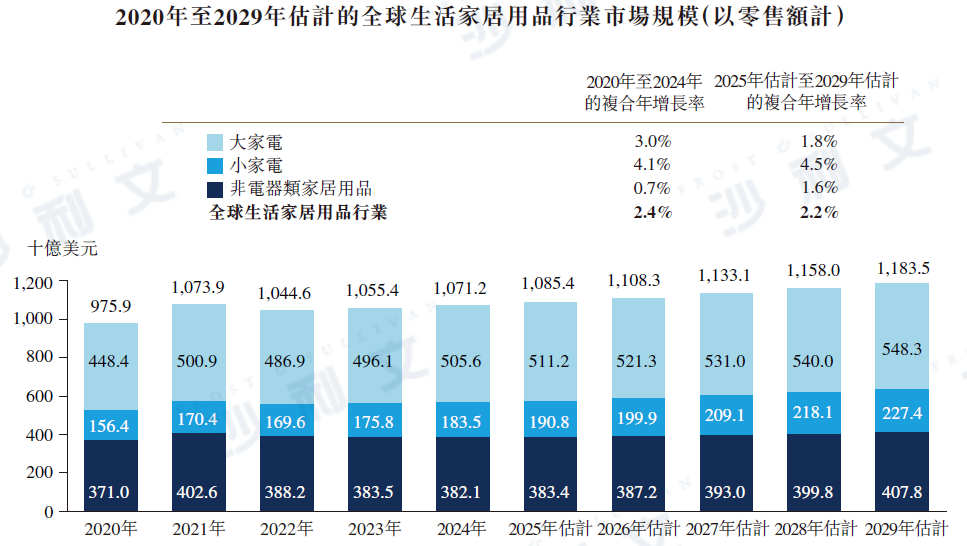
Data source: Interviews with industry experts, Frost & Sullivan reports
Global market scale of small household appliances
● Definition and Classification of Small Household Appliances
Small household appliances refer to compact and low-power household devices, excluding products with high output power, aimed at improving the quality of life. Small household appliances are an indispensable part of modern life, providing convenience and efficiency in various aspects of daily life. Based on their functions, small household appliances can be divided into kitchen appliances, home living and environmental appliances, and personal care appliances.
-
Kitchen appliances: Kitchen appliances include food preparation and cooking appliances.
· Food processing small appliances are used for preparing and processing food (such as mixers, egg beaters, juicers, food processors, etc.).
· Cooking appliances are used for cooking food in the kitchen (such as electric kettles, rice cookers, steamers, deep fryers, grills, etc.).
-
Home living and environmental small appliances: used to reduce household chores, improve living environments, and maintain cleanliness (such as air purifiers, dehumidifiers, humidifiers, electric fans, vacuum cleaners, etc.).
-
Personal care small appliances: used for personal hygiene, health care, and grooming (such as body shaving razors, electric toothbrushes, electric facial cleansers, etc.).
● Global market scale of small household appliances
Driven by technological progress, increasing consumer demand for energy-efficient products, and the rise of smart home solutions, the global small appliance industry has experienced stable growth in recent years. Its retail sales increased from $156.4 billion in 2020 to $183.5 billion in 2024, with a compound annual growth rate of 4.1%. The COVID-19 pandemic led to more people staying at home and reduced social gatherings, resulting in an increase in global demand for small appliances in 2020 and 2021. As the world enters a post-pandemic period, coupled with geopolitical tensions and a global macroeconomic downturn, retail sales in the global small appliance industry declined in 2022. Looking ahead, with continuous technological progress and environmental innovation, it is expected that the global small appliance industry will maintain stable growth, increasing from $190.8 billion in 2025 to $227.4 billion in 2029, with a compound annual growth rate of 4.5%.
Due to the increasing demand for convenient, time-saving, and energy-efficient products in the market, the market size of the U.S. small appliance industry has rapidly grown in recent years. Its retail sales increased from $38.6 billion in 2020 to $48.7 billion in 2024, with a compound annual growth rate of 5.9%. With technological progress and changes in lifestyle habits, more and more families are adopting innovative appliances. Driven by continuous innovation, increased disposable income, and growing emphasis on sustainability, it is expected that the upward trend will accelerate further over the next five years. The retail sales of the U.S. small appliance industry will increase from $51 billion in 2025 to $637 billion in 2029, with a compound annual growth rate of 5.7%.
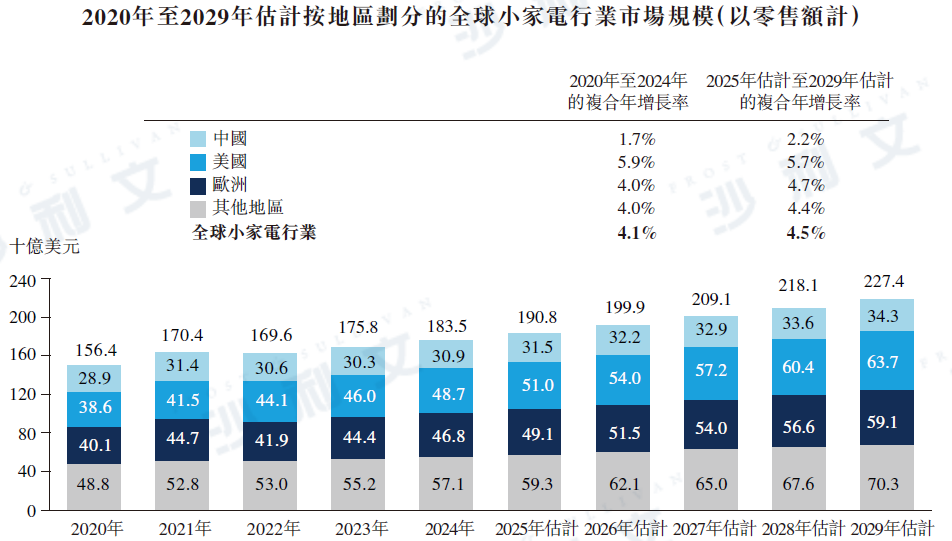
Data source: Interviews with industry experts, Frost & Sullivan reports
The global small appliance industry has experienced significant development, with notable growth in various products driven by consumers' increasing demand for convenience, health, and sustainability. Kitchen appliances account for the largest share of the market, with retail sales increasing from $66.6 billion in 2020 to $74.1 billion in 2024, a compound annual growth rate of 2.7%. Retail sales of home living and environmental small appliances increased from $57.4 billion in 2020 to $68.5 billion in 2024, a compound annual growth rate of 4.6%.
Meanwhile, due to the increasing emphasis on personal health care, beauty trends, and the application of intelligent portable personal care technologies, personal care small appliances have experienced rapid growth in the past few years. Their retail sales increased from $32.4 billion in 2020 to $40.8 billion in 2024, with a compound annual growth rate of 6.0%. As the industry progresses, kitchen small appliances are expected to maintain a dominant position, with retail sales increasing from $76.5 billion in 2025 to $89.7 billion in 2029, at a compound annual growth rate of 4.1%.
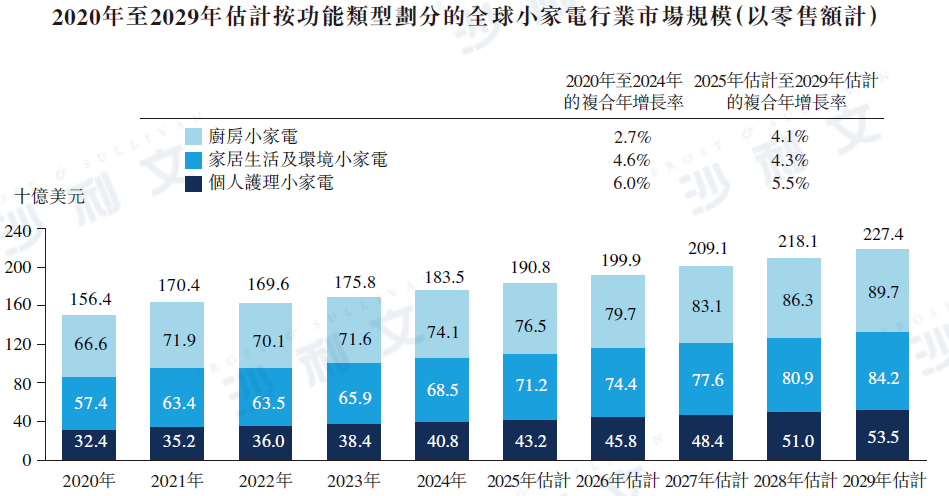
Data source: Interviews with industry experts, Frost & Sullivan reports
After years of development, China's small appliance industry has evolved from simple assembly to lean production, becoming one of the world's leading production bases. China's small appliance exports increased from $42 billion in 2020 to $568 billion in 2024, with a compound annual growth rate of 7.9%. Looking ahead, with the continuous recovery of the global economy, especially the rising demand for small appliances in developing countries, coupled with China's continuous technological innovation and diversified exports of small appliances, it is expected that China's small appliance exports will increase from $584 billion in 2025 to $656 billion in 2029, with a compound annual growth rate of 2.9%.
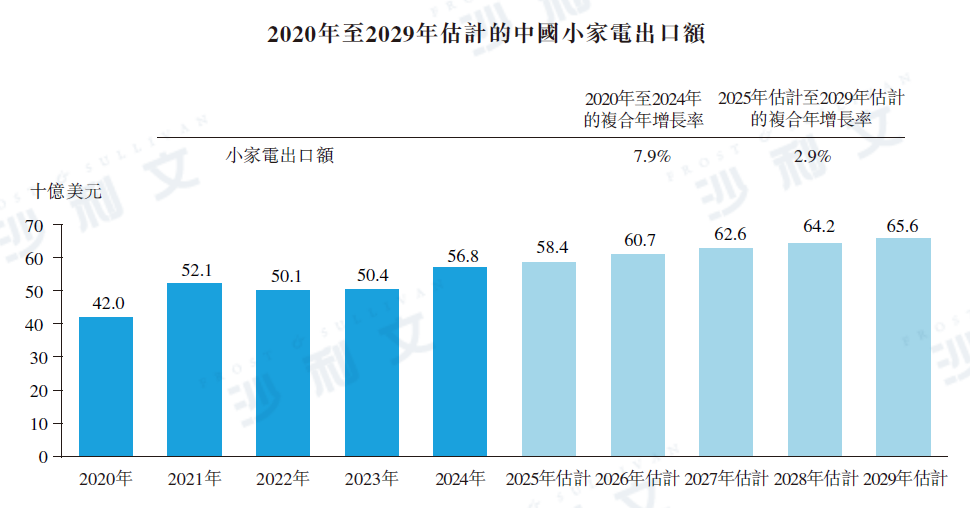
Source: China Household Appliance Association, China Chamber of Commerce for Import and Export of Mechanical and Electrical Products, Frost & Sullivan report
Market Drivers of the Global Small Appliance Industry
● Growth in demand for small household appliances in the US
The U.S. small appliance market has experienced rapid growth in recent years and currently holds an important position in the global landscape. As one of the largest markets in the world, the United States determines trends in the global home appliance industry and influences manufacturing and product development. The growth in demand for small appliances in the U.S. can be attributed to domestic consumers' increasing emphasis on convenience and lifestyle, as well as the reduction in household size. First, in the U.S., there is a strong demand for home appliances that provide convenience and time-saving solutions, especially smart kitchen appliances. These products are efficient and easy to use, suitable for modern lifestyles, and thus are increasingly popular among consumers. The market size of the U.S. kitchen small appliance industry increased from $172 billion in 2020 to $212 billion in 2024, and is expected to further increase from $221 billion in 2025 to $268 billion in 2029, with a compound annual growth rate of 5.0% starting from 2025. In the industry, some market sizes for kitchen small appliances are expected to expand. For example, by 2029, the market sizes for electric fryers, electric grills, and electric kettles in the U.S. will increase by compound annual growth rates (2025-2029) of 8.1%, 5.3%, and 5.1%, to $21.695 billion, $6.823 billion, and $3.142 billion, respectively. Second, the reduction in household size and the rise of the "lazy single-person economy" (especially in developed countries such as the U.S.) have driven growth in the small appliance industry, with more and more single consumers purchasing small appliances to improve their personal happiness and convenience. For example, according to data released by the U.S. Census Bureau, the average household size in the U.S. decreased from 2.6 people in 2010 to 2.5 people in 2024. In addition, the proportion of one-person households in the U.S. increased from 26.7% in 2010 to 29.0% in 2024. As families become smaller, consumers are looking for compact and space-saving appliances to meet their personal needs. This shift in family dynamics is expected to further drive growth in the small appliance industry, in line with the evolving living habits of the U.S.
● Increased demand for innovative and environmentally friendly small household appliances
As global living standards continue to improve, consumers are pursuing small appliances with more functions. They are no longer satisfied with basic operability but seek advanced performance, user-friendly design, and greater convenience. The rise of the 'lazy single person economy' has driven growth in the small appliance industry, with more and more single consumers purchasing small appliances to enhance their personal happiness and convenience. Therefore, innovative multifunctional small appliances particularly cater to the needs of this demographic, providing practical and time-saving solutions for personal lifestyles. In addition, the increasing awareness of low-carbon and green living has further influenced demand growth. Modern consumers prioritize products that are efficient, environmentally friendly, made from sustainable materials, and safe for personal health. For example, as people pay more attention to hygiene, the demand for kitchen small appliances that can sterilize, antibacterial, and are non-toxic is growing continuously. Electric grills and frying pans without polytetrafluoroethylene (PTFE) and perfluorooctanoic acid (PFOA) are more ideal, allowing customers to use them safely. As a result, more and more consumers choose products that can make their lifestyles cleaner and healthier. Therefore, small appliance manufacturers are investing heavily in research and development to improve product quality and functionality to meet consumers' diverse and changing needs. This trend marks a significant step forward for the small appliance industry towards innovation and sustainability, reflecting broader social values and consumer expectations.
● Innovative technological advancements in product, manufacturing, and quality control
Driven by advanced product design, automated manufacturing technology, better quality control systems, and enhanced product performance, technological innovation is profoundly reshaping the global small appliance industry. Companies are significantly increasing their R&D investments to launch appliances with cutting-edge features such as intelligent connectivity, remote control, and automatic operation. For example, modern smart kitchen appliances now come equipped with functions such as program control, voice control, and preset heating or cooking times, allowing users to easily set their own settings. In addition, smart production lines are improving efficiency and product quality while reducing costs. For instance, leading companies adopt modular standard designs and optimize processes by integrating temperature sensing systems, reciprocating elevators, and other equipment to enhance traditional production lines and achieve automated production. Based on the adoption of automated manufacturing technology, leading companies implement automated quality control systems that collect yield and quality data, conduct comprehensive automated testing, thereby reducing manual involvement, lowering the defective rate of finished products, preventing assembly errors, component shortages, measurement errors, missed measurements, and other issues, and thus improving product quality and reliability. Moreover, through innovative technological progress, product performance continues to enhance. For example, some industry-leading companies are upgrading motors to reduce heat generation and extend product lifespan. In addition, advanced product design helps improve heat dissipation. Innovations in product development, manufacturing, and quality control will significantly improve the performance and level of future products.
PART/3
Overview of the Global Garden Water Supply Industry
Garden tools refer to specialized instruments, machines, or devices used for horticulture and outdoor maintenance. Garden hoses are one of the main garden tools used for irrigation, cleaning, and other purposes, typically made from durable materials such as PVC, polyethylene, TPE (thermoplastic elastomer), latex, etc., and are characterized by being soft, lightweight, and durable.
Market scale of garden water pipes and garden tools industry
With the global economic expansion and the increasing demand for high-quality lifestyles, more and more consumers are investing in personal gardens. The continuous shift towards outdoor living and the growing popularity of gardening as a leisure activity have also contributed to a significant growth in the garden tool market. Garden hoses are an important part of the broad garden tool market. The retail sales of the garden hose market increased from $8.2 billion in 2020 to $9.2 billion in 2024, with a compound annual growth rate of 2.9%. This growth is mainly due to the increasing popularity of high-performance and durable garden hose products, which meet the needs of amateur and professional horticulturists. As the garden tool industry continues to expand, the market size of garden hoses is expected to grow from $9.5 billion in 2025 to $11.4 billion in 2029, with a compound annual growth rate of 4.7%.
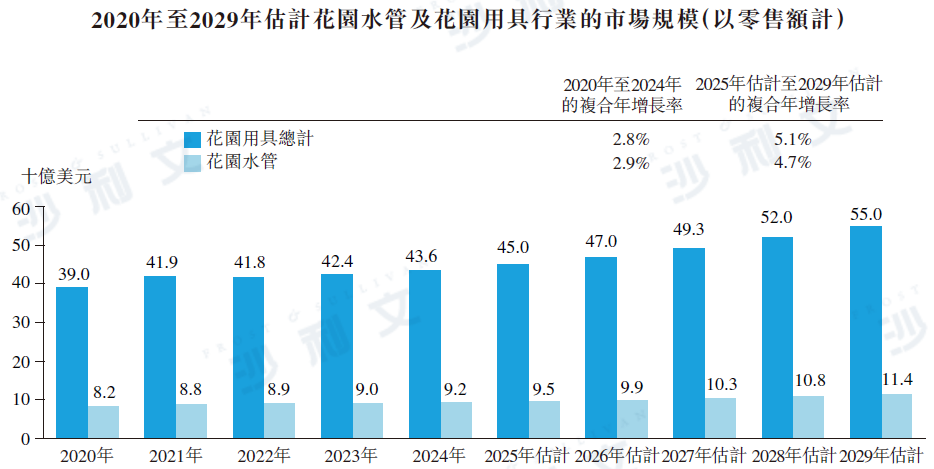
Source: Frost & Sullivan report
Over the past five years, the United States has been the world's largest garden hose market, accounting for more than 50% of the global market. Driven by the increasing popularity of gardening, the U.S. garden hose industry has grown rapidly in recent years, with retail sales increasing from $4.6 billion in 2020 to $5.3 billion in 2024, a compound annual growth rate of 3.9%. Looking ahead, the market is expected to continue rising driven by increasing participation in gardening activities, increased gardening spending, and continuous innovation in garden hose products. The retail sales of the U.S. garden hose industry are expected to increase from $5.5 billion in 2025 to $6.8 billion in 2029, with a compound annual growth rate of 5.8%.
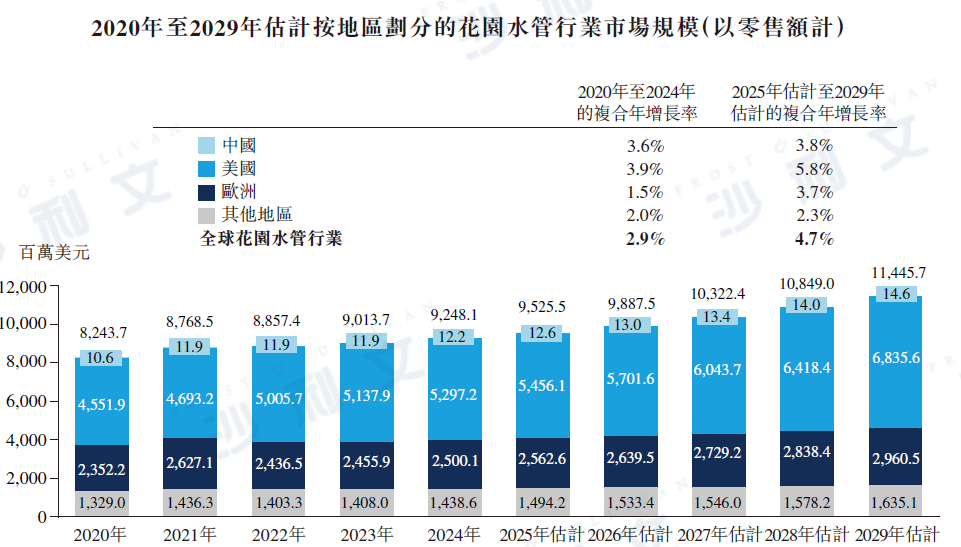
Source: Frost & Sullivan report
Market Drivers and Trend Analysis of the Global Garden Water Pipe Industry
● Horticultural activities have become popular due to the pursuit of a high-quality life
Horticulture is a major traditional activity in the United States and Europe, involving widespread public participation and creating a vast and stable market for garden hoses and related products. With the improvement of living standards, gardening has not only become a hobby but also a popular way of home maintenance. This shift has led to a significant increase in demand for gardening supplies, especially garden hoses, which are crucial for maintaining garden spaces and enhancing the aesthetic quality of living environments. In developed regions such as the United States and Europe, higher average incomes enable many families to enjoy and take care of their private gardens. People's growing interest in gardening, coupled with the pursuit of higher quality of life, is driving a steady expansion of the garden hose market. As an important tool, garden hoses can fully meet consumers' expectations for quality and functionality. As more families continue to engage in gardening for leisure, aesthetics, and self-sufficiency, the garden hose industry will benefit from a reliable customer base and strong demand growth.
● Emerging planting demand and increased horticultural expenses
The trend of growing vegetable cultivation at home and environmentally friendly garden beautification has stimulated the demand for high-quality, water-resistant pipes. With the expansion of gardening activities among urban and suburban residents, the demand for specialized pipes has been continuously increasing, including those designed for drip irrigation, flexibility, and environmentally friendly materials, making garden pipes an important part of household gardening expenses. In addition, the growing number of participants in gardening activities has also driven up the demand for garden pipes. The population of horticultural families in the United States increased from 9.58 million in 2020 to over 1.2 million in 2024. Moreover, as more consumers invest in outdoor spaces for leisure, aesthetics, and sustainable practices, gardening expenses show a clear upward trend. The average horticultural expense per American household increased from $458 in 2020 to over $700 in 2024. As people invest more in gardening, the demand for related products, including garden pipes, is driving up. With more consumers participating in outdoor home renovations and garden beautification, the market for garden pipe products is expected to further expand.
● Progress in technology and product performance
Driven by consumers' demand for enhanced functionality and convenience, the garden hose market is undergoing significant evolution in terms of technology and product performance. Automatic extending garden hoses are becoming increasingly popular due to their ease of handling, storage, and transportation, especially suitable for various garden spaces. Durability is at the core of consumer concerns, with them preferring hoses that are resistant to entanglement, extreme temperatures, and long-term wear. New models incorporate advanced features such as resistance to extremely high temperatures, explosion-proof design, and operational capabilities at very low temperatures. In addition, the industry also focuses on material innovation, using soft yet elastic materials and thicker inner tube designs to enhance reliability. The new design features a polyester woven outer layer and latex inner tube, offering excellent elasticity, high-temperature resilience, and frost resistance, suitable for various outdoor tasks. At the same time, the increasing emphasis on environmentally friendly materials and sustainable production methods not only helps improve product lifespan and safety but also meets consumers' demand for environmentally friendly gardening tools. This combination of advanced features, durability, and sustainability is driving continuous innovation in the garden hose market, ensuring that products not only meet but exceed the ever-changing expectations of consumers.




