Frost & Sullivan insights
Recently, the National Healthcare Security Administration released the following regarding the Fifth Session of the 13th National People's Congress:4955The reply to the 'Proposal on the Implementation of Volume-based Payment for Innovative Medical Devices' states that due to the immaturity of the clinical use of innovative medical devices and the temporary difficulty in estimating usage volumes, it is still challenging to implement volume-based payment.
What impact will 'Reply' have on innovative device companies? What is the current overall state of the domestic innovative device industry, and which main directions are being deployed? Commercialization of innovative devices in China is currently in its infancy. What difficulties exist during the implementation process? Frost & SullivanFrost & SullivanJiang Tengfei, Senior Consulting Director of the Healthcare Team at Frost & Sullivan (hereinafter referred to as 'Frost & Sullivan'), was interviewed by Economic Observer Network to discuss the current development status of the domestic innovative medical device industry.
Economic Observer Network
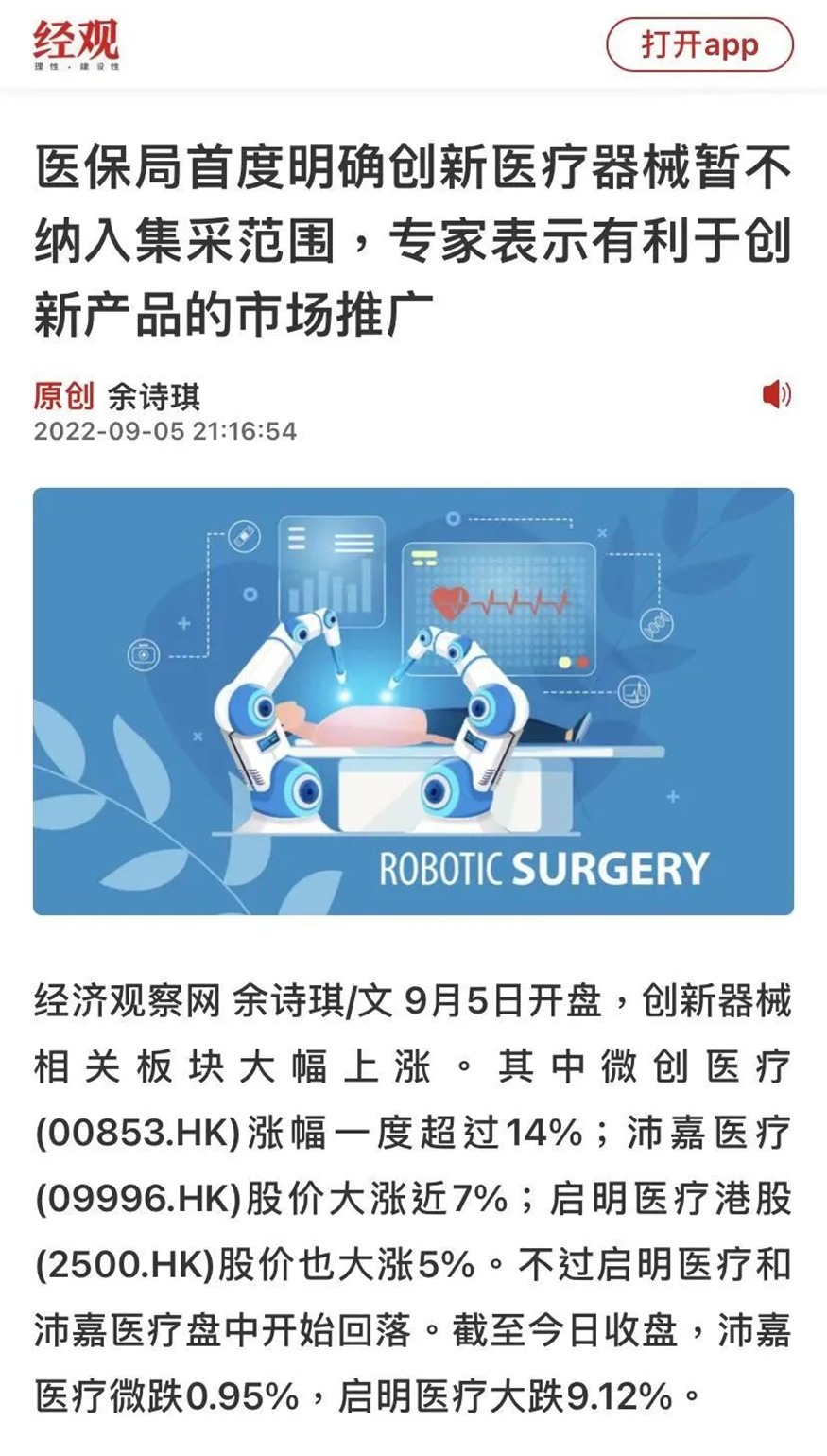
9month5On the opening day, the sector related to innovative medical devices rose significantly. Among them, minimally invasive medicine(00853.HK)The increase once exceeded14%Peijia Medical(09996.HK)The stock price soared nearly7%; Qiming Healthcare (HK)(2500.HK)Stock prices also soared5%However, Qiming Medical and Peijia Medical began to decline in price during the session. As of today's close, Peijia Medical was slightly down.0.95%Qiming Medical tumbled9.12%.
From the perspective of messaging, it is in conjunction with the National Healthcare Security Administration9month3First response on the news regarding the centralized procurement of innovative medical devices9month3On the same day, the National Healthcare Security Administration released an announcement regarding the "Opinions of the National Healthcare Security Administration on the Fifth Session of the 13th National People's Congress"4955Reply to the Proposal No.(hereinafter referred to as the 'Reply')In the 'Reply', the National Healthcare Security Administration has responded to questions regarding the centralized procurement of innovative medical devices for the first time.
In the 'Reply', the National Healthcare Security Administration (NHSA) stated for the first time that due to the immaturity of the clinical use of innovative medical devices and the temporary difficulty in estimating their usage volume, it is still difficult to implement volume-based procurement methods. During the centralized volume-based procurement process, the NHSA will reasonably determine the volume ratio based on factors such as clinical usage characteristics, market competition patterns, and the number of winning enterprises. A certain market space is reserved outside of centralized volume-based procurement to provide room for innovative products to develop their market.
This means that innovative medical devices will not be included in the centralized procurement scope for the time being. As of now, the National Medical Products Administration has approved173The registration and launch of an innovative medical device mainly involve cardiovascular intervention,IVDMedical imaging, peripheral intervention, surgical robots, diagnostic software aids, tumor treatment, and other fields.
Jiang Tengfei
Senior Consulting Director, Healthcare Team, Frost & Sullivan Greater China Region
Jiang Tengfei, Senior Consulting Director of the Healthcare Team at Frost & Sullivan Greater China, told ECONOMIC OBSERVATION that for a long time, domestic substitution has lacked competitiveness in high-end surgical instruments. However, in recent years, there has been a surge in innovative medical device products with independent intellectual property rights, such as laparoscopes./Orthopedic surgical robots, minimally invasive glaucoma surgeryMIGSincluding glaucoma drainage devices in ( ).
In his view, the statement from the Medical Insurance Bureau is quite important for innovative medical devices. To a certain extent, it protects innovative medical device products from fierce market competition and retains reasonable profits to promote academic dissemination. This is because the commercialization of most innovative device products depends on the R&D technical background of the founding team, lacking experience in scientific marketing planning. Moreover, many are limited to specific regions and lack national layout. This usually results in certain progress in some provinces but slow advancement at the overall Chinese market level.
Zhejiang Merchants Securities Research Institute stated that since2019Since China launched centralized procurement of high-value consumables in6The month has passed64In the centralized procurement model, the main varieties procured are those with a high market share, such as vascular interventional devices, orthopedics, ophthalmology, and dentistry. From the medical insurance bureau's response this time, innovative medical devices can be temporarily exempted from volume-based procurement, which demonstrates the policy's strong support for medical innovation. Subsequently, the industry space for medical device innovation will continue to expand.
CITIC Construction Investment also pointed out that in the futureDRG,DIPDuring the reform of medical insurance payment methods, it is expected that innovative devices will be given separate consideration, which is conducive to ensuring a reasonable life cycle and profit margin for innovative products. We continue to be optimistic about investment opportunities in innovative devices. Considering recent policy views, we believe that the marginal relaxation of medical insurance policies for innovative devices is on the horizon.
*This article is reprinted from Economic Observer Network.,Reporter Yu Shiqi,The original article is titled 'The Medical Insurance Bureau Defines for the First Time that Innovative Medical Devices Are Not Included in the Centralized Procurement Scope for the Time Being, with Experts Saying It Is Beneficial for the Market Promotion of Innovative Products'.