2022What are the characteristics of the medical device centralized procurement in [year]? Is the trend towards no exclusion zones in centralized procurement more evident? In the future, which products will be included in the scope of centralized procurement? After the expiration of the coronary stent centralized procurement agreement, some products have seen price increases. What signals does this send? Why has there been an increase in the number of local and alliance centralized procurements? What impacts will they bring about and whether they will escalate to the national level of centralized procurement?
Frost & SullivanFrost & SullivanGuo Jing, Senior Consulting Director for Healthcare in Greater China at Frost & Sullivan (hereinafter referred to as 'Frost & Sullivan'), was interviewed by Securities Daily to discuss the above topics.
 Securities Daily
Q
Securities Daily Reporter:2022What are the characteristics of the medical device centralized procurement in [year]?
since2022year10With the commencement of the centralized procurement of coronary artery drugs, China's medical device industry has been conducting volume-based procurement for over two years. Unlike the earlier radical price adjustments,2022In the year, the overall trend of device centralized procurement showed a slowdown in price reductions, with pricing tending towards rationality and science.
Specifically, this year10month27The price reduction for the provincial alliance's electrophysiological centralized procurement is as follows: group package price reduction> =30%, single-piece decrease> =50%;11month22In the provincial alliance's biochemical centralized procurement, enterprises have reduced prices based on the highest effective declared price.40%You can be shortlisted. This is different from the situation in the previous two years, where80 - 90%The decline has been greatly alleviated compared to before. Moreover, centralized procurement of medical devices, especially in the field of medical consumables, is gradually showing characteristics of normalization and institutionalization.
Q
Securities Daily Reporter: Since the beginning of this year, the centralized procurement bidding for orthodontics has been carried out, and has the trend of no exclusion zones in the centralized procurement become more apparent? What products do you think will enter the scope of centralized procurement in the future?
The point that 'centralized procurement has no no-go zones' needs to be considered from two aspects. Indeed, the types of medical device products covered by centralized procurement will indeed increase, but the state reserves a certain space for innovative medical devices to ensure room for innovation.
We can categorize medical devices into four types for consideration: startup products, development-stage products, mature-stage products, and consumer-grade products. For the first type, startup products, centralized procurement policies will slow down, leaving room for innovation while suppressing homogeneous competition with low-tech products; for the second type, development-stage products, such as electrophysiological devices, centralized procurement will favor leading enterprises, significantly increasing the certainty of winning bids; for the third type, mature-stage products, such as coronary stents, centralized procurement enterprises are expected to reshuffle their ranks, with the focus on the value of flow guidance and widespread application; for the fourth type, consumer-grade products, the price cuts in centralized procurement are more consistent, leaving some room for market-oriented adjustments.
Q
Securities Daily Reporter: After the expiration of the centralized procurement agreement for coronary stents, there has been a continuation in purchases, and some products have seen price increases. What signals does this send?
This is actually a manifestation of the 'trend towards rational and scientific pricing' just mentioned. The renewal results of this centralized procurement do not mean that future centralized procurements will continue with 'price hikes', but rather indicate the rationalization of procurement pricing, getting closer to the true value of products.
In fact, the number of occurrences in the first centralized procurement exceeds90%The 'floor price' resulting from the price cuts is not the original intention of centralized procurement. At the beginning of the system design, it was oriented towards artificially high product prices, with the hope that policy efforts could effectively adjust premiums and squeeze out excess liquidity.
However, this is not a trend towards healthy development of the industry. Therefore, if price cuts in the early stages were an inevitable phase of correction, then the current increase in coronary stent prices is a rational return to centralized procurement pricing, a process that allows product prices to return to their true value.
Q
Securities Daily Reporter: In addition, why has the number of local centralized procurement and alliance procurement increased? What impacts will this bring about, and can it escalate to the national level of centralized procurement?
Let's first provide some background here.2022year1month10At the State Council's executive meeting on the 1st, it was decided to normalize and institutionalize centralized volume-based procurement of drugs and high-value medical consumables. It was mentioned that with a focus on chronic and common diseases, national-level drug procurement will continue to be promoted, and localities will carry out provincial or cross-provincial alliance procurement for drugs not included in the national procurement. From the content of this meeting, it can be seen that national and local volume-based procurement will have their own priorities. National centralized procurement focuses on varieties that are not yet covered but have high costs, large clinical usage, or where existing procurement rules cannot be directly applied. Local procurement alliances, on the other hand, are formed by the medical insurance bureaus of cooperating provinces to jointly formulate procurement rules for centralized procurement.
In summary, the role of national centralized procurement is to build platforms and set rules, while local alliance centralized procurement involves pooling resources among provinces with similar product structures and regulations. An inevitable trend is the increase in the number of local and alliance centralized procurements, as this makes it more efficient and aligns better with local actual needs. Regarding the second question, the increase in local alliance centralized procurement will not have a substantial impact on national centralized procurement. Since their purposes are different, the development of both centralized procurement models complements each other, collectively making the entire centralized procurement system more mature.
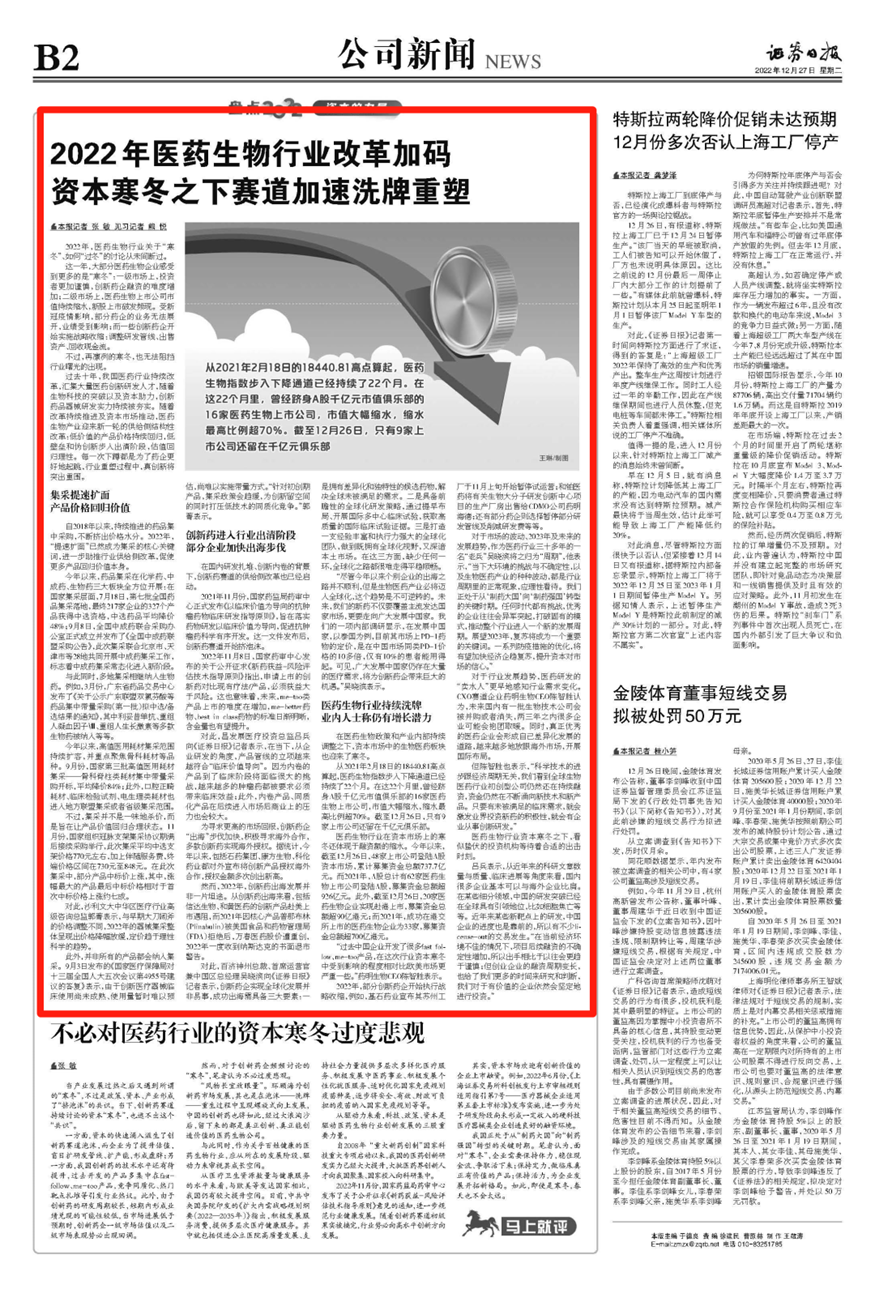
*This interview was published in 'Securities Daily', with reporters Zhang Min and Xiong Yue. The original article is titled ' 2022The reform of the pharmaceutical biotech industry has intensified in 2021 Under the capital winter, tracks are accelerating reshuffle and reconstruction >> (Click on "Read the Original Article" at the end of the text to view the full report).