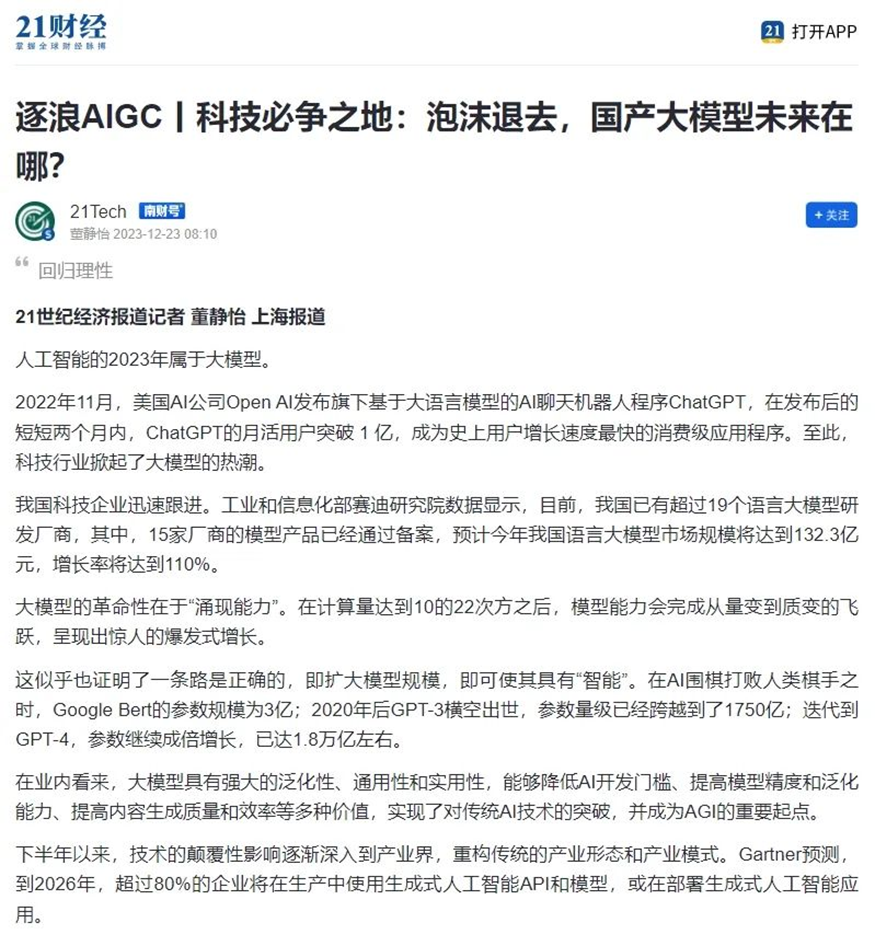
Artificial Intelligence2023The year belongs to large models. 2022year11month, United StatesAIcompanyOpenAIPublishes its large language model-basedAIchatbot programChatGPTWithin just two months after its release,ChatGPTMonthly active users exceed1Yi has become the consumer app with the fastest user growth rate in history. As a result, the technology industry has seen a surge in large models. Chinese technology companies are quickly catching up. Data from the CCID Research Institute of the Ministry of Industry and Information Technology shows that currently, there are more than19A language large model R&D provider, among which,15The model products of the home manufacturer have passed the filing process, and it is expected2023The market scale of language large models in China will reach132.3Yuan, with a growth rate that will reach110%.
Is the application direction of large models an advantage for domestic enterprises? Since the second half of the year, there has been an increased emphasis on application implementation. What are the common difficulties in commercialization? How do you view the future development trend of large domestic models? Frost & SullivanFrost & SullivanLi Qing, Director of Frost & Sullivan Greater China, was interviewed21Financial interview, jointly discussing the future development of large models in China.
21Finance and Economics
Q
Is the application direction of large models an advantage for domestic enterprises?
In fact, this should be a point that domestic enterprises need to address. Compared with Europe and America, the penetration rate of software-based applications in China is still relatively low. Overseas, applications based on large models are already very rich. However, domestically, people are currently focusing on optimizing based on large models themselves. On one hand, applications integrate the capabilities of large models with existing products, and on the other hand, they are re-platforming scenario-based applications related to large models. Currently, we see many applications choosing the second approach, but the second option faces the problem of weak data foundations in the early stages. Precisely because of this, it alsoAIThe application market has brought about tremendous development opportunities.
Q
Since the second half of the year, more emphasis has been placed on application implementation. What are the common difficulties in commercial implementation?
First and foremost, we still need to solve the chip problem. If there is no breakthrough in computing efficiency and computing power, in some highly difficult and complex scenarios,AIThe optimization and upgrade iterations of large models still have a certain gap compared to overseas. Globally, large models are evolving rapidly with frequent iterations. At the same time, development tools based on large models are also becoming increasingly sophisticated, which is an area that needs strengthening in China. In terms of commercialization itself, although the emergence of large models has reducedAIThe threshold for applications, but how to align your business and commercial scenarios withAIThe logic matches, and how to seekAIValue innovation, rather than merely reflecting efficiency, may be an issue that needs consideration in current advancement. If large models cannot be used flexibly or fully adapted to one's own business scenarios, it may be difficult to achieve the goal of cost reduction and efficiency improvement to a certain extent.
Q
What is your view on the future development trend of large models in China?
Firstly, after large models emerge, there will gradually be an oligopoly trend. Due to limited computing power and the homogenization of large models, computing and data resources will become concentrated in the future. Some large models with low value will also gradually be phased out.
Secondly, in the field of text creation, a number of related applications will emerge, as the demand for text creation in China is currently high, which benefits from the country's vast understanding and application scenarios of text.
At the regulatory level, there may still be an appropriate allowance. When large models were first introduced, due to their relatively vague understanding and future applications, a strict strategy was adopted at the beginning. However, as applications emerge and differences between domestic and international practices become apparent, the regulatory authorities may provide appropriate flexibility to support the development of the industry.
* This interview was published in 21Finance and Economics The reporter is Dong Jingyi, and the original title is: SurgeAIGC| The Battlefield of Technological Competition: As the Bubble Erupts, Where Lies the Future for Domestic Large Models? ">