'Frost & Sullivan' Insights
The three major operators are accelerating the collaborative advancement of network services for 5G-A commercialization. China Mobile previously planned to achieve full commercial deployment by the end of 2026. Since the beginning of this year, in addition to supporting typical scenarios such as low-altitude operations, 5G-A has gradually begun to empower robots and AI intelligent agents. How do you view the empowerment of 5G-A in recent years in multiple popular fields such as low-altitude operations, humanoid robots, and AI intelligent agents? Is this due to the traditional telecommunications business development of operators and communication enterprises slowing down and an urgent need to find new business breakthroughs, or is the development in related fields indeed supported by network upgrades? What stage has the development of 5G-A currently entered? Are the conditions ripe for full commercial deployment of 5G-A, or are there still specific challenges?
Frost & Sullivan (Frost & Sullivan, hereinafter referred to as 'Frost & Sullivan') industry analyst Song Anqi was interviewed by Cailian News to discuss the key paths and industrial breakthrough points for the full commercialization of 5G-A.
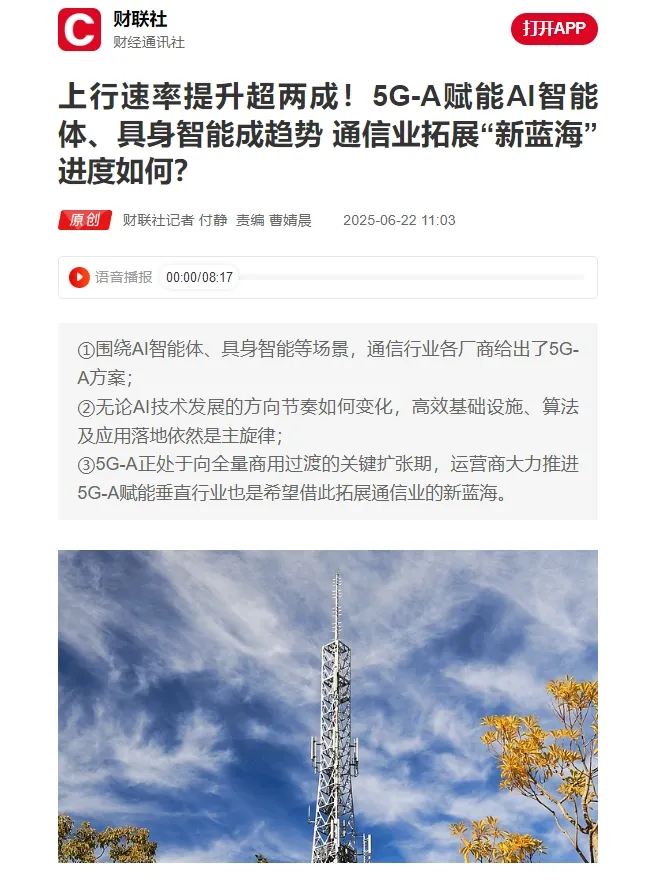
Cailian News
Q:How do you view the empowerment of 5G-A in recent years in multiple popular fields such as low-altitude operations, humanoid robots, and AI intelligent agents? Is this due to the traditional telecommunications business development of operators and communication enterprises slowing down and an urgent need to find new business breakthroughs, or is the development in related fields indeed supported by network upgrades?
Song Anqi
Frost & Sullivan industry analyst
5G-A does not create demand out of thin air but truly meets and supports the objective needs of emerging fields such as low-altitude drones, autonomous robots, and AI intelligent agents for higher-performance networks. It can be said that the development of these emerging fields indeed forces the evolution of communication network capabilities. In typical scenarios such as drone dispatching in low-altitude airspace, remote control of humanoid robots, and multi-modal task execution by AI intelligent agents, networks often need to have high upstream capacity, large bandwidth, low latency, and high stability simultaneously, which has already become a bottleneck for existing 5G networks. The technical characteristics of 5G-A can just meet the communication and computing power coordination needs of these complex tasks, enabling intelligent agents to think quickly in the cloud and act flexibly at terminals. More importantly, as scenarios such as AI large models, intelligent manufacturing, and urban low-altitude transportation continue to deepen and implement, networks are no longer ancillary facilities but gradually become the core infrastructure of intelligent systems, which must have predictable and guaranteed service capabilities. 5G-A is playing a key role in industrial upgrading by gradually shifting its role from being an 'available service' to a 'necessary service' with its enhanced connectivity and native intelligent network capabilities.
At the same time, it is undeniable that operators are vigorously promoting the empowerment of 5G-A in vertical industries in order to expand new blue ocean services in the communication industry and transform their own growth models. As traditional C-end business growth slows down, operators urgently need to find new growth drivers, and 5G-A provides them with a two-way breakthrough point for high-experience consumption and high-value government-enterprise services. On the one hand, through 5G-A-supported differentiated experience services (such as cloud gaming, XR live streaming, etc.), operators can try to shift from 'traffic-based billing' to 'experience-based billing'; on the other hand, in B-end scenarios such as industry, transportation, and healthcare, operators are gradually integrating technologies such as 5G-A with AI, edge computing, and cloud-network integration into the core systems of government-enterprise digital transformation, providing customized and operational network + computing power + application solutions. In this sense, 5G-A is not only a technological upgrade of communication networks but also a deep shift in the strategic focus of operators, which is expected to help operators transform from 'pipe providers' to 'digital enablers' and reshape their value positioning in the digital economy era.
Q:What stage has the development of 5G-A currently entered? Are the conditions ripe for full commercial deployment of 5G-A, or are there still specific challenges?
Song Anqi
Frost & Sullivan industry analyst
Currently, China's 5G-A has kicked off commercialization. The basic conditions from standards, networks to terminals have gradually matured and are in a critical expansion period transitioning from scale pilots to full commercialization. With the official freezing of the 3GPP R18 standard, the technical system of 5G-A has entered a finalization stage, and the three major operators are also rapidly deploying networks nationwide, with continuous coverage initially formed in several key cities. At the same time, terminal manufacturers have launched more than 160 devices supporting 5G-A, and the synergistic effect between networks and terminals has initially emerged. At the application end, industry exploration continues to deepen, with typical scenarios such as cloud gaming, naked-eye 3D live streaming, AI intelligent agents, and low-altitude economy becoming the first batch of customers for 5G-A to verify network performance and service capabilities in the next stage of large-scale implementation. For example, ZTE released the 'AgentGuard' network solution for AI intelligent agents at MWC Shanghai, supporting multi-modal task execution through upstream bandwidth enhancement and deterministic guarantee; Huawei demonstrated a digital human team and workflow intelligent agent built based on the integration of 5G-A and AI, used to improve operation efficiency and network self-optimization capabilities. The humanoid robot 'Kua Fu' also made an appearance at the conference, realizing remote control and intelligent decision-making relying on 5G-A to provide feasibility verification for operations in complex environments. It can be said that 5G-A is in a critical leap period from 'available' to 'usable', and 2025 will become a turning point year for the integration and advancement of network construction and application ecosystems, laying a solid foundation for full commercialization nationwide in 2026.
Although the current commercial technology and industrial foundation of 5G-A are quite mature, the general direction and pace of full popularization are basically clear. However, there are still some challenges that need to be overcome to truly achieve the full commercialization of 5G-A, not only in the deployment and technology integration of the network itself but also depending on the application ecosystem and demand cultivation. On the one hand, 5G-A has introduced many new capabilities such as sensory integration, air-ground-space integration, and endogenous intelligence, but stable operation in complex and variable actual scenarios still requires optimization and verification over time; on the other hand, whether it is high-end experience services for the C-end or industry solutions for the B-end, most are still in the demonstration or customized stage, and there is still a distance from large-scale replication. In addition, whether users are willing to pay a premium for higher-performance networks and how operators build sustainable business models are also key determinants of whether 5G-A can truly run smoothly. Therefore, in the next one or two years, 5G-A will not only 'be built well' but also 'be usable'. Only with the dual-wheel drive of technological evolution and ecological co-construction can we truly open up the next growth cycle of communication industry development.
* This interview has been published in Cailian News, with reporter Fu Jing, and the original title was: Upstream speed increases by more than 20%! The empowerment of AI intelligent agents and embodied intelligence is becoming a trend. How is the progress of expanding the 'new blue ocean' in the communication industry?