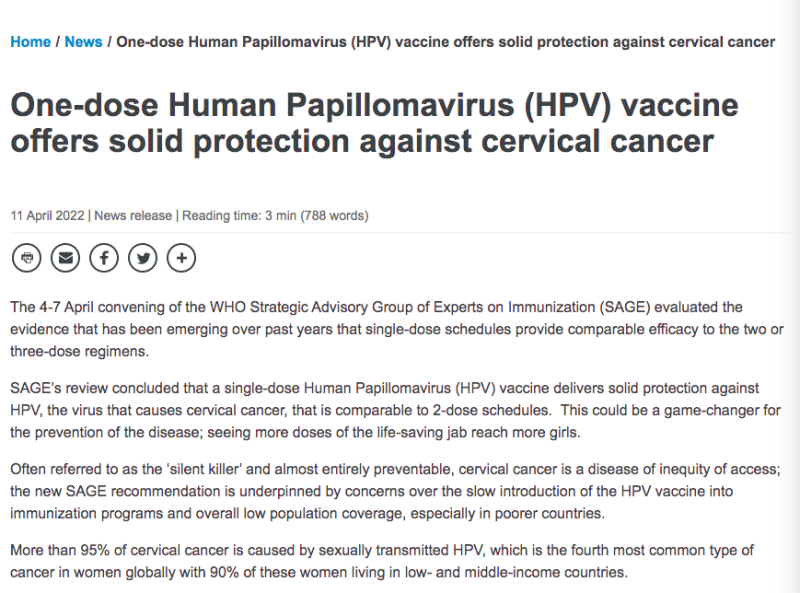
On April 11th, a press release titled "A single dose of human papillomavirus (HPV) vaccine can effectively prevent cervical cancer" published on the official website of the World Health Organization (WHO) attracted attention. Affected by the news, on April 14th, related stocks fluctuated and fell. The stock prices of Zhifei Biotech, which mainly acts as an agent for Merck & Co.'s HPV vaccine, the first domestic manufacturer of HPV vaccine, and Watson Biotech, whose bivalent HPV vaccine was just approved in March this year, dropped by 14.19%, 9.46%, and 3.08% respectively.
Will this incident change China's HPV vaccination plan? What impact will it have on related enterprises and industries? Currently, the National Health Commission is conducting a comprehensive study on including HPV vaccination in the national immunization program and gradually promoting HPV vaccination among eligible populations. Once included in the free program, will HPV face a sharp drop in price, affecting corporate profits?Yang Tianxin, a healthcare industry analyst at Frost & Sullivan (hereinafter referred to as "Frost & Sullivan") for Greater China, was interviewed by Blue Whale Finance to discuss the future development of the HPV track.
Blue Whale Finance
On April 11th, a press release titled "A single dose of human papillomavirus (HPV) vaccine can effectively prevent cervical cancer" published on the official website of the World Health Organization (WHO) attracted attention.
As the incident escalated, affected by the news, on April 14th, related stocks fluctuated and fell. The stock prices of Zhifei Biotech, which mainly acts as an agent for Merck & Co.'s HPV vaccine, the first domestic manufacturer of HPV vaccine, and Watson Biotech, whose bivalent HPV vaccine was just approved in March this year, dropped by 14.19%, 9.46% and 3.08% respectively. As of the close on April 18th, Zhifei Biotech continued its decline by 2.16%, Wanta Biotech rose by 2.18%, and Watson Biotech rose by 8.72%.
Will China's HPV vaccination plan change? What impact will it have on related enterprises and industries?
Can HPV vaccine be given only once?
The incident originated from a press release published on the WHO official website on April 11th, which pointed out that from April 4th to April 7th, the WHO Strategic Advisory Group of Experts on Immunization (SAGE) held a meeting to review the evidence for a single-dose human papillomavirus (HPV) vaccination. The conclusion was that a single dose of HPV vaccine can provide reliable protection, with effects comparable to those of two or three doses.
SAGE recommended the following immunization schedule: women aged 9 - 14 years (the priority population) receive one or two doses; women aged 15 - 20 years receive one or two doses; women over 21 years old receive two doses (at intervals of 6 months).
However, the press release also pointed out that SAGE's new recommendations are based on concerns about the slow introduction of HPV vaccines into the immunization program and low coverage rates among the general population, especially in poorer countries. Single-dose vaccination is less costly, occupies fewer resources, and is easier to manage.
WHO Assistant Director-General Nono Simelela pointed out, "I firmly believe that eliminating cervical cancer is possible. In 2020, the WHO launched the Cervical Cancer Elimination Initiative, and this single-dose recommendation may enable us to achieve our goal of vaccinating 90% of girls before the age of 15 by 2030 more quickly."
The possibility of implementing single-dose HPV vaccination in China may be relatively low
Will WHO's recommendations on HPV affect the vaccination of HPV vaccines in China? In this regard, Wei Lihui, a professor of obstetrics and gynecology at Peking University People's Hospital, pointed out, "The vaccination of HPV vaccines in China has just begun, and the current coverage rate is not high. Currently, there are only data from clinical trials, and there is a lack of real-world research data in China. As there is evidence-based recommendation for only one dose of HPV vaccine globally, I think more evidence is needed before recommending its implementation in China."
According to Wei Lihui, currently, we still recommend the three-dose vaccination schedule according to the vaccination plan approved in the instructions of the National Medical Products Administration. The domestic bivalent vaccine is administered in two doses for children aged 9 - 14 years.
A research report from Pacific Securities pointed out, "The possibility of implementing single-dose HPV vaccination in China is very small."
The research report pointed out that the possibility of the domestic single-dose method being accepted by the drug regulatory authorities is relatively low. Judging from the historical adoption of WHO's recommendations on HPV by the domestic national drug regulatory authorities, the low acceptance possibility of the single-dose method is mainly due to the lack of sufficient proof of its protection efficacy. Historically, after GlaxoSmithKline and Merck & Co. launched two HPV vaccines, WHO recommended using persistent infection data to replace cervical precancerous lesion grade II (CIN II) as the clinical endpoint. The purpose of the recommendation was to reduce the time of HPV vaccine clinical trials. However, considering safety and protection efficacy, the Chinese drug regulatory authorities adhere to CIN II as the clinical endpoint (bivalent HPV), thus effectively ensuring the protective effect of the vaccine. From this perspective, the possibility of the single-dose method being accepted is low.

Yang Tianxin, an analyst at Frost & Sullivan for Greater China Healthcare Industry
Yang Tianxin, an analyst at Frost & Sullivan, said that the immunization schedule of vaccines requires a large amount of long-term clinical trial data as support. Any change means that clinical trials, data analysis, and registration procedures need to be carried out again, which will take a lot of time. Before that, each HPV vaccine will continue to be vaccinated according to the currently approved immunization schedule. However, in the future, it is not excluded that existing manufacturers may change the immunization schedule or new manufacturers may be approved with a reduced number of doses for marketing.
In response to this incident, Wanta Biotech announced: Under the current national drug regulatory policies, if changes such as the number of vaccination doses are made, a series of clinical, data support, and registration change procedures need to be fulfilled, which takes a certain amount of time and has no significant impact on the company's operating performance in the short term.
Zhifei Biotech also said that the current immunization schedule for the four-valent and nine-valent HPV vaccines marketed in China is three doses, and this plan is based on the indications approved from domestic clinical research data.
Currently, there is an insufficient supply of HPV vaccines
As of now, there are a total of 5 HPV vaccines marketed in China, namely GlaxoSmithKline's bivalent HPV vaccine, Merck & Co.'s quadrivalent and nonavalent HPV vaccines, Wanta Biotech's bivalent HPV vaccine, and Watson Biotech's bivalent HPV vaccine. The latter two enterprises are local Chinese companies. And Zhifei Biotech is the exclusive domestic agent for Merck & Co.'s quadrivalent and nonavalent HPV vaccines.
“Currently, the Chinese HPV vaccine market is in a state of supply falling short of demand. In other words, even if we calculate only one dose for eligible women, the current vaccine supply is still seriously insufficient, and this does not take into account men.” Yang Tianxin said.
According to a research report by Guosen Securities, there are approximately 360 million eligible women aged 9 to 45 years old in China (about 120 million urban eligible women). Since the introduction of HPV products into China in 2017, the total number of batches issued is about 65 million, equivalent to about 20 million doses, and the overall population penetration rate is about 5.5% (the urban eligible female penetration rate is about 16.5%), which is at a low level.
Yang Tianxin pointed out, “The single-dose method” does not deny that the effect of three doses is stronger than one dose. Therefore, even if a reduced number of doses are approved for marketing in the future, some eligible people will still choose to get vaccinated with three doses, just as the bivalent HPV vaccine can already prevent 70% of cervical cancers, but most eligible people are still willing to get vaccinated with the nonavalent HPV vaccine. Therefore, the “single-dose method” has limited impact on the production capacity layout and planning of enterprises. Each enterprise still needs to increase its production capacity as much as possible to meet the huge market demand.
Entering the immunization program helps quickly boost corporate revenue
It is worth noting that in February last year, the National Health Commission's “Reply to Proposal No. 8996 of the Third Session of the 13th National People's Congress” mentioned that it would conduct a comprehensive study on including HPV vaccination in the national immunization program and gradually promote HPV vaccination among eligible populations.
Some market participants are worried that once included in the free program, will HPV face a sharp drop in price, affecting corporate profits?
In fact, since 2021, more and more cities and provinces have introduced policies related to free vaccination of domestic bivalent HPV vaccines (Xinkening from Wanta Biotech in Xiamen), including Ordos in Inner Mongolia, Xiamen in Fujian, Chengdu in Sichuan, Jinan in Shandong, Wuxi in Jiangsu, Guangdong, and the whole province of Hainan. According to the relevant financial reports of vaccine provider Wanta Biotech, Xinkening's sales revenue in 2020 was only 870 million yuan, but it grew rapidly in 2021, reaching 5.75 billion yuan.
Yang Tianxin pointed out, “Judging from the current situation of supply falling short of demand for HPV vaccines in China, as long as the production capacity of enterprises keeps up, entering the immunization program will not affect the profit of enterprises but can quickly boost corporate revenue.”
“The starting point of WHO SAGE (Strategic Advisory Group of Experts on Immunization) proposing the ‘single-dose method’ is more about allocating limited production capacity to more women and promoting the global HPV vaccination process. This also reflects WHO's emphasis on HPV vaccines.” Yang Tianxin believes that based on this, the HPV track will still be one of the popular tracks in the future, and there is an urgent need for more enterprises that can provide HPV vaccines to join together to increase production capacity and benefit those who need vaccination in China and even globally.
*This article is reprinted from Blue Whale Finance, authored by Tu Jun, with the original title "HPV vaccine only requires one dose? The protection efficacy has been proven, but behind the supply shortage lies a popular track".