 Huawei held its annual report press conference for 2021 on March 28, 2022, in Shenzhen. Analysts from Frost & Sullivan's Greater China region participated as special invitees.
According to Huawei's 2021 annual report, the company's overall operations were stable, achieving global sales revenue of 636.8 billion RMB and net profit of 113.7 billion RMB, a year-on-year increase of 75.9%. Looking ahead, Huawei continues to increase investment in research and development, reaching 142.7 billion RMB in 2021, accounting for 22.4% of the annual revenue, with cumulative R&D expenses exceeding 845 billion RMB over ten years.
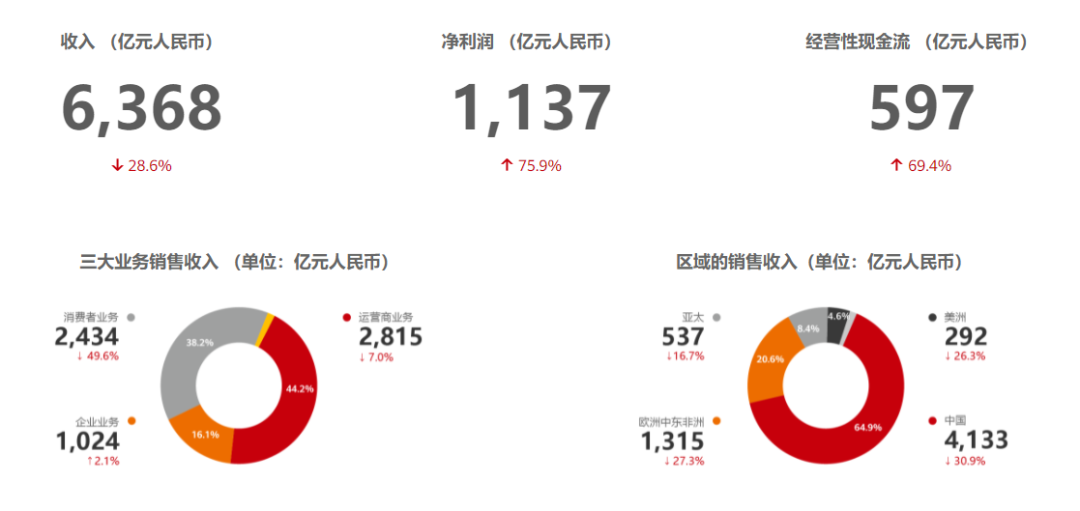
Image source: Huawei official website
Guo Ping, rotating chairman of Huawei, pointed out: 'The overall business situation of the company meets expectations, with stable operator services, robust enterprise growth, rapid development of new industries in terminal services, and accelerated ecological construction.'
Meng Wanzhou, CFO of Huawei, stated: 'Our scale has reduced, but our profitability and cash flow generation capabilities have both been enhanced, and the company's ability to cope with uncertainties is continuously improving.' Thanks to the improvement in the profitability of its main business, Huawei's operating cash flow increased significantly in 2021, reaching 597 billion RMB; the asset-liability ratio dropped to 57.8%, and the resilience and elasticity of the overall financial structure have been strengthened.

Image source: Huawei official website
In 2021, Huawei achieved sales revenue of 281.5 billion RMB in the operator business sector. Huawei helped global operators deploy leading 5G networks, and third-party reports show that in 13 countries including Switzerland, Germany, Finland, the Netherlands, South Korea, and Saudi Arabia, Huawei's built 5G networks provide the best user experience. Huawei has signed over 3,000 commercial contracts for 5G industry applications with operators and partners, and 5G has been commercially deployed in industries such as manufacturing, mining, steel, ports, and healthcare.
Under the wave of digital transformation, Huawei's enterprise business has achieved rapid growth, achieving sales revenue of 1024 billion RMB. For key industries such as government, transportation, finance, energy, and manufacturing, Huawei has released 11 scenario-based solutions, established coal mines, smart highways, customs, and port armies, and integrated resources to efficiently serve customers. More than 700 cities around the world and 267 Fortune Global 500 companies have chosen Huawei for digital transformation, with the number of service and operational partners increasing to over 6,000.
Terminal services adhere to a consumer-centric approach, building a global ecosystem that connects everything intelligently and billions of devices, bringing full-scenario smart life experiences to consumers worldwide, achieving sales revenue of 2434 billion RMB. Smart wearables, smart screens, TWS headphones, and consumer cloud services have all continued to grow, with wearable device and smart screen services growing by more than 30% year-on-year. Huawei devices equipped with HarmonyOS exceed 220 million units, becoming the fastest-growing mobile operating system in the world.
In the past year, Huawei has adhered to the concepts of openness, collaboration, and altruism, focusing on building prosperous ecosystems for Euler, Ascend, and HarmonyOS, with over 8 million developers adopting Huawei's open platform, open-source software, and rich development tools to explore innovative business scenarios and models.
- Interpretation by Frost & Sullivan analysts
1. Huawei's revenue in 2021 was 636.8 billion RMB, a year-on-year decrease of 28.6%, but net profit reached 113.7 billion RMB, a year-on-year increase of 75.9%.On one hand, Huawei's smartphone business was affected by chip sanctions, resulting in nearly half a reduction in consumer business revenue. On the other hand, Huawei has basically stabilized its B-side business, and after selling its Honor terminal business in 2021, its net profit actually increased.In 2022, on the premise that smartphones cannot recover, Huawei needs to make more efforts to ensure stable profit growth.
2. Huawei's overseas revenue still accounted for about 35.1% of its total turnover in 2021,Considering that Huawei's smartphone business is actually basically unable to operate overseas, its enterprise and operator businesses may actually be growing.
3. Huawei's chip supply chain capability can currently maintain the operation of its B-side business well, but it still has difficulty solving the problem of mobile phone chips with higher space volume and performance requirements in the short term. Huawei's R&D investment in 2021 was about 142.7 billion RMB, ranking second globally, and wecan reasonably infer that there is a large amount of R&D investment related to chips, aiming to solve chip supply problems in all aspects in the long term.