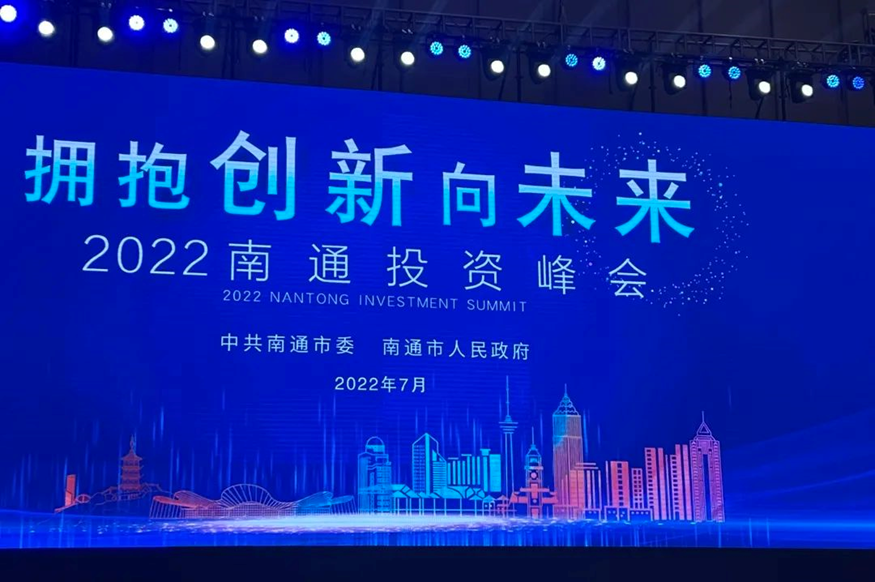
Embrace innovation Towards the future
The Nantong Municipal Party Committee and Government of Jiangsu Province will2022The year is designated as the city's 'Year of Investment Attraction Breakthroughs', 'Year of Business Environment Improvement', and 'Year of Work Style Construction Enhancement'. Four mechanisms have been established: quarterly project construction observation meetings, quarterly investment attraction analysis meetings, bi-monthly regular meetings on technological innovation, and monthly progress meetings for corporate listings.
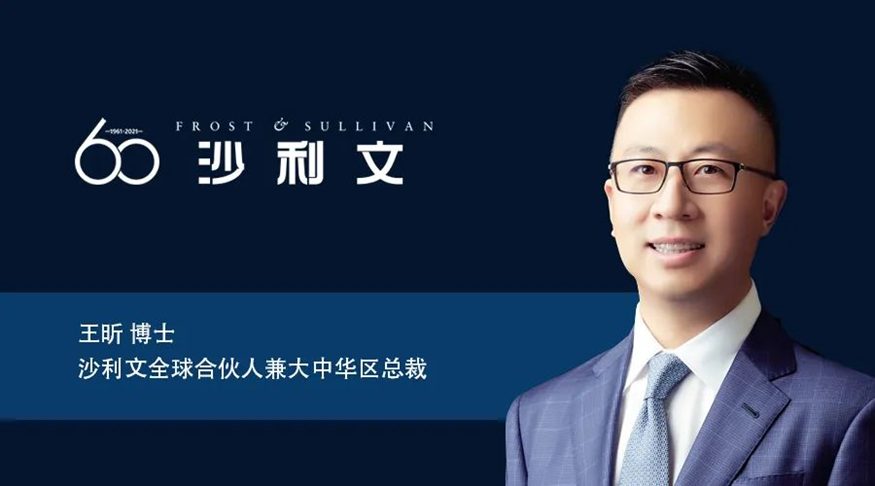
Against this backdrop,7month28On the day, co-hosted by the CPC Nantong Municipal Committee and the People's Government of Nantong Municipality, “2022Embrace Innovation for the Future —— Nantong Equity Investment Summit —— Held at the Nantong International Conference Center in Nantong City, Jiangsu Province, Frost & SullivanFrost & Sullivan,Dr. Wang Xin, Global Partner and President of Greater China at Frost & Sullivan (hereinafter referred to as 'Frost & Sullivan'), was invited to attend the summit and delivered a speech on identifying new opportunities in the Chinese biopharmaceutical and medical device industry market.
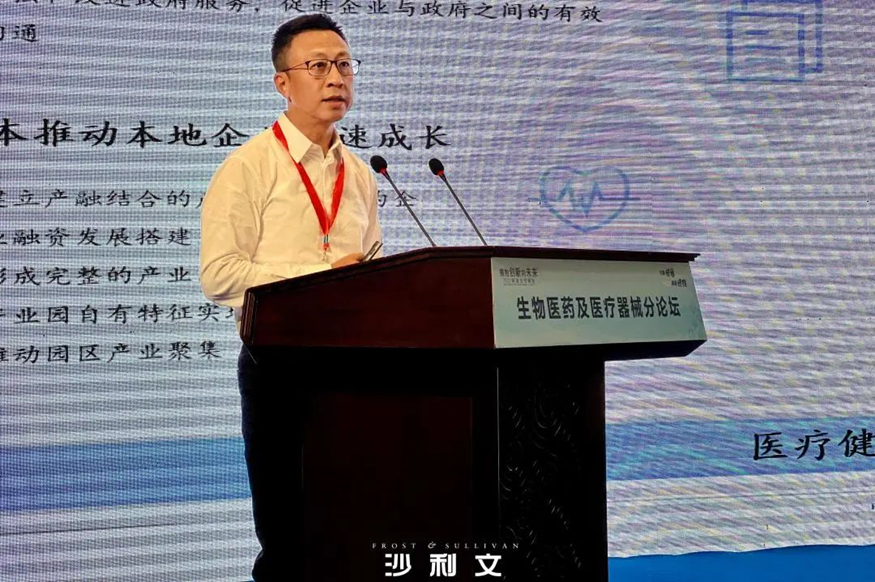
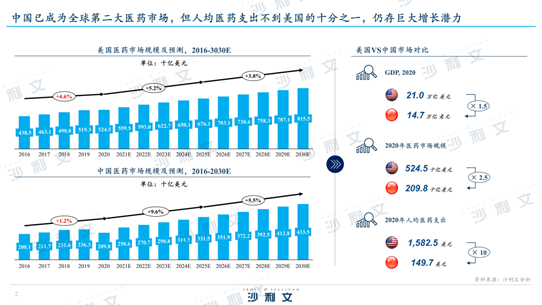
Dr. Wang Xin first analyzed the Chinese biopharmaceutical market, pointing out that China has become the world's second-largest pharmaceutical market, but per capita medical expenditure is less than one-tenth of that in the United States, indicating significant growth potential. .2020In [year], the US pharmaceutical market size was5,245billions, expected to2025In [year], the scale of the US pharmaceutical industry will reach6,761billion dollars2020Year to2025The annual compound growth rate for5.2%.2020In [year], the scale of China's pharmaceutical market was2,098billion dollars With the continuous development of domestic pharmaceutical companies and the implementation of multiple favorable policies in China, it is expected that by2025In [year], the scale of China's pharmaceutical industry will reach3,315billion dollars2020Year to2025The annual compound growth rate for9.6%.
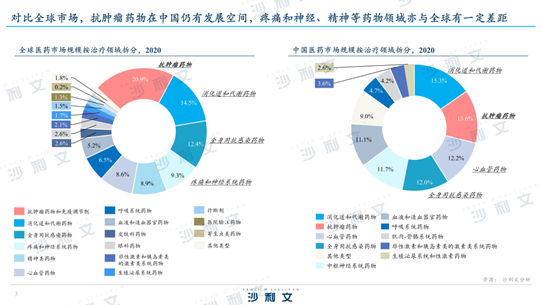
Data shows that in China, digestive system and metabolic drugs are the sub-sectors with the highest market share, reaching15.3%Proportion of the anti-tumor drug market13.6%; The cardiovascular drug market and the systemic anti-infective drug market account for, respectively,12.2%and12.0%Antitumor drugs and immunomodulators account for the largest market share globally, reaching20.9%, followed by the proportion of digestive tract and metabolic drugs being14.5%Antibacterial drugs, analgesics and neurotrophic drugs for the whole body accounted for12.4%and9.3%. In summary, there is still significant room for the proportion of anti-tumor drugs in China to increase. In addition, sub-sectors such as pain and neurological drugs, as well as psychotropic drugs, also have great development potential in China.
"2021The list of the world's top five best-selling drugs changed due to the impact of the pandemic, Pfizer COVID-19mRNAThe vaccine made the list and ranked first.ModernaCOVID-19mRNAVaccines also rank among the top,” Dr. Wang Xin said, "The COVID-19 pandemic has rewritten the global pharmaceutical market competition landscape. As major pharmaceutical companies...COVID-19 pandemicWith the continuous advancement of drug research and development, stock prices have also risen due to favorable news from various parties. New COVID-19 treatment drugs may also become a new research hotspot in the future.
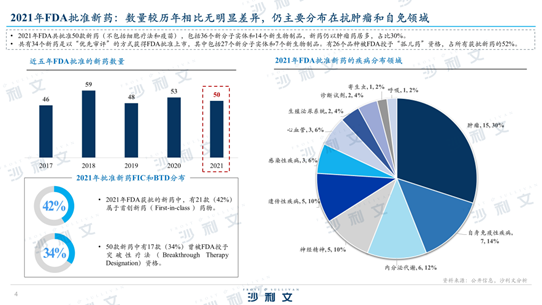
It is reported that2021National Medical Products AdministrationNMPA) Approved in total83A new drug, with a number2016New highs have been set for the year. In terms of drug types, the number of approved traditional Chinese medicines has surged; in terms of disease areas, oncology drugs and infectious diseases drugs remain the main focus. At the same time,2021The US Food and Drug AdministrationFDA) Approved in total50The number of new drugs (excluding cell therapies and vaccines) is not significantly different from previous years, still mainly distributed in the fields of anti-tumor and autoimmunity. Among them, there are34The new drug was granted priority review.FDAApproval for marketing, including27A new molecular entity and7A new biologic product. In addition, there is26A variety wasFDAQualified for orphan drug status, accounting for all approved new drugs52%.


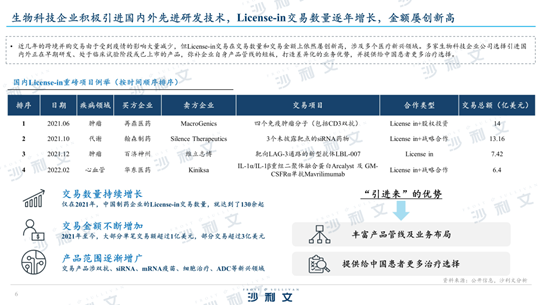
In recent years, cross-border M&A transactions have significantly decreased due to the impact of the pandemic, butLicense-in AcquisitionTransactions continue to set new highs in terms of volume and value, involving multiple emerging medical fields. Many biotech companies have chosen to introduce products that are currently in early research and development, clinical trials, or already on the market at home and abroad to acquire advanced R&D technologies, to make up for their own product pipeline shortcomings, create differentiated business advantages, and provide more treatment options for Chinese patients. According to statistics,2021In [year], Chinese pharmaceutical companiesLicense-in AcquisitionThe number of transactions has reached130Yu Qi,2021So far this year, the majority of individual transaction amounts exceed1billion US dollars, with some transactions exceeding3billions, product selection involves dual antibodies,siRNA,mRNAVaccines, cell therapy,ADCand many other emerging fields.
The advantage of introducing advanced R&D technologies from home and abroad lies in two aspects. Firstly, if the target or indication area aligns with the company's core R&D direction, or if it compensates for a weakness in the company's own product pipeline, it can enrich the business layout and create differentiated advantages. Secondly, most of the products introduced are those that have already entered clinical trials or been launched on the market, and existing data can initially verify the efficacy and safety of these products. This will accelerate the domestic approval process and bring more treatment options to Chinese patients as soon as possible.
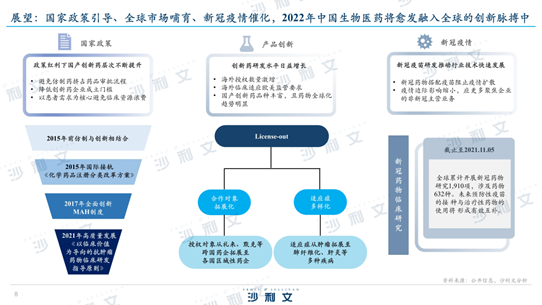
"With the enhancement of economic strength and the accelerated development of globalization, biotech companies are required not only to actively 'import' but also to seize the opportunity to boldly 'go global'." Dr. Wang Xin further explained, 'As the domestic innovation drug ecosystem gradually takes shape and matures, biotech companies are continuously leveraging...'License-out of the MainlandTransactions have brought domestic technology abroad, and cooperation with multinational companies can better enable participation in global competition. Due to the emphasis on product innovation and efficacy data by multinational pharmaceutical companies, domestic biotech enterprises have begun to accelerate the establishment and development of innovative technology platforms, improve new drug development efficiency, and shorten the time lag with international large pharmaceutical companies in order to enter larger international markets.
Bringing technology, equipment, and products out momentum at On the one hand, cooperation with multinational pharmaceutical companies means that we can leverage their global experience in registration, clinical trials, and commercialization. At the same time, with a large amountLicense-out of the MainlandDriven by the project,FDAThe recognition of Chinese clinical data is beginning to emerge, which will facilitate the internationalization of domestic products. Multinational pharmaceutical companies' resources in different commercial channels can also help them maximize product commercial benefits. Especially for domestic pharmaceutical companies with overseas expansion needs, the endorsement from multinational pharmaceutical companies is more conducive to market expansion, allowing them to focus their efforts and resources on more competitive projects.
On the other hand, enterprises can obtain sufficient cash flow support in the short term to strengthenIn-houseFor the subsequent research and development of products, the substantial funds obtained enable the company to more readily introduce new technologies, expand new pipelines, develop new industries, and gradually form its own multinational corporation, thereby better participating in economic globalization competition.

Currently, the steps for biotech companies to innovate and go global can be divided into4Stage one: The first step is product internationalization, directly authorizing the product to multinational pharmaceutical companies for global development; the second step is clinical internationalization, establishing overseas operational teams and conducting multi-center clinical research; the third step is R&D internationalization, directly forming early R&D teams overseas for global R&D; the fourth step is commercial internationalization, building a commercial team overseas to complete globalization sales.
"Today, Chinese enterprises have completed the first two steps of product and clinical internationalization. Some companies have also started setting up R&D departments abroad, which is expected to further enhance China's innovation drug R&D capabilities and its ability to export products overseas. At the same time, we believe that under the influence of various factors such as national policy guidance, global market nurturing, and the catalysis of the COVID-19 pandemic,2022In 2023, China's biomedicine industry will increasingly integrate into the global innovation pulse."Dr. Wang Xin said."

Subsequently, Dr. Wang Xin analyzed the current development status and trends of China's medical device market. As the world's second-largest medical device market, China's market size is second only to that of the United States, also demonstrating tremendous growth potential.2016In [year], the market scale of medical devices in the United States reached1,852billion dollars, to2020Year-on-year increase2,135billion US dollars. It is expected to2025Year is coming2,931billion US dollars, with an annual growth rate of6.5%.2016In [year], the market scale of medical devices in China was557US dollar, until2020Rapid year-on-year growth to1,058billions, with an annual growth rate as high as17.4%are expected to2025In [a certain year], the market scale of medical devices in China will increase to1,778billion US dollars, with an annual growth rate of10.9%.

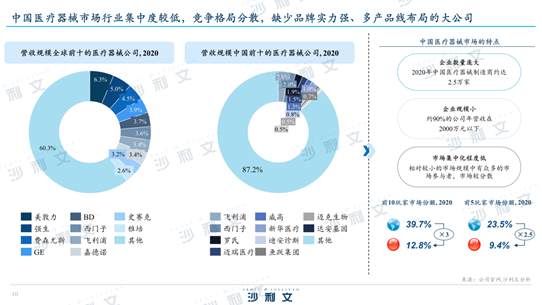
The Chinese medical device market is characterized by a large number of enterprises, small scale, and low market concentration. There are few giant companies with multi-product layouts. 2020In [year], the top ten global medical device companies by revenue included Medtronic, Johnson & Johnson, Fresenius, etc. The market share of the top three companies was [X]% respectively.6.3%,5.0%and4.5%The top ten companies in terms of revenue scale in China include Philips, Siemens, and Roche, with the market share of the top three companies accounting for2.6%,2.0%and1.9%.
Compared with the global situation, low-value medical consumables occupy a relatively high market share in China. Orthopedic instruments, ophthalmic instruments, general surgery and plastic surgery instruments, and drug delivery system instruments, which account for a relatively high share globally, have a low market share in China and still have great development potential. 2020In the global medical device market, in vitro diagnostic devices, medical imaging devices, and cardiovascular devices account for the top three shares, at14.7%,14.0%and11.0%.2020In the Chinese medical device market in [year], the shares of in vitro diagnostic devices, low-value medical consumables, and medical imaging devices ranked among the top three, accounting for14.7%,13.7%and12.6%.

"The overall localization rate of China's medical device industry is low, and high-end product areas and core technologies are still monopolized by imports. Enterprises should adapt to policy trends, accelerate the transformation of their R&D pattern, and achieve a shift from developing low-value products to high-value products with innovative barriers." Dr. Wang Xin pointed out that domestic medical devices are mainly concentrated in products with lower technical barriers, where the industry is severely homogenized and competitive at the low-end; however, the domestic rate of high-end medical devices is low, leaving a vast expansion space. However, due to the higher technical barriers of high-end devices, their localization process is slow. Currently, domestic medical device companies are gradually deploying in the high-end medical device field through independent research and development, cooperative research and development, mergers and acquisitions, etc. It is expected that they will gradually increase the localization rate of high-end products in the future and further promote domestic substitution.


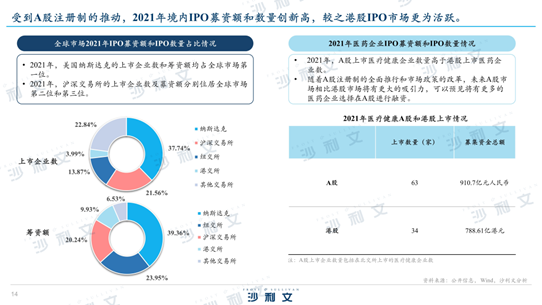
Finally, Dr. Wang Xin briefly introduced the investment and financing situation of China's healthcare industry to the attending guests.2021The global equity financing scale has been steadily increasing, with the Chinese mainland consistently ranking second in recent two years. At the same time, affected byAThe promotion of the share registration system,2021Domestic for the yearIPO listingThe amount and number of funds raised have reached new highs, compared with Hong Kong stocksIPO listingThe market is more active. In the field of healthcare,2017 - 2021Over the year, the number of listed companies has been on the rise in major global sectors,AShares are highly favored. And in ChinaAStock market, healthcare industryIPO listingfinancing scale,IPO listingThe number of enterprises ranks third and fifth among all industries.

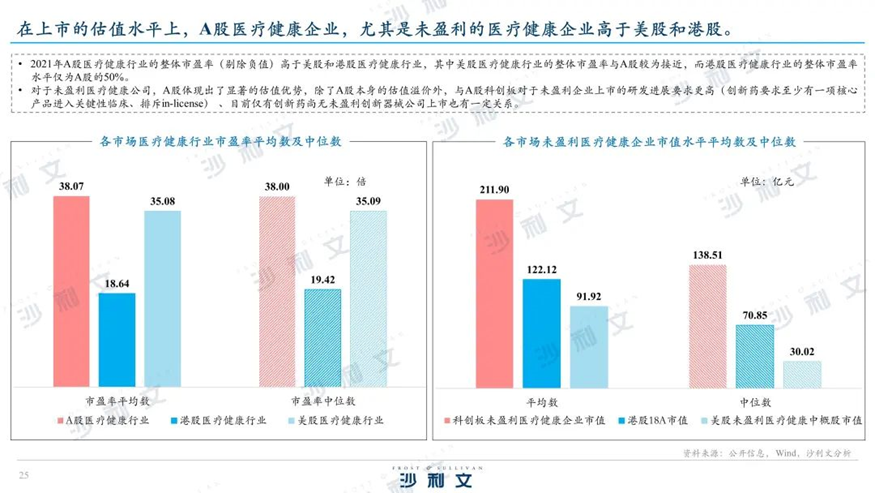
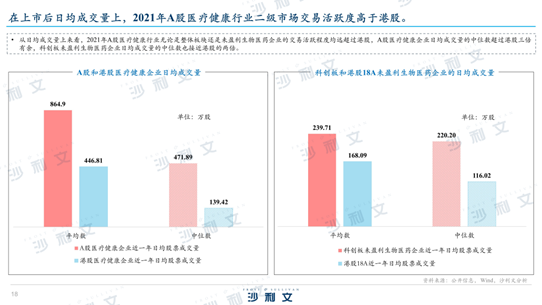
Judging from the listed valuation level, 2021yearAThe overall price-earnings ratio (excluding negative values) of the healthcare industry is higher than that of the US and Hong Kong healthcare industries. For unprofitable healthcare companies,AThe stock also demonstrates a significant valuation advantage, in addition toAIn addition to the valuation premium of the equity itself, andAThe Sci-tech Innovation Board has higher requirements for the R&D progress of unprofitable enterprises seeking listing (for innovative drugs, at least one core product must enter pivotal clinical trials and be excludedin-licensee) The current situation, where there are only innovative drugs available for listing without any profitable innovative medical devices, is also related to this. Looking at the average daily trading volume after listing, 2021yearAThe secondary market trading activity in the healthcare sector is higher than that of Hong Kong stocks.
"AThe average review days for the Sci-tech Innovation Board and Growth Enterprise Market are300Heavenly Reach374The review cycle is longer compared to Hong Kong stocks and US stocks. After the review phase is completed,AThe registration and declaration of shares still need to pass the issuance review committee/The listing committee meeting process is more complex. Therefore, a professional listing application team will help pre-listed companies better complete their listing application materials and successfully pass the threshold." said Dr. Wang Xin. " Frost & Sullivan integrates the globe.61Consulting experience over the past year, entering China24Over the past year, we have served most of the biopharmaceutical companies listed on the Hong Kong stock market.2019year7Since the first batch of companies on the Sci-tech Innovation Board was listed, many enterprises on the board have also referenced our data and reports."
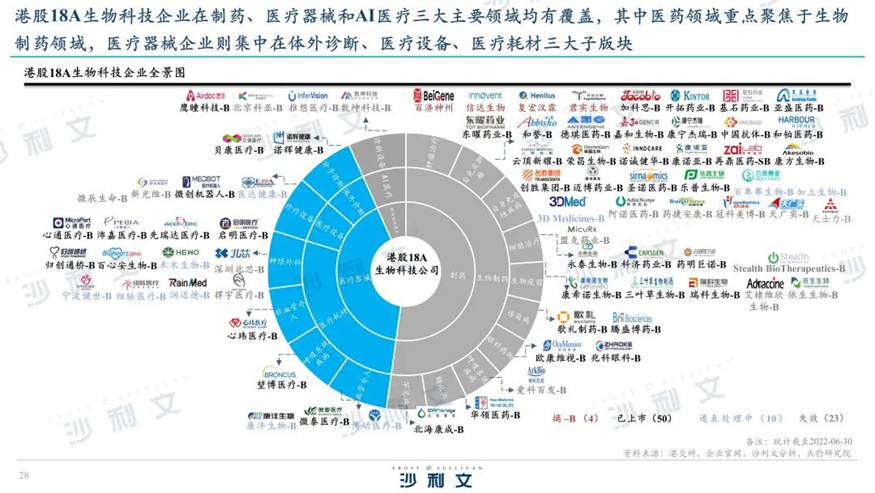
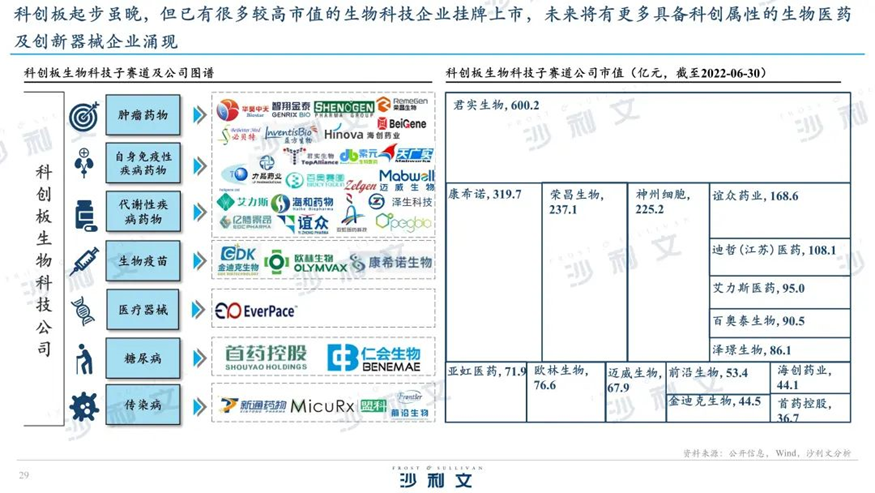
According to the research results of Frost & Sullivan, there are currently biomedical R&D and production enterprises in Nantong.68Home, medical device manufacturer220home.2021In [year], the number of biomedical R&D projects signed and started in Nantong City reached29One, the total investment has reached343.6100 million yuan.

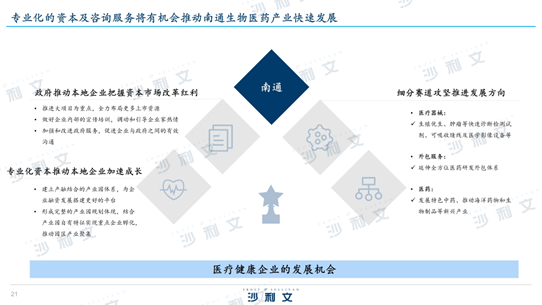
Dr. Wang Xin stated that the medical and health industry in Nantong has attracted investment from numerous pharmaceutical R&D projects, with total output value increasing year by year. With a solid foundation in bulk drug manufacturing, the formation of a pharmaceutical landscape, the development of model animal systems, and important and prominent exclusive varieties, there is a good development base and opportunities. Professional capital and consulting services will have the opportunity to promote the rapid development of Nantong's biopharmaceutical industry.