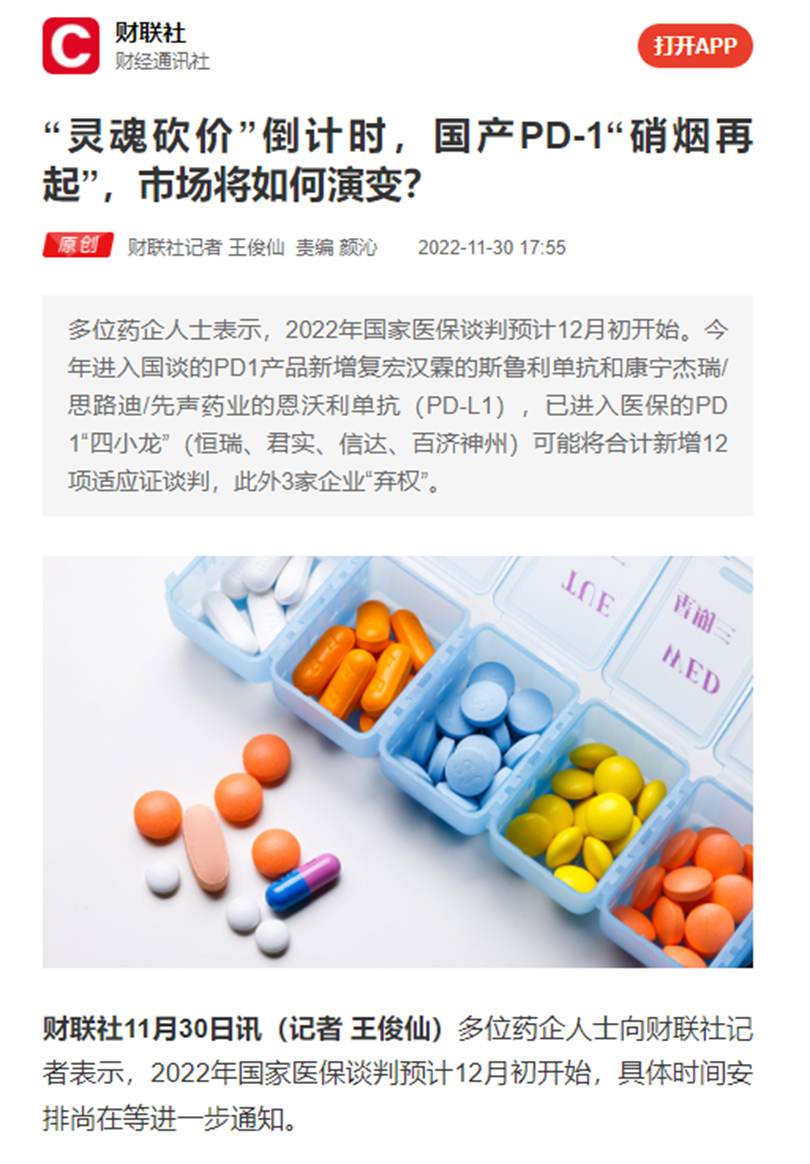
Several pharmaceutical industry insiders said,2022National Medical Insurance Negotiations for 202312Starting at the beginning of the month. This year, we have entered the national dialogue phase.PD1The product has added SruLi single antibody and Corinjera from Fosun Pharma./Lideidi/Synclair Biologics' Envarcept (PD-L1), which has been included in medical insurancePD1The "Four Little Dragons" (Hengrui, Junshi, Xinda, and BeiGene) may add a total of12Item adaptation indication negotiation, in addition3Enterprises 'abstain'.
Which factors determine whether a company can exchange price for volume after medical insurance negotiations? Why are some companies enthusiastic about negotiations and apply for new indications every year, while others do not participate in medical insurance negotiations? As more products are launched in the future, how should this be viewed?PD-1This highly competitive market? How should enterprises break through the deadlock? Frost & SullivanFrost & SullivanGuo Jing, Senior Consulting Director of Frost & Sullivan's Greater China region, was interviewed by Cailian News to discuss domesticPD-1Future development of the market.
 Cainiao Communications
Q
In the first three quarters of this year, domesticPD-1The rankings of the four leading players have changed, with BeiGene overtaking in the cornering phase. Q3PD-1Sales exceeded those of Innovent Biologics. Is this also related to the excessively high price cut in the medical insurance negotiation last year for Innovent Biologics (the price cut for Innovent Biologics62%, BYD's decline33%) Related? What factors determine whether a company can exchange price for volume after medical insurance negotiations?
The market performance of innovative drug products is determined by a multitude of factors, including the clinical data of the developed products, actual efficacy, indication selection, medical insurance negotiation outcomes, commercialization plans, and more.
at2021In the healthcare insurance negotiation in [year], the price cut for tirzepide monoclonal antibody was33%The reduction rate is lower than that of Simcirelizumab, which entered the medical insurance negotiation in the same batch. At the same dose, nearly35%The price advantage is indeed a guarantee for BeiGene's sales, but whether the higher average annual treatment costs can be accepted by end-users remains a further challenge for BeiGene.
2022Nianbai Ze'an is herePD-1Bend overtaking in the market is also determined by these factors. As of22year11Month, Baize'an has the most approved indications in ChinaPD-1Medications are also those with the most indications included in the medical insurance catalogPD-1Medications. As of2022year10Month, Baize'an already has10Indications for use in Chinabatch,5The indication has been included in medical insurance. Moreover, Bairen has submitted new drug marketing applications in multiple countries including the United States, Europe, and Australia, with the declared indications covering esophageal squamous cell carcinoma (ESCC), non-small cell lung cancerNSCLC) and other important fields.
According to the annual report disclosure of Baiji Shenzhou, with market promotion and sales expenses basically remaining the same, the significant increase in Baize'an's sales is mainly achieved through its wide range of indication options, more advantageous clinical data, and differentiated indication coverage. For innovative drug products with similar competition, the volume-based pricing brought about by medical insurance does not mean that sales can be scaled without worry. Product research and development, as well as clinical design, have become new competitive factors.
Q
This year, in addition to the four leading companies, there are also Fosun Pharma and CanSino Biologics.PD-L1Antibodies planning to participate in medical insurance negotiations, these companies in the first half of the yearPD-L1With an income of only tens of millions, can they catch up in the future?
PD-L1The competition in the field has indeed become increasingly fierce, but from a historical perspective5Looking at the sales situation in [specific year], domesticallyPD-1The market pattern has not yet taken shape, and latecomer products may become the new favorites of the future market.
forPD-L1For manufacturers in the field, it is a common corporate strategy to prioritize product approval and then gradually penetrate the market by expanding indications. More innovative indications and dosing methods will become important means for latecomer pharmaceutical companies to capture the market, for example this year3Month, Fuhong Hanlin'sPD-1The monoclonal antibody (sulimab) has been approved for marketing and is used for patients with unresectable or metastatic highly microsatellite unstable (MSI-Hsolid tumor,It is the first domestic 'pan-cancer'PD-1. Ideasidian/Corning Jerey/Synclair Biologics' Envykine (PD-L1) on2021year11Approved for listing in January, it is the first domestically produced product to receive this approvalPD-L1Monoclonal antibody, and it is also the world's firstPD-L1Subcutaneous injection.
On the basis of ensuring the clinical efficacy of products, indications that do not yet meet clinical needs, convenient administration methods, and diverse payment options will all be important weapons for latecomers to participate in this commercial competition.
Q
There are also some monoclonal antibody products from companies like CStone Pharmaceuticals and Yuheng Pharmaceutical that have not participated in medical insurance negotiations. Why do some companies engage in negotiations so enthusiastically, applying for new indication negotiations every year, while others do not participate?
For pharmaceutical companies, whether to participate in national negotiations depends on whether the products can generate sustainable operating profits after the negotiations. Under the combined effects of current medical insurance negotiations and the reform of the 'Three Medical Linkages', competition within hospitals for indications already approved by medical insurance has become saturated, gradually eroding profit margins for enterprises. Therefore, different companies will choose different commercialization strategies.
However, it does not mean that non-national medical insurance drugs cannot achieve good market sales. A series of payment methods such as urban inclusive insurance, mid-to-high-end medical insurance (including special drug insurance), innovative payments, charitable drug donations, and commercial insurance for serious illnesses can help patients reduce their actual treatment costs and encourage enterprises to increase drug sales. Non-medical insurance products can also achieve considerable sales through various means, benefiting more patients.
Data shows,2019In China's oncology innovative drug sales in [year], the proportion of total payments made through basic medical insurance was approximately40%, with self-payment accounting for approximately48%remaining12%The direct payment method without medical insurance access is adopted. Diverse payment methods play an important role in the commercialization of products not included in the medical insurance catalog. With the gradual progress of medical payment reforms over the past five years, insurance plans such as urban inclusive insurance and critical illness insurance have been increasingly included in payments.
Q
Currently approved in ChinaPD[L]-1Monoclonal antibody products in total14In the future, as more products are launched, how do you view this?PD-1This highly competitive market? How should enterprises break through the deadlock?
domesticPD-1The highly competitive market environment is undeniable. The emergence of this market environment is inseparable from the development of China's pharmaceutical industry, policy guidance, and changes in the healthcare system. Coupled with frequent overseas expansions in the pastDilemmas such as supply bottlenecks, medical insurance price cuts, distributor inventory subsidies, and turmoil in the commercial team havePD-1The market is gradually experiencing intensified competition. In such a market environment,PD-L1The R&D enterprise first needs to focus on the drug itself, as compared to20At the beginning of this century, sales were king. The quality of drugs represented by clinical data and their actual efficacy will become key factors for Chinese innovative drugs to break free from involutional competition and price cuts.
Of course, competition in the local market is already nearly saturated. For major indications targeting Chinese patients, such as lung cancer, liver cancer, gastric cancer, etc., first-mover companies have made arrangements accordingly. Therefore, going global may be the breakthrough method for Chinese pharmaceutical companies to truly achieve valuation premiums. But the decisive battle of Xinda is still ahead, If you hope toFDAThe model of going global for application still requires Chinese innovative pharmaceutical companies to deeply engage in research and development, as well as have a more profound understanding of global market competition. International application is currently the main way for local innovative enterprises to break through barriers, and dual applications to both China and the US are the optimal choice for most pharmaceutical companies to take the first step towards internationalization on their own. The Sino-US dual listing will increase R&D returns for Chinese pharmaceutical companies, enhance their international influence, and ultimately achieve valuation premiums.
*This interview was published in Cailian Finance & Economics News.APPReporter Wang Junxian, original title: 'Soul Bargaining' Countdown, DomesticPD-1"Will the market evolve with 'smoke rising again'?" (Click on 'Read the Original Article' at the end of the text to read the full report.)