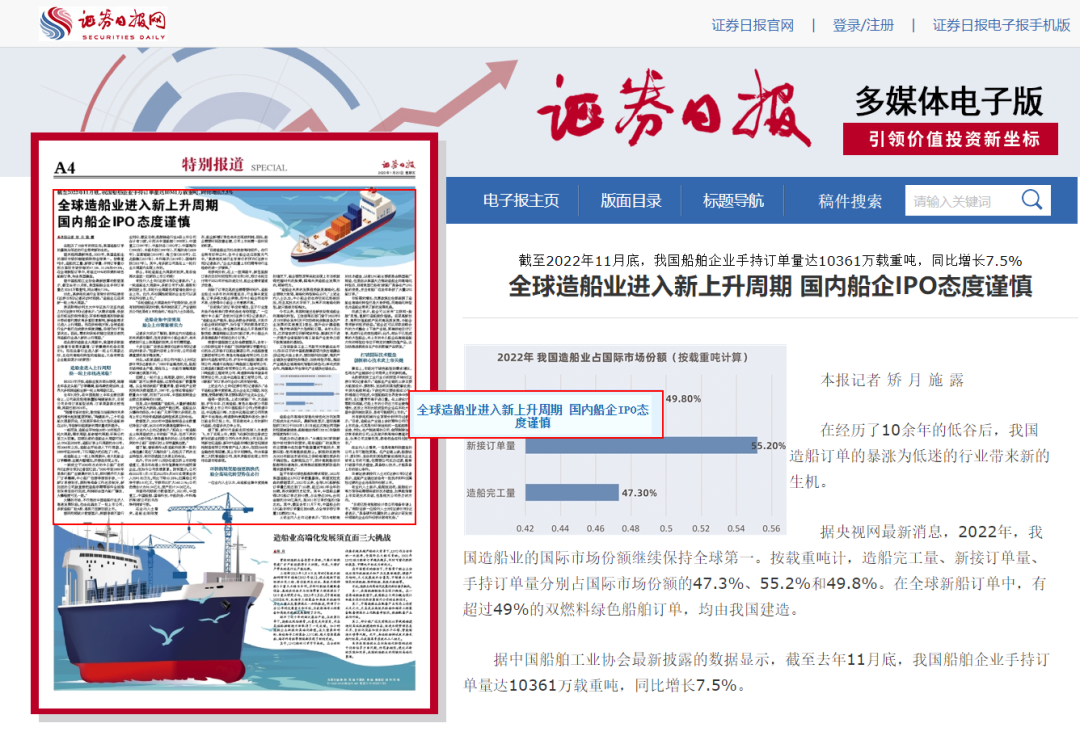
According to the latest news from CCTV.com,2022In [year], China's international market share in the shipbuilding industry continued to rank first globally. In terms of tonnage delivered, new orders placed, and orders in hand, they accounted for47.3%,55.2%and49.8%Among the global new ship orders, there are more than49%All orders for dual-fuel green ships are built in China.
The civil shipbuilding industry has welcomed20In the once-in-a-decade major cycle, how should we view the duration of this shipbuilding cycle? What stage is currently being experienced within this major shipbuilding cycle? Does this super-cycle have an impact on the primary market? Will private shipyards trigger a large-scale listing wave? Will the industry structure change as a result? What opportunities will this cycle bring to private shipyards? With the recent improvement in the oil shipping sector's prosperity, will it affect the order volume for oil tankers? Frost & SullivanFrost & SullivanFrost & Sullivan Greater China Executive Director Xiang Weili was interviewed by Securities Daily Interview, to jointly discuss the aforementioned topics.
Securities Daily
Q
Securities Daily Reporter: After a round of adjustments, the civil shipbuilding industry has welcomed20In the context of a once-in-a-decade major cycle, how should we view the duration of this shipbuilding cycle? What stage is currently underway within the major shipbuilding cycle?
To power
Executive Director, Greater China, Frost & Sullivan
From the demand side, affected by multiple factors such as high shipping market rates, increased environmental standards, and the driving of replacement demand by aging vessels, the demand for new shipbuilding has entered an upward cycle.
On the supply side, driven by multiple market cycles such as financial crises and pandemics, the global shipbuilding industry's capacity has undergone several deep adjustments and is currently still in a tight state. Therefore, the misalignment between demand and supply is driving the civil shipbuilding industry into a new cyclical upward phase.
Historically, the cycle of the shipbuilding industry typically lasts about twenty years. With the continuous improvement in the strength of shipbuilding enterprises and technological progress, we expect that the supply-demand gap in the civil shipbuilding industry will continue to widen, driving the industry to maintain a state of both volume and price increases.
Q
Securities Daily Reporter: From the perspective of the secondary market, individual stocks in the shipbuilding industry have shown price appreciation since last year. Is the industry still in its early stages of a major cycle at this stage?
To power
Executive Director, Greater China, Frost & Sullivan
In recent years, with the in-depth adjustment of the shipbuilding industry and the stable development of the economy and society, the shipbuilding sector has entered a new stage of steady growth. In addition, the pandemic has further consolidated China's position as a global factory, stimulating a significant increase in China's exports and ship demand, providing market conditions for shipbuilding enterprises to expand their orders. Therefore, the performance of individual stocks in the shipbuilding industry is not due to short-term fluctuations but rather the result of several years of upward cycles brought about by the improvement in the fundamentals of the shipbuilding industry.
With the rapid development of the industry and the continuous validation of the competitiveness of Chinese shipyards, we believe that the prosperity of China's shipbuilding industry has a relatively long sustainability.
Q
Securities Daily Reporter: Has this super-long cycle had an impact on the primary market? Will private shipyards trigger a large-scale listing wave? Will the industry pattern change as a result? What opportunities will this cycle bring to private shipyards?
To power
Executive Director, Greater China, Frost & Sullivan
In the short term, the soaring prices of international energy such as oil and natural gas due to regional conflicts have changed the global supply chain. At the same time, the pandemic has had a severe impact on global shipping logistics, leading to shortages of container equipment, significant delays in ship schedules, and continuous increases in freight rates. phenomenon. Currently, ship prices have been rising continuously, and the upward trend in the shipbuilding industry is evident. The profit per single order in the domestic shipbuilding industry has significantly increased, leading to a shortage of available berths.
With the clearance of overcapacity in the industry, the concentration of the shipbuilding industry has significantly increased, and the competitive landscape has been markedly optimized. Currently, the global shipbuilding industry is dominated by enterprises from China, Japan, and South Korea. Some leading Chinese companies have absorbed overseas technology during the downturn in the shipbuilding industry and have mastered the design capabilities of the most core power systems for shipbuilding. Against the backdrop of international energy transformation, Chinese shipbuilding enterprises have launched new power systems with independent intellectual property rights for future new energy directions. Considering environmental protection, the short-term capacity fulfillment will depend on the improvement of the utilization rate of shipyards' capacity.
The concentration of China's shipbuilding industry is relatively high, and the industry pattern is relatively stable. In the short term, private shipyards can take advantage of the industry trend by securing more orders. Since the delivery cycle of the shipbuilding industry is generally2 - 4Around2024Delivery started around [a certain year], with a certain lag in profitability.
Q
Securities Daily Reporter: The oil transportation sector has seen an uptick in prosperity recently. Will this affect the order volume of oil tankers?
To power
Executive Director, Greater China, Frost & Sullivan
The demand for oil tankers continues to rise due to the following factors:
1)OECDNational inventory replenishment needs. currentlyOECDOil inventories are at their lowest point in nearly a decade. With the easing of the pandemic, economic activities and travel demand have recovered in various countries. Coupled with the decline in crude oil prices, countries will start replenishing their inventories, leading to an increase in oil transportation demand.
2) The transportation distance is extended. Driven by geopolitical catalysis, the crude oil trade pattern is adjusting. Under Russia's oil embargo, Europe will shift to importing from the Middle East and the United States. Meanwhile, under the Sino-US trade agreement, China's proportion of imported US oil is expected to increase, which will extend the global average oil shipping distance and boost the demand for crude oil turnover.
3) Ship aging. At present, the average age of oil tankers is12Around [X] years. The age requirement for oil tankers is more stringent compared to other types of ships, usually15Oil tankers over 10 years old will withdraw from the mainstream oil transportation market. As the proportion of older ships increases, the demand for ship replacement continues to rise.
Impact on oil tanker orders: At present, the number of oil tanker orders in hand is at a relatively low level, and the capacity utilization rate of in-hand orders is7.9%, at a historically low value. Considering2021The year-ahead shipping industry is highly prosperous, with shipyards receiving a large number of shipping orders, and the queue for orders is already long2025Therefore, even if oil shipping orders are declining now, delivery will still take some time. In the near term, capacity supply growth is limited, with tight supply of oil tanker capacity.
Q
Securities Daily Reporter: What are the uncertain factors affecting the performance of the shipbuilding cycle?
To power
Executive Director, Greater China, Frost & Sullivan
Uncertain factors affecting the performance of the shipbuilding cycle include: the COVID-19 pandemic, port congestion, lockdowns, or similar 'Cheung Cheung Kai' incidents causing logistics disruptions, sharp fluctuations in raw material prices, natural disasters, as well as sanctions, embargoes, and so on.
In addition, recent exchange rate fluctuations caused by the Federal Reserve's interest rate hikes will also have an impact on the shipbuilding industry. Although export ships are basically settled in US dollars, the depreciation of the local currency against the US dollar is beneficial to shipbuilding enterprises. However, Japanese shipyards currently hold more than half of their orders from domestic enterprises. Therefore, exchange rate fluctuations pose higher demands on shipbuilding enterprises' exchange rate risk management capabilities and cost control abilities.
*This interview was published in 'Securities Daily', with reporters Jiao Yue and Shi Lu. The original title was "The The global shipbuilding industry has entered a new upward cycle Domestic shipping companiesIPO listingBe cautious >> (Click 'Read the Original Article' at the end of the text to read the full report).