With the popularity of high-speed hair dryer racing, many domestic hair dryer manufacturers now have relevant technical reserves. Do you think that at present, when comparing with foreign manufacturers such as Dyson, Panasonic, and Philips, there is a significant difference in technical level? Can domestic manufacturers break through in the future? In addition to technological innovation, many new brands of hair dryers now focus on deploying in new channels, including live e-commerce and Douyin. However, they rarely make efforts in offline channels. What is the reason for this phenomenon, and will it become a weakness in brand development in the future?
Frost & SullivanFrost & SullivanFrost & Sullivan's consulting analyst for the consumer industry in Greater China, Zhu Renjie, was interviewed by State Grid China and discussed together Hair dryer industry development .
State Grid of China
Q
With the popularity of high-speed hair dryer racing, many domestic hair dryer manufacturers now have relevant technical reserves. Do you think that at present, when comparing with foreign manufacturers such as Dyson, Panasonic, and Philips, the technical level gap between domestic manufacturers is significant? Can domestic manufacturers break through in the future?
Zhu Renjie
Frost & Sullivan Greater China Consumer Industry Consulting Analyst
The high-speed hair dryer is characterized by a larger air volume and a more precise temperature control system. It uses lower-temperature but high-speed air to replace the traditional hair dryer's high-temperature and low-speed airflow, thereby better reducing the damage caused by high temperatures to hair. The core components of a high-speed hair dryer include a speed exceeding per minute10High-speed motors with ten thousand revolutions per minute and temperature control components.
Take the foreign manufacturer Dyson as an example, as early as1999In that year, Dyson invested more than3.5Billion pounds, and has subsequently applied for1,000Remaining related patented technologies. Dyson spends10% - 15%The sales revenue is used for R&D, while the R&D investment of domestic home appliance brands is generally lower than the total revenue.5%Under the strategy of high-intensity investment in research and development, Dyson already has3,000Multiple patents and more than500Invention.
In recent years, domestic emerging brands such as Lai Fen and Zhen Wei have successively launched domestic high-speed hair dryers equipped with self-developed motors. Domestic high-speed hair dryer products have approached the technical level of foreign brands, but it will still take time to reverse the concept of 'substitute' in consumers' minds.
Domestic brands that can break through and dominate the high-speed hair dryer industry in the future need to possess four characteristics: Firstly, brands need to clarify their high-end positioning from the very beginning of establishment and make it clear to consumers during marketing; secondly, they require excellent product quality and experience to match the high-end price; thirdly, they need sufficient capital to support the brand's integration of products, services, channels, and marketing; finally, we need domestic brands to practice long-termism and use a persistent and focused attitude to gain industry discourse power.
Q
In addition to technological innovation, many new brands of hair dryers now focus on deploying in new channels, including live e-commerce and Douyin, but rarely on offline channels. What is the reason for this phenomenon, and will it become a weakness in brand development in the future?
Zhu Renjie
Frost & Sullivan Greater China Consumer Industry Consulting Analyst
In recent years, a clear trend has been an obvious acceleration in the cycle from establishment to brand formation for new consumer enterprises. The rise of emerging online channels such as Douyin, Rednote, and live e-commerce platforms has also brought a wave of traffic dividends to brands, accelerating their customer acquisition.
Certainly, many new consumer brands have quickly become popular with the support of traffic, but these newly popular brands seem to be more fragile than ever. A very important reason is that most new consumer brand enterprises believe in a strong marketing approach that claims miracles, with marketing and revenue 'relying on each other for survival.' Under homogeneous marketing tactics, consumer attention is distracted, and it is difficult for converted customers to form brand recognition. As a result, once the marketing stops, it is hard for customers to repurchase.
With the overall e-commerce industry in recent yearsGMVThe slowdown in growth rate, coupled with brands focusing only on online channels, could pose a hidden danger to future sustained growth.
Due to the different main categories, customer profiles, channel characteristics, and profit margins of offline channels, this poses a significant challenge to emerging brands that started online. This challenge is not limited to negotiations for entering offline channels; it also includes the development of subsequent coverage channels, differentiated product selection, pricing, and even larger difficulties such as whether R&D design, production supply can keep up. The overall offline channel layout requires long-term and continuous investment and experience. Without a long-term comprehensive layout, emerging brands will find it difficult to make a significant impact on offline channels in a short period.
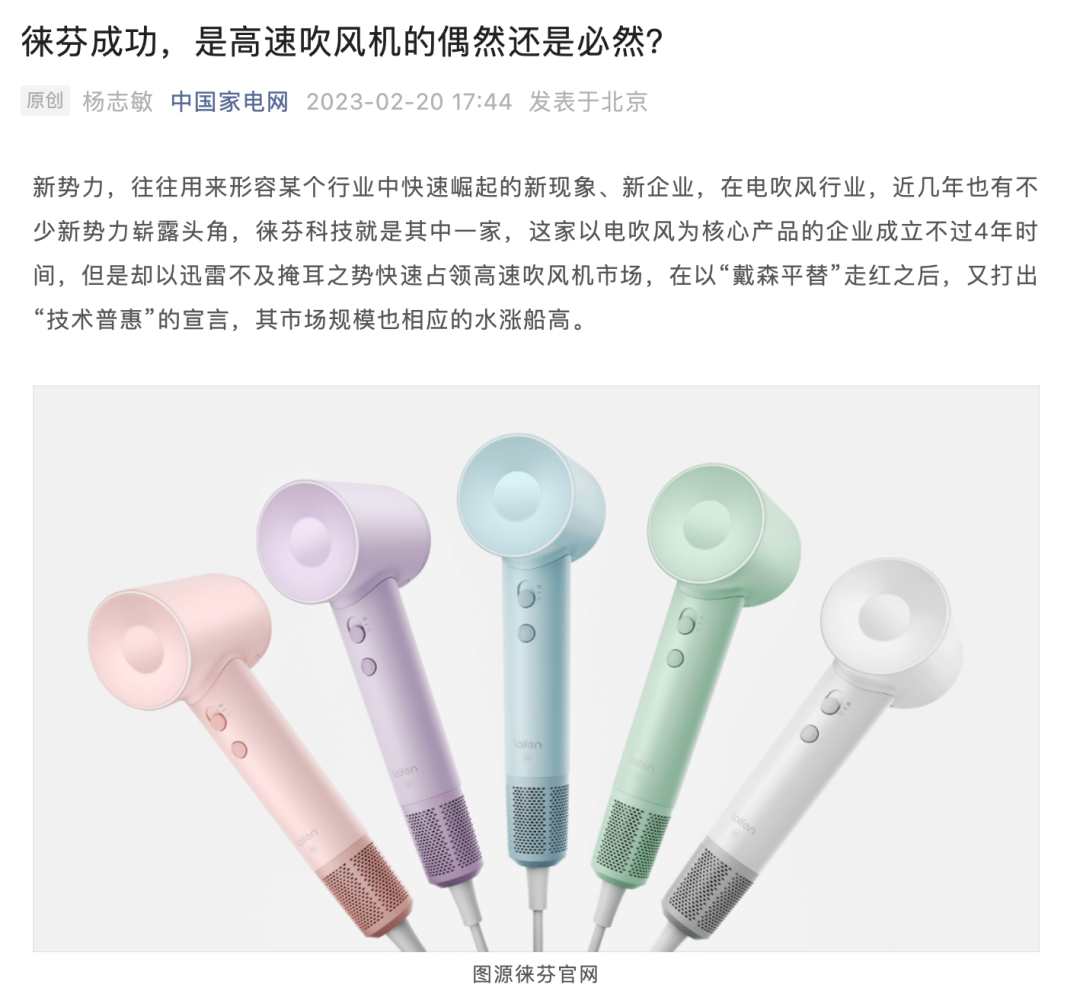
*This interview was published in China Power Grid, with Yang Zhimin as the reporter. Original title: Is the success of Lai Fen an accident or necessity of high-speed blowers? (Click the title to read the full report).