Has the demand for medical aesthetics in China increased after the relaxation of the epidemic? Who is consuming it? Is the demand for medical aesthetics positively correlated with economic growth? Does the current downward economic pressure have an impact on the industry? Besides consumer demand, how is the development of China's medical aesthetics industry chain progressing? Can domestic medical aesthetic products currently meet consumer requirements? With more and more medical aesthetics institutions emerging, however, complaints about medical aesthetics are also increasing. How should the industry be regulated?2017The annual scale of the cosmetic surgery industry still exceeds that of the non-surgical aesthetics industry, but in just a few years, non-surgical aesthetics has surpassed it. Why?
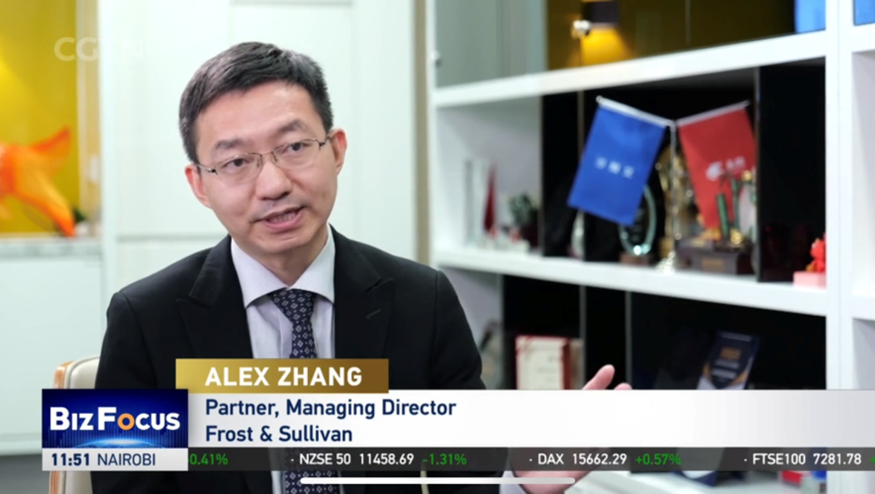
Frost & SullivanFrost & SullivanZhang Jian, Partner and Managing Director of Frost & Sullivan Greater China, was interviewed by China Media Group.CGTN"Financial Frontline Observation"Biz FocusProgram interviews focused on the Chinese medical aesthetics market, discussing the current development status and industry regulation of the market.
CGTN·BizFocus

Q
Many other skincare producers are also tapping into the industry. Data from research firm LeadLeo shows that domestic brands accounted for over 27 percent of the market share for functional skin care products in China.
The growing market share also stems from Chinese consumers' increasing knowledge of chemical-based beauty care and products.
Many brands are emphasizing added ingredients such as Pro-Xylane in their products, so customers then conduct research on them. The more you know about these ingredients when you buy them, the more you pay attention to whether they provide solutions to problems.
Nationwide, there are over 400 companies in hyaluronic acid related businesses. And globally, 82 percent of hyaluronic acid comes from China, putting it at the center of world production.
CHEN TONG CGTN Reporter: "We know China has many giants in producing raw materials for light medical procedures, do you think the domestic industrial chain is complete enough?"
Although some people may say that foreign products used to dominate the Chinese market, recently this has started to change. Very large raw material suppliers such as Bloomage and IMEIK have a sufficient supply of their products. Not only in the upstream of the industry but also in the midstream and downstream, these product suppliers, practitioners, and doctors have been well-developed. China is in the middle of a rapid development stage in the industrial chain.
Q
CHEN TONG CGTN Reporter: 'Do you think the economic uncertainties are affecting the industry?'
It is certain that, like other consumer industries, the medical beauty industry is positively correlated with Chinese economic growth. However, economic downturns and uncertainties are most likely to have a negative impact on the supply side. Competition among practitioners will be fiercer. Some small groups and players may go bankrupt or be merged and acquired by large groups, but we still believe that there is a favorable future for China's medical beauty business. To date, the penetration of Chinese consumers is only 2 percent compared with 10 percent in developed economies. This means there is still room for China's growth. Additionally, we can see from the first quarter of 2023 that practitioners are seeing or witnessing a significant return of their customers.
Q
CHEN TONG CGTN Reporter: "There are more and more hospitals offering cosmetic procedures in China, but we are still seeing places without any licenses conducting cosmetic procedures. How should the market be further regulated?"
Part one is advertising and promotion, as there are so many players advertising their benefits. Therefore, the government is regulating these players to reduce their flamboyance. Without data support, they cannot show off their benefits. The second part of market regulation is that the government is issuing a lot of approvals or licenses for regulation. In the future, the market will be well matured, with better market supply and government regulations. This is a bright future for us.
*This episode of the program has been8month21dayCGTNbroadcast Reporter: Chen Tong The program theme is: BizFocus: More affordable and accessible medical procedures gaining popularity among beauty seekers >> .
◾ Extended Reading
QHas the demand for medical aesthetics increased after the relaxation of the epidemic? Who is consuming it?
A: Judging from the changes in market demand, The epidemic has affected the terminal customer flow and customer acquisition in the medical aesthetics industry, putting pressure on the medical aesthetics industry chain in stages. The medical beauty industry is mainly offline, and the impact of the pandemic over the past three years has been recurrent, causing varying degrees of damage to the industry.2022Since the beginning of this year,3In the third quarter, Shanghai gradually recovered while the Chengdu outbreak emerged. At the end of the fourth quarter, epidemic control measures were lifted nationwide, and infection peaks were gradually reached in various regions. Against this backdrop2022The overall industry prosperity in the year fluctuated with the recurring pandemic.
In the post-pandemic era, as offline stores gradually resume operations, the demand for medical beauty consumption has rapidly warmed up. Currently published2023The listed medical beauty companies that reported in the first quarter of this year have achieved very gratifying growth:
1Beautiful Countryside: Based on as of2023year5month31The preliminary assessment of the Group's latest unaudited consolidated management accounts for the five months ended June 30, 2019, and the information currently available to the Board of Directors,2022As at the end of the period, consolidated management accounts that have been audited for the same period are expected to be2023year6month30Six months a year("During that period)The Group's revenue will grow by approximately40%The profit attributable to the company's owners will increase by approximately400%This surge was mainly due to an increase in customer visits during the reporting period, which was attributable toCOVID-19 pandemicThe recovery result amidst the adverse impacts. In addition, since the company started2023year1month16Since its listing on the main board of the Hong Kong Stock Exchange, the reduction in listing costs has also contributed to this growth.
2Langzi Co., Ltd.: The medical beauty business achieved operating income4.6Yuan, a year-on-year increase30.68%.
3Upstream supplier companies also showed significant growth. Aimeike2023Operating revenue in the first quarter of the year6.3Yuan billion, a year-on-year increase46.3%.
From the perspective of consumer profiles, The 'elderly patient' group is gradually becoming the main force in China's medical aesthetics industry. 2022In [year], there have been significant changes in the age composition, consumption psychology, and behavior of Chinese medical beauty consumers. In the early development stage of the Chinese medical beauty market, the main user group was25Individuals under the age of 18. However, this demographic structure has undergone subtle changes.2023The data on the proportion of paying users by age group in the first half of the year shows that the age group26Users aged 18 and above now account for50%As mentioned above, the evolution of the mainstream user demographic means that the consumption psychology and behavioral preferences of the core user group in China's medical beauty industry have changed. The age range is26The 'aged-based' population aged 18 and above is gradually becoming the main driving force behind China's medical beauty consumption. The age group is at26The increase in consumers aged 18 and above indicates that the age group for medical beauty consumption is starting to shift later, especially among26Year-end35The age group of [X] years old. This trend may be related to the pressures faced by young people in terms of education, work, and daily lifestyle.
The growth of the novelty-seeking group is weak, with highly loyal customers being the main consumer group. currently26year-30The number of “prime-aged” beauty seekers is almost as high as20 - 25The age group of “taste-takers” is comparable to that of beauty seekers. In addition, many well-known medical beauty practitioners have their core consumer groups consisting of35Year45The main age group is around [a specific age], characterized by frequent and consistent medical beauty consumption. Data from the New Oxygen platform supports this observation, showing that medical beauty consumers who make five or more transactions dominate this age group.2023In the first half of the year, among five or more medical beauty treatments, age35 - 40The proportion of people aged 60 and above is the second highest (15.3%), age in41The proportion of people aged 60 and above is the highest (17.0%), and this proportion shows a linear increasing trend with the increase of user age.
This phenomenon can be attributed to three main factors: First, as users age, their consumption psychology becomes more rational and their behavior more stable. Medical beauty consumption has become an integral part of their daily lifestyle. Second, medical beauty consumption, especially light medical beauty services, usually requires multiple sessions to achieve noticeable results. Given that users focus on achieving desired effects, they are willing to undergo frequent services to meet their beauty expectations. Third, medical beauty consumption has high unit prices and significant decision-making involvement. Once users have identified a reliable medical beauty institution and doctor, they tend to anchor their loyalty and trust, unwilling to bear the 'replacement cost.' This loyalty or trust is clearly reflected as 'user loyalty' or 'trust.'
In summary, the pandemic has affected the penetration of new customers, with demand mainly driven by high-end existing customers. From the perspective of purchasing power and customer structure, medical aesthetics belongs to mid-to-high-end discretionary consumption, with significant differences in per capita consumption. High-end and loyal customers have relatively stronger resistance to external influences on their purchasing power and willingness to consume. The pandemic may have delayed rather than canceled project consumption due to temporary lockdowns, but post-pandemic medical aesthetics consumption will mainly be driven by such customers. Conversely, during fluctuations in the pandemic, new customers will shift their income and expenditure towards savings, basic products, or higher-value discretionary categories, leading to a weakening demand for medical aesthetics. Taking the beauty countryside as an example,2022Affected by the pandemic, active members, that is, existing customers, still contributed to traditional beauty services94%Revenue, while the growth rate of active members slowed down year-on-year to+0.3%/+10.9%This slowdown may be attributed to the overall decline in passenger flow, leading to a reduction in the number of new customers, which in turn affects 'new customer-member-The conversion rate of 'active members' suppresses the consumption and repurchase intentions of new customers and non-retained customers.
QIs the demand for medical beauty positively correlated with economic growth? Is there any impact of the current economic downturn on the industry?
A: Similar to other consumer industries, medical aesthetics has consumption attributes, meaning that there is a positive correlation between medical aesthetics demand and economic conditions. The recovery of medical aesthetics is driven by the return of customer traffic, and overall, the industry's rebound prospects are promising. Many institutions are2023The business plan and objectives for the year show optimism, with the expansion strategy expected to return to normal.
We expect the recovery of the medical aesthetics industry to unfold in four stages: The first stage: travel restrictions are lifted, and passenger flow rebounds; the second stage: customer visits and consumption frequency increase, leading to a recovery in institutional profitability; the third stage: demand at the institutional level recovers and is transmitted to upstream suppliers, entering a period of strong supply and demand; the fourth stage: the economy and society operate stably, per capita disposable income rises, expenditure structure changes lead to an increase in the willingness to choose discretionary consumption, coupled with an increase in the penetration rate of medical aesthetics. This will lead to a continuous expansion of demand and consumer groups, and a sustained industry dividend.
Currently, the recovery of the medical aesthetics industry has entered the first phase: recovery of existing customer traffic+The era of profit recovery. We believe that as passenger flow recovers and profitability improves, there is hope to see an overall recovery in industry confidence for growth in the future. With economic recovery and an increase in per capita disposable income, we expect the industry penetration rate to recover at a growth rate, and we continue to be optimistic about the performance and resilience of leading companies.
From a demand perspective, against the backdrop of slowing economic growth, the overall market expansion of the industry has slowed to some extent, but has not yet reached a critical level. . This is mainly due to the relatively low penetration rate of medical aesthetics in China.2021annual about2%far lower than that of developed countries10%Currently, China's demand for medical aesthetics is being driven by a continuously growing penetration rate.
We believe that the economic downturn has placed more stringent demands on the supply side, specifically medical beauty institutions. The competitive landscape of the industry will show the following trends:
· The era of large-scale medical beauty chains is upon us. It is well known that customer acquisition costs are an important expense for medical beauty institutions. In addition, under the pressure of strictly following policies, operating costs are expected to rise significantly. At the same time, due to the maturity of the supply chain and fierce competition, the unit price of medical beauty services has been continuously decreasing, making cost reduction and efficiency improvement a common challenge faced by all industry participants. Non-surgical medical beauty categories focus on the combination of doctors' professional knowledge with product and equipment technology, and medical beauty institutions are becoming less dependent on individual doctors. It is foreseeable that compliant leading medical beauty institution enterprises will further increase their concentration, with large chains being one of the future development trends for Chinese medical beauty institutions.
- The Matthew effect of leading brands is becoming increasingly prominent. Trust will become one of the most core user decision-making factors. Large brands have a natural advantage in acquiring new users and are also the foundation for cultivating loyal customers.
QIn addition to consumer demand, how is the development of China's medical beauty industry chain progressing? Can domestic medical beauty products currently meet consumers' requirements?
A: After nearly30With the development of the past year, China's medical beauty industry chain has entered a mid-stage of rapid development, and many stars and unicorn enterprises have emerged at various nodes of the industry chain. For instance, the upstream of the industrial chain has given rise to many star enterprises such as Huaxi Biotechnology and Aimeike. At the same time, under the backdrop of the pandemic, investors have expressed a high enthusiasm for investment.2022In the year, several capital mergers and acquisitions took place in the medical aesthetics industry, with optoelectronic equipment from Lite Medical Aesthetics being a major acquisition and integration segment. The midstream of the industrial chain has given birth to many listed companies such as Hua Han, Peng Ai, Lang Zi, and Yisi, as well as large-scale enterprises like United Li Ge, Yimei'er, Yixing, and Meile. As a professional medical aesthetics service platform, New Oxygen has also2019Completed going public in the US in 2021.
Functionally speaking, domestic medical beauty products are currently sufficient to meet consumers' needs. The products are continuously iterating with mature technology, and the structure of medical beauty services in China has also changed over the past few years:
· The pandemic has affected the demand trend for medical aesthetics, with high-end light medical aesthetics showing resilience. From the perspective of project structure, the options and average prices of medical aesthetics projects are ranked from high to low as follows: surgical procedures, injection fillings, and skin management. Among them, surgical procedures have seen a gradual decline in proportion due to their higher pricing, longer recovery periods, and weaker natural results in recent years, especially under the wave of light medical aesthetics. The demand for skin management is resilient but tends to be driven by high-frequency, medium-to-low-price products, which have a volume-oriented nature. The frequency of visits to clinics has been greatly affected by the pandemic. High-end, long-acting injection products have had less impact due to their better fit for the mainstream customer group and the profit-seeking needs of institutions during the pandemic.
- The growth rate of traffic-oriented big products has been affected by passenger flow during the epidemic. New products&Profit-oriented products performed better. Against the backdrop of damaged passenger flow, the growth rate of traffic-oriented big products has been affected. Hi-Tech Beauty, as one of the few compliant third-category water-based skincare products in China, has a strong traffic-oriented nature. Since its launch, it has been highly recognized by the market for its outstanding competitiveness due to product compliance and scarcity of indications. To date, the institutional coverage has also reached a certain scale.2022In the context of a decline in passenger flow due to the pandemic in [year], the number of solution products under Aimeike, represented by [product name], increased year-on-year.23.5%The growth rate has slowed down; in contrast, the regenerative category, which was launched over a year ago, is still in a phase of rapid expansion. The year-on-year growth rate of gel injection products under Aimeike, represented by Ruyan Dayushi, is as high as65.6%, The Girl's Needle brand under Huadong Medicine achieved6.25100 million yuan in revenue2022The overall renewable products segment enjoyed category dividends, with a high growth rate against the backdrop of the pandemic.
QThere are more and more medical beauty institutions, but complaints about them keep emerging. How should the industry be regulated?
A: National institutions should play the primary supervisory role, with industry chain participants cooperating with supervision. It can be seen that in recent years, the state has continuously strengthened its law enforcement efforts against the medical beauty industry, leading to a significant increase in start-up costs. In the administrative penalty information published by Junhe Law Firm and Weike Xingyuan Legal Information Database, 'medical'+"beauty" is the keyword that yielded results.2019The number of administrative penalty cases for medical aesthetics in the year is4,400Starting from, about2018Number of cases in the year2times,2020year and2021The number of medical beauty administrative penalty cases in each year is as follows:4,679rise and5,956In this process, some medical beauty institutions and platforms are also making continuous efforts, conducting strict reviews of information on their platforms, and handling and intercepting any violations of regulations by institutions, doctors, information, etc.
The regulatory trend in the medical beauty industry has further strengthened, and the regulatory system has gradually become more complete. The main policies include those of seven ministries and commissions including the National Health Commission2021year6The 'Special Rectification Action Plan for Combating Illegal Medical Beauty Services' was released in [month]. The plan aims to rectify the beauty and medical industry, addressing issues such as illegal beauty medical services, unauthorized production and sale of drugs and medical devices, false advertisements, and information. This indicates that the government is committed to implementing stricter supervision over beauty medical services. In addition, the State Administration for Market Regulation has2021year11The 'Medical Cosmetics Advertising Law Enforcement Guidelines' released in January emphasize the supervision of medical cosmetics advertisements, highlight that consumer protection laws apply to beauty medical institutions, and recognize the consumer nature of medical cosmetic services. 2022In [year], there were two clear trends in medical aesthetics regulation: more precise regulation, focusing on the 'true information about medical aesthetics', and comprehensive supervision covering all aspects of the industry's supply chain.
Q:2017The annual scale of the cosmetic medical beauty industry still exceeds that of the non-surgical cosmetic medical beauty industry, but in just a few years, the non-surgical cosmetic medical beauty industry has surpassed it. Why?
A: Firstly, with the development of society and the increasing pursuit of beauty in appearance, the demand for non-surgical, non-invasive cosmetic methods has gradually increased. Light cosmetic procedures typically include injection fillings, skin management, etc. Compared to traditional major cosmetic surgeries, these procedures It is safer, more convenient, and has a shorter recovery time. Therefore, it is more favored by consumers.
Secondly, technological progress and innovation have also supported the rapid development of light medicine and aesthetics. New medical aesthetic technologies and products are emerging continuously. This makes the effects of light medical beauty projects more natural and the user experience better, further stimulating consumer demand.
In addition, Marketing and promotion have also played an important role in the growth of Light&Made Beauty. Lightweight medical aesthetics projects usually show significant results in a short period, providing this immediate satisfaction to better attract consumers and encourage them to choose lightweight medical aesthetics projects.
Finally, public opinion and celebrity effects also influence the rapid growth of lightweight medical aesthetics. Many celebrities and social media influencers publicly share their experiences with medical aesthetics, attracting more people to pay attention to lightweight medical aesthetics projects and thus promoting the expansion of the market.
2023Frost & Sullivan's New Investment Conference