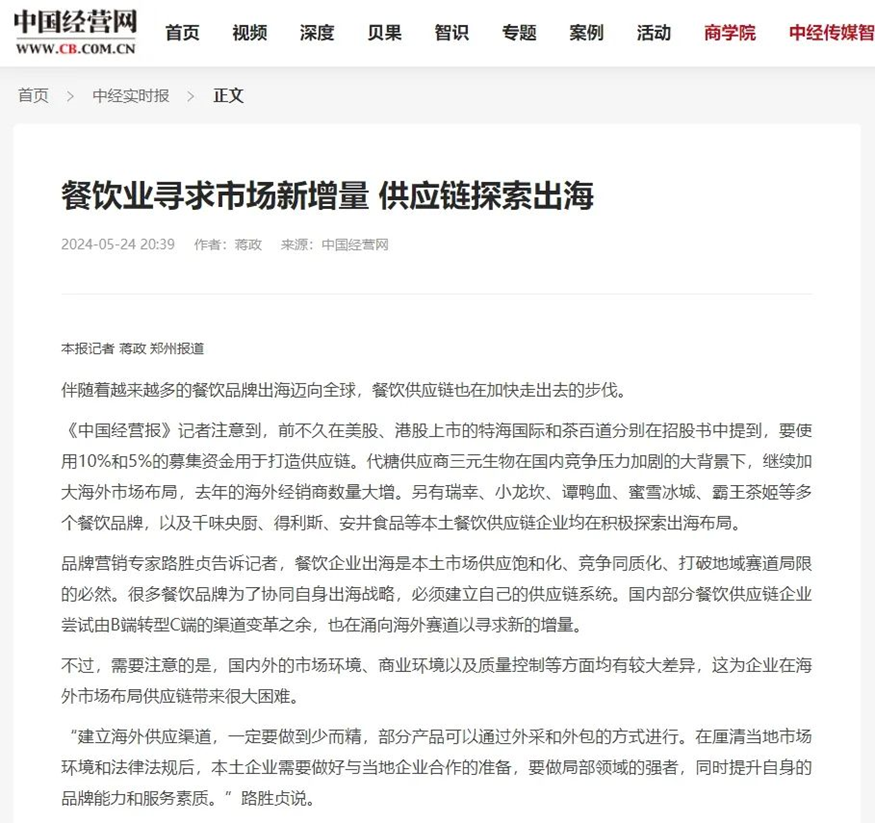
As more and more catering brands go global, the catering supply chain is also accelerating its pace of expansion overseas. Is it inevitable for the catering supply chain to go global? Compared to the domestic market, what are the differences and challenges in building an overseas supply chain? Given the characteristics of Chinese cuisine, which type of catering brand is more suitable for building a supply chain overseas? What are the characteristics of such brands? At present, which catering brands have already made clear moves to layout overseas supply chains? After catering brands go global and begin to layout their overseas supply chains, what issues need to be comprehensively considered? In terms of overseas supply chain layout, is self-built supply chain the only option? After Chinese catering brands go global, what trends will the development of their overseas supply chains show? In this process, which capabilities do enterprises and brands need to enhance?
Frost & SullivanFrost & Sullivan,Yao Le, a consulting advisor at Frost & Sullivan's Greater China region and referred to below as 'Frost & Sullivan', was interviewed by China Business Network to discuss the overseas expansion of the catering supply chain.
China Business Network
*Click at the end of the article Read the original text View the full report
Q: More and more chain catering brands are seeking to go global. Behind this, the catering supply chain is also looking to expand overseas. Is it inevitable for the catering supply chain to go global? Why? What are the differences and challenges in building an overseas supply chain compared to the domestic market? What should be noted during this process?
With Chinese catering brands going global, the overseas Chinese food market has broad development potential, and it is expected that by2027Annual achievement4,452billion US dollars2022 - 2027Compound annual growth rate7.8%;
With Chinese restaurants going global, the overseas expansion of the catering supply chain is also an inevitable trend, mainly due to:
1) can effectively reduce costs
Currently, many Chinese cuisine enterprises rely on domestic core raw materials. Cross-border logistics costs have led to an increase in ingredient costs, and there are also issues such as high losses. For catering enterprises, raw materials themselves account for a large portion of costs, generally ranging from30% - 40%Among the Chinese food enterprises currently going global, many still rely on domestic core raw materials. International logistics and transportation costs are a significant expense for catering businesses, which can lead to further increases in raw material costs. In addition, international logistics generally face customs inspection procedures such as customs declaration and clearance, which have poor timeliness and carry certain risks of raw material deterioration or damage. As the scale of the enterprise's overseas business expands, building a localized supply chain through one-time investment can significantly reduce costs over the long term.
2Localization of ingredients is a development trend
In addition to local Chinese, catering businesses also need to attract local consumers after going global. Therefore, localization of ingredients is particularly important. For example, Haidilao in Japan offers 'miso soup base' and local specialty ingredients such as beef intestines, all of which rely on the support of local suppliers. Therefore, it is very necessary for catering businesses to cooperate with local supply chain enterprises to build a local supply chain.
Differences, Difficulties, and Precautions:
1Market environment and consumer habits
Differences in culture and eating habits across regions may make it difficult for overseas catering to adapt. For catering businesses, it is necessary to conduct initial market research and brand promotion to improve product acceptance; for example, tea and coffee in the Chinese market emphasize 'healthiness', focusing on low-sugar or sugar-free alternatives, while in overseas markets such as Southeast Asia, consumers prefer high-sugar beverages. Copying domestic raw materials and products completely may lead to lower acceptance in overseas markets.
2Logistics and transportation
For some materials unique to China, such as ingredients or packaging materials that still need to be exported from the domestic market, cross-border logistics will continue to be necessary in the future to ensure supply. International transportation involves complex logistics management, including customs, tariffs, transnational logistics costs, and transit time, all of which can affect supply chain efficiency.
3Supplier selection and management
In the domestic market, mature catering enterprises have basically established stable supplier relationships. However, abroad, it is necessary to re-find, evaluate, and manage new suppliers, which involves a significant amount of time and resources. Taking tea as an example, fruits are key to ensuring product quality stability. Domestic tea brands usually reserve products from orchards six months to one year in advance. However, establishing such a supply chain system abroad is not easy.
Q: Given the characteristics of Chinese cuisine catering, which type of catering brand is more suitable for building a supply chain overseas? What are the characteristics of such brands? Which catering brands have already made clear moves to establish overseas supply chains?
At present, among the catering categories going global, hot pot and tea beverage companies account for the majority. These two types of businesses are typical examples suitable for building supply chains overseas, mainly due to their high degree of standardization and the ability to fully utilize local resources abroad.
1It has a high degree of standardization, a relatively simple production process, and low requirements for chefs: For example, hot pot is a category in Chinese cuisine with a relatively high degree of standardization. There is a standardized process for the base, dishes to be boiled, and seasonings, making it relatively easy to replicate overseas markets. Similar categories include spicy hot pot and spicy hot pot with noodles.2Types that can make full use of local resources: For example, when Chinese ready-made tea brands choose their overseas strategy, they usually give priority to the Asian market and then gradually expand into Europe and America. This is based on considerations such as geography, culture, market, and competition. Another important factor in choosing Southeast Asia is that the region is rich in fruits, making the main raw materials for tea relatively easy to obtain.
At present, the following brands have already made clear moves to deploy overseas supply chains:
Haidilao: Haidilao is a Chinese restaurant company that has an early overseas supply chain layout. Previously, it established a central kitchen in Singapore, which is responsible for the production and processing of meat, vegetables, and other ingredients. For other ingredients, it adopts a local supply chain procurement method. Recently, Special Haier International chose to be listed on both the US stock market and the Hong Kong stock market, with the net proceeds from the fundraising also10%It is planned to be invested in the supply chain.
Milk tea enterprises: such as Momo Ice Cream City, Naxcelate, Hita Tea, Bawang Tea Girl, etc.2022In [year], Midea Ice City invested in a coconut and coconut milk processing production base in the Philippines to support its overseas business development.
Q: When overseas layouting the supply chain, efficiency needs to be considered. This involves factors such as the density of offline stores and local market capacity. After a catering brand goes global and starts to layout its overseas supply chain, which issues need to be comprehensively considered? Is there only one option for overseas supply chain layout, which is self-building the supply chain?
We believe that the following factors need to be considered comprehensively:1Local cultural habits: Adjust ingredients and menus according to local market demand and consumer preferences. For example, combine local specialty ingredients and flavors to increase acceptance among local consumers;2Legal and Risk Management: Understand and comply with relevant laws and regulations of the destination country, including food safety, labor law, tax policies, etc., to ensure legal and compliant operations. Establish a risk management system to prevent and respond to various risks that may arise in the supply chain.
In terms of overseas supply chain layout, in addition to building their own supply chains, they can also adopt various forms such as outsourcing, collaborating with local suppliers or logistics companies, joint ventures, and acquiring established local supply chain enterprises. Generally speaking, although building their own supply chain can ensure that catering enterprises have control over raw materials, it faces high initial investment, especially when catering enterprises have just started operating overseas with a small number of stores. The density of stores is difficult to support large-scale investment. Additionally, building overseas factories and other supply chains may face different qualification and legal requirements compared to domestic ones, which is also a challenge that catering enterprises may face.
Q: In addition to catering brands building supply chains overseas, many local catering supply chain enterprises have also started seeking overseas market layouts. For example, Anjing Food, Qianwei Yangchu, Delisi, Sanyuan Biotech, and others have taken similar actions. What are the reasons and motivations for these enterprises to go global?
Reasons and motivations:
1) Conforming to the trend of Chinese cuisine going global: As more and more Chinese catering brands enter international markets, there is an increasing demand for standardized Chinese-style raw materials and semi-finished products. This provides opportunities for local catering supply chain enterprises. Going global in line with the trend is a win-win measure for catering brands and supply chain enterprises;
2Expanding markets and increasing revenue: Going global can help enterprises diversify market risks and broaden their sources of income. Especially in the current highly competitive domestic market, exploring overseas markets can help these enterprises find new growth points.
Q: Drawing on the development of global catering brands, what trends will emerge in the development of the catering supply chain overseas after Chinese catering brands go global? In this process, which capabilities do enterprises and brands need to enhance?
1With the in-depth development of Chinese cuisine brands in overseas markets, localized procurement and production will become mainstream. Enterprises will cooperate more with local suppliers to reduce transportation costs and time, as well as improve freshness and supply chain response speed.
2In the global market competition, supply chains must continuously optimize their processes, enhance efficiency and flexibility, and innovate supply chain models to adapt to changing market demands. This includes leading the world's largest catering supply chain enterpriseSyscoAs an example, the product covers almost all Western cuisine and has launched 'Advanced Solutions', constantly innovating dishes.SyscoDiversify its product offerings through a variety of supplier sources to meet the procurement needs of different customers.
*This interview has been published in China Business Network, reporter Jiang Zheng, original title: The catering industry seeks new market growth Supply Chain Exploring Going Global ">
Recommended Reading
Catering and beverage industryIPO listingIndustry consultant cases (scroll up and down for more)
- Frost & Sullivan assisted TEHAI International in successfully going public in the US(NASDAQ:HDL)
- Frost & Sullivan assisted Lancang Ancient Tea in successfully listing on the Hong Kong Stock Exchange(6911.HK)
- Frost & Sullivan assisted Sichuan Dekang Agriculture and Animal Husbandry in successfully going public in Hong Kong(2419.HK)
- Frost & Sullivan assisted Kuaquan in successfully going public in Hong Kong(2517.HK)
- Frost & Sullivan assistanceDavis CommoditiesSuccessfully listed in the US(NASDAQ: DTCK)
- Frost & Sullivan assisted Zhenjiao Lidu in successfully going public in Hong Kong(6979.HK)
- Frost & Sullivan assisted DAS Group in successfully listing on the Hong Kong Stock Exchange(1405.HK)
- Frost & Sullivan assisted Shenzhen Baihuagarden in successfully going public on the Hong Kong Stock Exchange(2411.HK)
- Frost & Sullivan assisted Zhengwei Group in successfully going public in Hong Kong(2147.HK)
- Frost & Sullivan assisted Weilong in successfully going public in Hong Kong(9985.HK)
- Frost & Sullivan assisted Shuangcaizhuang in successfully going public on the Hong Kong Stock Exchange(2321.HK)
- Frost & Sullivan assisted Youran Muying in successfully going public on the Hong Kong Stock Exchange(9858.HK)
- Frost & Sullivan assisted Joyou Wang in successfully going public in Hong Kong(1927.HK)
- Frost & Sullivan assisted BSWG in successfully listing on the Hong Kong Stock Exchange(9987.HK)
- Frost & Sullivan assisted Nongfu Spring in successfully going public on the Hong Kong Stock Exchange(9633.HK)
- Frost & Sullivan assisted Fengxiang Food in successfully listing on the Hong Kong Stock Exchange(9977.HK)
- Frost & Sullivan assisted SIMOR to successfully go public in Hong Kong(6969.HK)
- Frost & Sullivan assists China's Feihai in successfully going public in Hong Kong(6186.HK)
- Frost & Sullivan assisted China National Tobacco International in successfully going public in Hong Kong(6055.HK)
- Frost & Sullivan helps select top-quality products.360Successfully listed on the Hong Kong stock market(2360.HK)
- Frost & Sullivan assisted Wugu Mofang in successfully going public in Hong Kong(1837.HK)
- Frost & Sullivan assisted BaoBABA in successfully listing on the Hong Kong Stock Exchange(1761.HK)
- Frost & Sullivan assisted Haidilao in successfully listing on the Hong Kong Stock Exchange(6862.HK)
- Frost & Sullivan assists sustainable agriculture in successfully listing on the Hong Kong Stock Exchange(8609.HK)
- Frost & Sullivan assisted Longhui Holdings in successfully listing on the Hong Kong Stock Exchange(1007.HK)
- Frost & Sullivan assisted Xinrong International in successfully listing on the Hong Kong Stock Exchange(1587.HK)
- Frost & Sullivan assisted Yiyuan Liquor Industry in successfully listing on the Hong Kong Stock Exchange(8146.HK)
- Frost & Sullivan assisted Jierong International in successfully listing on the Hong Kong Stock Exchange(2119.HK)
- Frost & Sullivan assisted BNP Paribas International in successfully listing on the Hong Kong Stock Exchange(1705.HK)
- Frost & Sullivan assisted Nippon Sake & Foods in successfully going public in Hong Kong(1475.HK)
- Frost & Sullivan assists Asian grocery giant in successfully listing on the Hong Kong Stock Exchange(8413.HK)
- Frost & Sullivan assisted Chow Hing Duck in successfully going public in Hong Kong(1458.HK)
- Frost & Sullivan assisted COFCO Meat Group in successfully listing on the Hong Kong Stock Exchange(1610.HK)
- Frost & Sullivan assisted Yihai International in successfully going public in Hong Kong(1579.HK)
- Frost & Sullivan assisted Zhongdi Dairy in successfully going public in Hong Kong(1492.HK)
- Frost & Sullivan assisted Dahili Foods in successfully going public in Hong Kong(3799.HK)
- Frost & Sullivan assists Manor Ranch in successfully going public in Hong Kong(1533.HK)
- Frost & Sullivan assisted Vientiane International in successfully listing on the Hong Kong Stock Exchange(0288.HK)
*The above order is not sequential and is arranged in reverse chronological order by listing time.