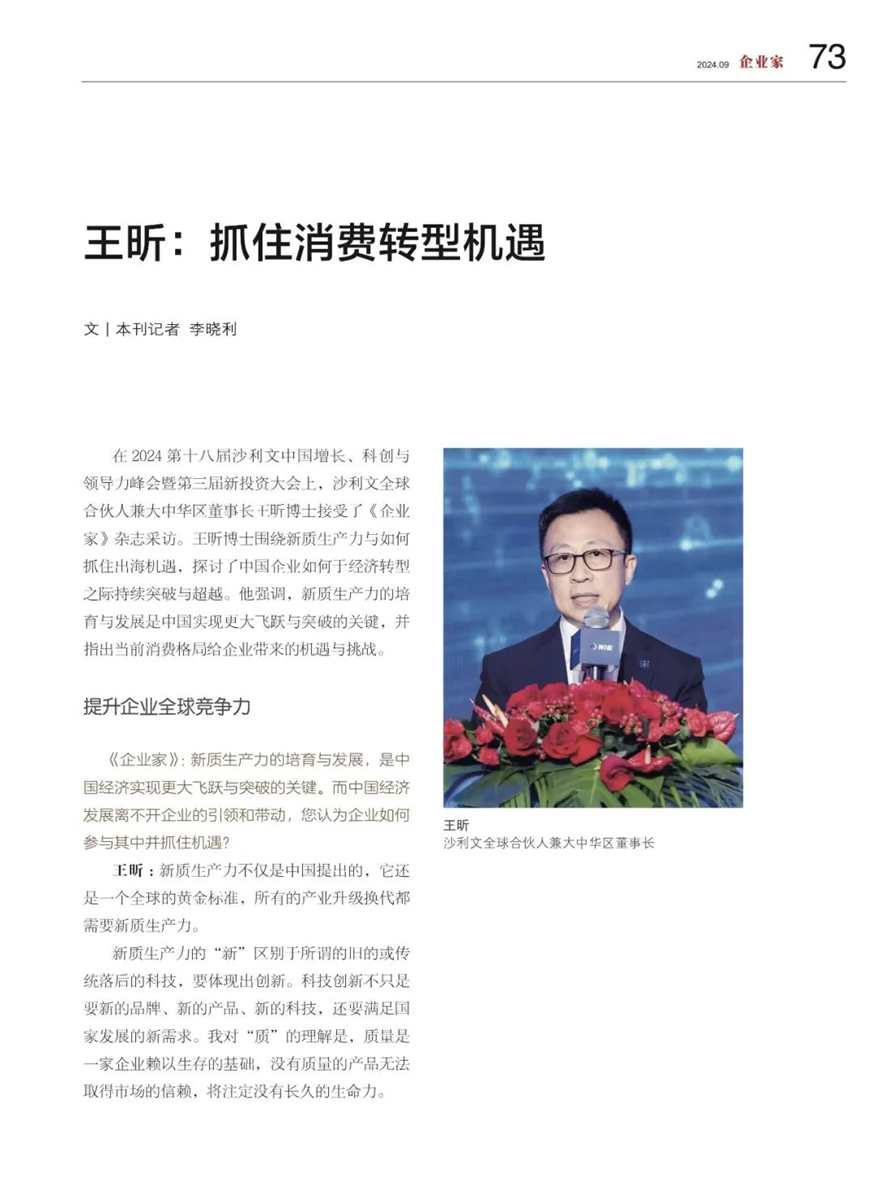
at2024At the 18th Frost & Sullivan China Growth, Innovation and Leadership Summit and the 3rd New Investment Conference, Dr. Wang Xin, Global Partner and Chairman of Greater China at Frost & Sullivan, was interviewed by Entrepreneur magazine. Dr. Wang Xin discussed how Chinese enterprises can continue to break through and surpass during the economic transformation period, focusing on new quality productivity and how to seize opportunities for going global. He emphasized that the cultivation and development of new quality productivity are key to China's greater leaps and breakthroughs, and pointed out the opportunities and challenges brought by the current consumption pattern to enterprises.

Dr. Wang Xin is2024Opening Remarks at the New Frost & Sullivan Investment Conference

Q&A
Enhance the global competitiveness of enterprises
Entrepreneur The cultivation and development of new productive forces are the keys to China's economy achieving greater leaps and breakthroughs. The development of China's economy cannot be separated from the leadership and drive of enterprises. How do you think enterprises can participate and seize opportunities in this process?
Dr. Wang Xin New productive forces are not only proposed by China but also a global gold standard. All industrial upgrading requires new productive forces. The 'new' aspect of new productive forces differs from the so-called old or traditional backward technologies, emphasizing innovation. Technological innovation is not just about new brands, new products, or new technologies; it must also meet new needs of national development. My understanding of 'quality' is that quality is the foundation upon which an enterprise can survive. Products without quality cannot gain market trust and are destined to have no long-term vitality.
As one of the world's largest economies, China ranks among the top in international rankings, indicating that our country has been continuously achieving self-breakthroughs, self-renewal, and self-upgrading. To achieve higher-quality development, we must significantly improve productivity and pay attention to green and environmental issues. Only green enterprises can achieve sustainable development goals, which is not only a national strategy but also a common vision for all humanity.
Entrepreneur China has numerous time-honored brands as well as a large number of emerging enterprises. What are the competitive advantages of time-honored brands? How can emerging enterprises further enhance their brand competitiveness?
Dr. Wang Xin The competitive advantage of a brand comes from an in-depth understanding of market demand. For example, those companies that have remained prosperous for a century are able to thrive because they are able to continuously meet market demand and maintain long-term competitive advantage, which includes effectively controlling costs and satisfying consumers' expectations for quality.
In recent years, with global climate change, carbon emissions,ESGAs topics become increasingly prominent, an excellent brand must not only perform well in traditional business competition but also assume social responsibilities. Only in this way can it be considered a brand with a long-lasting foundation. China is a major brand country, and its products with a long history, such as sewing machines and bicycles, are not only popular domestically but are also exported in large quantities around the world, enjoying a good reputation. These products are considered reliable and trustworthy in many countries, thanks to China's reform and opening up.40The achievements made over the years. The quality of our products has been recognized by the international market, and more products have obtained the qualification for exemption from inspection, which further demonstrates the strength of Chinese brands. In recent years, as a group of high-tech enterprises have entered the international market, they have not only been enthusiastically sought after by consumers but have also received high attention from the industry. The success of these enterprises has provided us with valuable experience.
Currently, enterprises are facing unprecedented challenges and opportunities. How to create growth opportunities in a complex and changing environment, stimulate performance growth rates, and build internationally influential brands has become a topic of common concern in the market. The new book 'The Growth Strategy for Companies', published by David Fung, Chairman of Frost & Sullivan's Global Board of Directors, systematically expounds the methodology for companies going global, including standardized, process-oriented, and systematic operational models, providing a followable path and theoretical support for companies going global. If a brand is limited to the domestic market and lacks international competitiveness, it is difficult to become a high-quality international brand.
We currently need to pay more attention to key areas of future national development, such as the development of artificial intelligence, which requires powerful computing power.GPUWith the support of software and hardware, we are confident that Chinese entrepreneurs and enterprises, under the correct leadership of the country, will be able to create more innovative brands in the international market.
Q&A
Enterprises going global should follow three principles
Entrepreneur What are your suggestions for enterprises going global?
Dr. Wang Xin "Riding a horse or sailing a boat involves three kinds of risks," which metaphorically refers to taking a ship, which carries certain risks. Therefore, it is recommended that companies follow three principles when going global. First, conduct thorough investigation and demonstration. To accurately select overseas target markets, companies need to carry out sufficient feasibility studies, hire professional third-party institutions or consulting companies to assist in research, and obtain detailed first-hand information.
Secondly, deeply implement globalization thinking and localization operational strategies. For instance, when entering local markets, enterprises should adapt to local customs, fully respecting local laws, regulations, local cultures, and social norms. In addition, enterprises should actively discover and utilize local business talents, treating them as the core force for the development of the enterprise in the local market. Through close cooperation with these talents, enterprises can more effectively collaborate with teams in the domestic market, jointly explore markets, and achieve sustained business growth and in-depth development.
Thirdly, a serious and dedicated attitude must be taken, and this matter should not be treated as a simple task. Enterprises should deeply understand and actively respond to the country's requirements and expectations for outbound enterprises. For this purpose, enterprises need to develop detailed outbound plans and integrate resources from various parties such as industry, academia, research institutions, investment, media, etc., by combining internal and external think tanks.
In addition, enterprises should cooperate with internationally renowned consulting institutions to obtain high-quality service support. Enterprises also need to build an ecosystem that includes the industrial chain, value chain, and supply chain to ensure the completeness of supporting services such as cross-border finance and supply chain finance.
In summary, going global for a company is like preparing for an ancient war, where it is essential to 'move the troops without moving the food and fodder.' This means that before officially going global, companies need to make thorough preparations to ensure that all resources and conditions are in place, in order to avoid unnecessary difficulties and challenges in overseas markets.
Q&A
Pay attention to the new opportunities contained in consumption transformation
Entrepreneur What is your view on the current consumption pattern? Under the transformation of consumption, what opportunities do enterprises face?
Dr. Wang Xin Consumption changes are not simply defined by upgrades or downgrades. For example, in the past, during periods of relative scarcity, it was very difficult to buy household appliances such as televisions, refrigerators, and washing machines, and even required a ticket system. Nowadays, these products are in abundant supply, and there is no longer the worry of not being able to buy or afford them. However, before the supply became sufficient, we went through a transitional phase where the consumption situation could neither be described as an upgrade nor a downgrade. For businesses, this period may have been a time of joy because they were able to sell more products. But for individual consumers, it might have been frustrating due to insufficient supply.
I believe that what we are currently experiencing is a transformation in consumption. With the significant improvement in the people's happiness index, we have not only solved the problem of relative population prosperity but also met the diverse needs of people in terms of basic living requirements such as clothing, food, housing, and transportation. This transformation reflects the evolution of consumption patterns. For example, you may no longer worry about enjoying a luxurious meal but prefer to enjoy hot pot or a new type of tea drink. This does not mean that you have given up high-end dining or beverages; rather, your consumption pattern has changed, and I believe this is a transformation.
This transformation has given rise to a series of outstanding enterprises, such as those producing various beverages. Whether it's tea, coffee, soft drinks, or other types of beverages, they have undergone changes, and so have consumers' tastes. However, this change is not a simple upgrade or downgrade. It's not like you went from drinking a bottle of high-end beverage to now drinking a bottle of soda and your status has been reduced. Some people might define a downgrade as a decline in consumption capacity and spending power, but I think this is an adjustment. The change in the Engel coefficient indicates that people are no longer80%~90%Income is used for food and clothing because basic needs have been met. Our needs are diversified, including higher-level demands such as travel, cultural life, education, and healthcare.
As our country faces the issue of aging, health care, wellness, and elderly care have become particularly important. Enterprises can take advantage of these opportunities to develop home-based elderly care products and services. In the context of insufficient social elderly care services, they can even develop family nursing, which is not just a family ward but a form of family care and nursing. Nowadays, many medical consumer electronics have become part of the family, such as electronic thermometers, blood pressure monitors, electronic blood glucose meters, etc. They can even be connected to mobile phones via Bluetooth to monitor vital signs and health indicators anytime, anywhere. These are areas where enterprises have great potential.
Therefore, I earnestly request all participants in various industries, entrepreneurs, and all relevant parties to pay close attention to these changes and make timely adjustments. Whether it is an upgrade or downgrade in consumption, our effective measures to cope with these changes are often more meaningful than the changes themselves.