Insights from Frost & Sullivan
Over the past few days, several pharmaceutical companies have successively disclosed their BD (business cooperation in the biopharmaceutical field, usually referring to pipeline licensing) expectations, drawing significant attention from the market. What trends are currently seen in BD transactions among innovative pharmaceutical companies in terms of transaction models, transaction data, and transaction targets? What are the reasons behind these trend changes? How should innovative pharmaceutical companies balance 'selling' and 'not selling'? When companies face contradictions between financial pressure and market prospects, when should they stick to independent development to control pricing power, and when should they achieve cash flow recovery through BD transactions? Is Yu Decao's decision-making logic of 'refusing short-term cashing out and betting on the ultimate outcome of the Chinese market' still valuable for reference in the current industry environment?
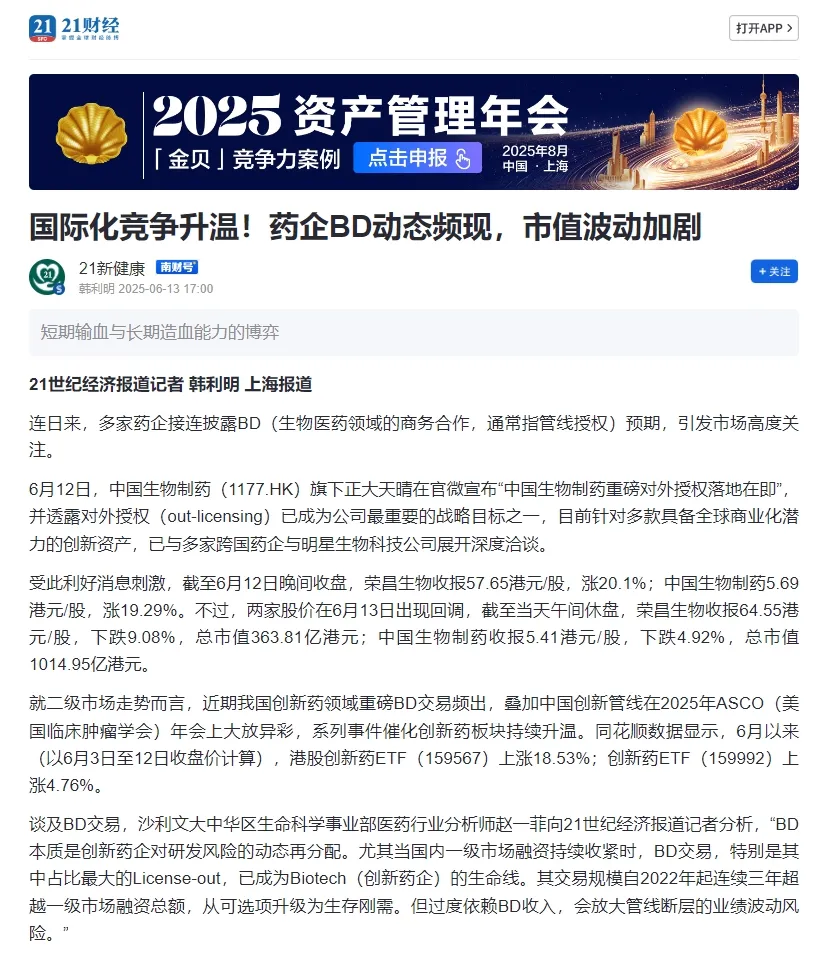
Zhao Yifei, a pharmaceutical industry analyst at Frost & Sullivan's Greater China Life Sciences Business Unit, was interviewed by 21st Century Business Herald to discuss the value boundaries of innovative drug BD.
*Click at the end of the articleRead the original articlefor the complete report
Q:What trends are currently seen in BD transactions among innovative pharmaceutical companies in terms of transaction models, transaction data, and transaction targets? What are the reasons behind these trend changes?
Zhao Yifei
Pharmaceutical industry analyst at Frost & Sullivan's Greater China Life Sciences Business Unit
From transaction data, the number of BD transactions remained strong in the first half of 2025. According to incomplete statistics, there were already 307 transactions, a slight increase compared to the same period in 2024; more notably, the transaction amount increased significantly, with multiple projects reaching high cooperation agreements. For example, Sanyo Pharmaceutical licensed its global rights (excluding the Chinese mainland) for its PD-1/VEGF bispecific antibody SSGJ-707 to Pfizer for a total transaction amount of $6.05 billion, including a $1.25 billion upfront payment. Such transactions indicate that market funds are concentrating on assets with real differentiation and global potential.
In terms of transaction models, License-out remains the absolute mainstream, accounting for more than 50% of transactions in 2024. However, the NewCo model is accelerating its rise—7 transactions were recorded in 2024 and 4 in the first half of 2025, mainly targeting early pipelines and binding long-term returns through joint venture structures; mergers and acquisitions continue to grow steadily, focusing on mature pipelines and providing efficient exit channels for resource-limited enterprises.
In terms of transaction targets, two trends are particularly evident. One is that platform-based technologies are becoming the core driving force of high-value transactions. For example, multiple rounds of high-value cooperation between Corbus Therapeutics and MSD around the ADC platform are based on their complete platform capabilities covering antibody screening, linker optimization, and toxin payload development. Buyers are willing to pay a premium for their scalability and high conversion rates. The second is a significant diversification of asset types. Transaction targets are no longer concentrated on traditional hotspots such as PD-1 and VEGF but are gradually expanding to new targets, non-tumor indications, and diverse drug types, reflecting that Chinese pharmaceutical companies are gaining international recognition through Best/First-in-class innovation after 'me-too' drugs.
The driving factors behind these trends include both internal initiatives for change within the companies and external push from the market environment.
On one hand, the innovation capabilities of Chinese innovative pharmaceutical companies continue to improve, with multiple First-in-class pipelines emerging globally; at the same time, domestic market profit margins are being compressed by centralized procurement and medical insurance cost control, and primary market financing is also tightening, making companies more dependent on BD transactions to raise funds and hedge uncertainties. In addition, national policies such as the '14th Five-Year Plan' for the pharmaceutical industry development plan are also strategically promoting companies to accelerate their internationalization process.
On the other hand, developed countries such as Europe and America not only have a large patient base and payment capabilities but are also facing the expiration of multiple original research drug patents, increasing their efforts to introduce innovative assets. At the same time, under the background of policies such as the 'Belt and Road', emerging market medical demand is growing rapidly, providing more opportunities for Chinese innovative pharmaceutical companies to go global.
Q:On one hand, some views hold that BD has broken the traditional model of 'cash flow only after product approval and launch', bringing sufficient cash flow to innovative pharmaceutical companies. In recent years, many innovative pharmaceutical companies have turned from losses to profits due to the inflow of BD funds; on the other hand, some innovative pharmaceutical companies such as Pemrix are considered to be adopting unsustainable measures of 'selling seedlings at low prices', which are not conducive to the development of domestic innovative assets in the long run. How should we view the conflict between these two views? Does the phenomenon of 'selling seedlings at low prices' reflect the bargaining power dilemma of Chinese pharmaceutical companies in the global value chain? How should innovative pharmaceutical companies strive for more favorable conditions in BD transactions?
Zhao Yifei
Pharmaceutical industry analyst at Frost & Sullivan's Greater China Life Sciences Business Unit
The essence of BD is the dynamic redistribution of R&D risks by innovative pharmaceutical companies. Especially when primary market financing in China continues to tighten, BD transactions—especially License-out, which accounts for the largest proportion—have become the lifeline of Biotech companies. Since 2022, the transaction scale has exceeded the total primary market financing for three consecutive years, upgrading from an option to a survival necessity. The example of Kangfang Biotech achieving its first profit through bispecific antibody licensing is an illustration. However, excessive reliance on BD income can amplify the performance volatility risk of pipeline breaks. Essentially, this is a game between short-term blood transfusion and long-term hematopoiesis capabilities.
The so-called 'selling seedlings at low prices' phenomenon profoundly reflects the phased weakness of Chinese innovative pharmaceutical companies in the global value chain: there are gaps between clinical data quality and international standards, target homogenization weakens asset scarcity, the commercial prospects of niche indications are unclear, and insufficient overseas promotion experience forms multiple constraints. At the same time, companies are forced to exchange core assets for survival rights under capital pressure, falling into a vicious cycle of 'R&D - low-price licensing - re-R&D' in the long run.
Enhancing bargaining power itself is about building uniqueness and differentiation. The first point is to build technical uniqueness by innovating targets, breakthrough designs, and platform capabilities to establish a data moat. The second is to strengthen clinical persuasiveness by adopting global trial designs that meet FDA/EMA standards and introducing third parties when necessary to enhance data credibility. Finally, be proficient in transaction strategies, using competitive negotiations and flexibly constructing transaction structures, simultaneously contacting multiple buyers to trigger bidding mechanisms, and maintaining asset control while maximizing benefits through flexible structures such as phased licensing and regional splitting.
Q:Against the backdrop of pharmaceutical companies going global becoming a trend, on one hand, companies such as BeiGene are exploring international markets through different models such as independent going global and License-out; on the other hand, companies like SinoCure have recovered their overseas rights for Cimzia but have also suffered losses in performance. How should innovative pharmaceutical companies balance 'selling' and 'not selling'? When companies face contradictions between financial pressure and market prospects, when should they stick to independent development to control pricing power, and when should they achieve cash flow recovery through BD transactions? Is Yu Decao's decision-making logic of 'refusing short-term cashing out and betting on the ultimate outcome of the Chinese market' still valuable for reference in the current industry environment?
Zhao Yifei
Pharmaceutical industry analyst at Frost & Sullivan's Greater China Life Sciences Business Unit
The essence of 'selling' and 'not selling' is the company's dynamic assessment and balancing of clinical development capabilities, cash flow reserves, and in-depth evaluation. BeiGene's successful independent going global with zanubrutinib stems from its investment of over $1 billion to build a global clinical team and commercial network; another strategy emphasizes the release of phased value, such as some companies choosing to recover product rights in specific markets or stages, focusing more on resource allocation and core market strategies, often based on comprehensive consideration of market rhythm and strategic priorities.
Therefore, the core of decision-making lies in: when a product has global competitiveness and the company has overseas development resources, sticking to independence is the long-term optimal solution; otherwise, BD transactions are a rational choice to avoid risks.
Specifically, companies need to dynamically choose strategies based on three elements: cash flow reserves, pipeline maturity, and technical barriers: if funds are sufficient and the pipeline is mature (clinical Phase III and beyond), it is recommended to adopt a dual-track approach of 'independent going global + cooperative development' to build global capabilities; for companies with tight cash flow but leading technology, they can use License-out to raise funds and retain core regional rights to maintain long-term revenue capacity for R&D and expansion; for early pipelines (clinical Phase II and before) with technical uniqueness, they can attract overseas capital through the NewCo model to lock in long-term returns; for companies with mature pipelines but lacking overseas resources, they can seek mergers and acquisitions to realize the monetization of technical value. The key is to accurately match models according to one's own endowment, rather than chasing a single paradigm.
*This interview has been published in 21st Century Business Herald, with reporter Han Liming, and the original title was: International competition heats up! BD dynamics among pharmaceutical companies frequent, market value fluctuations intensify
Contact phone: 021-5407-5836
Contact email: PR@frostchina.com