Frost & Sullivan insights
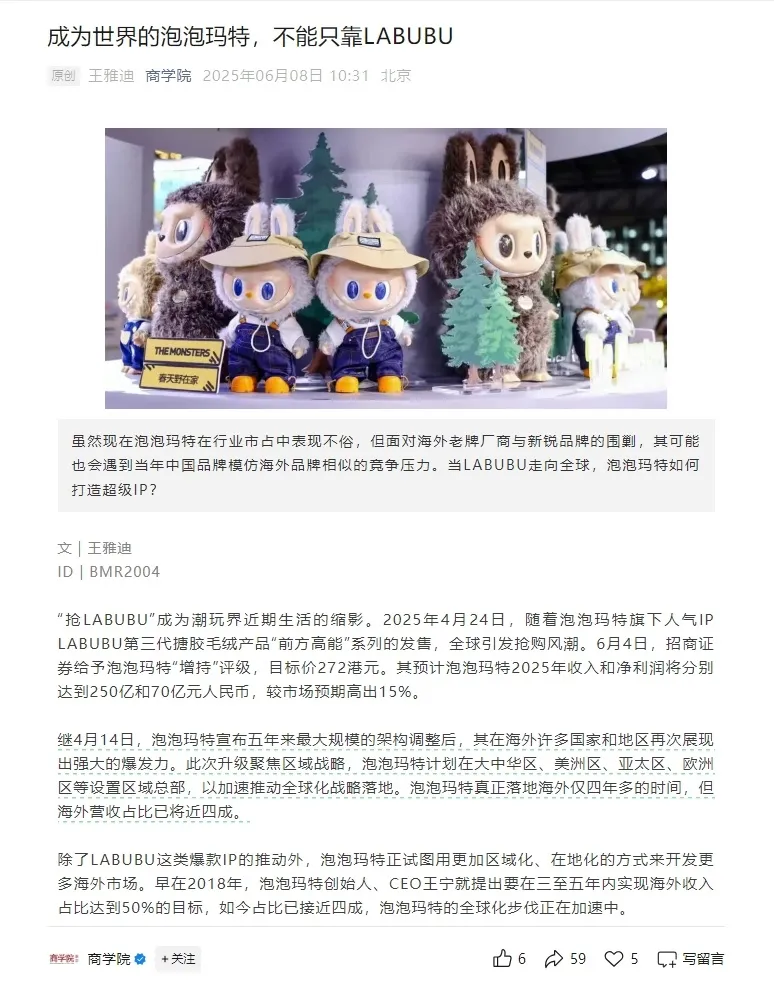
"Snatching up LABUBU" has become a microcosm of the recent life in the trendy toy industry. On April 24, 2025, with the release of the third-generation enamel plush toy "Frontal High Energy" series under Bubble Mart's popular IP LABUBU, a global craze for purchasing ensued. According to Bubble Mart's latest performance report, overseas market revenue soared by 475%-480% year-on-year, becoming the absolute main driver of growth. Among them, the Asia-Pacific region maintained its momentum, while Europe and America experienced explosive growth. What are the main reasons why Bubble Mart can achieve growth in these two regions? Bubble Mart belongs to non-essential consumer goods, and product sales are vulnerable to shocks during economic downturns. Why has Bubble Mart been able to maintain counter-cyclical growth? Compared to other trendy toy brands such as TOPTOY and 52TOYS, what is its differentiated advantage in the overseas market?
Zhu Yiming, Executive Director of Frost & Sullivan Greater China, was interviewed by Business School magazine to discuss IP going global and cultural resonance.
Business School Magazine
*Click at the end of the articleRead the original textView the full report
Q:According to the latest performance report of Popomart, overseas market revenue soared by 475%-480% year-on-year, becoming the absolute main driver of growth. Among them, the Asia-Pacific region maintained its momentum, while Europe and America witnessed explosive growth. What are the main reasons why Popomart has been able to achieve growth in these two regions?
Zhu Yiming
Executive Director, Greater China, Frost & Sullivan
The success of Popomart stems from the flywheel effect of 'IP incubation - full-channel reach - cultural promotion - user feedback'. By designing and resonating with emotions to create cross-cultural appeal, relying on direct-operated networks and localization strategies to lower market entry barriers, it has completed the transformation from trendy toys to pan-entertainment, building a global IP ecosystem.
1) IP Design: Cultural Resonance and Local Innovation
Popcorn Mart has formed an IP matrix covering different cultural backgrounds by signing global artists, tapping into local designers, and collaborating with internationally renowned IPs (such as Disney and Marvel). For instance, the Thai CRYBABY series was designed by local artists, incorporating tear-drop elements to evoke emotional resonance and entered the top two best-selling lists in Thailand within two months. Another example is the Tycoco skull image, which is popular in the Mexican market due to its connection with the undead culture, while the European market prefers the space-themed Space Molly29. By collaborating with local artists and designing limited editions, the brand enhances consumers' cultural identity.
2) Product Matrix: Category Expansion and Scenario Extension
Blind Box Mode Upgrade: The blind box gameplay combines randomness with collectible attributes, complemented by a scarcity design for hidden items, stimulating repeat purchases. For example, LABUBU plush accessories are 'hard to come by' in mainland China, and the trend has also been replicated in Southeast Asian markets.
Diversification of categories: Expanding from collectibles to MEGA (big kids), plush toys, building blocks, derivatives (such as Hanfu collaborations), and theme parks. In 2024, plush toy revenue increased by 994% year-on-year, while MEGA grew by 142%.
Build immersive scenarios: Extend the IP lifecycle through animations, mobile games (such as the collaboration with "Ne Zha 2"), theme parks, and pop-up entertainment exhibitions (such as PTS International Exhibition), to create immersive consumption scenarios. For example, the Singapore pop-up entertainment exhibition attracted over 20,000 visitors over three days, strengthening brand cultural output.
3) Sales Channels: Direct Store Expansion and Omnichannel Penetration
Landmark store strategy: Opening thematic flagship stores at global landmarks such as Bangkok's MEGA BANGNA and the Louvre in Paris, with the highest single-day sales reaching 10 million yuan.
Regional expansion strategy: Adopting a 'from near to far' approach, priority will be given to culturally similar regions such as Southeast Asia (e.g., Thailand, Indonesia) and East Asia (South Korea, Japan), followed by expansion into Europe and America. By 2024, overseas stores will exceed 147, with 11 new locations added in the United States.
Online full-platform coverage: Dominated by DTC online stores, social fission dissemination is carried out by integrating social e-commerce and UGC content.
4) Marketing: Emotion-driven and localized operations
Localized precision strategy: Promoted in Thailand with local stars (such as Lisa), launching traditional clothing versions of LABUBU; enhancing brand tone in Europe through the Louvre flagship store. For example, the welcome ceremony at Bangkok Airport with LABUBU featured an integration of IP into local cultural symbols, in collaboration with the Tourism Authority of Thailand.
Localization of the supply chain: Vietnamese factories are put into production to reduce production costs, and overseas warehousing arrangements (such as North America) improve logistics efficiency. By 2024, overseas production will account for 10% of total production, with the goal of further expansion.
Q:Bubble Mart is a non-essential consumer product. In times of economic downturn, product sales are vulnerable to impact. Why has Bubble Mart been able to maintain counter-cyclical growth? Compared to other trendy toy brands such as TOPTOY and 52TOYS, what is its differentiated advantage in the overseas market?
Zhu Yiming
Executive Director, Greater China, Frost & Sullivan
The current Chinese economy continues to maintain a steady growth trend, with GDP expected to reach 135 trillion yuan in 2024, maintaining a year-on-year growth rate of 5.0%. It may further increase to 5.4% in the first quarter of 2025. On the consumer side, the market is undergoing structural changes: The millennial and Z generations (accounting for over 45%) as the core consumer group exhibit a combination of rationality and emotionality—demanding not only a high match between product price and functional value but also seeking cultural identity and emotional experience carried by goods. Under this trend, trendy toy companies represented by Popomart are building competitive barriers through a full industrial chain layout: at the front end, they collaborate with over 800 artists globally to incubate IPs, using "cultural symbols + localized narratives" to resonate with consumers; at the middle end, relying on a digital supply chain system, they compress the design-to-production cycle to 21 days and achieve flexible production through overseas production bases in Vietnam and other regions; at the terminal, they form a closed-loop sales network with more than 300 direct-operated stores and D2C e-commerce platforms. Their ecological closed loop of "content creation - agile manufacturing - precise reach" not only drives an average annual growth rate of 15% in customer unit price but also reshapes the new consumption paradigm of "goods are emotional carriers." Compared to traditional toy merchants, this model, centered on cultural empowerment and supported by a responsive supply chain, provides a replicable sample for companies to achieve differentiated breakthroughs in the era of consumer segmentation.
Q:According to the financial report data of Popomart for 2024, the membership renewal rate has been on a downward trend, dropping from 58% in 2019 to 49.4% last year. The decline in the renewal rate is a market characteristic of this product. How should Popomart better improve the renewal rate?
Zhu Yiming
Executive Director, Greater China, Frost & Sullivan
Although the user repurchase rate of nearly 50% is still at a high level in the industry, the year-on-year decline of this indicator by 8.7 percentage points (from 54.3% in Q4 2023 to 45.6% in Q4 2024) requires a structural interpretation: In 2024, 11.729 million new registered members were added, a sharp increase of 34% year-on-year, driving the cumulative number of mainland Chinese members to exceed 46 million, with new customers accounting for 25.4% - the dilution effect brought about by large-scale traffic inflows is the main cause of short-term fluctuations. Looking at deeper data, core users (the 10.2% high-net-worth group with annual consumption exceeding five times) have a stable annual average repurchase frequency of 7.2 times, and the average transaction value per customer has increased by 18%, proving that the consumer stickiness of the base plate remains strong. The current challenge lies in how to convert the 'taste-testers' (with an average annual consumption of 1.2 times) who account for 62% of the total membership into continuous consumers. It is recommended to focus on two key approaches: one is to strengthen identity recognition by grading the membership system (such as offering limited edition priority purchase rights with annual subscription SVIPs); the other is to develop a 'luxury-oriented product line' based on user profiles (pricing between 200-500 yuan), filling the gap in consumer upgrade paths between ordinary blind boxes (59-99 yuan) and high-end collectibles (over a thousand yuan), to create a secondary repurchase scenario with a stepped product matrix. This may become the key path to breaking through the imbalance dilemma of 'traffic growth-retention conversion'.
Q:What are the main issues or challenges that Popomart still needs to face in its globalization expansion at present?
Zhu Yiming
Executive Director, Greater China, Frost & Sullivan
The essence of competition in the trend culture industry is the struggle for cultural identity, with a core focus on establishing a deep spiritual resonance between products and consumers. However, regional cultural differences lead to significant differentiation in consumer demands: Asian markets prefer cute and healing IPs (such as Sonny Angel, with a penetration rate of 37%), while European and American users tend towards rebellious street art symbols (such as KAWS, accounting for over 60% of sales in North America), and the Middle East market has seen a surge in demand for trend culture that incorporates local mythological elements (the transaction volume of related categories at the 2024 Dubai Trend Culture Exhibition increased by 82% year-on-year). This diversity requires companies to build a three-stage model of 'cultural decoding - IP reconstruction - product adaptation': first, through localized community operations (such as Popcorn Mart in Southeast Asia collaborating with local artists to hold 'cultural gene mining' workshops), extracting regional emotional symbols; then, using modular design to transform abstract cultural elements into commercializable IP images (such as the 'MOLLY Oriental Maid series' with a repurchase rate of up to 58% in Hong Kong and Macau); finally, matching product forms according to consumer scenario differences—first-tier cities promote limited-edition artworks (collectible items priced over 2000 yuan), lower-tier markets focus on cost-effective blind boxes (59-99 yuan mainstream line), and overseas markets develop religious cultural fusion items (such as Indonesian Islamic-style blind boxes with annual sales exceeding 1.2 million pieces). Only by completing a full-chain closed-loop from 'cultural insight' to 'commercial carrying' can companies truly break through regional barriers and achieve resonance between spiritual and commercial value.
Q:Under the influence of tariff background, what are the main reasons why Popomart can resist this risk to a certain extent?
Zhu Yiming
Executive Director, Greater China, Frost & Sullivan
From the strategic moves of Popomart in recent years to accelerate the layout of production bases in Southeast Asia, it is evident that its global supply chain reconstruction has formed a clear path: the capacity deployment in Vietnam (2 factories), Indonesia (1 industrial park), and Thailand (under construction) not only effectively offsets the trade barriers imposed by Europe and America on Chinese-made toys with an additional 15-25% tariff, but also constructs an agile supply network with 'regional center radiation'. Data shows that Southeast Asian factories have reduced the delivery cycle for orders from Europe and America to 12 days, a 40% acceleration compared to the original Chinese export model, and localized production has increased the product iteration speed to new series every quarter for 3-4 new items. The deeper value lies in the closed-loop of 'localized production - localized adaptation': on one hand, by monitoring regional consumption data (such as the Muslim population accounting for 87%), rapidly developing religious and cultural fusion products (with a 92% first-month sales rate for the 2024 Bali limited series); on the other hand, relying on local supply chains to achieve 'light inventory' operations, reducing the proportion of unsold items from 18% to 7%. This dual-engine strategy of 'risk diversification + direct demand connection' is reshaping the global competition paradigm of the pop culture industry.
*This interview has been published in the Business School magazine, with reporter Wang Yadi and the original title being: Becoming the World's PopMart, Not Just by LABUBU
Contact number: 021-5407-5836
Contact email: PR@frostchina.com