Over half of the population in Hong Kong lives in private residential buildings, many of which are jointly owned by multiple owners. The public areas and facilities of such buildings are generally held jointly by all owners of the building, and the costs of managing and maintaining public areas and facilities are shared through the payment of management fees.
On May 4, the Hong Kong Consumer Council (hereinafter referred to as 'the Council') released a research report on property management fees, advocating for increased transparency, communication, participation, and good governance to strengthen the protection of consumer rights and interests.
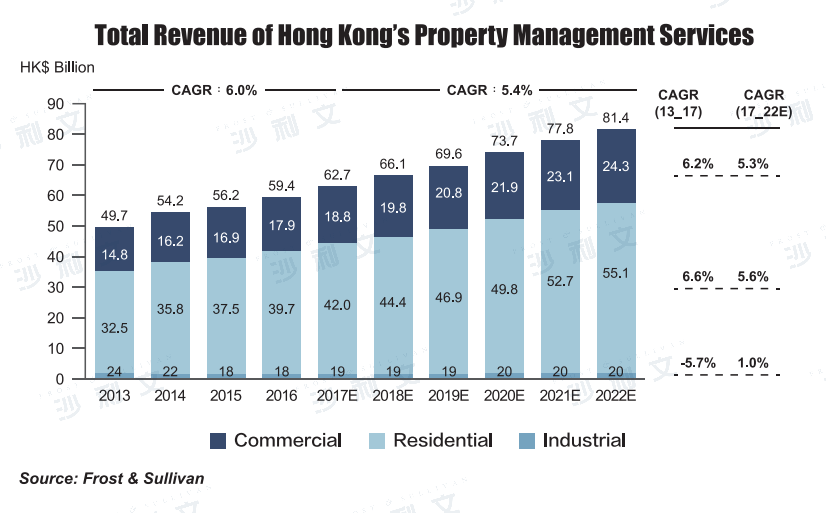
The report cites data from the 2016 Total Revenue of Hong Kong's Property Management Services market research by Frost & Sullivan (Frost & Sullivan, referred to as 'Frost & Sullivan') which indicates that the total revenue from property management services in the Hong Kong residential market is expected to reach HK$551 billion in 2022.
* Click "Read the Original Article" at the end of this text to read the full report "Innovative Value-added Services - Enhancing Transparency and Governance of Property Management Fees in Hong Kong".
Over half of Hong Kong's population lives in private residential buildings, many of which are jointly owned by multiple property owners. Hong Kong's landholding and transfer system is unique; the public areas and facilities of such buildings are jointly owned by all property owners and shared the costs of managing and maintaining them through the payment of management fees.In 2022, the total revenue from property management services in the Hong Kong residential market is estimated to reach HK$551 billion (about 2.0% of the local GDP).[1]The Consumer Council's survey found that the management fees paid by surveyed property owners each month ranged from $200 to $3,700, accounting for an average of about 7.4% of the household's monthly income. With residential buildings becoming increasingly aged, it is expected that management fees will continue to rise generally.
The owner has a legal duty to continuously and cumulatively pay a fair amount of management fees so that the property management company (PMC) can perform its duties in accordance with the building's common deed. However, looking at the unique property management fee market in Hong Kong, for example, owners must take collective action to influence decision-making, and the bargaining power between owners and developers is not equal; in addition, owners generally do not wish to participate in building management affairs, and the Consumer Council has also received complaints about property management from time to time; in view of this, the Consumer Council has conducted a survey titled"Creating Value-added Services - Enhancing Transparency and Governance of Property Management Fees in Hong Kong"The study (this research) aims to understand, examine and evaluate whether the current management fee system for private residential buildings in Hong Kong is operating effectively, and the issues that have attracted consumer attention.
This study has identified six major issues in the management fee market for private residential buildings in Hong Kong and put forward eight suggestions to strengthen the protection of consumers' rights and interests. The Consumer Council emphasizes that in addition to strengthening the existing regulatory system, comprehensive and clear information disclosure, and active participation of property owners in the management of their properties, these are all crucial for establishing a fair, healthy, competitive, and sustainable property management market to safeguard consumers' rights and interests.
The management fee responsibility depends on the number of property rights/management shares, which is shared by the owners.
One characteristic of property ownership in Hong Kong is determined by the distribution of 'ownership shares' and 'management shares' (if any) among property owners. The former defines the ownership of the property, while the latter defines the proportion of property management and maintenance costs that owners should bear from the moment they acquire ownership. The distribution of ownership shares is usually listed in the public deed of the relevant building or development project. In addition, some public deeds may specify the proportion of management shares as the basis for collecting management fees.
In short, property management includes the management of communal areas of buildings and the provision of appropriate services, such as security, cleaning, financial management, maintenance, and repair for the property. Property owners generally hire property management companies to provide these services, which collect management fees from the owners on a regular basis. A survey by the Owners' Association found that 'employee salaries and related expenses' (40.4%) constitute the largest portion of management costs, followed by 'maintenance and repair-related expenses' (27.7%) and 'cleaning-related expenses' (10.8%).
Dual regulations and multiple regulatory authorities govern the property management market in Hong Kong
To define the scope of this study, the Consumer Council has reviewed the main laws and regulatory requirements for property management in Hong Kong. The management of buildings jointly owned by multiple owners is mainly regulated by the 'Buildings Management Ordinance' (Chapter 344) and their respective public deeds, while property management services are governed by the 'Property Management Services Ordinance' (Chapter 626).
On one hand, the 'Regulations on the Management of Buildings' provide a statutory framework for the establishment of owners' corporations, facilitating the management and monitoring of common parts of buildings. The establishment of owners' corporations can especially avoid multiple lawsuits involving numerous owners and allows decisions to be made based on most decision-making principles, avoiding the need for unanimous consent from all owners in property management matters. On the other hand, after the public deed is drafted, it must undergo legal consultation by the Lands Department and inspection and approval by the Lands Transfer Office to ensure compliance with the 'Regulations on the Management of Buildings' and the guidelines for public deeds for buildings developed to promote the systematic management of private residential development projects. It is worth noting that public deeds are mainly drafted by developers, with prospective buyers not participating in them. In the early stages of property pre-sale and sale, before units are sold and ownership rights are transferred to buyers, developers have absolute control over decisions due to their possession of most of the ownership rights, while the ultimate owners of the property do not have any influence on the public deed and can only accept it.
The 'Regulations on Property Management Services' regulate the licensing and services of property management companies and practitioners, and establish the Property Management Industry Authority (PMIA). As the industry regulator in Hong Kong, the PMIA regulates the provision of property management services through a licensing system, disciplinary actions, and promotion of industry development. In addition to the PMIA, the Home Affairs Department has also been committed to encouraging private property owners to establish owners' case-filing associations and providing relevant support to owners.
Six related issues regarding property management fees in Hong Kong
In addition to reviewing legal provisions, this study also adopted an overall and comprehensive approach, from different channels[2]Collect opinions from stakeholders and market insights. Based on the survey results, the Consumer Council has identified six major issues:
Over the past 11 years (2012 to 2022), the Consumer Council has received a total of 694 complaints related to property management, about half of which were 'price/charging disputes', mainly involving issues such as the allocation of shares, whether certain parts of a building are public areas, and whether cost allocation is fair.
This study found that although development project public deeds and sales brochures disclose the allocation of property rights and management rights (if any), there is no calculation method for determining the distribution of these rights found in these documents. Although the basis for allocating property rights can be found in the statutory declaration of the building, it is not a sales document for public reference, and many consumers are unaware of the existence or how to obtain their building's statutory declaration. However, relevant calculation methods can help prospective buyers understand their responsibilities and make informed purchasing decisions, so from the perspective of consumer protection, the lack of these important materials is obviously undesirable, as prospective buyers' future property management responsibilities and maintenance expenses may exceed their family budget.
Under the current legal framework, once a public deed for a development project is registered with the Land Registry, it is binding on the property rights successors and beneficiaries of the contractors (regardless of whether they are aware of the deed), and must be unanimously agreed upon by all parties to the contract before the terms can be amended. However, the Consumer Council has found through research and analysis of relevant court cases that some deeds prepared by developers may no longer conform to the current interests of property owners, thus causing disputes and controversies. The Civil Affairs Committee of the Legislative Council proposed many years ago to establish a mechanism that would allow resolutions by less than 100% of the property owners to amend unfair clauses in the deed. However, due to considerations for the interests of a minority of property owners opposed to amendments, the proposal was not adopted. Therefore, the requirement that all property owners must unanimously agree to amend deed terms still exists today. In some large estates, or when some property owners are indifferent, unreachable, or unable to be found, other property owners face significant challenges in trying to amend the deed.
The decision-making power of property owners over property management matters is influenced by how the number of property rights is allocated. Some residential development projects are owned by developers who hold a large number of property rights, including those of all unsold units, thus having the decision-making power over significant property management matters such as establishing a property owners' case-filing committee or dismissing property management companies. According to the public deed analysis of this study, among the 249 reviewed development projects, there were five projects where the total number of property rights held by residential property owners was less than 50%, making it difficult for property owners in the residential sector to raise enough shares to pass property management resolutions.
Further analysis of public deed contracts reveals that among the development projects reviewed by the Consumer Council, 75% of public deed managers (i.e., the first property management company stipulated in the public deed) are related to developers, while 47% of development projects are managed by the top 10 public deed managers. If developers decide to allocate less than 50% of the property rights to residential property owners and appoint a property management company related to them as the public deed manager, it may raise concerns about potential conflicts of interest. When major stakeholders exercise their influence to intervene in specific property management decisions, it may result in residential property owners without a say needing to bear higher costs.
The Consumer Council received 694 complaints about property management between 2012 and 2022, mainly involving 'price/charging disputes' (about 50%), including improper use of collected management fees and dissatisfaction with service quality (42.7%). Although the law requires property management companies to regularly disclose their financial operations and owners have the right to obtain financial information related to management, accusations of chaotic financial accounts and improper use of collected management fees by property management companies are still heard from time to time, and some companies refuse to disclose financial and operational information.
The study also shows that property management companies and property owners have an expected gap in their perceptions of the performance of property management companies. 71.4%-100% of the surveyed property management companies believe that their performance (such as communication channels, information disclosure) meets expectations, while only 43.7%-56.4% of the surveyed property owners and 54.8%-65.9% of the surveyed property owner organizations believe that the performance of property management companies meets expectations. In addition to the gap in expectations for performance, 87% of property owners stated that they do not know the procedures for dismissing property management companies, and many property owners (40.4%) and property owner organizations (33.3%) find it difficult to select a suitable property management company due to a lack of sufficient market information.
The Consumer Council's survey found that, regardless of age, education level, occupation, and length of residence, about 60% of property owners rarely or never attend meetings (63%), express opinions on building management-related matters (62.7%), or participate in voting (58%). At the same time, most property owners (over 78%) lack awareness of building management and related regulations, which may lead to a low level of participation in building management. The survey further found that over 97% of property owners are unwilling to join an owners' organization as a chairman or committee member, with the main reasons being 'no time' (58.9%), 'no interest' (12.2%), 'no opinion' (12.2%), and 'too old to participate' (9.7%).
Data from the Legislative Council Information Research Group shows that as at the end of 2021, only 47% of private buildings in Hong Kong had established a owners' corporation. Despite the government's efforts over the years, the relevant percentage has remained at this level. Some stakeholders have pointed out that the lack of willingness among owners to participate is a major obstacle to establishing an owners' corporation. The non-active participation of owners may increase their risk of facing poor management or their properties being manipulated, ultimately harming their own interests. It can also lead to misunderstandings or disputes between owners, owner organizations, and property management companies due to insufficient communication.
According to the survey by the property management company, the main reasons for the increase in management fees are 'inflation' (100%), 'minimum wage increases' (72.4%), and 'building maintenance' (31.6%). When asked about the acceptable increase in management fees, nearly half (45%) of the surveyed property owners believe it should be less than 5%, while only 12.5% accept an increase of 10% or more.
Although the Public Contracts Ordinance stipulates the establishment of special funds to cover irregular expenses for the renovation, improvement and maintenance of public places and other related costs, a 2017 study by the Urban Renewal Authority showed that only one-third of the buildings surveyed had established special funds, and some fund balances were insufficient to cover the costs of major maintenance projects. One of the main reasons for insufficient funds is that property owners lack professional knowledge to determine the level of reserves needed for future maintenance project expenditures. Without special funds or insufficient reserves within them, property owners may have to share the high costs of projects, especially for retirees and the elderly, putting economic pressure on them. Therefore, establishing an affordable and sustainable mechanism to accumulate maintenance funds is an important safeguard for property owners.
In order for consumers to enjoy healthy, competitive, and sustainably developed property management services, the Consumer Council has put forward eight main recommendations. It hopes that by increasing market transparency, fairness, and efficiency, as well as encouraging property owners to actively participate, it can promote the long-term development of safe and sustainably livable buildings:
Promote market transparency, fairness and efficiency
The Consumer Council recommends that developers explain the calculation and allocation basis of the ownership shares when selling first-hand private residential properties, ensuring compliance with consumer rights through good corporate conduct. The above information should be prominently displayed in the sales brochure, and detailed data can be uploaded to the development project's website, with links to the website listed within the brochure. Additionally, for consumers' convenience, developers should present different categories of expenditure items in tabular form in the sales brochure. When the distribution of ownership shares and management shares is not consistent, developers should also provide clear explanations.
In the long run, the Consumer Council recommends that the Property Services Department may consider establishing a relevant database by collecting information on management fees in Hong Kong. The approach can draw on similar platforms of the Electrical and Mechanical Services Department and the Mandatory Provident Fund Schemes Authority. To ensure the desired effect, the database should be integrated and published with important information such as building age, number of units, location, facilities and services provided, gardening area, and the number of property management staff employed. When releasing the database, sensitive information such as the names of property management companies and buildings should be anonymized to dispel concerns about market competition.
Drawing on the experiences of the mainland and Singapore, the Consumer Council suggests relaxing the current mechanism for amending the terms of the building's public deed, allowing for amendments to the deed's terms (excluding those related to the number of shares) with the consent of most property owners. The Consumer Council recommends referring to the practice of the Companies Ordinance (Chapter 622), where a majority vote of at least 75% of members, either in person or through appointing representatives (not based on shareholding), is required to pass amendments to the company's articles of association. It is suggested that a majority resolution to amend the deed's terms should take as a reference threshold 75% of the number of shares in existence. To prevent abuse of the mechanism and protect the interests of a minority of property owners who hold opposing opinions, the mechanism for amending the deed should mainly apply to properties with a ten-year or older building age and have strict enforcement procedures and appeal mechanisms.
Recommendation 4: Avoid conflicts of interest arising from excessive involvement in property management decision-making
-
The relationship between the developer and the public deed manager is disclosed in the prospectus. If the public deed manager has not been appointed at that time, the prospectus should clearly indicate the timing and method of making any future disclosures; -
When selecting property management companies or other service providers, it is necessary to disclose their relationships with major property owners who hold 30% or more of the equity, or any members of the management committee; -
In the event of a conflict of interest, the developer, the major owner holding 30% or more of the shares, and any member of the management committee shall make a declaration of interest. If appropriate, he/she should withdraw from the meeting and waive his/her voting rights on the relevant project; -
After the term of office of the first public contract manager, the next property management company should be recruited through bidding; when recruiting other service providers, the method should also be based on the importance of project scale and service nature, and should be carried out through bidding.
-
Introduce new intelligent solutions for cleaning, security, communication, and other services at an appropriate speed and prioritization; -
In addition to the traditional method of posting notices for communication, use social media, communication tools and/or dedicated building websites to strengthen communication and information sharing with property owners; -
From the initial stages of the project until the launch of the plan, involve the owner in key project procedures and listen to their opinions; -
The industry, property management authorities, and the innovation and technology sectors are actively collaborating to find synergistic benefits in customizing software, applications, platforms, or templates to promote cost-effectiveness and proper handling of personal information and data.
Encourage property owners to actively participate
The Consumer Council suggests gradually strengthening the participation of property owners in property management matters. To this end, it is recommended that after the completion of property transactions, pre-made "Property Owner Information Packs" can be distributed through various channels to each property owner to introduce their rights and obligations as property owners. When property owners move into their homes, they should be made aware of property management matters as soon as possible, such as through welcome gatherings or regular workshops organized by property management companies. To continuously encourage property owners to participate in property management and provide them with relevant information, the Home Affairs Department may consider developing interactive learning toolkits or regularly holding workshops on property management and regulatory requirements. Property management companies can also increase their use of social media and websites to strengthen communication with property owners. In the long run, the feasibility of introducing online property owner meetings can also be explored.
The Consumer Council also calls on property owners to participate in property management from the beginning of property acquisition, including reviewing expenditure documents, attending property owners' meetings regularly, and expressing their opinions on property management matters before making major decisions.
Given the survey results, which show that half of the surveyed property owners are unaware of the procedures for establishing a property owners' case-filing committee, and most of the surveyed property owners (97.3%) indicated that they are unwilling to join property owners' organizations, the Consumer Council calls on relevant parties to strengthen education and promotional activities in order to deepen the public's understanding of the importance of property owners' case-filing committees in property management, thereby increasing their attention and willingness to establish such committees.
In addition, the Consumer Council calls for a review of the deadline for property management companies to convene their first owners' meeting. Currently, the Common Premises Ordinance stipulates that common property managers must convene their first owners' meeting within 9 months from the date of the common property deed. The Consumer Council suggests that once residential property owners collectively hold more than 50% of the property rights, they should immediately convene their first owners' meeting to facilitate the early establishment of a corporation. To encourage property owners to join the management committee, the Home Affairs Department may consider introducing a commendation scheme to reward the efforts and achievements of management committees or individual members in promoting good property management. Furthermore, the authorities may need to review the maximum allowances paid to specific committee members under the Buildings Management Ordinance to better reflect their contribution value.
For buildings without a registered owners' association or other forms of owners' organization, property management companies may consider holding at least two general meetings with owners per year to strengthen communication with them, rather than the current meeting schedule of once every 12 to 15 months.
Promote the development of safe, sustainable and livable buildings
The Consumer Council, drawing on the experience of Shenzhen and Australia, recommends the establishment of an engineering fund, a 10-year maintenance plan, and legislation requiring all property owners to make regular and reasonable contributions. The funds contributed cannot be transferred to avoid the financial pressure caused by having to pay a large amount of money at once. The contribution amount can be determined in the following ways: (1) A maintenance budget compiled by independent professionals; (2) A certain proportion of the annual property management fee budget; (3) A hybrid model where the developer pays the seed fund, plus an owner contribution equivalent to 2 months' management fees, followed by monthly contributions from the owners; or (4) Continuing with the current budget compilation practices of property management companies or owner-managed corporations.
The Consumer Council recommends that newly purchased property owners should start making contributions to the fund from the following year. Buildings with a ten-year or less age should set up a reserve fund, and the amount of contributions should be determined based on the condition of the building and maintenance needs. For property owners with a building age exceeding ten years, due to potential large-scale maintenance and repair needs, they should seek the advice of professionals to assess the expenses required. The current regulation that funds are deposited into designated interest-bearing accounts should be maintained, and a list of maintenance projects that can use the funds in the future should be specified.
Joint efforts are made to enhance the transparency of the property management market, promote good governance, and strengthen protection of consumer rights and interests
Effective property management, combined with high-quality services and good maintenance, will have a positive impact on the living environment and contribute to the market value of buildings. To achieve a win-win situation and find effective and feasible long-term solutions, the joint efforts of all stakeholders are crucial. In addition to regularly reviewing regulatory systems, the Consumer Council reiterates that information must be disclosed comprehensively and clearly at all levels, and the rights and obligations of property owners must also be fairly implemented. At the same time, the Consumer Council also encourages property owners to actively participate in the management of their properties to protect their own rights and interests. Through this research, the Consumer Council has conducted in-depth and constructive discussions with all stakeholders and put forward the above eight suggestions, hoping to create a fair market environment, strengthen the protection of consumers' rights and interests, and ultimately create the best return for property owners for their contributions to property management.
[1] Frost & Sullivan. (2016) Total Revenue of Hong Kong's Property Management Services.
[2] The Consumer Council conducted an in-depth analysis of 694 complaints related to property management received over the past 11 years; and consulted stakeholders such as relevant government departments, regulatory bodies, public institutions, industry chambers of commerce, and professionals at different stages of the research; examined 249 public deeds, 50 sales brochures, and 2 statutory declarations of first-hand private residential development projects, focusing on the remuneration collected by deed managers and how deeds display the distribution of property rights and management shares; conducted field surveys covering three aspects: property owners, property owner organizations, and property management companies. The Consumer Council also examined the regulatory systems of five selected markets: Australia, Mainland China ("Mainland"), Singapore, Taiwan, and the United Kingdom.