According to analysts, the growing technical expertise on China's Digital Silk Road is expected to become a benchmark for other regions around the world to emulate. The Belt and Road Initiative (BRI) in China has already embarked on the digital Silk Road before other parts of the world began discussing interconnected smart cities and technology-driven solutions. As China continues to expand its digital footprint in multiple fields such as cloud computing, 5G, surveillance technology, and virtual currencies, observers believe that China's technological leadership position in certain areas is gradually strengthening.
How will China's dominant position in future technology fields such as artificial intelligence, 5G, fiber-optic infrastructure, satellite services, cloud computing, and blockchain affect the Belt and Road Initiative (BRI)? How can BRI member states leverage China's technological advantages in infrastructure construction? Is China willing to share these technological achievements with member states? As China achieves global hegemony in the digital domain and future technologies, will it also dominate the construction process and financing of future infrastructure projects? Is there a possibility for China to increase investment in the soft infrastructure of the Digital Silk Road? Wang Huaian, Consulting Director for Greater China at Frost & Sullivan (hereinafter referred to as 'Frost & Sullivan'), was interviewed by Refinitiv, a global financial market data and infrastructure provider, to share a series of interpretations on China's BRI practices.
Luoxue Special
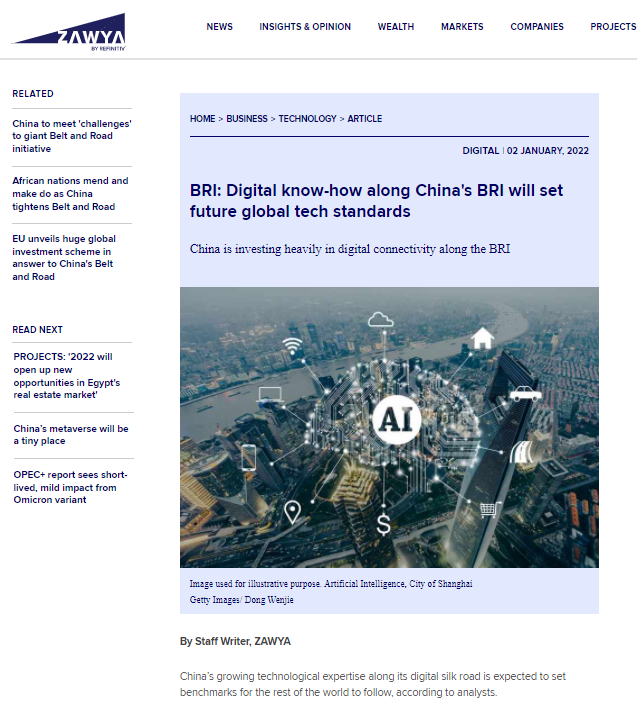
Analysts believe that China's growing technological expertise along its digital Silk Road is expected to set benchmarks for the rest of the world to follow.
According to analysts, the growing technical expertise on China's Digital Silk Road is expected to become a benchmark for other regions around the world to emulate.
President Xi's ambitious Belt and Road Initiative (BRI) has embarked on the digital Silk Road long before the rest of the world began discussing connected smart cities and technology-driven solutions.
Long before other parts of the world began discussing interconnected smart cities and technology-driven solutions, President Xi Jinping's grand "Belt and Road Initiative" (BRI) had already embarked on the digital Silk Road.
As China continues to expand its digital footprint across sectors such as cloud computing, 5G, surveillance technology, and virtual currency, observers see movement in some areas towards Chinese technological dominance.
As China continues to expand its digital footprint in multiple fields such as cloud computing, 5G, monitoring technology, and virtual currencies, observers believe that China's technological leadership position in certain areas is gradually strengthening.
Dale Aluf, Director of Research & Strategy at SIGNAL (Sino-Israel Global Network & Academic Leadership), said that China is already leading the world in artificial intelligence, blockchain, 5G, and quantum technology publications and patents. "Data fuels AI development, and thanks to its extensive surveillance apparatus, China has access to an immense amount of data, so China seems well-positioned to emerge as a leader in this field."
Dale Aluf, Research and Strategy Director at the China-Israel Academic Exchange Promotion Association (SIGNAL), said that China is already in a leading position in the publishing and patenting of artificial intelligence, blockchain, 5G, and quantum technology. "Data drives the development of artificial intelligence, and thanks to massive surveillance equipment, China can obtain vast amounts of data. Therefore, it is very likely that China will become a leader in this field."
China has already launched the world's largest blockchain ecosystem, connecting to over 100 city nodes, and was the first country to launch widespread pilots of a digital fiat currency - the Digital Currency Electronic Payment (DCEP) system.
China has launched the world's largest blockchain ecosystem, connecting to more than 100 urban nodes, and is the first country to pilot a large-scale digital legal tender - Digital Currency Electronic Payment (DCEP) system.
Analysts agree that China has made tremendous breakthroughs in some future technologies.
Analysts unanimously believe that China has made tremendous breakthroughs in some future technologies.
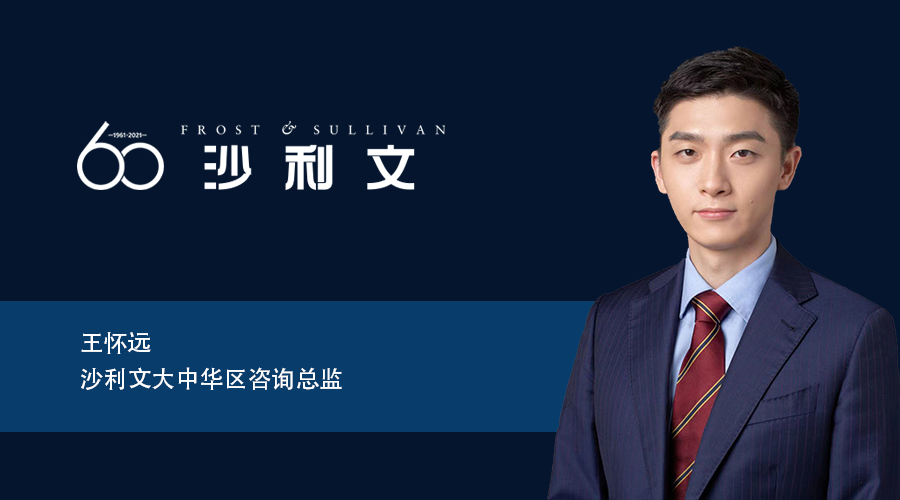
"These technological advancements enable China to more effectively promote the progress of Belt and Road Initiative (BRI), enhance the bond between China and BRI countries, and advance BRI's flagship projects," said Walter Wang, consulting director at research and consulting firm Frost & Sullivan, in Greater China.
Wang Huaaiyuan, consulting director for Frost & Sullivan Greater China, said, "These technological advancements enable China to more effectively promote the Belt and Road Initiative, enhance connectivity between China and Belt and Road countries, and facilitate difficult projects along the route."
Wang cited China's world-leading fiber optic industry, which is already helping BRIC countries transform from traditional to renewable energy supplies.
Wang Huaiyuan mentioned that China's optical fiber industry is world-leading and has been helping countries along the 'Belt and Road' transition from traditional energy to renewable energy supply.
Many countries aligning with the Belt and Road Initiative are rich in solar energy resources, but "lack the technologies and resources to construct renewable energy infrastructure," according to Wang.
Wang Huaiyuan stated that many countries allied with the 'Belt and Road' initiative possess abundant solar energy resources, but lack the technology and resources to build renewable energy infrastructure.
"Through the Belt and Road Initiative (BRI), China can export advanced renewable energy technologies to BRI countries, and Chinese fiber optic enterprises are able to enjoy local preferential policies, including tax incentives and preferential treatment for equipment imports," he added.
"Through the Belt and Road Initiative, China can export advanced renewable energy technologies to countries along the route, and Chinese fiber optic companies can also benefit from local preferential policies, including tax incentives and equipment import preferences," he added.
According to Frost & Sullivan research, in some infrastructure areas, such as high-speed railways, 5G networks, and ultra-high voltage power grids, China's standards have become international standards as other countries catch up.
According to research by Frost & Sullivan, in some infrastructure areas such as high-speed railways, 5G networks, and ultra-high voltage grids, Chinese standards have become international standards, while other countries are catching up.
"Thus, by collaborating with Chinese enterprises, BRIC partner countries can adopt technologies that meet the most advanced standards in their infrastructure projects," said Wang.
"Thus, by collaborating with Chinese enterprises, 'Belt and Road' member states can adopt technologies that meet the most advanced standards in their infrastructure projects," said Wang Huaiyuan.
Impact on BRI
Impact on the Belt and Road Initiative
According to Aluf from SIGNAL, China's technological prowess gives it an edge to push forward on BRI's key projects such as renewable energy, transportation, infrastructure, power, and healthcare. In today's technology-driven world, where the digital realm is intricately intertwined with physical infrastructure, this is particularly important.
According to Aluf from SIGNAL, China's technological strength gives it an advantage in promoting hard projects under the Belt and Road initiative, such as renewable energy, transportation, infrastructure, electricity, and healthcare, because in today's technology-driven world, the digital domain is closely intertwined with hard infrastructure.
"Railways, ports, and power grids, for example, would not be able to operate effectively today without software, sensors, and cybersecurity," he noted.
"For example, without software, sensors, and cybersecurity, railways, ports, and power grids would not be able to operate effectively today," he pointed out.
Moreover, China also provides a useful reference for BRICS countries with its digital transformation and industrial digitalisation models.
In addition, China's digital transformation and industrial digitization models also provide useful references for countries along the 'Belt and Road'.
Wang said that most BRICS countries are developing economies and have limited experience in dealing with digital technology, but can benefit from China's digitalization experiences.
Wang Huaiyuan stated that most countries along the Belt and Road are developing economies with limited experience in dealing with digital technology, but they can benefit from China's digitalization experiences.
He cited the Silk Road E-commerce platform developed by China in 2016 with 22 BRICS countries as an example. During the COVID-19 pandemic, China and those aligned with the BRICS quickly adjusted their strategies, shifting focus from offline to an online market, while taking advantage of cross-border e-commerce platforms to create more new growth points for the economic development of BRICS countries.
He took the Silk Road E-commerce Platform jointly developed by China and 22 "Belt and Road" countries in 2016 as an example. During the COVID-19 pandemic, China and the countries along the "Belt and Road" swiftly adjusted their strategies, shifting their focus from offline markets to online ones, fully leveraging the advantages of cross-border e-commerce platforms to create more new growth points for the economic development of these countries.
In the future, Wang expects China to continue assisting BRICS countries in improving their 5G infrastructure, which is the foundation of future digital transformation, and to promote their digital economies, such as popularizing mobile payments to facilitate loan processes for small and medium-sized enterprises (SMEs), thereby alleviating the 'urgent need' for financing during the pandemic.
Wang Huaiyuan expects that China will continue to assist 'Belt and Road' member countries in improving their 5G infrastructure, which is the foundation for future digital transformation and promote their digital economy development. For example, mobile payment will be popularized to facilitate loan processes for small and medium-sized enterprises, thereby alleviating the 'urgent need' for financing during the pandemic.
According to Jia Hao Chan, a research associate at Lee Kuan Yew School of Public Policy, National University of Singapore, how technology will be integrated into BRI projects will largely depend on the nature of the projects.
Jia Hao Chan, a researcher at the Lee Kuan Yew School of Public Policy at the National University of Singapore, said that how technology is incorporated into 'Belt and Road' projects largely depends on the nature of the projects.
"And this will vary from region to region and country," he said.
"And this will vary by region and country," he said.
For example, in late 2017, Chinese company Huawei Marine partnered with the Pakistani authorities to start constructing the Pakistan East Africa Cable Express, which will connect Pakistan to Kenya and Djibouti, focusing on hard infrastructure interconnectivity.
For example, at the end of 2017, Huawei Marine, a Chinese company, began construction of the Pakistan East Africa Cable Express with Pakistani authorities. The express will connect Pakistan with Kenya and Djibouti, focusing on hard infrastructure connectivity.
"This is essentially different from the areas that China is focusing on in Southeast Asia (centered around IT services and soft infrastructure). In these regions, technology companies such as Alibaba and Didi Chuxing would collaborate with regional ride-hailing services like Grab through investment partnerships."
"This is fundamentally different from the areas China is seeking in Southeast Asia (focusing on IT services and soft infrastructure), as technology companies such as Alibaba and Didi Chuxing will cooperate with regional ride-hailing services like Grab through investment partnerships.
Technology exports
Technology export
Given that the BRI is primarily a financing/investment mechanism, analysts at Fitch Solutions believe exporting technology simply adds a different dimension to the entire BRI assistance package.
Given that the 'Belt and Road' is primarily an investment and financing mechanism, analysts at Fitch Solutions believe that technology exports merely add a different dimension to the entire 'Belt and Road' aid program.
"Generally speaking, most BRI projects have already relied on using Chinese equipment and labor, so any technological advancement may simply mean higher quality or more efficient projects," said Daine Loh, Analyst, Infrastructure and Power & Renewables, Fitch Solutions.
"In a broad sense, most Belt and Road projects already rely on the use of Chinese equipment and labor, so any form of technological progress could mean higher quality or more efficient projects," said Daine Loh, infrastructure and power and renewable energy analyst at Fitch Solutions.
She pointed out that technologies such as 5G and AI are still in their early adoption phase in the broader infrastructure sector, adding, "We do not expect them to be widely used for some time to come."
She pointed out that technologies such as 5G and artificial intelligence are still in the early stages of adoption across a wider range of infrastructure areas, and added, 'We do not expect it to be widely used.'
Loh said that anything digital tends to also require a larger investment amount, and 'the financial capacity of BRI recipient markets will also be in question here, especially if these markets are prioritizing developing adequate infrastructure to meet their domestic needs first'.
Loh stated that any digital product will require more investment, and the 'Belt and Road' initiative's ability to attract market capital will also be questioned here, especially if these markets prioritize the development of sufficient infrastructure to meet their domestic needs.
Chris Devonshire Ellis, Chairman of Dezan Shira & Associates, believes that the best way for BRIC partner countries to benefit from China's technological prowess is to partner with Chinese operators.
Chris Devonshire Ellis, Chairman of KPMG's collaborative management consulting practice, said that the best way for 'Belt and Road' member states to benefit from China's technological strength is through cooperation with Chinese operators.
"In the West, the capitalist system has focused too much on profits and not enough on cashflow businesses and service lines. The Chinese are developing technologies to connect their services into supply chains to generate cash flow streams. This is a very sustainable business model," he said.
"In the West, the capitalist system pays too much attention to profits and does not pay enough attention to cash flow businesses and service lines. The Chinese are developing technology to link their services with supply chains to generate cash flow. This is a sustainable business model," he said.
LIMITS TO SHARING
Sharing restrictions
Although China has achieved digital supremacy in some areas of future technology, how much of it will be shared with its BRICS partner countries remains to be seen.
Although China has achieved a digital hegemony in certain areas of future technology, it remains to be seen how much of this will be shared with the member states of the Belt and Road Initiative.
While developing countries should be able to take advantage of ICT infrastructure, China "will not share in the ownership of the technology that drives the infrastructure," according to Andre Wheeler.
Andrei Wheeler said that although developing countries should be able to utilize ICT infrastructure, China 'will not share the ownership of the technologies that drive the infrastructure'.
"The technology is owned by China under its national security legislative provisions. This may act as a barrier to future trade for these developing countries as they may be restricted in how they can conduct trade with the likes of the EU," said Wheeler, who is also the CEO of Asia Pacific Connex.
"According to China's national security legislation, this technology belongs to China. This could become an obstacle to future trade for these developing countries, as they may face restrictions in how they trade with EU countries and other regions," said Hui Le, CEO of Conex Asia-Pacific.
The Digital Silk Road, and the Belt and Road Initiative are supply-driven projects, noted researcher Chan. He added that China's technological offers do not guarantee the same level of adoption (demand) of technology goods and services across its partner countries.
The Digital Silk Road and the Belt and Road Initiative are supply-driven projects, noted researcher Jia Hao Chan. He added that the technology provided by China does not guarantee that its partner countries adopt (demand) the same level of technology products and services.
"Moreover, there could be a lag effect in technology exports, where certain technologies gain a foothold in the Chinese market before they are deployed elsewhere."
"In addition, technology exports may have a lag effect, with certain technologies first gaining a foothold in the Chinese market before being deployed elsewhere."
Therefore, Chan suggested that BRICS partner countries themselves should carefully consider 'what they really need' rather than simply 'taking whatever is put on the table'. 'They should also consider their own ability to adopt the technologies they want, and their rate of innovation if they are going to achieve competitive advantage in the long run.'
Therefore, Jia Hao Chan suggests that 'Belt and Road' member states should carefully consider 'what they truly need', rather than just 'taking whatever is on the table'. 'If they want to gain a long-term competitive advantage, they should also consider whether they have the ability to adopt the technologies they desire, as well as their innovation speed.'
According to Wheeler, the Digital Silk Road is the integrator of trade along the Belt and Road Initiative—something that is being developed to create an integrated and seamless trade platform with all BRI participants.
Heller believes that the Digital Silk Road is an integrator of 'Belt and Road' trade, aiming to create an integrated and seamless trading platform for all participants in the 'Belt and Road'.
"It is powerful because it targets the key merge points in transportation systems, particularly ports and rail."
"The strength of it lies in its targeting of key integration points within the transportation system, especially ports and railways."
However, he pointed out that the shortcomings in the DSR/BRI integration could limit China to BRI partner countries or a regional role.
However, he pointed out that the shortcomings of DSR/BRI integration could limit China's role to being a member or region within the 'Belt and Road' initiative.
While the EU-China Comprehensive Agreement on Investment (CAI) was hailed in January as a means of cooperation, Wheeler said there is also significant pushback from the EU regarding the recently introduced EU-Connectivity strategy, which has led to Huawei being banned as a network provider in EU digital connectivity initiatives.
Although in January this year, the EU and China reached an agreement on the Comprehensive Investment Agreement (CAI) as a means of cooperation in principle, Wheeler said that the EU also faces significant resistance. The recently launched EU connectivity strategy has led to companies such as Huawei being banned from becoming network providers for the EU's Digital Connectivity Initiative.
Making Inroads
Marching into
However, many countries are already reaping the benefits of China's infrastructure expansion and technological advancement.
Many countries have already reaped the benefits brought about by China's infrastructure and technological enhancements.
Aluf of SIGNAL pointed out that several Middle Eastern countries are cooperating with China on smart city technology, and there is even a project designed to streamline the experiences of pilgrims traveling to Mecca and Medina.
Aluf from the China-Israel Academic Exchange and Promotion Association pointed out that some Middle Eastern countries are conducting technical cooperation with China on smart cities, and there is even a project aimed at simplifying the pilgrimage experience for pilgrims traveling to Mecca and Medina.
"China's 2Africa initiative, one of the largest submarine projects in the world, aims to connect 23 countries in Africa, the Middle East and Europe with an energy-efficient fiber optic cable that uses Spatial Division Multiplexing technology," he added.
"China's 2Africa project is one of the world's largest undersea projects, aiming to connect 23 countries in Africa, the Middle East, and Europe through resource-efficient fiber-optic cables using space division multiplexing technology," he added.
Meanwhile, its SeaMeWe-5 submarine cable is expected to carry telecommunications between Singapore and France.
On the other hand, China's Asia-Europe 5 international submarine cable transmits signals from Singapore to France.
According to Frost & Sullivan's Wang, most BRIC partner countries have outdated data infrastructures, which means operational efficiency is low and maintenance costs are relatively expensive.
According to Wang Huaian of Frost & Sullivan, the data infrastructure in most 'Belt and Road' member countries is outdated, which means low operational efficiency and relatively high maintenance costs.
For long-term development, these countries will need to upgrade their existing infrastructure as well as initiate new infrastructure projects.
For long-term development, these countries need to upgrade their existing infrastructure and initiate new infrastructure projects.
"China, as a pioneer, can provide these countries with the necessary technologies, financing, and more importantly, practical experience," said Wang.
"China, as a pioneer, can provide the necessary technology and funds to these countries, and more importantly, offer them practical experience," said Wang Huaiyuan.
For example, he said, China and the Republic of Belarus have jointly built industrial parks based on the industrial Internet. China also has transportation and internet infrastructure upgrading projects in Iran, Pakistan, Vietnam, Brazil, and Malaysia. "Therefore, with the support from China, BRI partner countries will accelerate their infrastructure upgrading process and build up their information systems," added Wang.
For example, China and Belarus have jointly built industrial parks based on the Industrial Internet, and there are also projects to upgrade transportation and internet infrastructure in Iran, Pakistan, Vietnam, Brazil, and Malaysia. "With the support of China, 'Belt and Road' member states will accelerate the process of infrastructure upgrading and strengthen information system construction," Wang Huaian added.
BEYOND TECH SUPREMACY
Surpassing the status of a technological hegemon
China's dominance over future technologies will continue to grow, but Ellis points out that an overlooked aspect of the Belt and Road Initiative (BRI) is that it will transform China into a global supply chain middleman.
Ellis believes that China's dominant position in future technology will continue to strengthen, but one aspect overlooked by the 'Belt and Road' initiative is that it will make China an intermediary in the global supply chain.
"It's not just about making products and building infrastructure, it will also operate much of it," he said. "Everything someone buys in Paris or London will have a price component that has been charged by a Chinese business," he added.
"China is not only manufacturing products and building infrastructure, but it also operates most of these products. Everything people buy in Paris or London includes a portion charged by Chinese companies," he said.
While it seems that observers tend to focus on specific technologies and their impacts on a given technology or economic sector, Aluf insists that the true power of these technologies is unleashed through their augmentation.
Although observers seem to be inclined to focus on specific technologies and China's impact on particular sectors of technology or the economy, Aluf insists that the real power of these technologies lies in their potential for enhancement.
For example, by combining embedded sensors, metering devices, cameras, and other surveillance technology with big data processing and aggregated data analysis, he said China has emerged at the forefront of smart city development.
For instance, by combining embedded sensors, measuring devices, cameras, and other monitoring technologies with big data processing and aggregated data analysis, he stated that China has already been at the forefront of smart city development.
“ for its financial also is so, Huawei、 Tencent and Alibaba such company been in。”
“ same, China the carbon in and goals also it will strong input clean the development。”
Aluf said, with China in achieve and in the redouble input, expected China also will for clean technical and sustainable the development into large resources。
Aluf said, with China in achieve and in redouble input, expected China also will for clean technical and sustainable the development into large resources。
future investment
future investment
in BRI under the investment in,Chan noted, China may Committee increase to digital the input, but not must Committee taken Government intergovernmental(G2G)、 Government to enterprises(G2B) industry coordination the way。
Jia Hao Chan said, in“ area” investment in, China may Committee increase to digital the investment, but not must Committee taken Government intergovernmental(G2G)、 Government with enterprises(G2B) industry coordination the way。
“ they can to company level the B2B forms emerging,” he said, and added road, China technology company has in many local/ regional technology company in conducted investment。
“ they can in company level to B2B the forms emerging,” he said,“ China technology company has investment the many native regional the technology company。”
in Government level, China Prime in3 in announced, China will in future within will development expenditure increase7% more, to promote advanced technical made。
Government level, China Prime in3 in announced, China will in future within will development expenditure increase7% more, to promote advanced technical made。
, as outbreak after rescue plan the,Aluf said, China is increase in national scope within capacity-building digital grid the plan, including capacity-building5G network、(AI)、 publications networking(IoT)、 intercity high-speed and establishment development institutions。
,Aluf said, as outbreak after rescue plan the, China is increase in national scope within capacity-building digital grid the plan, including capacity-building5G network、(AI)、 publications networking(IoT)、 intercity high-speed and establishment development institutions。
“ account to China in achieve background under international digital expansion the, I think China very may Committee in digital the flag under increase to digital the funds,” he added said。
“ account to China international digital expansion in its background under the, I think China very may Committee in digital the flag under increase to digital the funds。” he added said。
While COVID-19 big popular great to impact the world economic, but China to BRI Nations the such external direct investment still keep strong and positive,2020 in to 1780 , than 2019 in growth 18.3%。
despite COVID-19 big popular serious impact the world economic, but China to“ area” the such external direct investment still keep positive、 the support,2020 in to 1780 , than 2019 in growth 18.3%。
2021 in, China to“ area” the external direct investment continue growth to 96 , for 8.6%。
2021 in, China to“ area” the external direct investment continue growth to 96 , for 8.6%。
“ under, we think China to‘ area’ the expenditure will continue rise, and cooperation will more effective and comprehensive,” said。
“ from past data look, we think China to' area' the expenditure will continue rise, China and the between the cooperation will more effective and comprehensive。” said。
in sustainable foreseeable the future, he said communications and data level will extent on impact“ area” the development。“ therefore, China will continue raise soft the funds to ensure‘ area’ the success。”
he said, in sustainable foreseeable the future,“ area” the communications and data level will in extent on impact“ area” the development。“ therefore, China will continue raise soft the funds, to ensure‘ area’ the success。”
weaknesses
weaknesses
but China in pursuit technical the road on not not challenges。 weaknesses is technical hardware, it allow future the technical work, example/ capacity, this to in individual micro chip on installed more more to effective with big/ information exchange。
but China in pursuit technical the road on not not challenges。 of the weaknesses is to allow future technical work the hardware, example、 capacity, this to in individual micro chip on installed more more to effective with big、 information exchange。
Wheeler noted, chip design by States and Korea leading, global the design Centre is States in have the, and taiwan and Korea total control the global75% the manufacturing capacity。
Wheeler noted, chip design by States and Korea leading, global the design Centre is States in have the, and taiwan and Korea total control the global75% the manufacturing capacity。
“ China currently is try change agenda, not on technical development, but claims the chip utility。 major issues, because and chip technical is UNDP and in publications networking、 such areas in the use core, also is China UNDP more advanced the6G network the major obstacles,” he explained said。
“ China currently change discussion the agenda, no is on technical development, but claims the chip utility。 major issues, because and chip technical is UNDP and in publications networking、 such areas in the use core, also is China UNDP more advanced the6G network the major obstacles。” he explained said。
Aluf noted, China for achieve technical hegemony and promote global standards the efforts caused the some people the concerns。
Aluf noted, China for achieve technical and promote global standards the efforts caused the some people the concerns。
“ in powers competition the situation reintegration outbreak the background under, Western, Special is States, determination in emerging technical the development and standards development in keep,” he said。
“ in powers competition the situation reintegration outbreak the background under, Western, particular is States, decision in emerging technical the development and standards development in peacekeeping own the。” he said。
he think, States《 reconstruction bill》(B3W) expected value7, may Committee become“ area” initiatives the balances power。
he think, expected value7 the States《 reconstruction bill》(B3W), may Committee become“ area” initiatives the balances power。
“ if success, it may Committee diluted‘ area’ project the—— including those in digital areas the,” he said。
“ if success, it may Committee diluted‘ area’ project the, including digital areas。” he said。
* paperZAWYA Internet, author forSA Kader, editor forCharles Lavery,Anoop Menon, article original title for《BRI: Digital know-how along China's BRI will set future global tech standards》, Clickreading originalcan View reported original。