In recent years, Chinese sports apparel companies have submitted outstanding results and gained more recognition and trust among consumers. Many Chinese brands are major sponsors of the 2020 Tokyo Olympics, earning a good reputation.
In the next five years, it is expected that government policies will provide significant impetus for the development of the sports industry chain from upstream to downstream. At the same time, provinces and cities are likely to introduce more specific guidelines and incentives. The government hopes to improve the overall physical fitness level of residents and promote national fitness. Sports equipment manufacturers, gyms, and training venues may benefit from this trend in the coming years.
Although the event was postponed for a year, the 2020 Tokyo Olympics finally concluded successfully last month. The Chinese delegation achieved good results at this Olympics, and many Chinese brands were major sponsors of the event. Lou Lei, Executive Director of Frost & Sullivan Greater China, said in an interview with China Daily that over the next five years, it is expected that government policies will provide significant impetus to the development of the sports industry chain from upstream to downstream. Sports goods manufacturers, gyms, and training venues may benefit from this trend in the coming years.
Sports brand merchants are 'starting fast' to attract new business opportunities
Sports brands quickly get off to a good startto attract new business
Chinese athletes excelled at the 2020 Tokyo Olympics, which ended early last month, despite competing in empty venues due to the COVID-19 pandemic.
Chinese athletes achieved outstanding results at the 2020 Tokyo Olympics, which concluded earlier last month, although many venues were empty due to the COVID-19 pandemic.
Despite the lack of spectators, the Games attracted a huge television and online audience in China, mainly due to the one-hour time difference between China and Japan, and people staying at home to avoid possible infection from new clusters of the virus on the Chinese mainland.
Despite the absence of spectators, the Olympics still attracted a large number of Chinese viewers through television and the internet, as China and Japan only have an hour's time difference, and people stayed at home to avoid contracting the virus.
Lou Lei, executive director at consultancy Frost & Sullivan China, said, "Chinese athletes performed well in different competitions at Tokyo 2020."
Lou Lei, Executive Director of Frost & Sullivan Greater China, said: 'Chinese athletes performed exceptionally well in all events at the 2020 Tokyo Olympics.'
"In recent years, Chinese sportswear companies have also delivered excellent results, winning increasing recognition and confidence among consumers," Lou said.
Lou Lei said that in recent years, Chinese sports apparel companies have also submitted outstanding reports card, gaining more recognition and trust among consumers.
"Several Chinese brands that were major sponsors of the Tokyo 2020 Olympics and provided sportswear and equipment have been very successful. It is only natural for consumers to associate sports brands with Chinese athletes, thereby giving the brands a good reputation when people buy their products," Lou added.
"Some very successful Chinese brands were the main sponsors of the 2020 Tokyo Olympics and provided sportswear and equipment. Naturally, consumers associate sports brands with Chinese athletes, so when they buy products from these brands, they have a good reputation," added Lou Lei.
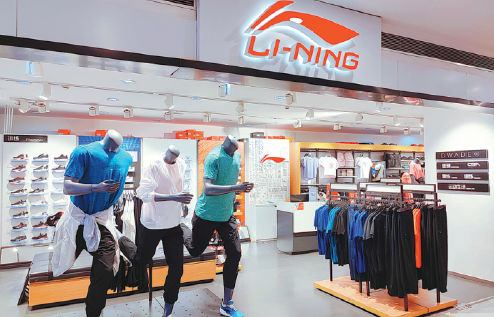
A Li-Ning store in Shanghai. CHEN YUYU/FOR CHINA DAILY
Source: China Daily
However, Adam Zhang, founder of Key-Solution Sports Consulting, a sports marketing and consulting company based in Beijing, said that sponsorship for the Tokyo Olympics was not as active as that for previous Games in terms of promotion and integration of online and offline activities. This was due to the constantly changing situation caused by the pandemic.
Zhang Qing, founder of Beijing's Key-Solution Sports Consulting Company, said that the sponsorship for the Tokyo Olympics was less active in terms of promotional efforts and a combination of online and offline activities compared to previous editions. This is mainly due to the continuous changes caused by the pandemic.
Zhang said that with the widespread use of mobile devices to watch the Olympics, the relationship between consumers, athletes and sponsors has changed significantly.
Zhang Qing stated that due to the widespread use of mobile devices by viewers to watch competitions, there have been significant changes in the relationship between consumers, athletes, and sponsors.
"From athletes competing and spectators watching events, to audience participation and content creation, a new kind of collaboration requires more long-term engagement and quick real-time responses from sponsors," Zhang said.
Zhang Qing said: 'From athletes competing and spectators watching, to spectators participating in content creation, a new sense of collective effort has made sponsors need to increase long-term investment and be able to respond quickly and in real time.'
Chinese beverage producers including Nongfu Spring and leading sportswear brands such as Li-Ning, Anta and Peak were among the sponsors.
Sponsors include Chinese beverage manufacturers such as Nongfu Spring, and leading sports brands like Li Ning, Anta, and Pique.
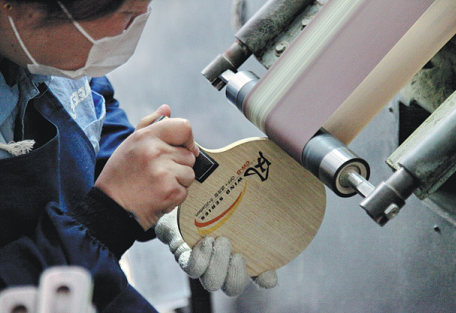
A worker finishes assembling a table tennis racket at a Shanghai DHS Group factory. PROVIDED TO CHINA DAILY
Source: China Daily
Anta Sportswear Group, a sports apparel giant and an official partner of the Chinese Olympic Committee, designed the podium uniforms for Team China at the Tokyo Olympics.
Anta Sports, a sports apparel giant, is an official partner of the Chinese Olympic Committee and designed the podium uniforms for the Chinese team.
The results of an Olympic 'mindshare' brand marketing survey just released by a leading research institution show Anta taking the lead over other brands, with a 40% share among customers.
The results of a recent Olympic 'Thought Sharing' brand marketing survey by authoritative research institutions show that Anta leads other brands with a share of 40% among customers.
In the first half of this year, Anta launched a new brand concept inspired by the Olympics. The company said it has frequently interacted with consumers on national mainstream media and social network platforms, winning over 10 billion brand views.
In the first half of this year, Anta launched a new brand concept inspired by the Olympics. The company stated that it has been frequently interacting with consumers on mainstream national media and social networking platforms, earning over 10 billion brand views.
Having worked with the Chinese Olympic Committee for 16 years, Anta has invested over 30(4.6) in the research and development of sportswear technology and has vowed to add another 40 to this sector.
Cooperating with the Chinese Olympic Committee for 16 years, Anta has invested over RMB 3 billion (US$460 million) in the research and development of sports apparel technology and has committed to increasing investment by another RMB 4 billion in this field.
Based in Xiamen, Fujian Province, the company has provided sportswear products for 28 Chinese teams competing at Olympic Games. It has developed advanced technologies to manufacture equipment for 10 teams representing China, including shoes and a waist support system for weightlifters and super-light shoes for boxers.
The company's headquarters is located in Xiamen City, Fujian Province, and has provided sportswear products for 28 Chinese teams participating in the Olympic Games. It has developed advanced technology to manufacture equipment for 10 Chinese teams, including weightlifters' shoes and waist support systems, as well as ultra-lightweight shoes for boxers.
This year, it launched "Anta championship experience stores" in key shopping locations, attracting a wide range of consumers. Licensed products have been introduced for the 2022 Winter Olympics in Beijing and Zhangjiakou, Hebei province. The items featuring the Chinese national flag attract buyers with "medium and high consumption capacity", paving the way for the company to open more such stores.
According to the company, it opened 'Anta Champion Experience Stores' at major shopping locations this year, attracting a wide range of consumers. The Winter Olympics held in Beijing and Zhangjiakou, Hebei in 2022 introduced licensed products. These products featuring the Chinese national flag have attracted buyers with 'moderate to high consumption capabilities,' paving the way for the company to open more such stores.
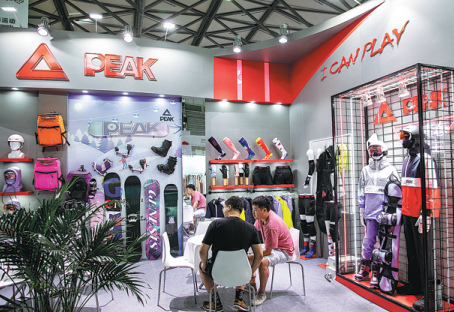
Products are displayed at a Peak store in Shanghai. PROVIDED TO CHINA DAILY
Source: China Daily
Revenue growth
Revenue increase
Ding Shizhong, Chairman of the Board of Directors and CEO of Anta Group, said that the company will continue to focus on sportswear, consolidate research and development, and continuously develop a multi-brand competitive edge to cater to sports-loving consumers in different market segments and fields.
Ding Shizhong, Chairman and CEO of Anta Group, stated that the company will continue to focus on sports apparel, consolidate R&D, continuously build competitive advantages across multiple brands, and cater to consumers who love sports in different market segments and fields.
The group can achieve this due to government policies promoting national fitness, as well as the Tokyo 2020 Olympics and the 2022 Beijing Winter Olympics, Ding said.
Ding said that the group was able to achieve this due to the government's policies promoting national fitness, as well as the Tokyo Olympics in 2020 and the Beijing Winter Olympics in 2022.
The Tokyo Olympics also boosted revenue and profits for sportswear manufacturer Li Ning Co. According to its interim report for this year, revenue soared by 65 percent in the first six months to 101, while net profits rose by 187 percent to 19.6. The brand sponsored the Chinese shooting, diving and table tennis teams.
The Tokyo Olympics also boosted the revenue and profits of sports apparel manufacturer Li Ning. According to this year's interim report, revenue surged by 65% to RMB 10.1 billion in the first six months, while net profit increased by 187% to RMB 1.96 billion. The brand has sponsored the Chinese shooting team, diving team, and table tennis team.
Zhang said that many Chinese sponsors have explored marketing innovation, for example by inviting gold medalists to participate in live-streaming sessions sponsored by brands.
Zhang Qing said that many Chinese sponsors have explored marketing innovations, such as inviting gold medal winners to participate in live events sponsored by the brand.
"The winners of the Olympics are 'nationals of the internet' - the athletes who participated and the internet users who volunteered to develop content based on real-time events at the Games," Zhang said.
Zhang Qing said that the winners of the Olympics are 'Internet natives' - athletes participating in the competition and internet users who voluntarily develop content based on real-time Olympic events.
Marketing major sporting events is now defined as 'emotional marketing', as young athletes and the events themselves create emotions that inspire the public and viewers, Zhang said.
Zhang Qing said that marketing of major sports events is now defined as 'emotional marketing', because young athletes and the events themselves create emotions that motivate the public and spectators.
He added that transforming emotions and traffic generated from such events into business and revenue opportunities requires brand teams to accurately locate the market and respond quickly.
He added that converting the emotions and traffic generated by such events into business and revenue requires the brand team to accurately position the market and respond quickly.
The strong momentum in China's sportswear industry is deeply rooted in government policies aimed at promoting national fitness and building a wholesome and healthy society.
The strong momentum in China's sports apparel industry is deeply rooted in the government's policies aimed at promoting national fitness and building a healthy society.
Last month, the State Council, China's Cabinet, unveiled a five-year blueprint for 2021 to 2025, designed to increase public participation in physical exercise. The guideline includes measures to increase the number of sports facilities in communities nationwide.
Earlier this month, the State Council of China announced a five-year blueprint for 2021 to 2025, aiming to increase public participation in physical exercise. The guide includes measures to increase the number of community sports facilities nationwide.
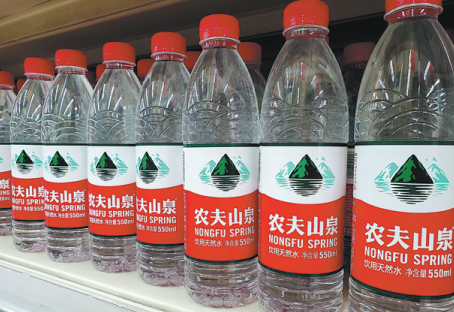
Nongfu Spring was one of the Chinese sponsors at Tokyo 2020. ZHU XIAOMENG/FOR CHINA DAILY
Source: China Daily
By 2025, the government aims for 38.5 percent of the population to participate regularly in physical exercise—last year, the proportion was 37.2 percent. According to the plan, the market scale of the sports sector in China is expected to reach 5 trillion yuan by 2025.
By 2025, the government's goal is to have 38.5% of the population regularly participate in physical exercise—last year, this proportion was 37.2%. According to the plan, by 2025, the market size of China's sports industry is expected to reach 5 trillion yuan.
The government also aims to set up more fitness facilities in counties, villages and communities, so that residents can access them within a 15-minute walking distance.
The government also plans to establish more fitness facilities in counties, villages, and communities, allowing residents to use these facilities within a 15-minute walk.
Lou, from Frost & Sullivan China, said: 'In the next five years, the plan seems set to give a huge boost to the development of the sports sector industry chain from upstream to downstream, as the level of support is unprecedented in China. Provinces and cities are expected to launch more-specific guidelines and encouragement measures in response to the blueprint.'
Lou Lei, Executive Director of Frost & Sullivan Greater China, said: 'In the next five years, this plan seems to offer tremendous impetus for the development of the sports industry chain from upstream to downstream, as the level of support is unprecedented in China. It is expected that provinces and cities will introduce more specific guidelines and incentives based on the blueprint.'
"China aims to improve the overall physical fitness levels of residents and promote fitness as a habit for the public, rather than just for a small group of professionals. Sports goods manufacturers, gyms and training venues are likely to benefit from this trend in the coming years," Lou said.
"The goal of China is to improve the overall physical fitness level of its residents and promote fitness as a habit for all, not just a small group of professionals," said Lou Lei. "Sports equipment manufacturers, gyms, and training venues may benefit from this trend in the coming years," he added.
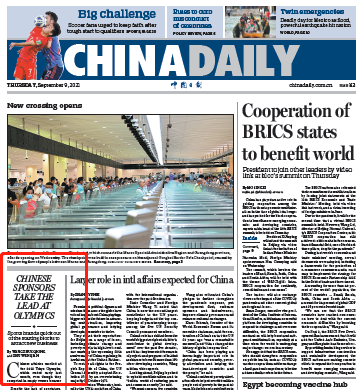
*This article is reprinted from 'China Daily', authored by WANG ZHUOQIONG and ZHU WENQIAN, with the original title 'Chinese sponsors take the lead at Olympics'.