NIXT China Summit
In the past few years, there have been tremendous breakthroughs in the technology sector. Emerging technologies such as artificial intelligence, metaverse, 5G, blockchain, Internet of Things, AR/VR have brought new opportunities and momentum, and the wave of digital transformation is spreading across all industries. Using emerging technologies has become a development key point that every enterprise must consider and prioritize. How can enterprises quickly grasp emerging technologies to drive their own business digital transformation? How can they explore markets through emerging technologies and establish new business models?
From July 19th to 21st, 2023, the NIXT China Summit was successfully held at the National Convention Center in Beijing. The conference focused deeply on emerging technologies, connecting all stakeholders in enterprise digital transformation, and conducted exchanges and discussions on six vertical industries: artificial intelligence, smart cities, finance, advanced manufacturing, logistics, and retail, providing assistance for industry and enterprise digital transformation.
Frost & Sullivan (Frost & Sullivan, abbreviated as "Frost & Sullivan") was invited to attend the conference.
According to the "China Data Element Market Development Report (2021-2022)" by the China Industry and Information Security Administration, enterprises that achieve digitization can maintain a 41.2% increase in business growth, a 42.8% increase in production efficiency, and a 15.3% reduction in product research and development cycles. With the acceleration of the wheels of the digital economy era, the gap between leading and lagging digital enterprises will continue to widen.Enterprise digital transformation is inevitable, not an option. Digitization is an important lever to help traditional enterprises transform into new forms and an inevitable choice to support the strategic development of companies. Enterprises should leverage digital technology to build unique competitiveness and disrupt existing markets with new products and services.
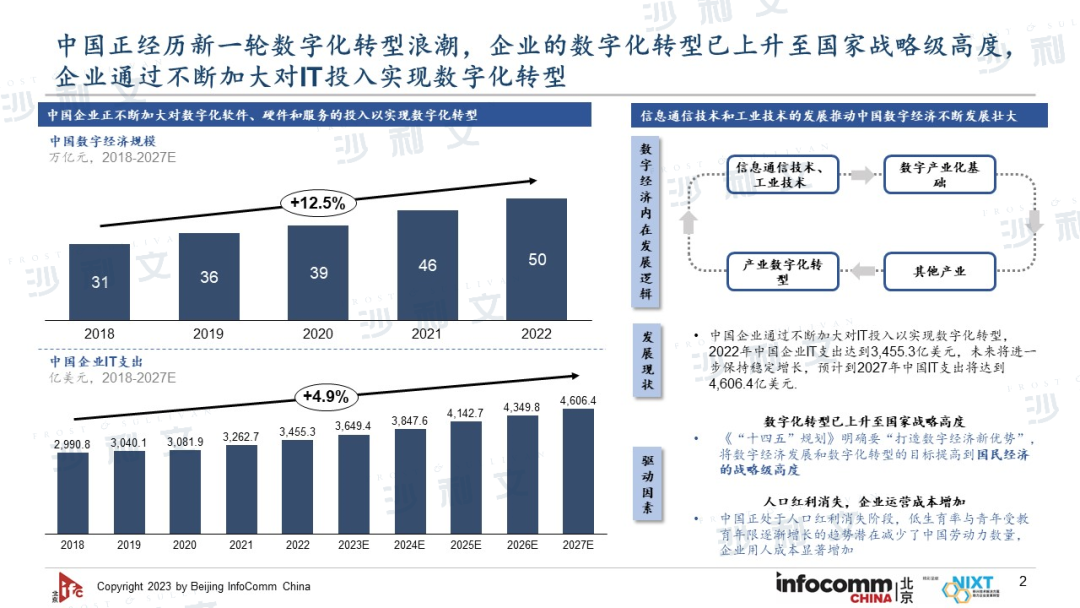
The development of information and communication technology and industrial technology has continuously promoted the continuous growth and expansion of China's digital economy. China is experiencing a new wave of digital transformation. Currently, developing the digital economy has been elevated to the level of national strategy, with the State Council and the Ministry of Industry and Information Technology successively introducing favorable policies to promote enterprise digital transformation, such as the "14th Five-Year Plan" which clearly states the goal of "creating new advantages in the digital economy." At the same time,Enterprises are also achieving digital transformation by continuously increasing IT investment. In 2022, Chinese enterprises' IT expenditure reached $345.53 billion, and it is expected to continue growing steadily in the future, with China's IT expenditure expected to reach $460.64 billion by 2027.
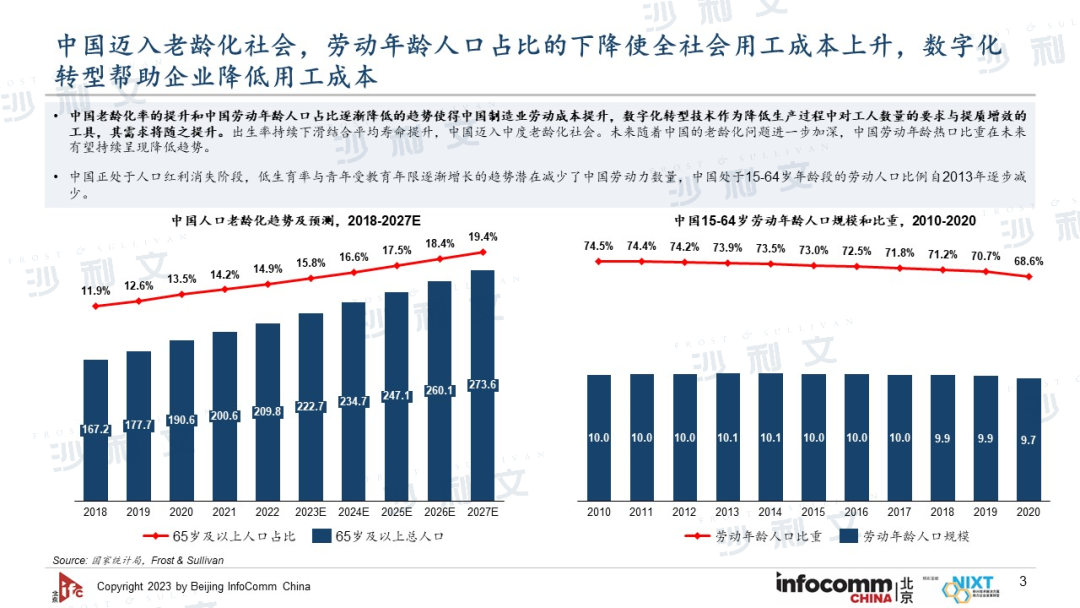
In addition, with the continuous decline in birth rates combined with an increase in average life expectancy, China has entered a moderately aging society.The increasing aging rate and the gradual decrease in the proportion of working-age population have led to an increase in labor costs in China's manufacturing industry. As a tool to reduce the demand for the number of workers during production and improve quality and efficiency, the demand for digital transformation technology will increase accordingly.It is expected that in the future, as China's aging problem deepens further, the proportion of working-age population in China will continue to show a downward trend.
Digital technology has penetrated into all aspects of social and economic life, and the new economy will become an important support point for economic growth. In the face of the wave of digital economic development, it is necessary for China to seize development opportunities, drive the transformation of traditional industries, promote high-quality economic development, build a new development pattern, and achieve the rise of a great nation.
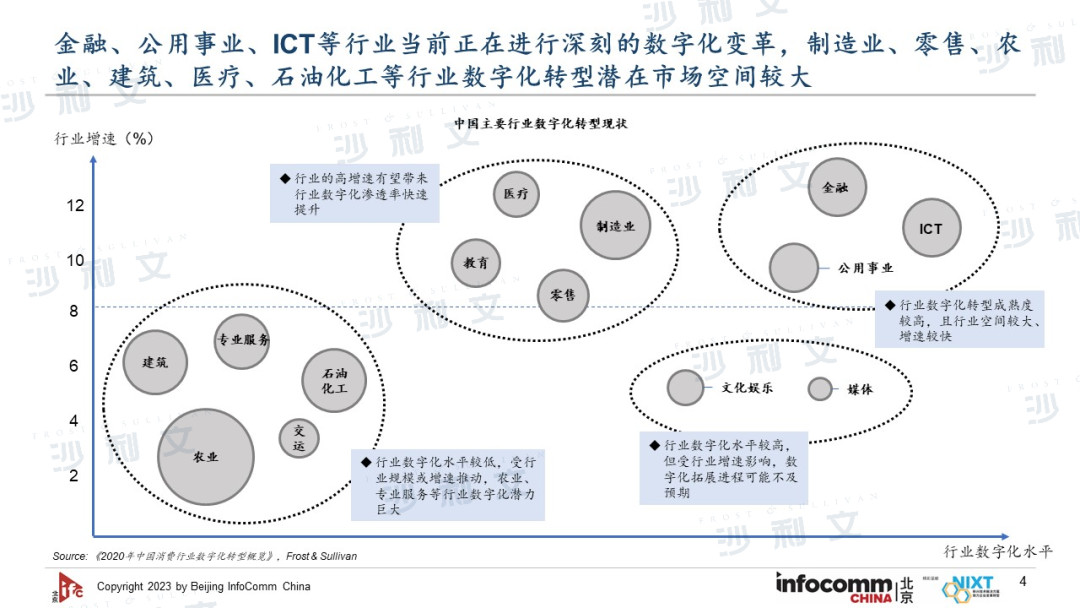
According to Frost & Sullivan research, looking at the current digital transformation status of major industries in China, the service industry currently has the highest penetration rate of digitization. Since the tertiary industry has always been a key area of digital transformation, its level of digitization and speed of digital transformation rank first among the three major industries, far higher than the digitization process of agriculture and industry. In the future, the pace of digitization in agriculture and industry will accelerate. With the maturity of 5G infrastructure, combined with the integration of new infrastructure such as industrial Internet, Internet of Things, and cloud computing from pilot construction to integrated applications, digital technology will penetrate deep into the tertiary industry, while accelerating its penetration into the secondary and primary industries, with development dividends expected to radiate into sub-sectors such as smart factories, smart energy, and smart agriculture.
However, it should be noted that although the current digital transformation penetration rate in China has been comprehensively improved, there is still a dilemma of high failure rates, making successful digital transformation for Chinese enterprises a long and arduous journey.The main problems at this stage are manifested in the lack of systematic and holistic awareness of digital transformation among enterprises, the lack of a systematic transformation framework that prevents them from implementing digital strategies, and the lack of effective measurement mechanisms.
Enterprises' digital transformation mainly includes the construction of digital cultural organizations and digital technology platforms. Successful digital enterprises rely on a complete strategy, through more agile business processes, interconnected platforms, analysis tools, and collaboration capabilities to improve production efficiency, thereby achieving a more lean and agile operational model.
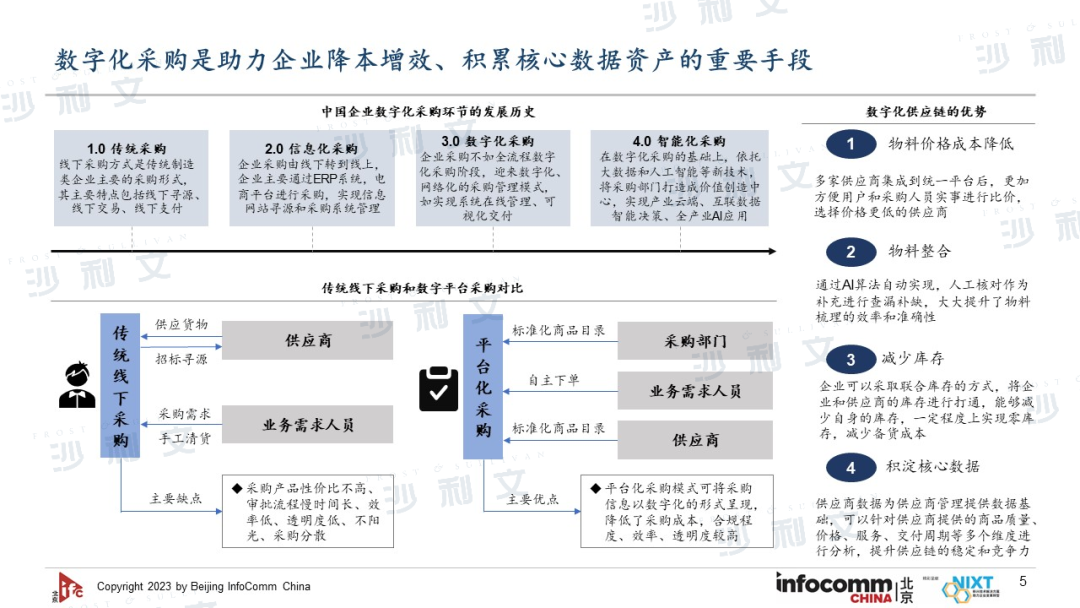
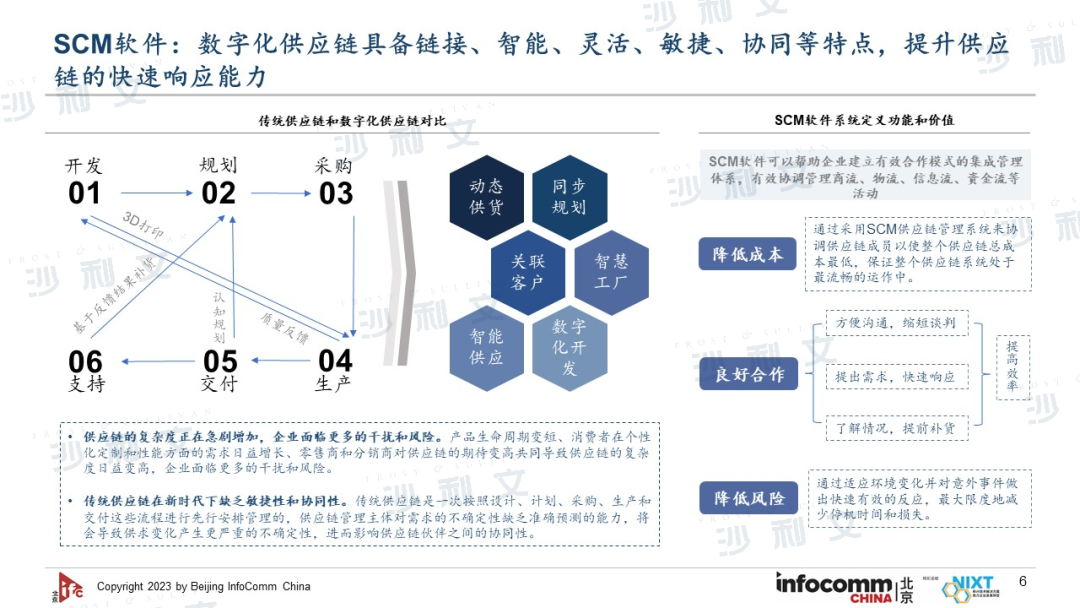
For example, digital procurement is an important means to help enterprises reduce costs and increase efficiency, and accumulate core data assets. Compared with traditional offline procurement, the platform-based procurement model has prominent advantages, as it can present procurement information in a data form, reducing procurement costs and featuring high efficiency and transparency; digital supply chains can integrate and optimize enterprise supply chains, covering multiple links from suppliers to end-users, including raw material procurement, production, warehousing, logistics, sales, etc. By improving upstream and downstream supply chain relationships and integrating and optimizing information flow, logistics, capital flow, etc. in the supply chain, enterprises can enhance their competitive advantage.
In summary, enterprise digital transformation is not only a trend but also an inevitable choice for enterprises to improve competitiveness and development. Digital transformation will lead enterprises into the future.