From July 24th to 25th, 2021, the 2021 China Commercial Health Insurance Conference, hosted by CaiBailan and co-organized by WardHealth, Magnesium Health, Easy Group, Jumei Engine, HuaMeihaoLian, and Junling Health, was grandly held in Shanghai.
At the invitation of the organizers, Ms. Ding Zhuowen, Managing Director of Frost & Sullivan's Greater China Region (hereinafter referred to as 'Frost & Sullivan'), attended the conference and delivered a keynote speech titled 'Industry Development Models and Strategies in the Context of Health Insurance under the Perspective of Health Management', based on the '2021 White Paper on Promoting the Development of Health Management through Health Insurance jointly released by Frost & Sullivan and LeadLeo Research'. The main contents of the speech are as follows:

In the context of China's basic medical insurance system, a multi-level social and commercial integrated medical security system has been basically established.
Since the Third Plenary Session of the 18th Central Committee in 2016, which elevated the construction of a 'Healthy China' to a national strategy for the first time, the development concept of the healthcare system has shifted from 'disease treatment-centered' to 'health promotion-centered', and clear requirements have been put forward for the reform of China's medical security system.
At present, China has formed a multi-level social medical security system that takes basic medical insurance as the main body, medical assistance as the foundation, and is supplemented by civil servant subsidies, enterprise supplementary insurance, special population insurance, commercial health insurance, etc. Health insurance has a protective nature and plays an important role in China's medical security system.

With the continuous rapid growth of premium income from health insurance, the depth and density of health insurance have also increased synchronously.
The scale of health insurance premium income has been continuously expanding, with significant fluctuations in growth rates. From 2010 to 2020, the scale of China's health insurance premium income increased from 677 billion yuan to 8173 billion yuan, with an annual compound growth rate of 28.3%.
Affected by policy adjustments, the growth rate of premium income fluctuated significantly over the past decade. It showed a continuous rapid growth trend from 2012 to 2016. However, due to the regulation of medium and short-duration life insurance products and the restriction on fast-return products, the growth rate of health insurance premiums has slowed down.
The outbreak of the COVID-19 pandemic has promoted an increase in people's awareness of health protection, and health insurance premiums in 2020 were significantly higher than those for life insurance and other types of insurance.

The depth and density of health insurance continue to increase, and market maturity has been improved. From 2010 to 2020, China's health insurance density (calculated as the average insurance premium per resident within a defined statistical area) increased from 51 yuan per capita to 575 yuan, while the insurance penetration (measured as the proportion of premium income to the country's GDP) rose from 0.16% to 0.74%. During this period, China's health insurance depth and density maintained a relatively rapid growth rate.

Driven by multiple factors such as policies and the market, health insurance and health management are accelerating their integration.
Driven by multiple factors such as policy orientation, market development, and technological progress, insurance companies have begun to explore health management services. They integrate health management services into health insurance products to improve the quality of insurance services and enhance user experience.
The government and insurance companies are the two main entities driving the integrated development of health insurance. Insurance companies establish health management institutions through equity investments, directly conducting health management, or by collaborating with pharmaceutical enterprises, biotechnology companies, and medical institutions to obtain health data and technical support. They combine health management services with health insurance products to enhance their health management service capabilities.
In addition, the government plays an important role in promoting the integrated development of health insurance and health management. By cooperating with insurance companies, it jointly launches inclusive health insurance products to create a 'people's livelihood project' that benefits the people.

Under the background of national health, three strategies for health insurance to promote the development of health management
Ms. Ding pointed out that, based on the regulatory environment of health insurance, current market conditions, and the phased characteristics of the health management market, there are three major strategies for promoting the development of health management through health insurance:
Policy 1:Adopting the 'Health Insurance + Medical Healthcare' model, integrating medical resources such as physical examinations, screenings, and rehabilitation, to create a closed-loop health management system for the entire life cycle.
Policy 2:Drawing on the development experience of health insurance in the United States, adopting a mixed development model can boost the upgrading of the health management service industry with dual attributes.
Policy 3:Implement a differentiated positioning strategy to enable enterprises to obtain more market opportunities while effectively controlling costs.
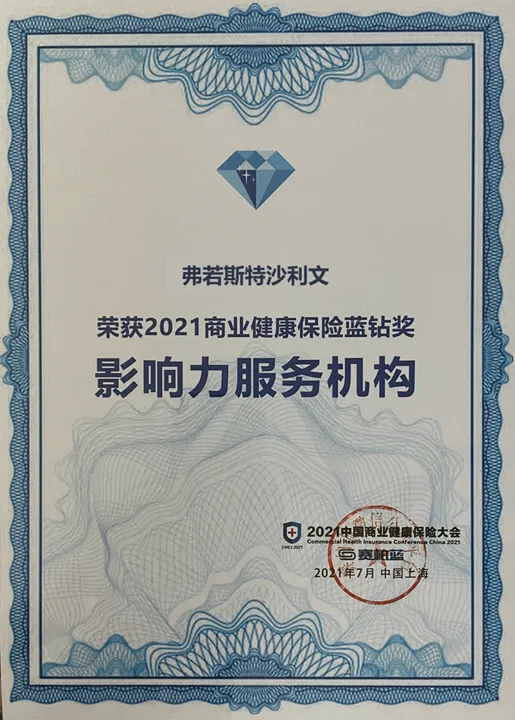
The conference organizing committee conducted in-depth research and comprehensive evaluation of various stakeholders in the commercial health insurance sector. It highly recognized and commended Frost & Sullivan's relevant research and insights into the industry, believing that their studies play an important guiding role in the development of the industry and the growth of industry participants. The committee has decided to confer Frost & Sullivan2021 Business Health Insurance Blue Diamond Award - Influential Service Provider.