Insights from Frost & Sullivan
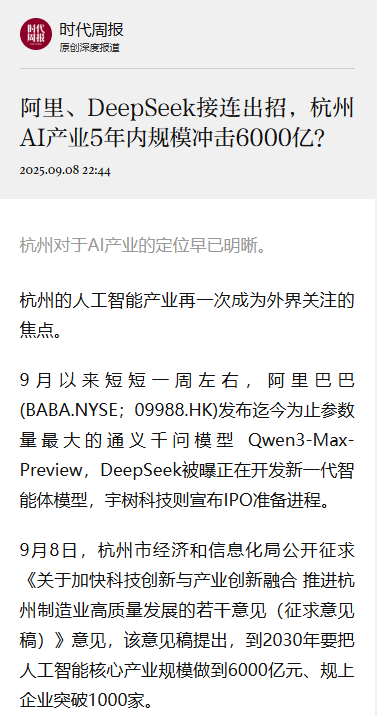
On September 8th, the Hangzhou Economic and Information Technology Bureau publicly solicited opinions on 'Several Opinions (Draft for Soliciting Comments) on Accelerating the Integration of Technological Innovation and Industrial Innovation to Promote the High-quality Development of Hangzhou's Manufacturing Industry'. The draft proposes that by 2030, the scale of the core AI industry should reach 600 billion yuan, with over 1,000 enterprises above designated size. Will the demand for domestic substitution of AI chips accelerate in 2025? Is the main direction of substitution towards the inference end or the training end? What is the potential market for domestic AI computing power chips in the next three to five years? How large will it probably reach?
Tran Cui, Executive Director of Frost & Sullivan Greater China, was interviewed by Times Weekly to discuss the domestic substitution of AI chips and future market potential.
Times Weekly
*Click on the end of the articleRead the original articlefor a complete report
Q:Will the demand for domestic substitution of AI chips accelerate in 2025? Is the main direction of substitution towards the inference end or the training end?

Tran Cui
Executive Director of Frost & Sullivan Greater China
From the current industrial and policy environment, it is very likely that the demand for domestic AI chip substitution will enter an accelerated phase in 2025. There are three reasons:
First, the international environment remains uncertain, and the security of the computing power supply chain has become a consensus in the industry, with domestic manufacturers and application enterprises having an urgent need to strengthen their autonomy and control.
Second, the implementation of domestic AI applications is expanding, whether it is the deployment of large models on the enterprise side or the application of generative AI on the consumer side, both driving larger-scale computing power demand.
Third, the technical capabilities and ecological adaptability of domestic chip manufacturers have significantly improved in the past two years, and they are already ready to undertake larger-scale applications.
As for the direction of substitution, the inference end will be substituted faster in the short term. Inference scenarios have higher requirements for chip cost-effectiveness, energy efficiency ratio, and ecological adaptability, and domestic manufacturers can already provide competitive solutions in these dimensions. At the same time, the domestic application market is vast, providing opportunities for rapid iteration. The substitution of the training end is also advancing, but due to the involvement of software frameworks, ecological compatibility, and the stability verification of large-scale computing power clusters, the progress will be more steady and may require a longer time window.
Q:What is the potential market for domestic AI computing power chips in the next three to five years? How large will it probably reach?

Tran Cui
Executive Director of Frost & Sullivan Greater China
In the next three to five years, the market space for AI computing power chips in China will be very large, mainly due to the following reasons:
First, the breadth and depth of the demand side are continuously expanding. Large models are gradually becoming the infrastructure for industrial intelligence, not only with internet companies increasing their investment but also traditional industries such as finance, energy, manufacturing, and healthcare actively exploring AI applications. This means that the long-term demand for inference and training computing power will remain high.
Second, dual-driven by policy and capital. At the national level, it has been clearly stated that an autonomous and controllable computing power system should be built, and local governments are also promoting the construction of intelligent computing power centers. At the same time, the capital market's investment enthusiasm for AI computing power has not diminished, creating an environment for the accelerated maturity of the industrial chain.
Third, ecological factors are gradually improving. With the continuous progress of domestic chips in hardware performance, software stack compatibility, and developer ecosystems, the adoption threshold for application enterprises is gradually decreasing, and the conditions for chip large-scale implementation are maturing.
Therefore, in the next three to five years, the domestic AI computing power chip market will not only grow rapidly in scale but more importantly, AI computing power chips will become one of the most strategically significant links in the entire AI industrial chain.
*This interview has been published in Times Weekly, with reporter Zhu Chengcheng, and the original title was: Alibaba, DeepSeek Launch Successive Moves, Will Hangzhou's AI Industry Reach 600 Billion in Size within Five Years?
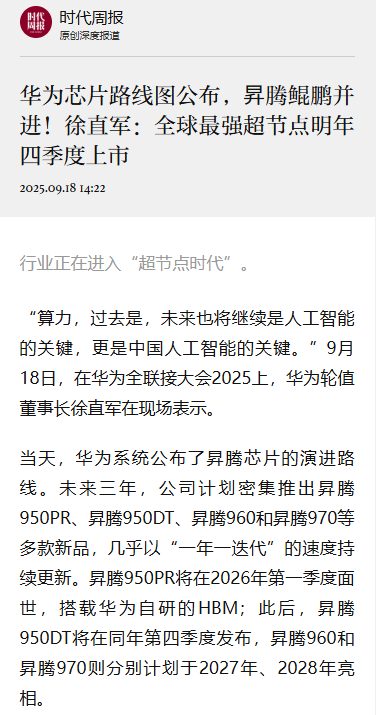
Huawei's chip roadmap announced, Ascend Kunpeng advancing side by side! Xu Zhijun: The world's strongest super-node will be launched in the fourth quarter of next year