To ensure the healthy development of private higher education groups listed on the Hong Kong stock market and offer suggestions to relevant government decision-making departments,6month10On the same day, the Private Education Research Center of Soochow University held an internal seminar on 'Sustainable Development of Hong Kong-listed Private Higher Education Groups'. Frost & SullivanFrost & SullivanLiu Wenjun, Executive Director of Greater China and Head of the Education Consulting Business Unit at Frost & Sullivan (referred to as 'Frost & Sullivan'), was invited to participate in a seminar and delivered a speech on 'Exploration and Practice of the Current Situation and Development Path of Private Higher Education in China with Capital Support'.
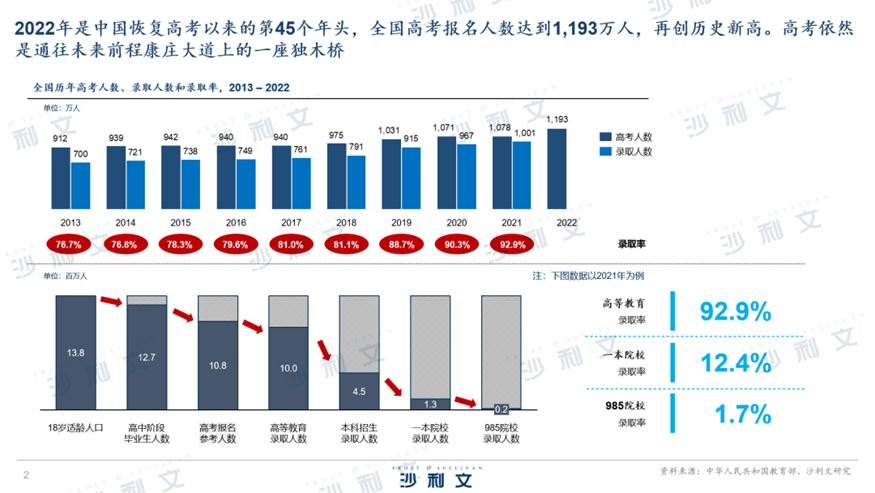
The data shows,2022The number of applicants for the national college entrance examination reached1193Tens of thousands, setting a new historical high. Moreover, with the continuous expansion of enrollment at major national universities, the admission rate for the college entrance examination has decreased from2013year76.7%Grew to2021year92.9%. However, this does not mean that higher education resources are already abundant domestically; competition for high-quality educational resources and higher education degrees remains fierce. with2021Taking the year as an example, those who were admitted to colleges and universities through the college entrance examination1,000Among tens of thousands, less than half are admitted to undergraduate programs450Around 10,000 people), while first-tier universities and985The number of admissions to institutions is even more limited, with first-tier universities having an admission rate for that year12.4%, and985The admission rate of the institution is only1.7%.
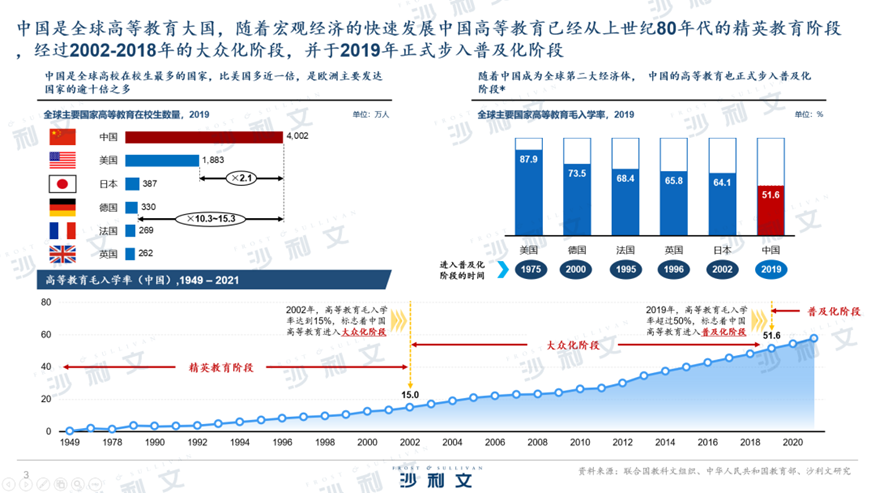
Liu Wenjun believes that if we use a numerical indicator to measure the development process of higher education in China and define milestones, then this indicator must be the gross enrollment rate in higher education.1978In that year, the gross enrollment rate of higher education in China was only1.55%At that time, higher education was in the stage of elite education; by2002In that year, the gross enrollment rate of higher education in China reached15%marks the entry of higher education in China into the popularization stage; by2019In [year], the gross enrollment rate of higher education in China exceeded50%(51.6%), marking the official entry of higher education in China into the popularization stage; as of2021In [year], this numerical indicator in China reached57.8%.
Compared with Western developed countries, the development of higher education in China is still a bit slower. Currently, the gross enrollment rate of higher education in the United States has exceeded80%Developed countries such as the UK, France, Germany, and Japan have also surpassed60%.
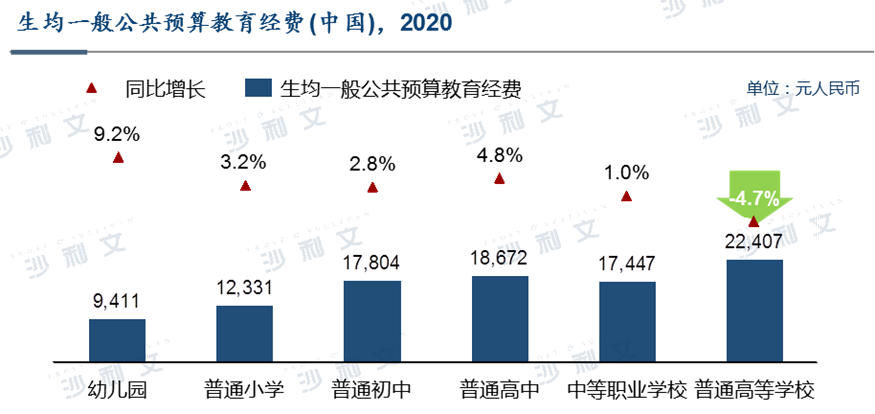
Education is the foundation of a nation, and the highest leadership core has set a financial bottom line guarantee to support the development of education. 'One not lower than, two only increasing' demonstrates our Party's determination to develop education, while the continuously growing social demand for education also brings new challenges to its development.2021The release of the 'Notice on the Joint Efforts of the Ministry of Education, National Bureau of Statistics, and Ministry of Finance regarding2020According to the 'Statistical Bulletin on the Implementation of National Education Funds for the Year', the average general public budget education expenditure per student in regular institutions of higher learning nationwide is22,407.39Yuan, a year-on-year decrease4.65%.
Average public expenditure per student on education (china),2020
 Source: Frost & Sullivan
It can be seen that, against the backdrop of a continuous increase in the number of higher education students and rising popularization and enrollment rates, this has brought new pressures and challenges to the requirements for fiscal education funding in our country and the development of the education sector. Under the premise of limited growth in national financial funds, the efficiency of fund use becomes particularly important.
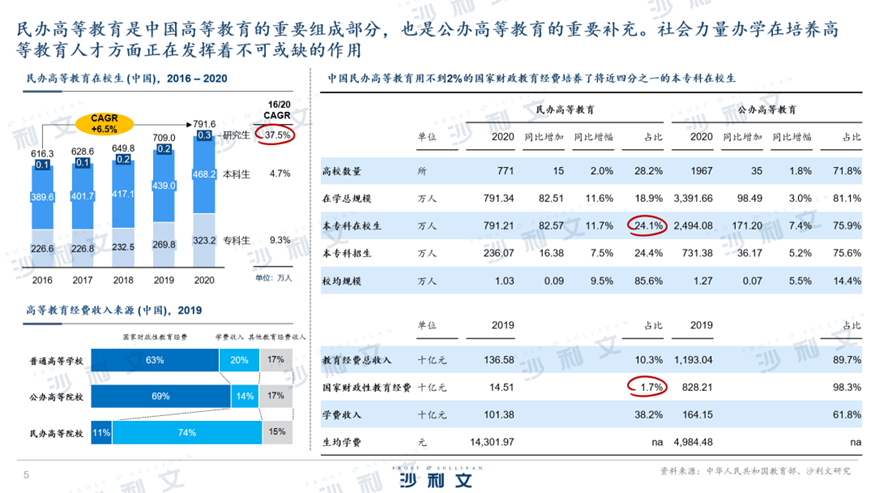
Liu Wenjun stated that private higher education is an important part of China's higher education and also a significant supplement to public higher education. The role of social forces in running schools is playing an indispensable role in cultivating higher education talents. According to the data in the 'National Education Development Statistical Bulletin' disclosed by the Ministry of Education,2020Number of private general higher education institutions across the country771Colleges (including independent colleges241%), accounting for the total number of general higher education institutions in the country28.2%; Regular undergraduate and junior college students791.34Ten thousand, a year-on-year increase11.6%, accounting for the undergraduate and junior college students in institutions of higher learning across the country24.1%.2019In [year], the national financial education funds for private higher education institutions were approximately145Yuan, accounting for about1.7%From this perspective, private higher education institutions in China do not need2%The national financial education funds have cultivated nearly one-fourth of the undergraduate and junior college students nationwide. In addition, private higher education institutions also play an important role in the process of vigorously developing and constructing vocational and technical education, as well as in the action to improve the quality and excellence of vocational education.
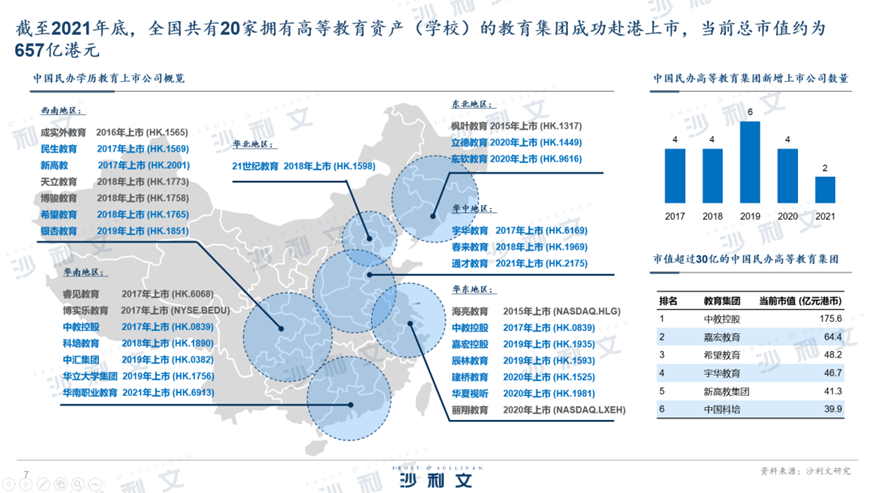
2017Since the beginning of this year, social education forces represented by private university organizers have embarked on the exploration of capitalizing private higher education.2017The year marked the first year of capitalization for private higher education. Yu Hua Education, Minsheng Education, New Higher Education Group, and China Education Holdings have successively listed on the Hong Kong Stock Exchange, officially bringing private higher education in China into the sight of international capital. According to Frost & Sullivan statistics,2017till2021At the end of the year, there were a total of20An education group with higher education assets successfully went public in Hong Kong, raising a total of more than214HK$10 billion, with the current total market value being approximately657HK$10 billion.

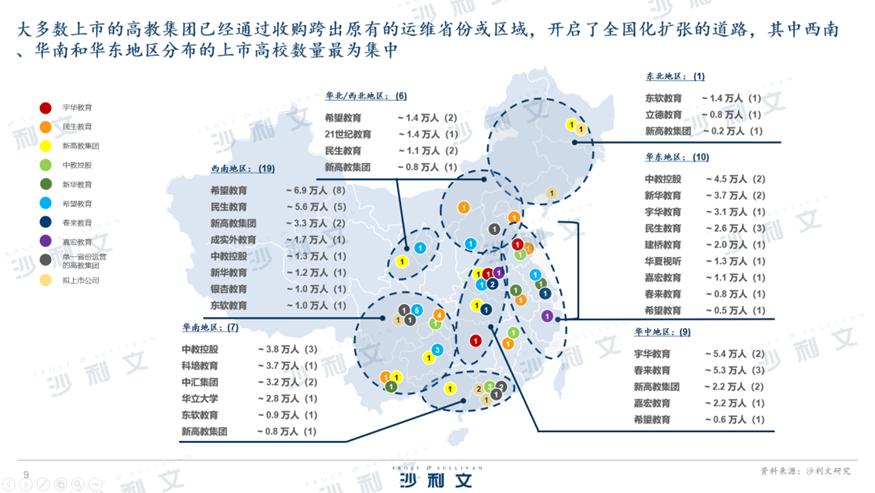
"Going public is just the first step in the rapid development of private higher education groups," said Liu Wenjun. "Most listed private higher education groups use the funds raised through listing to carry out mergers and acquisitions, expanding beyond their original operating provinces or regions and embarking on a path of national expansion. Among them, the number of listed universities distributed in Southwest, South China, and East China is the most concentrated." The influx of capital has helped private higher education achieve better development conditions and faster growth.
2019In China, the capitalization process of private higher education accelerated in 2021, with mergers and acquisitions exceeding initial public offerings.(IPO)Become the main way for private universities to capitalize. after sand According to a survey by Liewen, most acquisition targets either have serious debts or other funding shortages, indicating certain 'defects' in the target companies. The mergers and acquisitions of listed companies not only solve the debt problems of the targets but also provide necessary financial support for the expansion and sustainable development of schools. At the same time, the rich experience of listed companies in school operation and management is also very beneficial for the subsequent restructuring, upgrading, and other development actions of the acquired schools.
Over the past five years, Frost & Sullivan has served more than60Home Education Group and more than120Investment and financing of private schoolsIPO listing(listed) projects, and have successfully assisted over40An education group goes to Hong Kong/Going public in the US, among which there are more than29Home, covering all Chinese degree-earning education enterprises listed on the capital market.
In the future, Frost & Sullivan will continue to empower the development of China's education industry, especially private higher education groups and schools, through professional services, contributing its part.