Frost & Sullivan insights
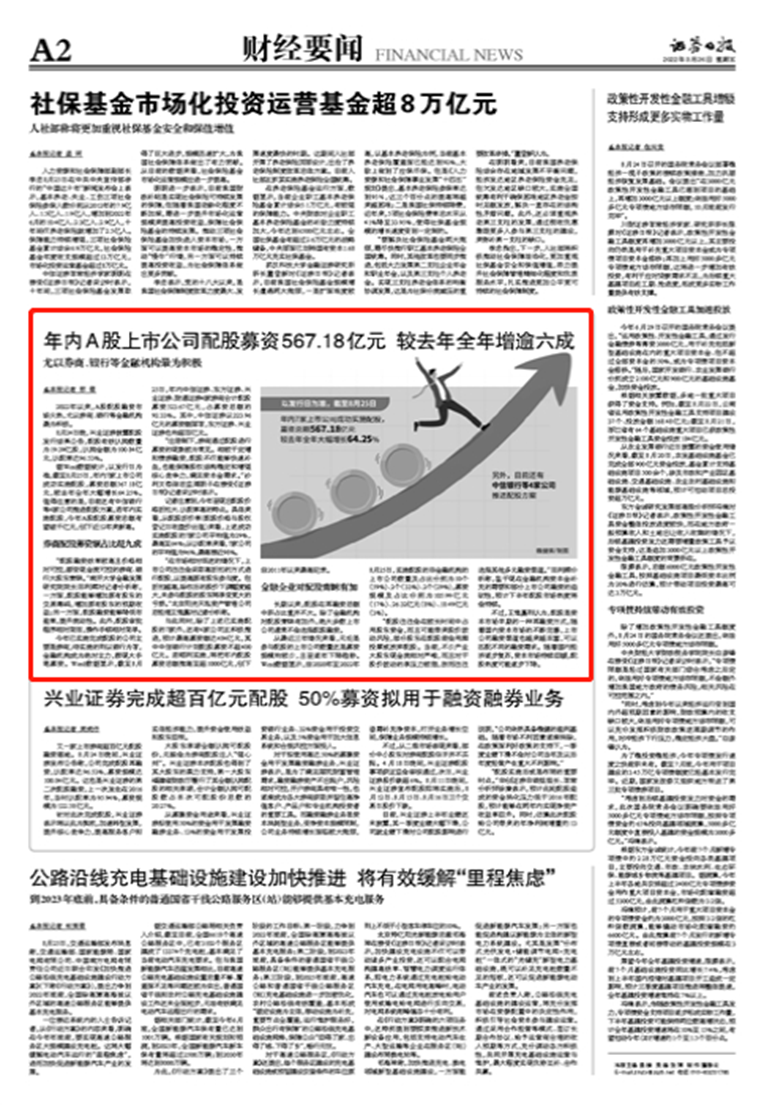
2022Since the beginning of this year,AThe market for share-based capitalization financing is booming, especially among financial institutions such as securities firms and banks. As of8month25day, within the year7Total amount of funds raised by the listed company after successfully implementing a rights issue567.18Yuan billion, a significant increase compared to the whole year of last year64.25%.
Why is the scale of share placement financing by securities firms and banks so large this year? Among refinancing instruments, placements are not popular, with few listed companies adopting them except for institutions. What are the reasons? Frost & SullivanFrost & SullivanZhou Mingzi, consulting director for Greater China at Frost & Sullivan (hereinafter referred to as 'Frost & Sullivan'), was interviewed by Securities Daily to discuss the reasons behind the booming rights issue financing market.
Securities Daily
2022Since the beginning of this year,AThe market for share-based capitalization financing is booming, especially among financial institutions such as securities firms and banks.
8month24On the evening of the same day, Industrial Securities disclosed the announcement on the results of the rights issue issuance. The valid subscription quantity for the rights issue was19.39100 million shares, subscription amount100.84Yuan, with a subscription rate of96.53%.
According towindData statistics are based on the issuance date, as of8month25day, within the year7Total funds raised by the listed company after successfully implementing a rights issue567.18Yuan billion, a significant increase compared to the whole year of last year64.25%It is worth noting that there are currently CITIC Bank, etc.4The company is advancing a rights issue plan. If the rights issue is implemented within this year,AThe total amount of funds raised from share placements and rights issues is expected to exceed 100 billion yuan, setting a new high in recent12New highs for the year.
The proportion of funds raised from brokerages' rights issues exceeds 90%.
"The efficiency of rights issue financing is relatively high and the price is relatively controllable, which is quite favored by major shareholders of securities firms and banks with manageable cash flows." Tian Lihui, dean of the Financial Development Research Institute at Nankai University, analyzed to reporters that on one hand, rights issues can increase the trading chips of existing shareholders and their expected returns; on the other hand, rights issue financing can reduce the price-earnings ratio and enhance liquidity. In addition, the approval process for rights issues is relatively simple, and the operational procedures are also straightforward.
Companies that have completed the rights issue this year are mainly securities firms, followed by banks. Financial institutions have become the absolute main force, frequently making large-scale fundraising efforts.windData shows that as of8month25On the same day, CITIC Securities, Orient Securities, Industrial Bank Securities, and Caitong Securities within the year4Total share placement proceeds of the listed brokerage firm523.67Yuan, accounting for the total raised funds92.33%Among them, CITIC Securities is223.96The fundraising amount of hundreds of billions ranks first, with both Orient Securities and Industrial Bank Securities also exceeding one hundred billion.
Zhou Mingzi
Frost & Sullivan Greater China Consulting Director
"Under the registration-based system, it is quite common for securities firms to raise funds through rights issues. Compared with private placements and bond financing, rights issues can not only quickly replenish capital but also ensure a stable equity structure and enhance core competitiveness, meeting the needs of capital." Zhou Mingzi, consulting director at Frost & Sullivan, said in an interview with a reporter from Securities Daily.
The reporter noted that this year has seen significant discounts in the issue price and a high subscription rate. Specifically, looking at the issue discount rate (the ratio of the issue price to the closing price on the record date), the aforementioned successful implementation of the rights issue7Company average29%, up to64%; In terms of matching rate,7The average value of the home company96%, with a maximum close98%.
"In a relatively sluggish market, listed companies often adopt high discounts for rights issues to increase the participation of existing shareholders. However, the higher the discount, the greater the price drop after ex-rights, and shareholders who do not participate in the rights issue will bear greater losses," Wang Weijia, general manager of Beijing Sunshine Tianhong Asset Management Company, analyzed to reporters.
Meanwhile, in addition to the aforementioned share placements that have been carried out7Outside the home, there is also4The company is actively promoting and expects the maximum fundraising amount to reach484100 million yuan, among which CITIC Bank plans to raise funds through rights issue not exceeding400Yuan. If successfully implemented, it will push the total amount raised from this year's rights issue above1000yuan, setting a new record since2011The highest record since [start year].
Financial enterprises are showing a strong preference for rights issues
For a long time, the proportion of rights issues in total refinancing has not been significant. Apart from financial institutions showing a strong preference for rights issues, the vast majority of listed companies usually do not choose to raise funds through rights issues.
Looking at the past three years, both the number of listed companies participating in rights issues and the scale of fundraising have been relatively small, showing a downward trend year by year.windData shows that since2020Year-end2022year8month25On _, the number and proportion of listed companies with rights issues among non-financial institutions were as follows:10an59%),2an33%),2an29%), with the fundraising scale and proportion being105.99100 million yuan17%),26.32100 million yuan8%),18.49100 million yuan3%).
"Rights issues often occupy shareholders' funds for a long time and may bring risks of stock price fluctuations. Some shareholders may vote against or abstain from rights issues before they occur. Currently, many major industrial shareholders have relatively severe cash flows and are less able to bear stock price fluctuations, so they tend to choose other diversified financing channels." Tian Lihui analyzed that given the current need for capital replenishment by financial institutions and the urgency of financing for some listed companies, it is expected that the enthusiasm for the rights issue market will continue in the second half of the year.
However, Wang Weijia believes that rights issue is an early form of refinancing in the capital market. With the continuous improvement of the domestic capital market, listed companies have increasingly diversified their financing channels to meet different financing needs. As the domestic economy gradually recovers and the capital market continues to warm up, the enthusiasm for rights issues may gradually decline.
*This article is reprinted from 'Securities Daily'.Author: Xing Meng,Original title:within the yearAEquity listed company rights issue for fundraising567.18100 million yuanMore than 60% higher than the whole of last year">
Frost & Sullivan Insight & Extended Readings
QThis yearAThe reason for the high scale of share-based and rights issue financing is the substantial investments made by securities firms. Why has the scale of share-based and rights issue financing by securities firms and banks been so large this year?
A: The scale and strength of capital funds are one of the important foundational capabilities for securities firms, as well as a necessary basis for banks to maintain stable loan disbursement. Against the backdrop of the reform of the registration-based system, it is quite common for securities firms to raise funds through rights issues. Compared to private placements and bonds, rights issues can not only quickly replenish capital but also enhance core competitiveness while ensuring the stability of the equity structure. For banks, they need core capital to be replenished through rights issues. This is mainly due to the continuous deepening of capital market reform policies in recent two years, with both securities firms and banks having a demand for capital funds to meet their business development needs.
QIn refinancing instruments, rights issues are not popular and are rarely adopted by listed companies except by institutions. What are the reasons?
A: There are many ways for listed companies to raise funds after going public, mainly including rights issues, conversions, and additional shares issuance. One limitation of rights issues is the quantity restriction; the number of shares allocated cannot exceed the number of shares outstanding before the allocation.30%Secondly, rights issue is the issuance of new shares to existing company shareholders. For original shareholders who do not participate in the rights issue, there is a risk that their shares may be diluted, and there is also a risk that the company's stock price may fluctuate.Therefore, market investors hold reservations about the rights issue method.