 Chinese Cosmetics .
China Cosmetics magazine is a professional and authoritative media in the cosmetics industry supervised by the China Federation of Commerce, with an internal publication number.CN:11-3013/TsInternational ISSNISSN:1004-5163.
In recent years, due to the improvement of residents' income levels in China, their pursuit of quality of life, enhanced health awareness, and consumption upgrading, skincare products have become a highly concerned area among Chinese consumers. As the cleaning cosmetics with the largest consumption volume and essential items for daily life in the Chinese cosmetics market, skincare products still have great sales volume and development potential.
Frost & SullivanFrost & Sullivan,Xie Weirong, a consulting analyst at Frost & Sullivan's Greater China region and the author of an article on the domestic skincare market format for China Cosmetics magazine, discussed the current situation and future development trends of the domestic skincare market.
 China Cosmetics Magazine
author | Xie Weirong
Frost & Sullivan consulting analyst
In recent years, due to the improvement of residents' income levels in China, their pursuit of quality of life, enhanced health awareness, and consumption upgrading, skincare products have become a highly concerned area among Chinese consumers. As the cleaning cosmetics with the largest consumption volume and essential items for daily life in the Chinese cosmetic market, skincare products still possess great sales potential and development prospects.
Ten or even five years ago, the largest share of the personal care market was held by international daily chemical giants such as Procter & Gamble, Unilever, and L'Oréal.
and2020At the beginning of the year, a sudden COVID-19 pandemic(COVID-19)Rapidly spreading globally, in response to the government's call for self-quarantine at home, the method has driven the rise of the live streaming e-commerce industry. The emergence of WeChat business and e-commerce has begun to transform the domestic skincare market ecosystem.
Development History and Current Situation of the Chinese Personal Care Market
The development of China's personal care industry began at20century60The era roughly went through four stages:
The first phase is the initial cleaning era, The national income level is low, and the domestic consumer goods market is limited. The hair care industry has not received widespread attention. In the early years, people mainly used basic products such as soap, shampoo, and conditioner to clean their hair;
The second phase is the infancy of skincare products,70At the end of the decade, the concept of separating shampoo and conditioner was promoted, leading to the birth of China's first shampoo - Fenghua Shampoo.
The third phase is the era of rapid development for skincare products, International companies Procter & Gamble and Unilever have begun to enter the Chinese market and quickly took a leading position. As the market share of international daily chemical companies has been climbing year by year, domestic shampoo and care manufacturers have realized the development potential of this industry and started to gradually make progress, but there is still an obvious gap;
The fourth phase is the era of comprehensive cleansing and care. To meet consumer needs, major brands have launched comprehensive skincare products that satisfy various aspects of consumers' demands from the perspectives of ingredients and efficacy. Since then, the Chinese skincare market has entered a period of full-scale development and prosperity, with domestic brands led by Adore leading the way into the mid-to-high-end market.
at2020At the beginning of the year, a sudden COVID-19 pandemicCOVID-19 pandemicAffected by this, the washing and care industry has entered a new development era. Local enterprises are increasingly gaining market share in the washing and care industry due to their advantages in e-commerce channels and functional and technological innovations in product quality.
Secondly, with90later,00Gradually, they entered the workplace and became the main consumers in the shampoo and hair care industry. High-intensity work pressure, anxiety, irregular diet, staying up late, and other habits have made consumers increasingly value the safety and functionality of cleaning and conditioning products. Simple cleansing and conditioning combinations can no longer meet the needs of the younger generation.
1. The industry scale is growing rapidly, with shampoo products taking a dominant position; consumer demand is segmented, and domestic brands in the skincare industry are emerging. Currently, it is in an upward phase at the mid-to-high-end level.
The increase in per capita disposable income has enhanced consumers' purchasing power and promoted consumption upgrading. People are beginning to pursue a higher quality of life, which has strongly driven the development of China's washing and grooming market. In the current era of the beauty economy, hair is also regarded as a person's 'second face' for care, and consumers are paying more attention to their own hair quality and hairstyle.
In recent years, the market scale of personal care products in China has continued to grow. According to JD.com data statistics,2021The market scale of China's personal care industry in500Hundreds of millions,2016Year-end2021The annual compound growth rate for the year is about6%left and right.
Currently, in the domestic washing and care market, shampoo and hair care products still account for the vast majority of market share. Among them, shampoo products occupy the largest market share.
According to a study by Frost & Sullivan,2021In the Chinese shampoo and hair care industry market in40%,34%Left and right. The proportion of hair growth share is relatively small, but in recent years, due to the fast-paced life pressure, people's attention to preventing hair loss has been increasing. It is expected that the market share will gradually increase year by year in the future.
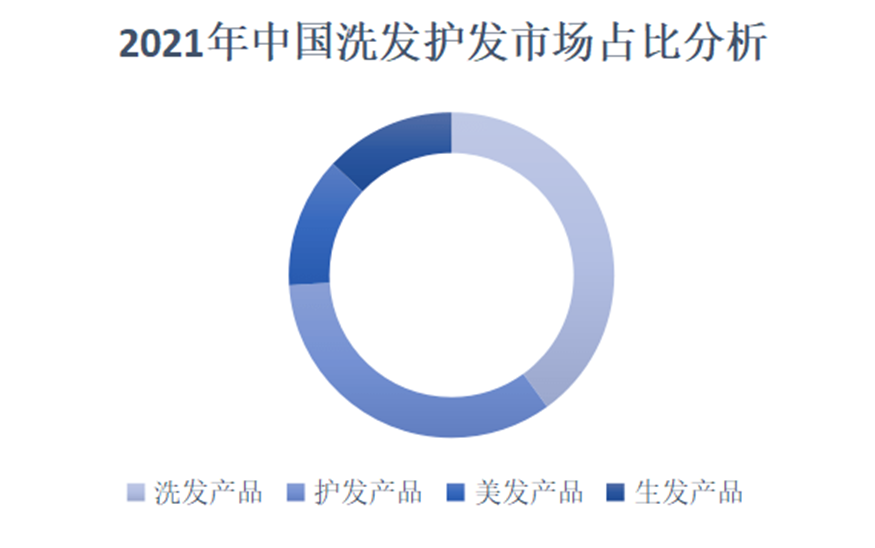 Source: Frost & Sullivan research
2021The market scale of Chinese shampoo products in China was approximately200Hundreds of millions, with the market scale growing steadily year by year.
As the main product in the industry, it is predicted that its market share may remain stable and slightly decline in the future. This is because the incremental market mainly lies in more segmented care and hair styling products.2022Year to2027The annual compound industry growth rate may be at3%The range fluctuates, expected2027The market scale of Chinese shampoo products may reach270About 100 million yuan.
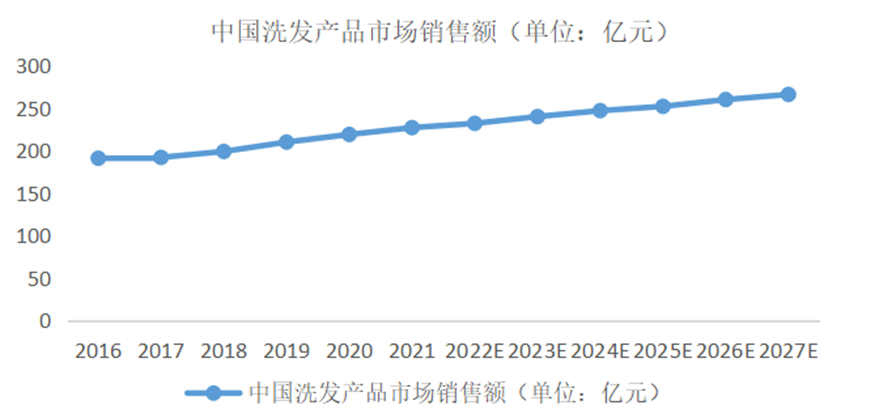
Source :Frost & Sullivan research
Due to the increasing popularity of health care and skincare separation models, consumers' attention to hair care products has also been rising year by year. According to LeadLeo's data research, consumers' preference for mid-to-high-end hair care brands is becoming more evident.2017The import volume soared rapidly from the beginning of the year to2020The import value of hair care products reached nearly9billion dollars.
Although leading skincare brands are still overseas ones, domestic brands are showing a strong momentum. Relatively speaking, domestic manufacturers understand better the habits of Chinese people, their skin conditions, and product demand trends, thus laying a good foundation for the development of the functional skincare market for domestic products.
According to LeadLeo's data research, recently40%Consumers in2021In recent years, consumers have shown a greater preference for domestic brands, and the proportion of those with a strong intention to purchase imported brands is declining year by year.
Under the combined influence of internal factors such as high anxiety and stress, greasy diets, and staying up late, as well as external factors like frequent dyeing and perming, inadequate care, consumers' hair and scalp health are affected to varying degrees. This has led to a series of common hair problems including dandruff, scalp itching, oily or dry split ends, and more.
This has led to consumers having more diverse needs for skincare products, evolving from basic cleansing capabilities to those with additional effects such as oil control, anti-dandruff, fullness and softness, smoothness, dandruff removal and itch relief, soothing properties, scalp care, and long-lasting fragrance.
Therefore, the attractiveness of ordinary cleaning and care products to consumers has begun to decline, with consumers preferring to purchase mid-to-high-end functional cleaning and care products to meet their specific needs.
Mid-to-high-end skincare products are a sub-category that goes beyond basic cleaning capabilities, offering further enhancements. The difference between them and mass-market skincare products is not just in price disparity; the premium nature is mainly reflected in optimized innovation designs for product quality, ingredient additions, and packaging.
According to preliminary data statistics, from2017Since the beginning of the year, there has been a clear trend of market consumption upgrading in the domestic skincare industry. Consumers' ability to purchase mid- to high-end skincare products has improved, and their demand for product grades has risen.
Among them, the market scale of high-end skincare products is growing at a rate of approximately20%As mentioned above, the market scale growth rate of mass shampoo and hair care products is relatively slow, but the market scale still maintains a stable growth trend. Although the scales of the two are2020Affected by the pandemic, they have all decreased, but are expected2021The annual growth rate of product scale in the mass shampoo and hair care market may reach8%Left and right, while the growth rate of product scale in the high-end shampoo market may be at24%left and right.
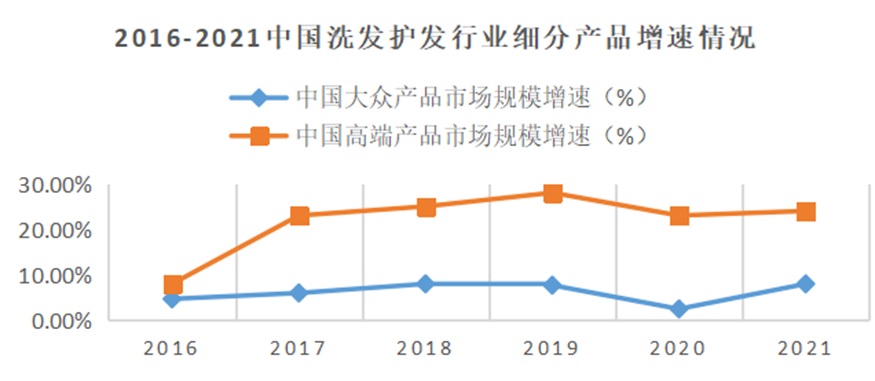
Source :Frost & Sullivan research
According to JD.com's2022The "Personal Care Trend Report" shows that consumers are clearly showing a trend towards purchasing high-end brands, with product sales year-on-year growth exceeding90%The sales speed of the high-end line has even reached114%Among them, after Kaisi opened its official flagship store on JD.com for one month, both its search traffic and recommended traffic from the self-operated store quickly rankedTOPLevel.
Second, consumers' demand for skincare products is no longer limited to traditional basic cleansing. Affected by consumption upgrading and demand segmentation, functional skincare products that can solve multiple skin problems are favored by consumers, with a significant increase in consumption proportion. The growth rate is higher than the overall daily chemical skincare market, indicating a promising future development prospects for the market.
Functional skincare is a type of product that adds specific ingredients to regular cleansing and care products to help solve specific problems with hair or skin. The functional skincare industry in China has been1980The budding period of the year has begun, and it has continued to this day40Over the years, it has gone through four main stages: the budding period, the development period, the fluctuating period, and the mature period.
The germination period is in1980Around Many time-honored brands on the market today were born during this period, such as Fenghua and Meijiaojing, but most of the functional skincare products in their infancy were low-end products. The influx of multiple international daily chemical company brands has squeezed the market share of local brands, leading to their closure.
Subsequently, the market entered a development and volatile period. During this period, the market characteristics were that domestic brands dominated the mainstream, while overseas brands took the lead in localized development.
21Since the beginning of this century, the functional skincare industry has entered a mature phase. This phase is influenced by the refinement of consumer demand, with a continuous emergence of various new products such as scalp cleansing care and scalp serums.
With the improvement of living standards, consumers' disposable income has increased, driving consumption upgrades. Ordinary skincare products have lost their appeal to consumers, and hair and scalp problems such as oiliness, hair loss, dryness, and dandruff are becoming more frequent. The consumer group is more inclined to choose skincare products with specific functions that can solve their needs, mainly focusing on products with functions such as oil control, anti-dandruff, softening, repair, and moisturizing.
According to LeadLeo's data research, the market scale of functional skincare products in China is2016 - 2020The annual compound growth rate may reach5%Left and right. Currently, it occupies a significant market share globally and is still growing steadily. With the COVID-19 pandemic being well controlled and the domestic economy beginning to recover, the functional skincare industry may see a second wave of rapid development in the future.
Secondly, with the increase in economic income and continuous improvement of education levels, the female consumer group in China has become a new force in the consumer industry.
According to its statistics, among Chinese online functional skincare product consumers60%Women account for the majority of the market on both the left and right sides, while their male consumer performance is also relatively impressive. According to Alibaba Health data and LeadLeo research, men's consumption growth rate in hair loss prevention products is the fastest. Female consumers, when purchasing functional skincare products, place more emphasis on packaging aesthetics and innovative designs, which are one of the important factors influencing their decision-making on whether to buy.
According to the data from LeadLeo Research Institute, functional skincare products can be divided into two main categories: hair cleansing products and scalp care products.
hair cleansing products It occupies the main sales share in the skincare market, and overall demand is quite widespread. Products with functional effects such as anti hair, dandruff removal and itching relief, scalp rejuvenation, and damage repair are showing a good growth trend, responding to the young people's need for 'anti hair, moisturizing and soothing' under the influence of stress and staying up late habits, becoming hot-selling products.
Scalp care market The scale of 'LeadLeo', which is relatively smaller compared to the shampoo market, has seen the fastest annual growth rate according to LeadLeo's data. Scalp care is an emerging concept product in recent years, mainly aimed at conditioning the scalp skin rather than improving or repairing hair quality. Its product diversity covers all aspects, such as scalp cleansing, scalp activation, balancing the microbiota, nutritional care, and a series of other products.
Under the cultivation of skincare products, in pursuit of keeping up with trends and the times, the scale of hair care products has also been expanding year by year. Moreover, the demographic distribution of hair care consumers is broader and more diverse, including both older and younger consumers who have issues covering white hair and hair loss, as well as those with the demand for trendy dyeing.
However, the majority are hair dye products. Under the impact of the pandemic, home hair dyeing has sparked a craze, with consumers' enthusiasm for DIY increasing significantly.
According to JD.com reports, the transaction volume of hair dye products accounted for2021Approximately half of the market for year-round dyeing and perming wigs is made up of 'home dyeing' products, while the volume of social media posts about 'home hair dyeing' has nearly doubled. Among these, products with natural plant ingredients that are safe, non-irritating, gentle, and have a dyeing and conditioning function are favored by consumers; products that offer optimized experiences and convenient operations are chosen by more people.
Driving factors for the development of China's functional skincare market
· Enhanced purchasing power and consumption upgrading
The increase in per capita disposable income has enhanced consumers' purchasing power and promoted consumption upgrading, thereby facilitating the development of China's functional skincare market. It has evolved from basic cleaning functions to today's 'skin care-style' hair care models. Comprehensive maintenance has become the choice of more and more consumers, with meticulous care from scalp, root, tip to color not allowed for error.
· The rise of health-conscious washing and grooming habits and the diversified demand for products
With economic growth, awareness of personal care and health has been continuously increasing, and China's per capita expenditure on personal care products has steadily risen.
According to data from LeadLeo Research Institute, about90%Consumers believe that shampoo and conditioner should be used in the same way as skincare, with products tailored to different hair types for corresponding effects. Currently, driven by the needs of Chinese consumers, in addition to mainstream functions such as deep cleansing and strengthening hair quality, new sub-categories have emerged for stabilizing the scalp, protecting against hair loss, soothing and repairing, and controlling oiliness.
· Rapid growth in e-commerce and digital marketing
With the development and expansion of different sales channels, various skincare products are becoming more recognizable to consumers nationwide, leading to an increase in product consumption frequency.
andZGenerations of widespread internet use have accelerated the promotion of digital marketing campaigns, driving the development of the feature-rich skincare market. Traditional sales channelsKAChannels, such as specialty stores, will continue to be important sales channels for skincare products (especially high-end ones).
· Technological innovation and enhancement
Advanced technology is crucial for the upgrading and innovation of skincare products.
For example, mature technology has enriched product styles and achieved significant efficacy in products such as scalp serums and anti-aging care; the integration of plant extracts, expensive medicinal materials, and other nutritional elements into products is increasing day by day. As more consumers choose to use professional skincare products, the rapid growth of technology supports the continuous development of China's overall functional skincare market.
Future development trend of China's functional skincare market
· Product features tailored to specific consumer segments
Under high-intensity work pressure and a fast-paced lifestyle, consumers are experiencing more pronounced phenomena such as hair loss and baldness.
According to data from the National Health Commission, the number of hair loss patients in China is as high as approximately2.5Hundred million people, among whom the number of men with hair loss is relatively large, about1.6Hundreds of millions account for the hair loss population65%Left and right, and the population experiencing hair loss is showing a trend towards younger age groups. The increasing awareness among Chinese people to protect their hair volume through upgraded washing and care has driven the development of the anti-hair loss shampoo market. Under the huge demand for anti-hair loss products, various hair care products for preventing and nourishing hair have emerged.
According to LeadLeo data,2016 - 2020In China, the annual compound growth rate of the minoxidil market scale is as high as20%Left and right. The continuous growth in the market scale of minoxidil proves the ongoing rise in the number of hair loss patients in China.
According to JD Supermarket data, in terms of skincare efficacy, blue ocean anti-dandruff products have become one of the main consumer trends. The number of users and sales of anti-dandruff products have seen rapid year-on-year growth.
· Enhancement of consumer safety awareness
The frequent occurrence of consumer safety issues has made consumers pay more attention to added ingredients in products in recent years, with many turning pale at the mention of 'chemicals'. As a result, products containing natural ingredients (plant extracts) and silicone-free oils are receiving increasing attention from consumers, driving the development of the functional skincare market.
According to LeadLeo research data, Chinese skincare productsTop 5Among the natural ingredient types, sulfur and sea salt rank among the top two favored by consumers. Secondly, according to JD.com data, hyaluronic acid and plant extracts (phytopreparations) have become one of the main consumption trends, with a significant year-on-year increase in transaction volumes for soothing and scalp anti-aging products.
Additionally, among shampoo products, those that rank in the top three in sales also contain hyaluronic acid and plant extracts. Finally, silicone oil usually refers to dimethylsiloxane, which is primarily used as a sealant. Although it can help smooth hair texture, this chemical substance can cause serious harm such as hair loss.
Therefore, according to LeadLeo data, many skincare brands have launched silicone-free products, such as Pantene, Paris Olé, and Adore.
· Preference for comprehensive skincare product matrix
With the development of the skincare industry, comprehensive skincare products (including basic and professional ones) will continue to increase in volume.
In the future, skincare products are expected to be more diversified, innovative, and upgraded.2 - 3The use of efficacy washing and care products, as well as set packages for one wash and one care, has become routine. Consumers will also need multi-functional washing and care products to effectively prevent and treat issues such as hair loss and scalp aging. This is also conducive to the development of leading enterprises with strong R&D capabilities and industry experience.
· The rise of domestic brands and diversified channels
Affected by the pandemic, the emergence and rapid development of e-commerce and live shopping have driven the rise of domestic brands, leading to more diverse consumer choices.
The penetration rate of high-end skincare products in specialty stores and comprehensive commercial businesses has also been increasing year by year, thereby expanding the diversification of skincare market channels. Leading domestic skincare brands are better aware of the demand trends of Chinese consumers and offer suitable price ranges, which can help them build stronger market competitiveness.
III. The supervision of new policies in the skincare industry will also make its industry requirements more stringent and standardized in the future, enhancing consumer confidence and purchasing power.
The upgrade of supervision in the personal care industry not only reflects a gradual standardization and maturity of the industry, but also provides necessary basis for its development. It also implies continuous innovation and enhancement of technical capabilities, continuous improvement of technical standards, which enhances consumers' motivation and security in the personal care market, and lays a good foundation for future development.
- The International Agency for Research on Cancer (IARC) of the World Health Organization, which is published by the National Medical Products Administration of China, lists dioxins as2BClass 2 carcinogens have the potential to cause cancer in humans. It is necessary to ensure the safety of the product, which does not contain dioxins.
- 2020In [year], the State Council passed and issued the "Regulations on the Supervision and Administration of Cosmetics", which came into force in2021year1It came into effect from the beginning of this month. Article 16 of Chapter II of the 'Regulations' clearly classifies special cosmetics and ordinary cosmetics. Ordinary cosmetics, such as shampoos and hair care products, usually only achieve basic effects such as cleaning and increasing hair softness, and do not have therapeutic effects for symptoms like hair loss or regrowth.
- 2 021In 2019, the National Medical Products Administration issued and implemented the 'Cosmetic Label Management Measures', which clearly stipulate that medical terms and descriptions of medical functions and effects should not be used in cosmetics advertising, such as hair regrowth, sterilization and antibacterial properties, traditional Chinese medicine prescriptions, etc.
*This article is published in the magazine China Cosmetics , author Xie Weirong , Original title: The growth rate of high-end products has been remarkable, and the logic of the shampoo and care market has changed. ">