In recent years, Chinese automakers have accelerated their pace of going global. Just last month, BYD announced its entry into the Japanese market, and NIO has established an energy factory in Hungary.
Some believe that in recent years, Chinese automakers' overseas expansion has shifted from simple automobile exports to a global layout of the industrial chain, and their sales markets have gradually expanded from developing countries to developed ones. What are the reasons or logic behind this? Is new energy vehicle sales an opportunity for China's automotive exports to turn the corner? What are the advantages and obstacles for Chinese automakers going global? Frost & SullivanFrost & SullivanZhang Zhiwei, Executive Director of Frost & Sullivan Greater China, was interviewed by The Paper to discuss the significant implications of new energy vehicle exports for the future development of Chinese automakers.
Pengpai News
From simple vehicle exports to automakers going global with their industrial chains and technologies, China's automotive industry has undergone structural changes in its overseas expansion.
9month5On the same day, Li Fei, Assistant Minister of Commerce, proposed to actively support the export of key products such as new energy vehicles. Prior to this, automakers had already made a significant investment in the export of new energy vehicles.
Just past8In the month, BYD has successively announced its entry into markets such as Japan, the Netherlands, Germany, and Sweden. Its recent frequent moves are a microcosm of Chinese automakers' efforts to go global, utilizing their advantages in new energy vehicles to reverse-engineer their way into traditional automotive powers like Germany and Japan.
Consulting firm Frost & Sullivan(Frost & SullivanZhang Zhiwei, Executive Director of Greater China, said in an interview with The Paper that “2021The proportion of new energy passenger vehicle sales in China's total global sales in53%"New energy vehicles represent an excellent opportunity for China's automotive exports to overtake on a curve."
Riding on the wave of new energy vehicles, China's pattern of automakers going global is quietly changing.
The rising automobile-exporting powerhouse
The UK's Financial Times recently reported in a piece that a trend that could change the global manufacturing structure has begun, namely the rise of China as a major automobile exporter.
2021In the year, China's export sales achieved201.510,000 units, a year-on-year increase of101%Second only to Japan internationally38210,000 and Germany's230Ten thousand units, surpassing South Korea and becoming the world's third-largest.
It is worth mentioning that this is also the first time China's automobile exports have exceeded a certain threshold200Ten thousand vehicles a mark. And2010Year-end2020Throughout the year, China's automobile exports have been100Around 10,000 vehicles fluctuate. Therefore, many industry insiders also2021The year is referred to as the first year for Chinese cars going global.
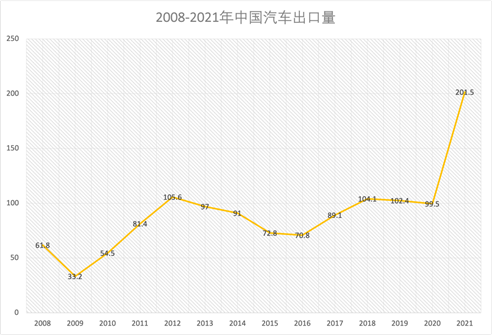
Data from the China Association of Automobile Manufacturers, charted by: Pengpai News reporter Wu Yuli
In the automotive export data, new energy vehicles have performed very impressively.
According to data from the China Association of Automobile Manufacturers,2020In the year, China's new energy vehicle exports were nearly710,000 units, accounting for the total automobile exports7%;2021New energy vehicle exports in 20XX3110,000 units, proportion15.38%; In the first half of this year, new energy vehicle exports20.210,000 units, accounting for16.6%.
Among the notable growth, Tesla's incremental output cannot be ignored. The Tesla Shanghai Superplant was established in2020year10Launched the export business of complete vehicles in January2021Annual export volume is about16Ten thousand vehicles contributed half of China's new energy vehicle exports for the whole year.
However, even after deducting Tesla's exports,2021Annual exports are still2020The year-on-year base has doubled, and the growth rate remains significant.
New energy vehicles go global: overtaking on the 'cost plain'
last century70During the oil crisis of the 1970s, Japanese automakers such as Toyota captured the American market with their excellent fuel-saving technology. With the recent emergence of traditional automakers' 'Nokia Moment,' a similar window is now before Chinese new energy automakers.
Regarding the tremendous opportunities that new energy vehicles bring to Chinese automakers, many industry insiders believe that this is not just a 'curveball.'
Mei Songlin, a senior analyst in the automotive industry, told The Paper that the booming trend of new energy vehicles globally is a great opportunity for Chinese enterprises to change lanes and overtake.
Liu Mingyu, an associate professor in the Department of Applied Economics at Fudan University School of Management, said in an interview with The Paper that overtaking through new energy vehicles is a 'direct cost path.' He stated that the transition from traditional fuel vehicles to new energy vehicles has magnified China's cost advantage. In terms of hardware, electric vehicle parts are significantly fewer than those of fuel vehicles, greatly reducing the difficulty of overall assembly. Just like with mobile phones, China has a clear cost advantage in assembly.
Taking batteries as an example, according to McKinsey's calculations, the cost-performance ratio of pure electric models in China is approximately21kilometers/1RMB ten thousand yuan, while the range price of international models is generally about11kilometers/1RMB ten thousand yuan.
However, Liu Mingyu also mentioned that after seizing the cost advantage to overtake, the ultimate advantage of automakers still comes from technology.
An insider from Aiche Auto told The Paper,7Month-on-month, AIC accumulatively exported to overseas642tableU5, with year-on-year growth exceeding8Double-digit growth is a new high for monthly exports since the official delivery. 'China's leadership in electric vehicle technology, along with our advantages in manufacturing and operating costs, are significant competitive strengths in overseas markets.'
In addition, the new business models developed by Chinese new energy vehicles during their growth process have also become a competitive advantage for going global. NIO Auto told The Paper that its products, services, and innovative business models have initially gained recognition in the global market. Among all orders in the Norwegian market,92%Users who chose the battery leasing plan made a final purchase on average every four test drive customers, with a significantly higher conversion rate from test drives to orders compared to domestic markets.
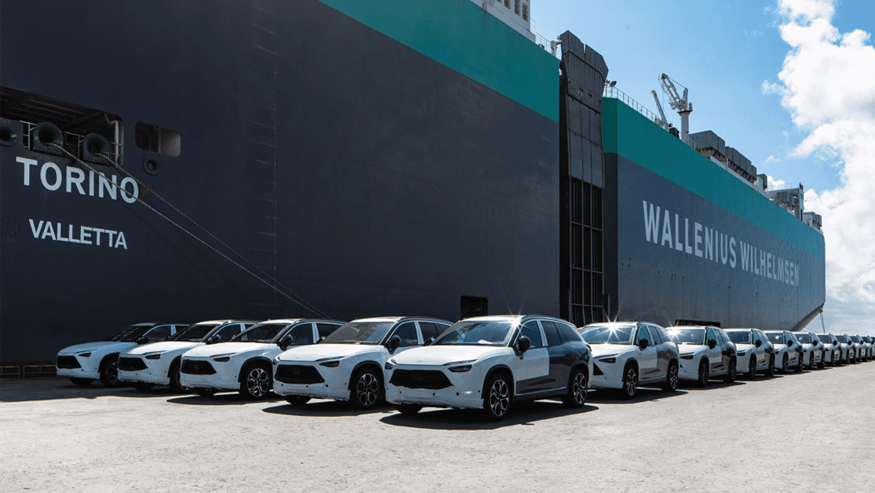
NIO vehicles destined for Europe, from the official website
"
Zhang Zhiwei believes that China has positioned itself at the forefront of the world in multiple core technologies for new energy vehicles. "In this context, Chinese automakers can leverage their many early-mover advantages in new energy vehicles to enter overseas markets during the rapid development period of global new energy vehicles, seize a certain market share, and reverse China's disadvantages in the traditional fuel vehicle market."
It is worth noting that the export of new energy technologies by Chinese automakers will also commence.
Geely Automobile GroupCEOGan's family-owned enterprise recently introduced at its performance meeting that Geely has been exporting its new energy technologies and products such as hybrid and pure electric vehicles globally through innovative models including technology licensing, subscriptions, and cooperation with local automakers, accelerating the globalization process.
The window of opportunity to go global is still open
The automotive industry is a typical global industry. Liu Mingyu believes that from a macro perspective, although there is currently a trend towards anti-globalization, the window remains open, and Chinese enterprises need to seize the opportunity.
He said that Chinese automakers' overseas expansion is backed by a solid 'base', namely the huge domestic market. 'The automotive industry has a high dependence on scale, and the domestic market can effectively spread the cost.' The fixed costs and R&D expenses of automakers. "Another aspect is a relatively complete industrial chain. 'China's automotive industry has a complete supporting system, as well as the advantage of industrial clusters, which can greatly reduce logistics and manufacturing costs.'
Li Ze (a pseudonym), who is in charge of the export business of a certain automaker, told The Paper that from a technical perspective, China's vast territory provides rich samples for the usage environment of new energy vehicles. 'Unlike fuel vehicles, the batteries of new energy vehicles are greatly affected by temperature. Our main factories can conduct tests on Hainan Island or Mohe, and we have various actual usage environments for car owners. Therefore, our batteries have strong competitiveness.'
"Of course, to go global, you must also do a good job in internationalization and localization," Li mentioned. "We have also encountered special situations where the vehicle's onboard system only had minor issues in a specific region of Northern Europe. Later, our team conducted continuous testing locally and found that it was because a part could not work in extremely cold weather. After replacing it, the problem was solved easily. So, if you only focus on vehicle exports and do not have your own R&D or service teams locally, then you can only be considered a simple manufacturer."
"
Zhang Zhiwei also believes that China has a more stable and comprehensive automotive industry chain, which gives it stronger risk resistance in the tight global supply chain. 'For example, last year Tesla's global production included half of its models coming from Shanghai factories. At the same time, China's overall raw material costs and labor costs are also lower than those in the international market. In addition, China is at the forefront of new energy vehicle layouts globally. Overall, the product strength of our models is still stronger than that of most international automakers. Some components' technology and supply are also at the global leading level. Coupled with a relatively stable supply chain, lower comprehensive costs, and higher production efficiency, this gives Chinese automakers more confidence going global.'
However, Zhang Zhiwei also mentioned that in recent years, the demand for automobiles from overseas markets has not been stable due to the recurring COVID-19 pandemic, marginal political conflicts, and uncertain economic situations in multiple countries. Moreover, developing overseas markets requires a significant investment of time and money, including marketing and product adaptation improvements. Chinese automakers going global not only have to face unfamiliar market environments but also strong competitors. If overseas sales targets are not met in the initial stages, it may lead domestic automakers to become more conservative about overseas investments.
The Exploration of Chinese Auto Brands Going Global
Regarding the issue of Chinese cars going global, Zhang Xiang, a specially invited expert and automotive analyst at the China International Automotive Industry Research Association Think Tank, told The Paper News that this problem needs to be viewed rationally.
He analyzed that, 'A large portion of the cars exported from China are international brands. For example, Tesla is not a Chinese domestic brand, and Dongfeng Yijie Te is a joint venture between Dongfeng Motor and Renault.-The joint venture established by the Nissan Alliance is not an independent brand. In this regard, we lag behind Japan and Europe. Japan, Europe, and South Korea export their brands on a large scale, but the number of exports of our country's own brands is still relatively small and in its initial stages.
However, in recent years, with the strong rise of new energy vehicles, many Chinese automakers have begun to experiment with deeper layouts in brand expansion.
2021year5month6Today, NIO released its Norwegian strategy, officially entering the Norwegian market and taking the first step into overseas markets. According to a previous disclosure by NIO Motors,2022In [year], WeRoo's products and full-service offerings will be officially launched in Germany, the Netherlands, Sweden, and Denmark.2025Annual coverage exceeds25Countries and regions. Regarding Weilai's globalization, Li Bin hopes to proceed steadily. 'Don't expect overnight success. There are such expectations.'Those who look at it will die in a rather ugly way.
 NIO Auto Norway Store, from the official website
Pengfei Motors also set sail for overseas markets from Norway, highlighting its intelligent features in its marketing just like domestically.
2020year12In January, Xpeng delivered the first batch to the Norwegian marketG3Model, followed by XpengP7,P5It has also successively entered the European market. Xpeng MotorsCEOHe Xiaopeng once stated that in the medium to long term, the goal of Xpeng is to develop into a global automaker, with overseas markets contributing half of the car deliveries. Regarding Xpeng's strategy for going global, He Xiaopeng said that the core of Xpeng's expansion abroad is focusing on developed countries and will firmly build a strong brand.To CAt the same time, he also said bluntly, “Going global requires10The commitment to deployment and preparation for the year includes actions taken by predecessors such as Toyota in terms of globalization10Years or even longer."
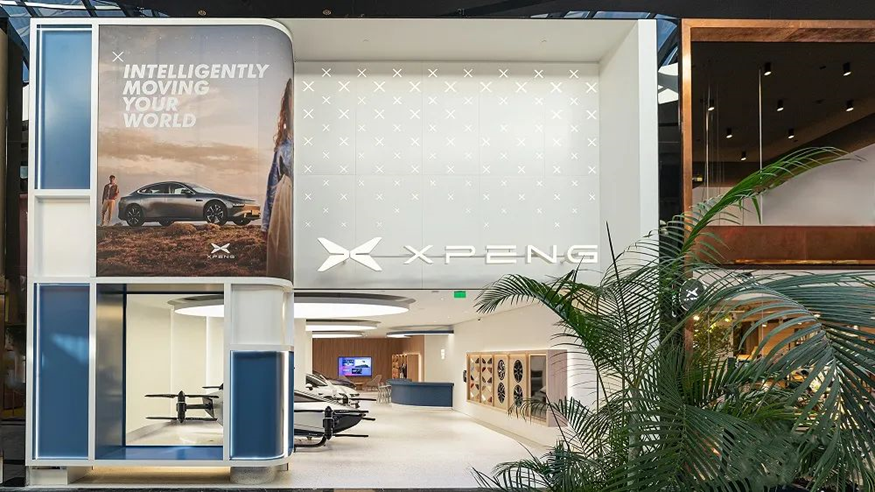
Pengfei Auto Netherlands, from the official website
These automakers' overseas expansion has a clear common point: they are exploring the global layout of their brands. Liu Mingyu believes that the focus of brand globalization should be placed on 'globalization.' 'To have global competitiveness, one must become a global brand. In fact, many world-renowned automakers have undergone multiple changes of ownership; they can only say that their birthplace is a certain country, but the brand has become a global one, and the company itself has become a multinational enterprise.'
Mei Songlin stated that without a domestic market, one cannot grow large, and without an international market, one cannot become strong.2.0Chinese Brands of the Times (For the Fuel Vehicle Era:1.0The era of new energy vehicles is2.0We must not only achieve large scale but also strengthen our brand. Only with scale can we survive, and only with a strong brand can we command a premium price; neither can be dispensed with.
"In the car1.0In the era, Chinese automakers basically rely on local partners to handle export sales, and have not fully established their own brands.2.0Times should try to create a brand like they do in the domestic market, establishing the brand while selling cars to gain recognition in the local market. "Mai Songlin said, "The investment is significant and the learning cost is also high, but this path must be forged through. Fortunately, the smartphone industry has blazed a trail that is worth learning from for China's intelligent new energy vehicle industry."
*This article is reprinted from The Paper Author: Wu Yuli , Original title: China's new energy vehicle exports have surged! Tesla contributed more than half of them. How can domestic automakers overtake on this curve? ">
Frost & Sullivan Insight & Extended Reading
QSome believe that in recent years, Chinese automakers' overseas expansion has begun to shift from simple automobile exports to a global layout of the industrial chain, and their sales markets have gradually expanded from developing countries to developed ones. What are the reasons or logic behind this?
A: China's automotive industry is gradually entering a mature phase, and 'going global' has become one of the important development plans that Chinese automakers are focusing on. In the past few years, the sales volume of new cars in the domestic market has tended to be stable, but market competition has become increasingly fierce. Going abroad has become an inevitable path for automakers seeking new growth curves.
Although the main markets for Chinese automakers going global are still developing countries, it can be seen that developed countries are gradually becoming important destinations for Chinese automakers. Chinese independent brands are gradually penetrating from Asia, Africa, and Latin America to developed European and American markets. The reasons for this include not only the larger market space in developed countries but also China's complete supply chain, stable production capacity, leading new energy vehicle models, as well as a greater focus on medium- and long-term planning and thinking. Leading domestic automakers have realized that the current period is an excellent opportunity to layout in overseas developed country markets, so they dare to take the initiative and compete with traditional overseas automakers for the market.
QAlthough China has significant advantages in new energy vehicles, many key technologies are still controlled by others. What impact does this have on our vehicle exports, parts exports, and overseas investment layout?
A: Although there are still some technologies and components in China that come from overseas suppliers, leading global component manufacturers have established operations in the Chinese mainland, with only a few high-end parts relying on imports. Moreover, the Regional Comprehensive Economic Partnership AgreementRCEP) in2022year1month1The official implementation has brought about favorable policies such as reduced tariffs, market opening, and lowered standard barriers. These have reduced risks for China's automotive industry going global, which is very conducive to the stability and integration of the regional automotive industry chain. It holds great significance for China's complete vehicle exports, parts exports, and overseas investment layout of enterprises. China's leading engine manufacturers and parts suppliers are accelerating their layout in overseas markets.