In the past decade, significant achievements have been made in the institutionalized two-way opening of the capital market. Interconnection measures such as the Shanghai-Hong Kong Stock Connect, the Shanghai-London Stock Connect, and the Bond Connect have been successively implemented.AEquities and Chinese bonds have been successively included in major international indices, attracting a continuous inflow of large amounts of foreign capital. This has optimized investor institutions and brought long-term incremental funds to the capital market.
How do you view the important role played by a series of interconnected capital market systems initiatives? As the stock and bond markets are gradually included in international indices, what positive impacts will it have on enhancing the internationalization level of China's capital market? Overall, what are the attractions of Chinese assets, and how do you view the future development prospects of China's capital market? Frost & SullivanFrost & Sullivan,Dr. Wang Xin, Global Partner and President of Greater China at Frost & Sullivan (hereinafter referred to as 'Frost & Sullivan'), was interviewed by the Capital Market Opening-up Special Edition of the 20th National Congress Reportage Series published by Securities Daily. The interview aimed to discuss the achievements and future development trends of China's capital market opening up in recent years.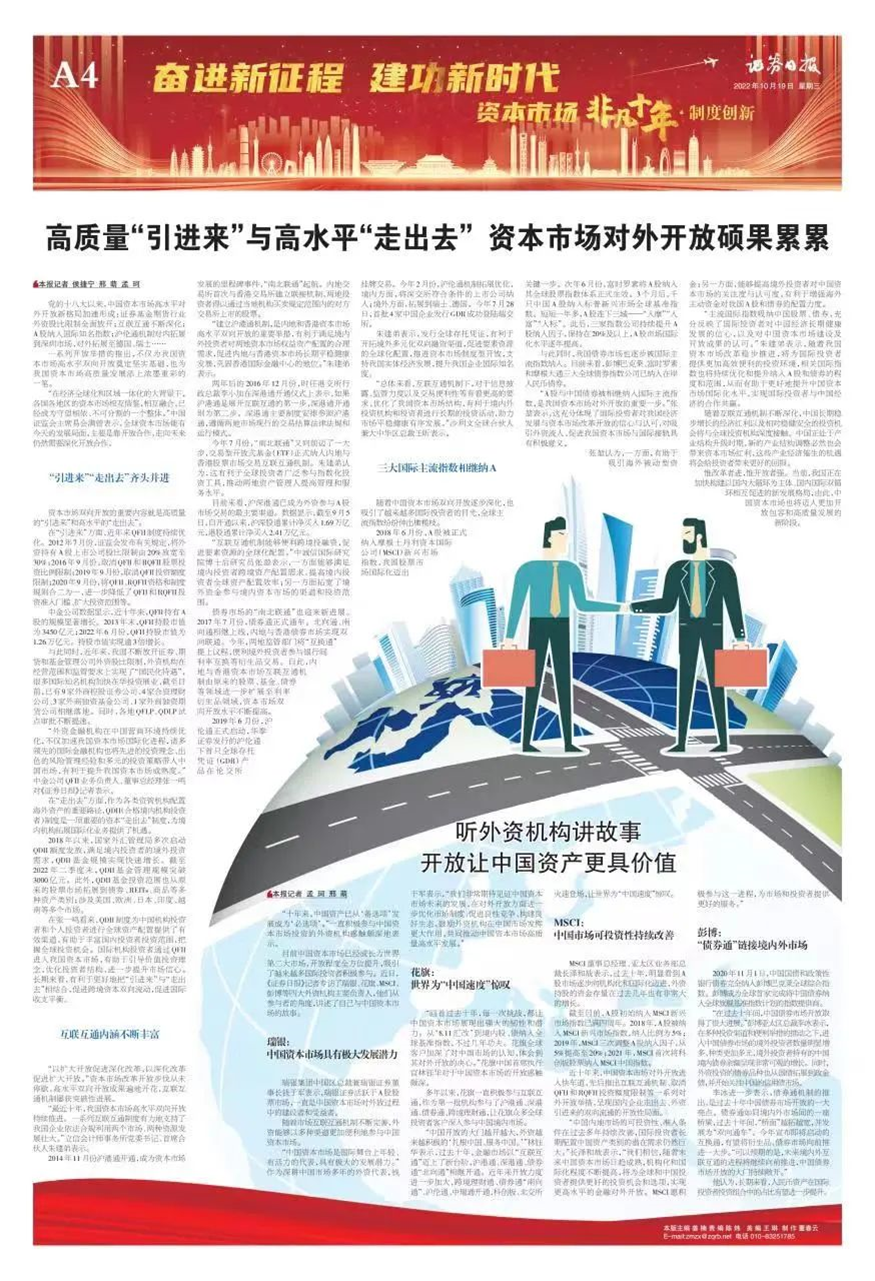
Securities Daily
Since the 18th National Congress of the Communist Party of China, a new pattern of high-level opening up of China's capital market to the outside world has been accelerating: restrictions on foreign equity in the securities, funds, and futures industries have been fully lifted; interconnectivity has been continuously deepening;AThe stock is included in internationally renowned indices; the Shanghai-London Stock Connect mechanism has been extended to the Shenzhen market domestically and to Germany, Switzerland...
The launch of a series of opening measures has not only laid a solid foundation for the high-level two-way opening of China's capital market, but also added a significant stroke to the high-quality development of China's capital market.
"Against the backdrop of economic globalization and regional integration, capital markets in various countries and regions are learning from each other and integrating with each other, becoming an inseparable whole that relies on each other." Yi Huiman, Chairman of the China Securities Regulatory Commission, once stated that the global capital market has achieved its current development mainly through openness and cooperation. Moving forward, it still requires deepening open cooperation.
"
"Introducing in" and "going global" advancing hand in hand
An important aspect of the two-way opening up of the capital market is high-quality 'bringing in' and high-level 'going out'.
In terms of 'bringing in', in recent yearsQFIIThe system is continuously optimized.2012year7In the month, the China Securities Regulatory Commission (CSRC) issued relevant regulations on foreign capital holdingsAThe share ratio limit for listed companies is20%relaxed to30%;2016year9Month, canceledQFIIandRQFIILimit on equity investment ratio;2019year9Month, canceledQFIIInvestment quota limit;2020year9month, willQFII,RQFIIThe combination of qualifications and institutional rules has been further reducedQFIIandRQFIIInvestment access thresholds, expanding investment scope, etc.
According to data from CICC, over the past decade,QFIIholdAThe scale of stocks has increased significantly.2013At the end of the year,QFIIMarket value of shares held3450100 million yuan;2022year6month,QFIIMarket value of shares held1.26trillion yuan. The market value of shares held exceeded3Double growth.
Meanwhile, in recent years, China has continuously relaxed the foreign share ratio restrictions on securities, futures, and fund management companies. Foreign institutions have achieved 'national treatment' in terms of business scope and regulatory requirements. Many internationally renowned institutions have accelerated their investment and business development in China. As of now, there are9Domestic and Foreign-controlled Securities Companies,4Joint-venture financial management company,3Domestic wholly foreign-owned fund company,1Domestic and foreign wholly-owned futures companies have been established one after another. At the same time, across various regionsQFLP,QDLPPilot approval has been accelerating.
"The continuous optimization of the business environment in China by foreign-funded financial institutions has not only accelerated the internationalization process of our capital market, but also introduced advanced investment concepts, excellent risk management experience, and diversified investment strategies into the Chinese market. This is conducive to enhancing the maturity of our capital market." CICCQFIIZhang Yiming, business leader and managing director, told the Securities Daily reporter.
In terms of 'going global', as an important route for various asset management institutions to allocate overseas assets,QDIIThe Qualified Domestic Institutional Investor (QDII) system is an important capital 'going global' mechanism, providing opportunities for domestic institutions to expand their international business.
2018Since [start year], the State Administration of Foreign Exchange has launched it multiple timesQDIIQuota issuance to meet the overseas investment needs of domestic investorsQDIIThe fund's scale has achieved rapid growth. As of2022At the end of the second quarter of 2019,QDIIFund management scale exceeds expectations3000yuan. In addition,QDIIThe investment scope of the fund has also expanded from the original stock market to bonds,Real Estate Investment TrustsCommodity and other asset classes; involving multiple markets such as the United States, Europe, Japan, India, Vietnam, and more.
In Zhang Yiming's view,QDIIThe system provides an effective channel for Chinese institutional and individual investors to allocate global assets, helping to broaden the investment scope of domestic investors and seize global investment opportunities. International institutional investors throughQFIIEntering China's capital market helps to guide the concept of value investing, optimize the investor structure, and further enhance market confidence. In the long run, it is conducive to better combining 'bringing in' with 'going out', promoting cross-border capital flows in both directions, and facilitating balance of payments.
"
The connotation of interconnection and interoperability is constantly enriching.
"Promote deepening reform through expanding openness, and promote expanding openness through deepening reform." The pace of capital market reform and opening-up has never ceased. High-level two-way openness has yielded fruitful results everywhere, and the interconnection mechanism has made breakthrough progress repeatedly.
"In the past decade, China's capital market has continuously advanced towards high-level two-way openness. A series of interconnected systems have effectively supported Chinese enterprises in using both markets and resources in accordance with laws and regulations to grow and expand." said Zhu Jiandi, Secretary of the Party Committee and Chief Partner of Lixin Certified Public Accountants.
2014year11The launch of the Shanghai-Hong Kong Stock Connect in a particular month marked a milestone event in the development of the capital market, and the 'North-South Connectivity' began. The mainland exchanges established a connection mechanism with the Hong Kong Exchanges for the first time, allowing investors from both regions to buy and sell stocks listed on each other's exchanges through local institutions within the specified scope.
"The establishment of the Shanghai-Hong Kong Stock Connect mechanism is an important measure for high-level two-way opening up of capital markets between the mainland and Hong Kong. It is conducive to meeting the reasonable needs of domestic and foreign investors for asset allocation in the capital markets of both places, promoting the long-term stable and healthy development of the capital markets between the mainland and Hong Kong, and consolidating Hong Kong's status as an international financial center," said Zhu Jiandi.
Two years later2016year12In a certain month, Li Ka-shing, then Executive Chairman of the Hong Kong Exchanges and Clearing Limited (HKEX), stated at the launch ceremony of the Shenzhen-Hong Kong Stock Connect that if the Shanghai-Hong Kong Stock Connect is the first step towards interconnectivity, the opening of the Shenzhen-Hong Kong Stock Connect would be the second. The main institutional arrangements for the Shenzhen-Hong Kong Stock Connect are based on those of the Shanghai-Hong Kong Stock Connect, following the current trading and settlement laws, regulations, and operational models of both markets.
this year7Month-on-month, 'North-South Connect' has taken another big step forward. Exchange-traded open-end fundsETFIt has been officially incorporated into the interconnection mechanism for trading between the mainland and Hong Kong stock markets. Zhu Jiandi believes that this is conducive to global investors' wider participation in index investment tools, and will promote asset managers on both sides to improve their management and service levels.
At present, the Shanghai-Hong Kong-Macao Stock Connect has become a participation point for foreign capitalAThe most important channel for stock market trading. Data shows that as of9month5Since its launch, the cumulative net purchases through CSI-Exchange Connect have been1.69trillion yuan, cumulative net purchases through the Hong Kong Stock Connect2.41trillion yuan.
"The interconnection mechanism can facilitate cross-border investment and financing, promoting the globalization of factor resource allocation." Zhang Kun, a postdoctoral researcher at the China International Credit Rating & Research Institute, said that on one hand, it can meet the cross-border asset allocation needs of domestic investors, improving the efficiency of global asset allocation for domestic investors; on the other hand, it broadens the channels and investment scope for overseas funds to participate in the domestic capital market.
The 'north-south connectivity' of the bond market has also made new progress.2017year7In a certain month, the Bond Connect officially went live. The northbound and southbound services were launched one after another, achieving two-way connectivity between the mainland and Hong Kong bond markets. This year, regulatory authorities from both places put 'swap connect' on the agenda to facilitate overseas investors to participate in derivative transactions such as interbank interest rate swaps. Since then, the mechanism for capital market connectivity between the mainland and Hong Kong has been further expanded from the original areas of stocks, funds, bonds, etc., to the field of interest rate derivatives, continuously improving the level of two-way opening up of the capital markets.
2019year6Month, the Shanghai-London Stock Connect was officially launched. Huatai Securities issued the first global depositary receipt under the Shanghai-London Stock ConnectGDRThe product is listed and traded on the LSE. This year2Month, the Shanghai-London Stock Connect mechanism has been expanded and optimized. Domestically, eligible listed companies on the Shenzhen Stock Exchange have been included; internationally, it has been extended to Switzerland and Germany. This year7month28day, the first batch4Domestic Chinese enterprise issuanceGDRSuccessfully logged in to the Ruixin Stock Exchange.
Zhu Jiandi stated that issuing global depositary receipts is conducive to exploring diversified two-way financing channels overseas, promoting the globalization of factor resource allocation, advancing institutional opening up of capital markets, supporting the development of China's real economy, and enhancing the international recognition of Chinese enterprises.
"
"Overall, under the interconnected mechanism, there are higher requirements for information disclosure, regulatory intensity, and transaction convenience. This has optimized the capital market structure in China, which is conducive to long-term investment activities by domestic and foreign investment institutions and investors, and helps promote the stable, healthy, and orderly development of the market," said Wang Xin, Global Partner at Frost & Sullivan and President of Greater China.
"
Three major international mainstream indices were successively includedA
With the gradual deepening of the two-way opening up of China's capital market, it has also attracted the attention of more and more international investors, leading global mainstream indices to extend olive branches.
2018year6month,AThe stock has been officially included in Morgan Stanley Capital International (MSCI) The emerging market index marks a crucial step in the internationalization of China's stock market. The following year6Month, FTSE Russell willAThe inclusion of stocks into its global stock index system came into effect.3A thousand months later, a thousand ChineseAThe stock was included in the S&P Emerging Markets Global Benchmark Index. In just over a year,AThe stock has connected three consecutive highs — "entering the market cap list," "entering the rich list," and "entering the top 100." Since then, the three index companies have continued to improve.AEquity inclusion factor, maintained at20%and above,AThe internationalization level of the stock market has been increasing year by year.
Meanwhile, China's bond market has also been gradually incorporated into international mainstream indices. Currently, three major global bond index companies—Bloomberg Barclays, FTSE Russell, and JPMorgan Chase—are including onshore RMB bonds in their indexes.
"AThe inclusion of stocks and Chinese bonds in international mainstream indices is an important step towards the opening up of China's capital market to the outside world. 'Zhang Kun stated that this fully demonstrates the confidence and recognition of international investors in China's economic development and the reform and opening-up of the capital market, which has positive implications for attracting foreign investment inflows and promoting the integration of China's capital market with international standards.'
Zhang Kun believes that, on the one hand, it helps to attract overseas passive funds; on the other hand, it can increase the attention and recognition of overseas investors towards China's capital market, which is conducive to enhancing overseas active funds' investment in our country.AThe allocation intensity of stocks and bonds.
"The mainstream international indices incorporating Chinese stocks and bonds fully reflect the confidence of international investors in the long-term healthy development of China's economy, as well as their recognition of the achievements in the construction and opening up of China's capital market," said Zhu Jiandi. With the steady progress of China's capital market reform, it will provide an even more efficient and convenient investment environment for international investors, and related international indices will continue to be optimized and upgraded for inclusion.AThe degree and scope of equity and bonds can help better enhance the internationalization level of China's capital market, achieving win-win cooperation between international investors and the Chinese economy.
With the continuous deepening of interconnection mechanisms, China's long-term and steady economic dividends as well as relatively stable and secure investment opportunities will come into close contact with global investment institutions. China is in a period of industrial structure upgrading, and new adjustments to the industrial structure will inevitably bring capital market dividends. The opportunities generated by these industrial economies will provide investors with better returns.
Only those who reform advance, and only those who open up become strong. Currently, our country is accelerating the construction of a new development pattern that takes the domestic big cycle as the main body and promotes mutual reinforcement between domestic and international dual cycles. Consequently, China's capital market will also enter a new stage of greater openness, inclusiveness, and high-quality development.
*This article is reprinted from 'Securities Daily', with reporters Hou Jiening, Xing Meng, and Meng Ke. , Original title: High-quality "bringing in" and high-level "going out" The opening up of the capital market has yielded fruitful results ">
Frost & Sullivan Insight & Extended Readings
Securities Daily Reporter: How do you view the important role played by a series of interconnected capital market systems and measures?
Dr. Wang Xin: The important role brought about by this series of interconnected systems can be interpreted from three aspects:
Firstly, for China's capital market, due to the interconnection mechanism, there are higher requirements for information disclosure, regulatory enforcement, and trading convenience. These measures are steadily strengthening the openness of China's capital market to the outside world, while also promoting the improvement of the capital market system, optimizing the structure of the capital market, and facilitating long-term investment activities by domestic and foreign investment institutions and investors. This helps to ensure the stable and orderly development of China's capital market. In addition, for the Hong Kong Special Administrative Region (HKSAR), under the interconnection mechanism, Hong Kong will become an important hub for international funds investing in the mainland, which is conducive to strengthening its global financial position.
For domestic investment institutions and investors, it has also created an opportunity for differentiated development. In the future, the overall financial investment industry will also enter a new stage of development. At present, internationally leading investment institutions generally possess their own distinctive business models and investment positioning. In China, the business homogenization of top investment institutions is quite evident, with relatively single models and products. Under the backdrop of interconnectivity, top investment institutions will have more types of investment products and funding channels, and can adopt more innovative investment strategies. The liquidity of capital will also continue to strengthen. For ordinary domestic investors, in an environment where real estate investment is restricted and appreciation narrows, they are no longer constrained by the original investment thresholds and market conditions, and have the ability and more opportunities to make more diversified and rational global asset allocations.
For Chinese enterprises, the interconnection system has reduced their financing costs and broadened financing channels. At the same time, with the continuous entry of more mature overseas investment institutions, they will also empower the future development of Chinese enterprises.
Securities Daily Reporter: As the stock and bond markets are gradually included in international indices, what positive impacts will there be on enhancing the internationalization level of China's capital market?
Dr. Wang Xin: Firstly, optimizing the investment structure of China's capital market involves not only diversification of investment institutions but also reflects in the richness of market products and the diversity of capital raising channels.
Secondly, newly established overseas investment institutions and investors often bring with them their mature market management and risk control experience as well as products when entering the Chinese capital market. This is conducive to China's market learning from and continuously optimizing its capital market structure and risk management to align with international standards.
Thirdly, international capital can deeply participate in the upgrading of China's industrial structure through this opening-up process. This will bring about more distinctive and innovative cooperation models and areas, which will also strengthen and enhance the role and influence of major Chinese exchanges in international finance.
Securities Daily Reporter: Overall, what do you think are the attractions of Chinese assets, and how do you view the future development prospects of China's capital market?
Dr. Wang Xin: 1) After the implementation of several five-year plans, China's economic growth dividends have not been fully opened up to global capital. With the advent of interconnectivity, China's long-term and steady economic dividends as well as relatively stable and secure investment opportunities will come into deep contact with global investment institutions.
2) China is in the period of industrial structure upgrading, and the government's relevant policies are also strongly supporting new economic pillars such as chip development, the utilization of new energy, and the establishment of the Internet of Things. The new industrial structure adjustment will inevitably bring capital market dividends, and the opportunities generated by these industrial economies will bring better and higher product returns to investors.
3) In recent years, the income level of Chinese residents has been continuously rising, but the appreciation rate of real estate has gradually narrowed. At the same time, China's 14th Five-Year Plan aims to create a low-interest-rate investment environment while building a dual circulation economy. Chinese residents will continue to increase their proportion of capital investment allocation, which will also drive the expansion of the overall capital market and generate additional investment dividend space.
4) At present, China's financial regulatory environment is more relaxed, which will inevitably give rise to a series of financial innovation products and derivatives. These products will provide additional and rich financial products and investment tools for domestic and foreign investors.
Overall, the development of China's capital market in the future will surely involve a more sustained and intensive opening up to the outside world, continuously increasing the liquidity within the capital market. The strengthening cooperation between domestic and foreign investment institutions will also promote the construction of a more complete, inclusive, stable, and solid financial system in China's capital market.