10month14day2022The annual World Egg Products China Day, themed 'Egg Product Technology and Marketing', Invite experts from various fields to jointly discuss the development of the egg industry. Frost & SullivanFrost & SullivanZhu Yiming, Executive Director of Greater China at Frost & Sullivan (referred to as 'Frost & Sullivan'), was invited to attend an online meeting and deliver a speech on insights into the Chinese egg industry.
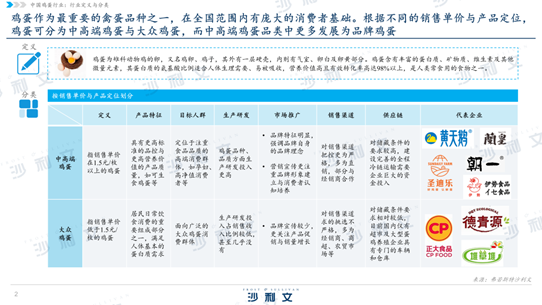
Eggs, as one of the most important poultry egg varieties, have a vast consumer base nationwide. Based on different selling prices and product positioning, eggs can be divided into mid-to-high-end eggs and mass-market eggs, with the mid-to-high-end category evolving more towards branded eggs.
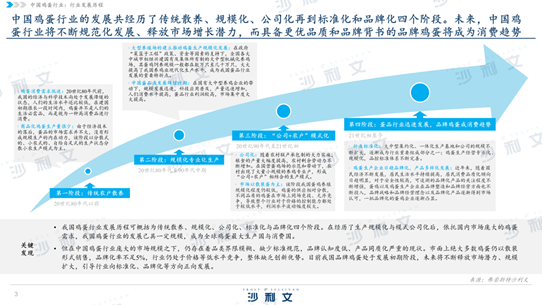
Looking at the development history of the industry, the development process of China's egg industry can be summarized into four stages: traditional free-range farming, large-scale operation, corporatization, standardization, and branding. According to Zhu Yiming, after experiencing large-scale production and model company operations, relying on the huge domestic demand for eggs, the development of China's egg industry has reached a certain scale. It has become the world's largest producer and consumer of eggs, with output accounting for nearly40%.
According to data from the National Bureau of Statistics,2021The annual poultry egg output is at34 millionAbout ten tons, based on egg production31 millionCalculated in tons, according to data from the Ministry of Agriculture and Rural Affairs, the national average wholesale price of eggs is9 - 10yuan/kilograms, from which the output value of China's egg industry can be calculated at3,000More than 100 million yuan.
However, under the vast market scale of China's egg industry, there are still issues such as blurred category boundaries, lack of standardization, low brand recognition, and severe product homogenization. The domestic egg industry is in its infancy, with most business models being small and scattered, resulting in low concentration. The vast majority of eggs on the market are still sold loose, with a low branding rate.5%The industry is still in a state of low-level competition characterized by price, lacking overall innovation advantages. The reasons for the above phenomena are as follows:
· Product features
Egg products have a relatively short shelf life. The industry consensus is that the optimal coverage sales range for egg producers is800About kilometers. Since eggs are primary agricultural products, ensuring product freshness is a factor that must be considered. Limited by transportation costs, factories have to be built nearby. At the same time, the small and decentralized industry model inevitably limits the enterprise's expansion capabilities, restricting egg companies from expanding breeding bases.
· consumer perception
Consumers lack awareness of the safety, nutrition, and practical functions of truly high-quality eggs, believing that the quality of bulk eggs is already sufficient to meet their needs.
· Brand building requires high investment and a long return cycle.
Enterprise brand building requires both time and investment. Even so, it is not certain that the brand will achieve quick results when introduced into the market. Once there are mistakes or errors in brand strategy formulation, there is often a high possibility of no returns at all. Currently, only large and medium-sized egg production enterprises in China have the financial strength to establish brands, while small enterprises or small farms simply do not have the capital to productize their brands.
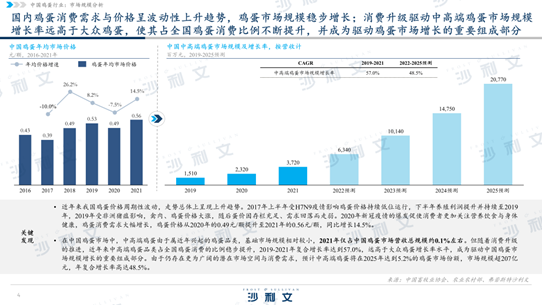
Data shows that in recent years, egg prices in China have fluctuated cyclically, with the overall trend showing an upward trend.
2017In the first half of the year, affected byH7N9 influenzaAffected by the epidemic, egg prices have continued to operate at a low level. In the second half of the year, breeding profits will increase and continue2019year,2019In 2019, affected by African swine fever, the prices of poultry meat and eggs soared. Subsequently, egg prices weakened due to sufficient inventory and falling demand.
2020The outbreak of the COVID-19 pandemic in 2020 prompted consumers to pay more attention to nutritional diet and physical health, leading to a significant increase in egg consumption demand. Egg prices have fluctuated from2020year0.49yuan/Upgrade to2021year0.56yuan/pieces, a year-on-year increase14.5%.
In the Chinese egg market, mid- to high-end eggs are a relatively new category that has emerged in recent years. The basic market size is therefore relatively small.2021Only accounts for about0.1%Left and right. However, with the advancement of consumption upgrading, in recent years, the proportion of mid- to high-end egg categories in national egg consumption has steadily increased.2019 - 2021The annual compound growth rate reached57.0%It is far higher than the general growth rate of eggs in the market, becoming an important component driving the growth of China's egg market size.
Due to the still vast potential market space and consumer demand, it is expected that mid- to high-end eggs will continue to2025Annual achievement5.2%The market share of eggs, with a market scale exceeding207Yuan, with an annual compound growth rate as high as48.5%.
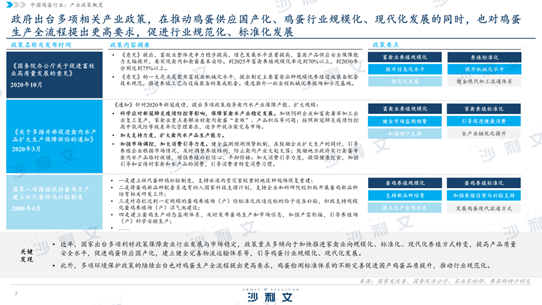
In recent years, the state has introduced a number of favorable policies to ensure the development and market stability of the poultry industry. The focus of these policies tends to be on accelerating the transformation of the poultry industry towards large-scale, standardized, and modern breeding methods, improving product quality and safety levels, promoting the localization of egg supply, establishing and improving a complete logistics transportation system, etc., to guide the large-scale and modern development of the egg industry.
In addition, the successive introduction of multiple environmental protection policies has also put forward higher requirements for the entire egg production process. The continuous improvement of the egg testing standard system promotes the quality enhancement of domestic eggs and drives industry standardization.
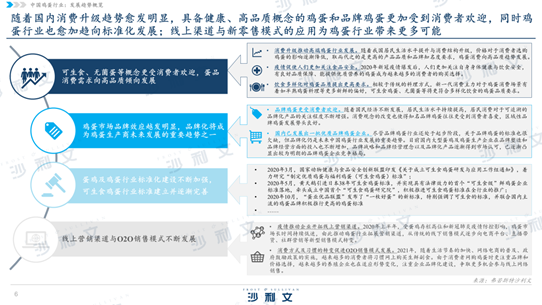
Zhu Yiming stated that, on the basis of good macroeconomic conditions and policies, China's egg market has seen growth driven by both consumer demand and production supply; at the same time, the development of online sales channels such as internet platforms has also brought new opportunities to the egg industry. In the future, it is expected that the Chinese egg industry will show the following development trends:
1With the increasingly evident trend of consumption upgrading and the impact of the pandemic, people are paying more attention to their physical health and dietary safety. Eggs with good quality assurance and capable of providing high-quality nutrition have become a purchasing choice for more consumers. Concepts such as raw eggs and sterile eggs are even more popular among consumers, and egg consumption demand is trending towards higher quality.
2With the continuous development of the national economy and the sustained improvement of residents' living standards, consumers' attention to traceable branded products is constantly increasing. The change in consumption concepts has also made well-known brands such as eggs more popular among consumers. The brand effect in the egg market is becoming increasingly evident, and branding will become one of the important trends for egg producers in the future.
3The standardization construction of the laying hen and egg industry has been continuously strengthened. The industry standard for raw eggs has been established and is gradually being improved, making the egg industry increasingly oriented towards standardized development.
4The epidemic has driven enterprises to explore online marketing channels, and the transformation of consumption methods and habits has facilitatedO2O modelWith the development of sales models, the application of online channels and new retail models will bring more possibilities to the egg industry.
Finally, Zhu Yiming analyzed the competitive focus of China's mid-to-high-end egg industry. He pointed out that the competition in the mid-to-high-end egg industry mainly revolves around four aspects: brand and marketing, food safety, supply chain, and channel expansion.
· Brand promotion and marketing increase exposure
The egg industry in China is highly fragmented, with few well-known brands. Consumers generally have a low memory for egg brands, and eggs produced by small and medium-sized unbranded chicken farms dominate the market. With consumption upgrading and the pursuit of healthy nutrition, various egg brands are using integrated marketing strategies to increase brand exposure and conversion rates, aiming to achieve rapid overtaking on the market and drive brand sales growth.
· Strictly control food safety to ensure deliciousness and safety
The quality of brand eggs is guaranteed. From the introduction of ancestral chickens, parent stock to breeding hens, Salmonella is strictly controlled. Antibiotics are not used in breeding, and eggs go through cleaning, sterilization and other steps before leaving the factory, meeting consumers' demands for 'aseptic' and 'antibiotic-free' products. In addition, egg production and transportation are strictly controlled to ensure the market time and storage conditions, guaranteeing the safety and freshness of eggs.
· Improve the supply chain to ensure product quality
Currently, the egg industry is characterized by scattered farms, mostly small-scale operations. The professional knowledge of the breeders varies widely, and chicken farm facilities are generally average with extensive management practices. Moreover, labor costs and feed prices have been rising year by year, making it difficult to control production capacity and egg quality. Egg merchants need to face up to the transformation and upgrading of the egg industry, appropriately expand production scale, control the supply chain, and improve the entire industrial chain from feed, chicks, breeding, distribution, to retail terminals. This can ensure a continuous and stable output of high-quality products and enhance brand competitiveness.
· Expand through multiple channels to increase sales
In addition to traditional egg sales channels such as supermarkets and farmers' markets, online sales channels have gradually received attention in recent years. Especially after the pandemic, major brands quickly seized the online market. The main online channels include comprehensive e-commerce platforms such as Tmall, Taobao, Pinduoduo, etc.; new retail channels such as Hema, Dingo.com, etc.; sharing platforms like Rednote, etc.; and someB2BE-commerce platforms such as Meicai, which use online live streaming for promotion and offline multi-channel distribution to increase brand exposure and awareness, thereby leading to repeat purchases.