Emerging Technologies Future Analysis Cloud Lecture Hall
3month16On the day of April 10th, the ninth lecture of the 'Emerging Technologies Future Analysis Cloud Lecture Hall', co-hosted by the Emerging Technologies Future Analysis and Management Special Committee of the Chinese Enterprise Management Research Society and organized by the Technology Foreseeing Professional Committee of the Chinese Science and Technology Policy Research Society, was successfully held. Frost & SullivanFrost & SullivanDr. Wang Xin, Global Partner and President of Greater China at Frost & Sullivan (hereinafter referred to as 'Frost & Sullivan'), was invited to be the keynote speaker for this event, delivering a presentation titled 'The Current Situation and Outlook of the Global Digital Health Industry'.


01
Background related to the digital health industry
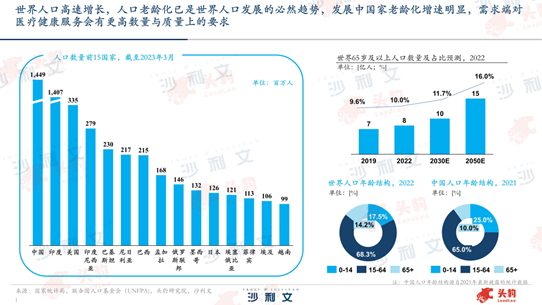
Dr. Wang Xin pointed out that the world's population has now reached80Yi, which refers to the total population in the mid-20th century3.2times. Among them, China and India are populous countries in the world, with both having populations exceeding10Yi, the combined population proportion of the two countries reaches35.7%. Urbanization development, improved medical standards, and gradually extended human lifespan are driving rapid population growth worldwide. It is estimated that by2050In [Year], the world's population will reach97billion.
In terms of age structure, the number and proportion of the world's elderly population are gradually increasing.2019The world's elderly population reached71000 million, accounting for9.6%,2022The world's elderly population reached81000, accounting for10.0%, expected to be reached by2050In that year, the world's elderly population reached151000, accounting for16%Among them, the aging rate in developing countries is increasing significantly. Taking China as an example, the proportion of the elderly population in China has changed from2016year10.9%Grew to2021year14.2%, with an annual compound growth rate of5.6%The degree of population aging exceeds the world average. Population aging is an inevitable trend in world population development, and the demand side in the future has higher requirements for medical and health services in terms of quantity and quality.
02
Current Situation of the Digital Health Industry
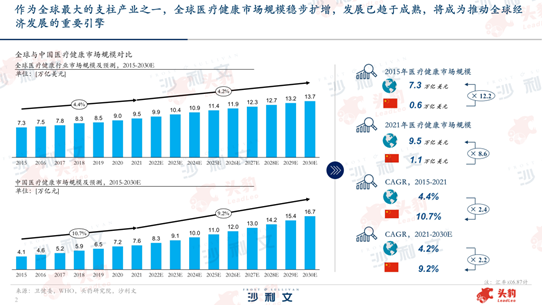
Dr. Wang Xin stated that in terms of market size, the global healthcare market has been showing a steady growth trend in recent years. ,2015Year-end2021In the year, the global healthcare market size grew from7.3Trillions of dollars grow to9.5trillion dollars, with an annual compound growth rate of4.4%, is expected to arrive2030The annual market scale reaches13.7trillion dollars2021Year-end2030The annual compound growth rate for4.2%.
2015Year-end2021In [year], the market scale of healthcare in China grew from4.1trillion yuan grew to7.6trillion yuan, with an annual compound growth rate of10.7%, is expected to arrive2030The annual market scale reaches16.7Ten thousand yuan,2021Year-end2030The annual compound growth rate for9.2%Due to the stage of industrial development, the Chinese market has seen a significant growth rate, with its share of the global market2015year8.2%Upgrade to2021year11.6%It is in a period of rapid growth.
The global healthcare market is showing a steady growth trend, and its development has become mature. Currently, the global healthcare industry has become one of the world's largest pillar industries, accounting for approximatelyGDPof1/10It will become an important engine driving global economic development.
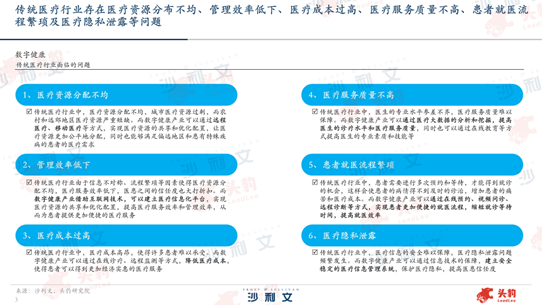
Dr. Wang Xin believes that the traditional healthcare industry faces issues such as uneven distribution of medical resources, low management efficiency, high medical costs, low quality of healthcare services, cumbersome patient care processes, and the leakage of medical privacy. The digital health industry not only breaks the traditional medical system structure, but also enables market participants such as patients, hospitals, and doctors within the healthcare system to communicate information through digital means and online platforms. This enhances the efficiency and quality of medical services, as well as the efficiency in pharmaceutical research and development, medical diagnosis, health management, and other aspects. It provides solutions for various scenarios of healthcare needs.
For example, the digital health industry can achieve the sharing and optimized allocation of medical resources through remote healthcare, mobile healthcare, and other methods, making medical resources more equitably distributed. It can also meet the medical needs of patients in remote areas and those with special diseases, providing a solution to the problem of uneven distribution of medical resources in traditional healthcare industries.
Digital health is an interdisciplinary concept that combines medical health with modern digital technology. It integrates modern digital technology into the field of medical health, digitizing the entire healthcare process through the generation, collection, analysis, and application of big data in healthcare. This achieves dynamic linkage among all parties involved in healthcare, thereby providing patients with convenient, efficient, and intelligent healthcare services and management, and bringing new value to all parties involved in the healthcare industry. Digital technology has promoted development and model transformation in the field of healthcare, endowing digital health with three core values: equity and accessibility, precision and effectiveness, and efficiency improvement.
Dr. Wang Xin further stated, The content covered by digital health mainly includes six aspects: digital medicine, digital diagnosis and treatment, digital enterprise services, digital health management, digital health platforms, and digital insurance. With the deepening of digital applications in healthcare, the digital health industry will better meet the multi-level and diverse healthcare needs in the future.
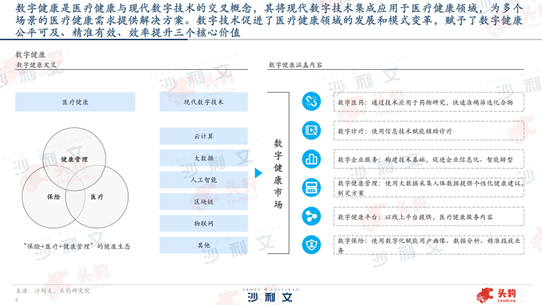
Dr. Wang Xin pointed out that, looking at the development trajectory of digital health, over the past three years, the global COVID-19 pandemic has challenged the world's health systems and is undergoing profound changes in the global health sector. AIThe development of digitization has driven the transformation of traditional healthcare industries. In the 'post-pandemic era', the application of digital health technologies to strengthen healthcare systems and vigorously develop the digital health industry has become a consensus among countries around the world.
With the rapid development of digital technology, the world is in an era of information explosion, and the integration of digital technology with healthcare has gradually become mainstream. In recent years, the World Health Organization has issued several global strategies related to the digital health industry, such as2019In 2019, the World Health Organization released the Global Strategy on Digital Health2020 - 2024for the first time clarified the definition of digital health, officially called on countries around the world to actively formulate national-level digital health construction transformation plans, and2020In 2019, the 'Guidelines on Strengthening the Application of Digital Technologies in the Health System' and the 'Draft Global Strategy for Digital Health Care' were released2020 - 2025In [year], guidelines were provided for the digital health construction of various countries, and a series of promotion strategies and measures were proposed.
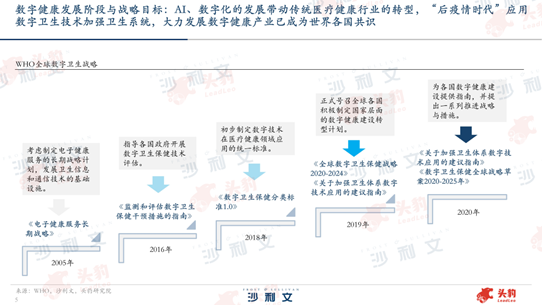
Looking at the national level, countries around the world have formulated different development policies for the digital health industry based on their own economic development and digital healthcare technology levels. For example2016In the United States21The Century Cure Act proposes to develop combined products of health software and mobile medical applications, providing clearer and consistent reasonable regulatory norms; several strategies encourage and regulate the 'interconnection' of healthcare data;2021The European Digital Agenda for the Decade2030) actively promote digital construction, improve the electronic health records of all citizens, and ensure that every citizen can obtain medical and health services or healthcare under a secure online environment;2022In 2018, the UK's 'Data Saves Lives: Reimagining Health and Social Care with Data' policy proposed a national healthcare data strategy, covering multiple aspects such as enhancing trust in healthcare data systems, collecting medical information, and providing decision support with healthcare data.
Dr. Wang Xin stated that, in terms of common development policy characteristics, all development policies share the same development goal, which is to deeply integrate digital and healthcare, resulting in1+1>2The role is to deeply mine and widely apply data on the basis of eliminating data barriers and constructing a medical big data system, thereby promoting the healthy development of national healthcare.
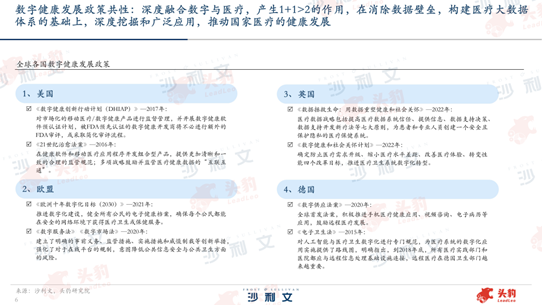
At the same time, Dr. Wang Xin also pointed out that the digital health industry is2022A globally co- attention the hot area. In terms of the distribution of investment hotspots, countries with high investment enthusiasm themselves possess a good digital foundation, and a country's digital health investment boom can radiate and drive the development of the digital health industry in neighboring countries, thereby promoting the vigorous development of the global digital health industry.
2022In 2021, the five countries with the most healthcare financing events globally were the United States, China, the United Kingdom, Israel, and India. Among them, Israel and India have risen as healthcare innovation forces in Asia. Especially, the enthusiasm for healthcare financing in Israel and India has surged significantly, making them one of the five hotspots. Like India, digitization is also an important factor contributing to healthcare innovation in Israel.
2022In1,257Matters related to financing,440.0US$10 billion in financing leads the world, closely followed by China; both China and the US account for the total financing of all countries75.0%financing event81.0%.
Looking at single financing events, The average financing amount per deal in the United States is0.35Billions of dollars, ranking first. As a leading country in digital health, it can be seen that the digital health industry in the United States is highly active and proactive in the capital market, which will further fuel the development of the industry.
Although the average financing amount per deal in China is only0.13The economy is worth hundreds of billions, but with continuously strengthened technological innovation and rising international competitiveness, more investment opportunities will emerge in the high-quality development of China's economy. The capital market development prospects for China's digital health industry are long-term positive.
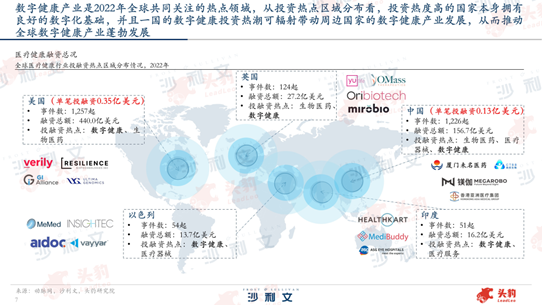
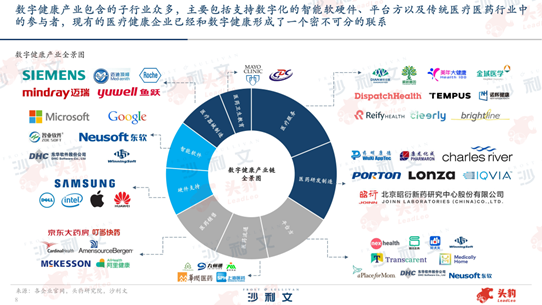
"The digital health industry encompasses numerous sub-industries, mainly including intelligent software and hardware supporting digitization, platform providers, and participants from the traditional healthcare sector. Existing healthcare enterprises have formed an inseparable connection with digital health."Dr. Wang Xin said."
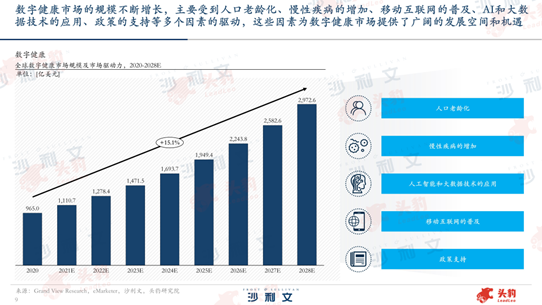
Subsequently, Dr. Wang Xin further introduced the digital health market situation. The data shows that2020The global digital health market size is965.0billions, expected2021year-2028Year will be15.1Compound annual growth rate of % increases. The scale of the digital health market is continuously growing, mainly driven by population aging, an increase in chronic diseases, the popularization of mobile internet,AIDriven by multiple factors such as the application of big data technology and policy support, these factors provide a broad development space and opportunities for the digital health market:
1Population aging
As the global trend of population aging continues to intensify, the demand for medical services from the elderly is also growing. Digital health technologies can help the elderly access medical services more conveniently, such as telemedicine and intelligent health monitoring. According to data from the US Census Bureau, it is estimated that by2050Year, global65The population aged 65 and above will account for16%than2018year11%There has been a clear increase, which will further drive the development of the digital health market.
2Increase in chronic diseases
With the change in lifestyle and the aggravation of environmental pollution, the incidence of chronic diseases is constantly rising. Digital health technologies can help patients better manage and control their diseases, such as through intelligent monitoring and telemedicine. According to data from the World Health Organization, the number of chronic disease patients worldwide will continue to increase in the coming decades.2030Will reach in5.6hundreds of millions.
3The popularization of mobile internet
The popularization of mobile internet has provided favorable conditions for the development of the digital health market. More and more people are using smartphones and other mobile devices to obtain medical information, manage their health, and receive healthcare services. According toeMarketerdata2019The global smartphone penetration rate is about55.7%The smartphone penetration rates in Singapore, South Korea, and other economically developed countries have reached88.9%and88.4%, India and other countries are expected to reach63.3%and39.0%The increase in smartphone users in emerging markets will drive the growth of the digital health market.
4The application of artificial intelligence and big data technologies
The application of artificial intelligence and big data technologies has brought more opportunities and challenges to the digital health market. These technologies can help medical institutions and patients better manage and analyze medical data, thereby improving the quality and efficiency of healthcare services.
5Policy support
Government support and regulation are crucial for the development of the digital health market. An increasing number of governments and regulatory bodies are beginning to formulate relevant policies and regulations to promote the development of the digital health market and protect the rights and interests of patients. For example, in the United StatesFDASeveral digital health products and services have been approved, bringing a favorable development environment to the digital health market.
03
Digital health industry sub-sectors
Dr. Wang Xin further elaborated on the promising niche segments in the digital health market.
First is medical informatization, which is also a focal point in the digital health sector. It includes hospital core management systems, data centers, electronic medical records,HISThe system consists of inspection information systems, emerging medical informatization systems, etc.
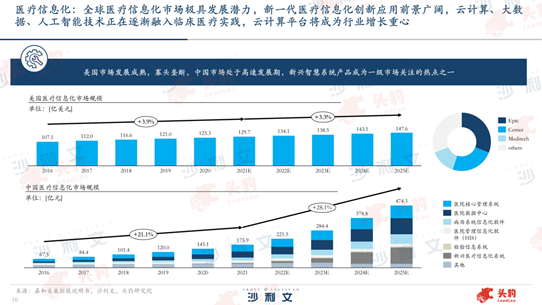
In terms of market scale, the US market is mature and developed.2016Year-end2021In [year], the market scale of healthcare informatization in the United States was from107.1USD billion growth to129.7billion US dollars, with an annual compound growth rate of3.9%, is expected to arrive2025The annual market scale reaches147.6billion dollars2021Year-end2025The annual compound growth rate for3.3%The US healthcare information market has matured, with a relatively concentrated market share and an oligopoly situation. The top three companies areEpic Games,Cernerand Meditech, its2019The combined annual market share is close to70%ranked firstEpic GamesMarket share exceeds30%.2022year6Month, Oracle Bone Script Company283$100 million price to complete the acquisitionCernerThe acquisition involves one of the world's largest software providers and another leading company in the US healthcare information industry. This epic merger reflects the international giants' future layout for the digital health industry.
Compared with the US market, the Chinese market is in a period of rapid development.2016Year-end2021In [year], the market scale of China's medical informatization industry grew from67.5RMB billion growth to175.9Yuan, with an annual compound growth rate of21.1%, is expected to arrive2025The annual market scale reaches474.3yuan,2021Year-end2025The annual compound growth rate for28.1%.
In comparison, the market concentration in the Chinese market is relatively low, and there are no truly leading enterprises. There are many reasons for this result. Cognitive limitations, product form, and other factors have constrained the 'growth and strengthening' of Chinese healthcare information technology enterprises. Currently, leading companies have achieved economies of scale in basic information construction such as medical record systems, forcing emerging companies to focus on developing new systems. This has also made emerging smart system products one of the hot topics in the primary market.
Dr. Wang Xin pointed out that the global healthcare informatization market has great development potential, with broad prospects for innovative applications in the new generation of healthcare informatization. Cloud computing, big data, and artificial intelligence technologies are gradually integrating into clinical medical practice, and cloud computing platforms will become the focus of industry growth. It supports the application of artificial intelligence technology, virtual reality, robotics, and other technologies in various fields such as telemedicine, remote surgery, integration of healthcare and elderly care, drug research and development, and health management, ultimately promoting the intelligentization of healthcare services.
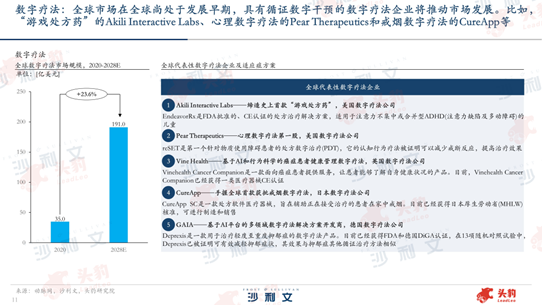
Next is digital therapeutics, which has seen rapid development alongside the digital health market, with global digital therapeuticsDTxThe market scale is also constantly climbing.2020In [year], the global digital therapy market size was35.0billions, expected2028The annual market scale increased to191.0billion dollars2020 - 2028The annual compound annual growth rate will reach23.6%.
With the increasing popularity of mobile internet, the demand for healthcare cost control continues to grow. The incidence of chronic diseases and mental health disorders is gradually climbing. Coupled with the COVID-19 pandemic, which has fundamentally changed people's attitude towards healthcare intervention software, the global digital therapy industry has entered a fast development phase amidst the interweaving of various factors.
Currently, many countries and regions still lack a comprehensive understanding of digital therapeutics. Coupled with concerns about patient data privacy, the market growth for digital therapeutics may be limited. However, in the long run, this represents high-growth potential in unexploited markets, which will bring key profit opportunities to digital therapeutics companies.
Dr. Wang Xin stated that the digital therapy market is still in its early stages of development globally, and digital therapy companies with evidence-based digital interventions will drive market growth. For example, 'game prescription drugs'Akili Interactive LabsPsychological digital therapyPear TherapeuticsDigital therapeutics for smoking cessationCureAppDigital Therapy for Cancer Patient Health ManagementVine HealthAnd based onAIDeveloper of multi-domain digital therapy solutions on the platformGAIAwait.
Although digital therapeutics are emerging medical approaches to improve clinical outcomes, the commercialization of digital therapy products still faces challenges due to the lack of payer reimbursement pathways that match their value.
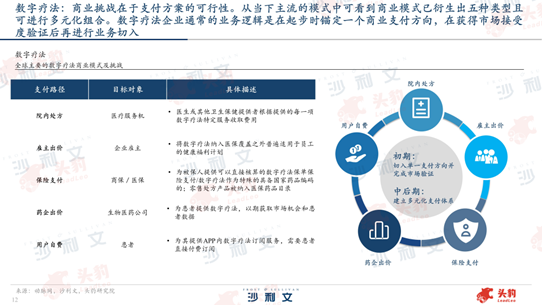
Currently, the main digital therapy business models globally include in-hospital prescriptions, corporate employer offers, insurance payments, pharmaceutical company offers, and user self-payment. And can be combined in a diversified manner. Digital therapy companies typically start with a business focus on a specific payment channel, and only after gaining market acceptance do they expand into other areas. For example, digital therapy providers for chronic disease managementDario HealthIn the early stages, the service was directly delivered to users through software and achieved success. In the later development phase, service examples and data support were provided by expanding models such as enterprise employer payments and commercial insurance premiums.
Against the backdrop of higher demands for digital healthcare solutions, it is essential for both payers and digital therapeutics companies to explore potential payment options."Dr. Wang Xin said."
Furthermore, Dr. Wang Xin analyzedAIDrug R&D track. In recent years, driven by capital, the worldAIA development boom has swept through the field of drug research and development.
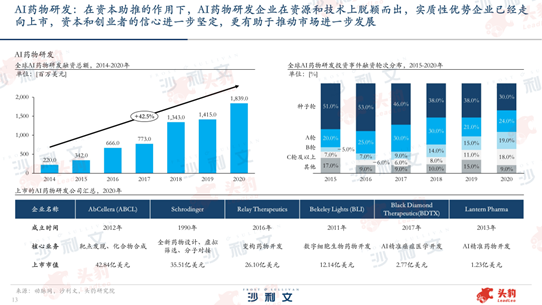
From the perspective of the primary market,AIThe total financing for drug research and development is from2014year2.2USD billion growth to2020year18.4billions, compound growth rate42.5%From the perspective of corporate financing rounds,2015The proportion of enterprises with seed round as their annual financing round is51%, whereas2020In FY2019, this proportion dropped to30%, whereasBwheelCThere are more and more financing round events. The main reason isAIThe integration trend in the drug R&D industry is evident, with someAIEntrepreneurial companies have achieved a substantial lead in resources and technology and developed accordingly, while lagging companies are forced to focus on the early service-oriented areas of drug discovery, which further hinders their development.
From the perspective of the secondary market, globallyAIThe pharmaceutical R&D industry has made significant breakthroughs in the capital market, with substantial advantage companies moving towards listing. This further strengthens the confidence of both capital and entrepreneurs, which is conducive to promoting further market development.
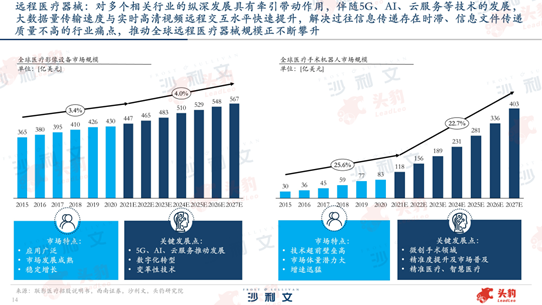
Finally, there is the remote medical device track. As an interdisciplinary field involving multiple industries such as medical devices, information and communication, and healthcare, the development and application of remote medical devices play a leading role in driving the in-depth development of related industries such as medical imaging, medical robots, and remote monitoring. Countries around the world have introduced policies to encourage the development of remote medical devices. In terms of market size, the global remote medical device market is continuously climbing, especially in the two sub-sectors of medical imaging and surgical robots.
First, medical imaging equipment. Globally, medical imaging devices with diagnostic or therapeutic guidance capabilities have been widely used, and the industry has matured.2015Year-end2021In [year], the global market size of medical imaging equipment was365USD billion growth to447billions, with an annual compound growth rate of3.4%, is expected to arrive2027The annual market scale reaches567billion US dollars2021Year-end2027The annual compound growth rate for4%In the future, the medical imaging equipment track will be in5G,AIDigital transformation is being driven forward through technologies such as cloud services.
Second, surgical robots. Surgical robots differ from the medical imaging equipment market, as the market volume is not yet large enough to form a scale, and the industry has shown a rapid development trend in recent years.2015Year to2021In [year], the global surgical robot market size was30USD billion growth to118billions, with an annual compound growth rate of25.6%, is expected to arrive2027The annual market scale reaches403billion dollars2021Year-end2027The annual compound growth rate for22.7%.
In the field of minimally invasive surgery, products that use surgical robots to assist humans in precise control of medical devices have advantages such as reducing surgical wounds, high precision, and low learning and promotion difficulty. In the future, the key development point of the industry will be the revolution brought about by the popularization of surgical robots, which will transform surgical operations and develop towards precision medicine, telemedicine, and smart healthcare.
accompany5G,AIWith the development of cloud services and other technologies, the transmission speed of large volumes of data and the level of real-time high-definition video remote interaction have rapidly improved. This has resolved industry pain points such as latency in information transmission and low quality of information file transfers. In the future, the global remote medical device industry will grow rapidly.
04
Frost & Sullivan and LeadLeo empower the digital health industry
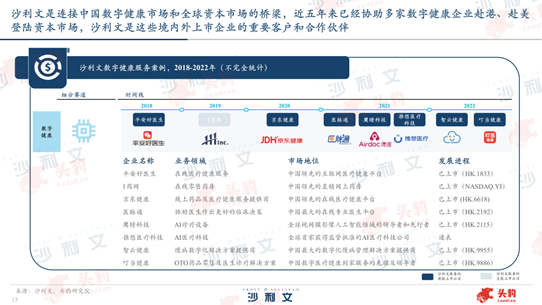
Finally, Dr. Wang Xin introduced: " This year marks the 50th anniversary of Frost & Sullivan's global establishment.62The anniversary is also the first time we have entered the Chinese market25For decades, Frost & Sullivan has been playing the role of a bridge connecting China's digital health market with the global capital markets. In the past five years, it has assisted many digital health companies in listing on Hong Kong and US capital markets. Frost & Sullivan is an important client and partner for these domestic and overseas listed companies.
Relying on the global think tank resources of Frost & Sullivan and its cross-industry business development platform in Greater China, the Frost & Sullivan Greater China office has unique core strengths in investment and financing as well as strategic development support services for the digital health industry. Frost & Sullivan can assist enterprises in writing in-depth articles and industry white papers, as well as conducting multi-channel dissemination. For example, Frost & Sullivan recently plans to jointly release 'Hong Kong Stock18A 2023The white paper "Biotechnology Industry Development" aims to provide18ABiotechnology service providersIR/PRPlatform. Moreover, it can also help shareholders of companies planning to go public or those that have already listed, capital market intermediaries, and market investors gain a more comprehensive and in-depth understanding18AThe biotechnology sector provides breakthrough ideas for investment and financing in related capital markets.
In the future, TradeGo, together with Frost & Sullivan's LeadLeo Research Institute and cloud technology, will continue to provide customers with comprehensive and high-quality services. As an important witness and participant in the development of the global and Chinese economic landscape, we will always place a strong emphasis on China and look forward to the future development of its industries. "