In March, the much-anticipated reform plan for State Council institutions was officially released, proposing six important measures including the establishment of a National Financial Supervision and Administration Commission. As the integration of modern technology with the financial industry becomes increasingly high, this reform plan highlights the country's ability and determination to prevent and resolve risks, as well as to improve digital transformation and upgrading.
For financial institutions that have weathered the pandemic, digital transformation is facing challenges such as accelerating international and domestic technological iterations, economic dual circulation stimulation, domestic compliance operations, regulatory scrutiny, and the increasingly prominent contradiction between changing financial demands and long software development cycles. They urgently need to adapt to the situation, tailor their strategies to local conditions, address current pain points, and maintain a sustainable development pace. This also means that the application and growth space of fintech is still very broad, with enormous market potential.
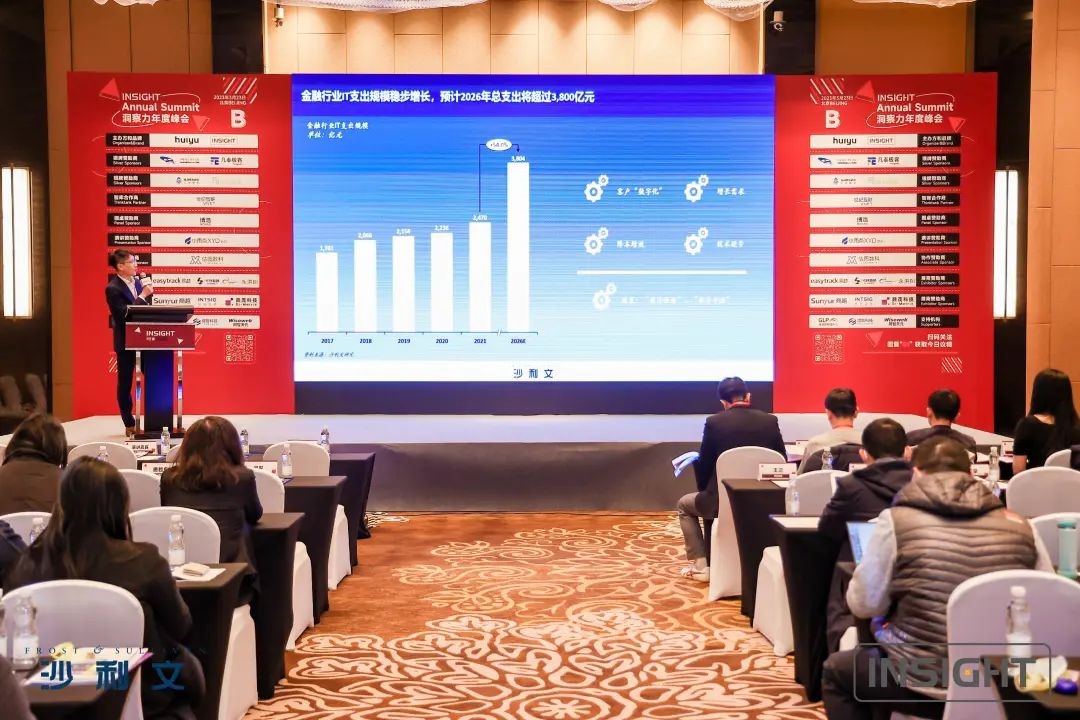
3month23dayInsightOrganizing Committee in Partnership400Leaders from mainstream financial institutions and outstanding technology representatives empowering the financial industry held their annual Insight Summit in Beijing. The summit focused on 'Insight, Influence, Integration, and Innovation,' and discussed topics such as the new global fintech regulatory trends, 'Revitalizing the Banking and Securities Industry with Technology,' 'Striving at the forefront of insurance technology to revitalize the industry,' and delved into industry hotspots to strengthen exchanges and cooperation within the sector. Frost & SullivanFrost & SullivanCui Nan, Executive Director of Frost & Sullivan Greater China, was invited to attend the event and delivered a speech on the future development trends of financial new technologies.

Executive Director, Greater China, Frost & Sullivan Cui Nan
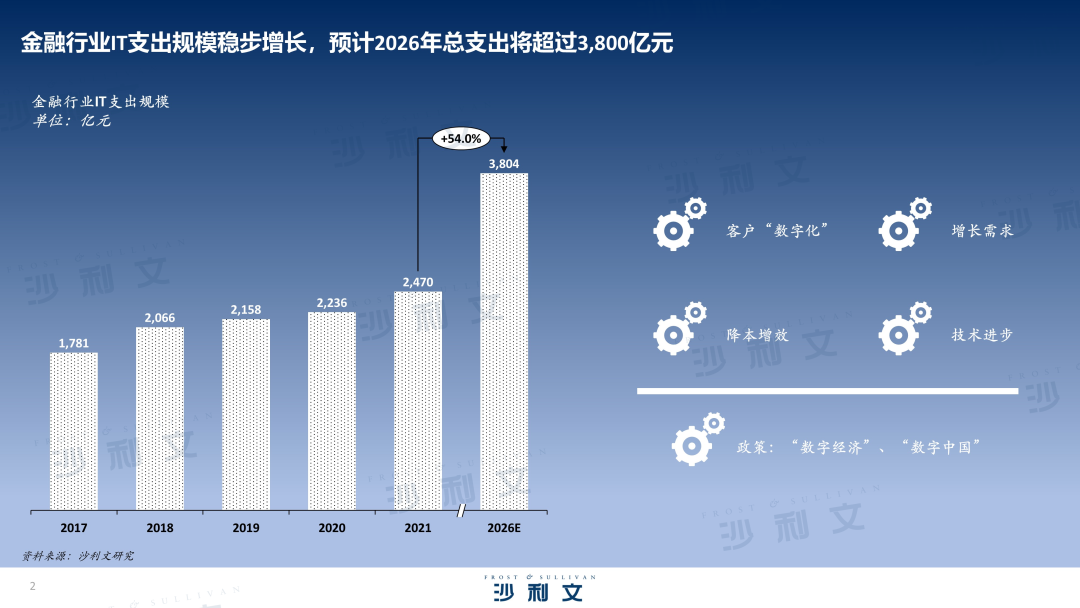
Cui Nan stated that the financial industry is the 'goldmine' in the field of digital transformation.2017Year-end2022In the year, the added value of the financial industry was6.5trillion yuan, increasing to9.7trillion yuan, and every1%The improvement of output efficiency will bring970Yi-billion added value. In recent years, the financial industryITThe expenditure scale is growing steadily. Driven by factors such as customer 'digitization', increasing demand, technological progress, and favorable policies, it is expected that by2026Total annual expenditure will exceed3,800100 million yuan.
"The digital transformation of the financial industry has unique advantages," Cui Nan further explained, such as in the financial industryITThe infrastructure is complete, with a large amount of data accumulated in business systems and a high degree of standardization. Moreover, due to factors such as high industry concentration and average volume, the industry has a strong awareness of digital transformation and the ability to conduct digital transformation payments.
Currently, emerging digital technologies in the financial field include artificial intelligence, blockchain, cloud services, big data, and the Internet of Things. Cui Nan focused on analyzing the market development status of these three areas: artificial intelligence, cloud services, and big data.
According to a study by Frost & Sullivan, the market scale of China's artificial intelligence market is2017Renminbi in [year]545RMB billion growth to2021Renminbi in [year]2,603Yuan, with an average annual compound growth rate of48%In the future, it will maintain stable growth, with an expected2026In [year], its market size will grow to RMB17,504yuan,2021Year to2026The annual average compound growth rate reaches46%.
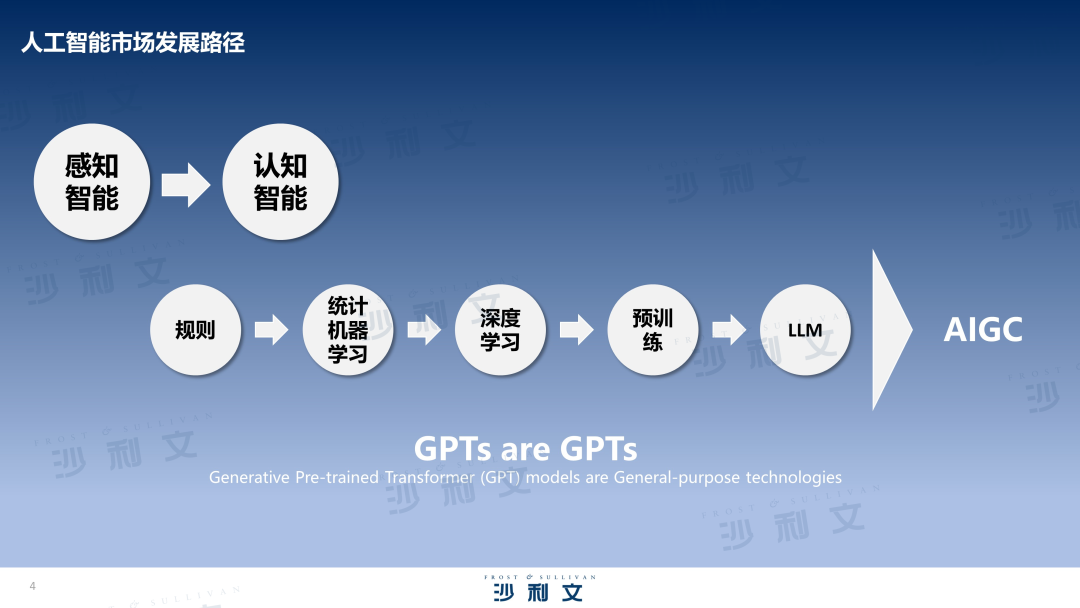
Cui Nan pointed out that the new generation of artificial intelligence is gradually upgrading from perceptual intelligence to cognitive intelligence. Perceptual intelligence refers to the ability of computers and different devices to possess human-like perceptual abilities such as vision, hearing, and touch. By structuring and processing multi-source heterogeneous data and communicating with humans through these means, cognitive intelligence draws inspiration from brain-like research and cognitive science on top of perceptual intelligence. It combines technologies such as cross-domain knowledge graphs to endow computers and different devices with human-like thinking and cognitive capabilities.
From a technical perspective, computers have evolved from simple rule-based judgments at the beginning to statistical machine learning, and then further to deep learning. Different neural network algorithms enable robots to recognize data such as text, images, and sounds. Pre-trained models achieve the goal of learning with few samples through transfer learning and enhance their application capabilities in various complex scenarios by integrating with knowledge bases from different industries. Among them, large-scale pre-trained language modelsLLMBased onTramsformerThe model, along with a vast amount of online corpora, can acquire knowledge from massive datasets to achieve capabilities such as recognition, summarization, translation, prediction, and text generation.UGC,PGCThen there is a brand-new content production model —AIGC. futureAIGCThe market has broad development space.
The market scale of cloud services in China is2017Renminbi in [year]860RMB billion growth to2021Renminbi in [year]2,933Yuan, with an average annual compound growth rate of36%, is expected to arrive2026In [year], this number will grow to RMB9,042100 million yuan.
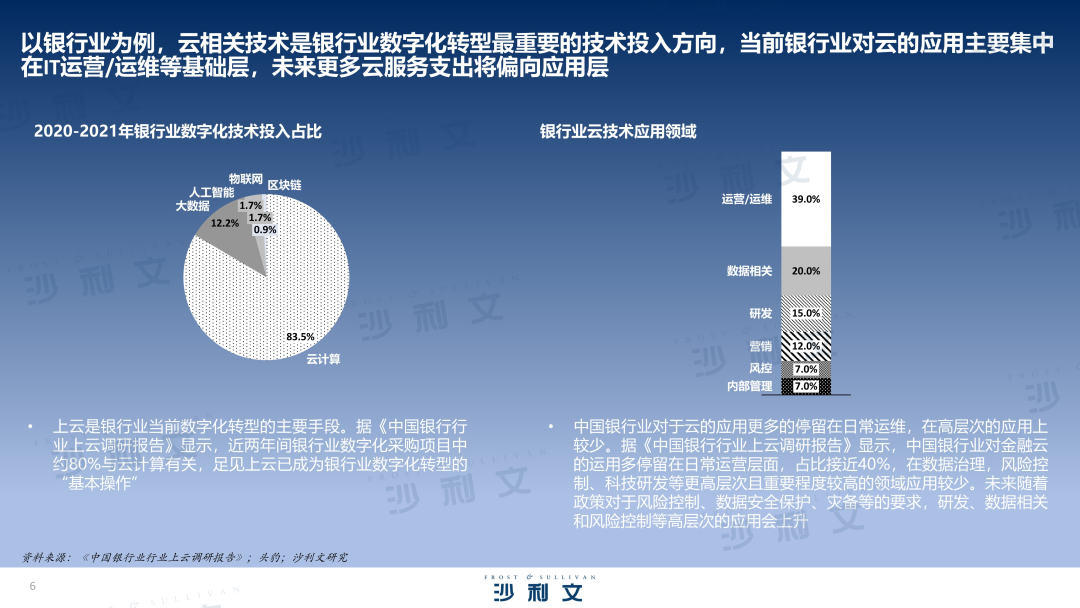
Take the banking industry as an example. Cloud-related technologies are the most important investment direction for digital transformation in banking. In the past two years, approximately80%Related to cloud computing, according to the 'Banking Industry Cloud Adoption Survey Report' by Bank of China, the application of financial clouds in Chinese banking mostly remains at the operational level, accounting for nearly40%, It is less applied in higher-level and more important areas such as data governance, risk control, and technology research and development. In the future, with policy requirements for risk control, data security protection, disaster recovery, etc., high-level applications related to research and development, data, and risk control will increase.
The market scale of big data in China is2017Renminbi in [year]412RMB billion growth to2021Renminbi in [year]849Yuan, with an average annual compound growth rate of20%, is expected to arrive2026In [year], the market size will grow to RMB2,195yuan,2021Year to2026The annual average compound growth rate reaches21%.
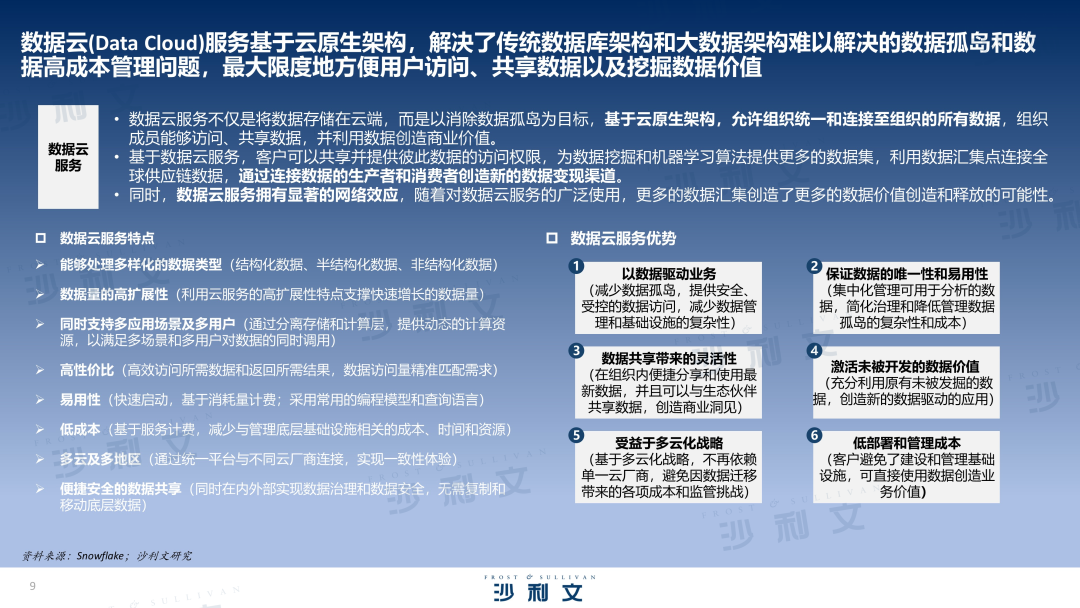
Cui Nan stated that solutions based on traditional databases or big data architectures often face challenges such as lack of scalability, data silos, data integrity, and data governance, making it difficult to meet the increasingly flexible needs of data analysis. However, the data cloud(Data Cloud)The service is built on a cloud-native architecture, which, compared to Data cloud services offer advantages such as driving business with data, ensuring data uniqueness and usability, flexibility brought by data sharing, activating untapped data value, benefiting from multi-cloud strategies, and low deployment and management costs. They can solve the problems of data silos and high-cost data management that are difficult to address with traditional database architectures and big data architectures, maximizing user convenience in accessing, sharing data, and mining data value.
Data shows that banks with a higher proportion of technology investment grow faster, while those with an insufficient proportion see less growth.3%The average annual compound revenue growth rate of banks over the past decade was10.2%, and the proportion of investment exceeds4%The bank's annual compound revenue growth rate over the past decade has exceeded11%Digital transformation has led to a significant 'Matthew Effect' across the entire industry.
"In the future, the application of new financial technologies will shift from addition to multiplication, from superposition to integration, further empowering the digital transformation and upgrading of the financial industry." said Cui Nan.