In recent years, Chinese fast food has become increasingly popular, especially Chinese hamburgers. What are the reasons for its continuous rise in popularity? Is it related to the resurgence of nationalist consumption? Why have they been able to maintain strong growth momentum despite the economic slowdown? What key strategies have businesses adopted? What are the well-known brands in the Chinese fast food industry? Are there potential risk factors for franchise operations?
Frost & SullivanFrost & SullivanLou Lei, Executive Director of Frost & Sullivan Greater China Region (hereinafter referred to as 'Frost & Sullivan'), was interviewed The Wire China Interview, jointly discussing the development of the Chinese catering industry.
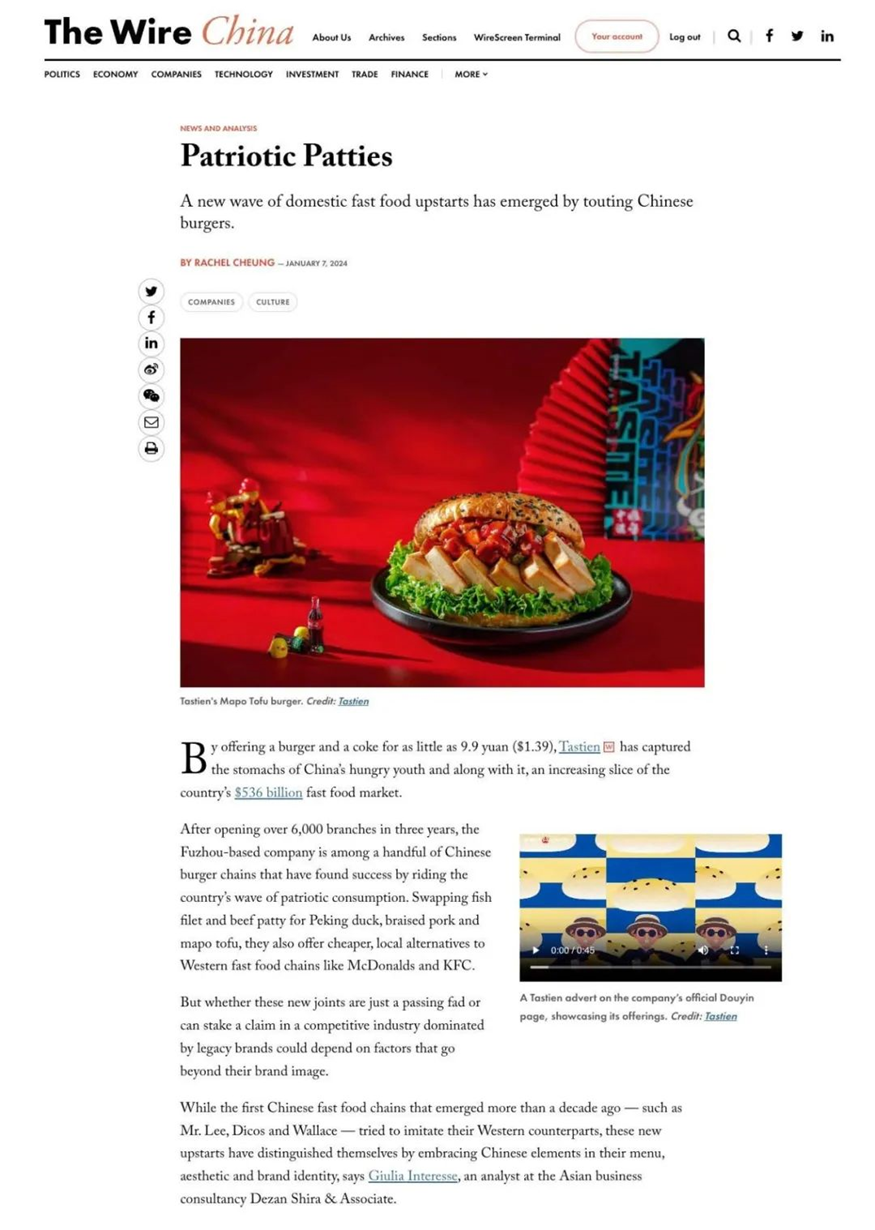
The Wire China
Q
In recent years, Chinese fast food, especially hamburgers, has become increasingly popular among the public. What has led to their popularity? Is this related to the rise of national trends or nationalist consumption? Why can they still maintain a strong growth momentum despite the economic slowdown?
This is the result of multiple factors converging:
(1The economic growth rate has slowed down, and there has been structural adjustment in the economy. Consumers have an increasing demand for cost-effective products. This type of local fast food, including Chinese hamburgers, happens to meet this demand.
(2China's catering supply chain has experienced rapid development over the past few decades. The upstream and downstream of the industrial chain have built a very complete industrial chain in terms of raw material supply, distribution, and the preparation of intermediate products. To a certain extent, this is also inseparable from the contributions of KFC and McDonald's, which have cultivated a group of modern suppliers. This has enabled Chinese fast food to easily find suitable, competitive-priced, and standardized product suppliers and quickly establish their own supply chain systems.
(3In recent years, new social tools, especially products represented by Douyin, have provided catering brands with new traffic channels. Some emerging brands have taken advantage of their understanding of consumer new needs by applying for delivery services first, diverting traffic to offline stores and thus reaping the benefits of development.
(4Many emerging brands are local fast-food chains or those targeting the lower-income market. For a long time, the lower-income market has not formed a leading enterprise sector, with a large number of traditional and fragmented catering businesses. This has provided space for the development of these emerging fast-food chains.
We believe that although the rise of Chinese-style hamburgers in recent years has been aided by national trends and local consumption, their sudden surge is essentially the result of a combination of various comprehensive factors. Consumers are not simply paying for national trends.
The economic slowdown mainly affected some consumer goods industries that were previously relatively priced higher. These Chinese-style hamburgers are known for their cost-effectiveness and affordability, so they were not greatly impacted.
Q
withTastienFor example, the number of its stores has increased from30The company rapidly expanded to6000Multiple locations. How has this expansion rate been achieved? What key strategies have been adopted by the company to drive this growth?
In summary, the rapid rise of Taster's is due, on the one hand, to macroeconomic background and era dividends such as new changes in economic structure and vast market space in the lower-tier markets (more than half of its stores are located in third- and fourth-tier cities), and on the other hand, to its unique products and flavors (Chinese-style hamburgers, freshly baked bread rolls).+Standardized and quality-controlled products+The full application of Douyin's traffic monetization strategies is the reason for his success.
Q
besidesTastienWhat other well-known brands in the Chinese fast-food industry are similar to Paila Burger and Jia Guolong?
In addition to hamburgers, other fast food options are also worth noting. This includes noodle restaurants (such as Hefu Lao Mian and Chenxianggui), as well as rice-based fast food (such as Yu You Yi Zhi, Miyamura Bunmi). For a long time, these sub-sectors have been characterized by large category sizes and a lack of leading brands, but there is significant room for large-scale and chain development in the future. Drawing on Japanese examples, when the economy underwent structural changes, large-scale chain enterprises such as Sushiya and Salad Bar emerged. They have carved out a niche by offering cost-effective, standardized products that are delicious but not expensive.
Q
In terms of the number of branches,TastienIt is rapidly catching up with competitors such as McDonald's. What changes have taken place in its market share? Is there a possibility that it could threaten the market positions of traditional brands like KFC, McDonald's, and Wallace in the future?
We believe that at the current stage, everyone is still competing in a misaligned manner, as there are significant differences in terms of customer unit price, location selection, and urban distribution. Companies like Tastin mainly develop in lower-tier cities and generally do not directly compete with KFC and McDonald's in the same locations when entering high-tier cities. The target customer groups also vary. However, in the long run, it is inevitable that KFC and McDonald's will continue to expand downward while Chinese-style hamburgers develop upward. We believe that more players and richer product innovation are beneficial for the long-term development of the industry. We can also see that KFC has recently launched some products similar to Chinese-style hamburgers. The rise of Chinese-style hamburgers is also inseparable from KFC and McDonald's transformation of the Chinese catering supply chain.
Q
At the operational level,TastienAre there any potential risk factors? For example, last yearTastienThere have been food safety issues at Hamburg, with some branches found using expired ingredients. Are these incidents isolated cases or reflect deeper problems?
For this type of catering business that primarily relies on franchisees, the management of franchisees, especially in terms of food safety, has always been one of the most fundamental and important aspects. This is also the reason why many of the earliest Chinese franchise enterprises have seen a decline in their performance.
The company needs to find a balance between development speed and quality control. During rapid development, issues with quality and store management are most likely to arise, such as exceeding the original store density and transitioning to more intensive encryption, franchisees not complying with the company's food safety regulations, etc. We have also seen leading enterprises continuously strengthening management and investment in this area. The improvement of electronic tools now also provides relevant guarantees, but there is still much room for improvement here.
For thousands of franchisees, many of whom are individual businesses, certain security issues can sometimes arise and are difficult to avoid. However, whether this proportion can be controlled and continuously improved is the fundamental for a company's longevity. KFC and McDonald's have also gone through nearly a century of development before achieving today's success.
* This interview was published in The Wire China Reporter forRachel CheungOriginal title: Patriotic Patties — A new wave of domestic fast-food upstarts has emerged by touting Chinese burgers .