Recently, Frost & SullivanFrost & SullivanSponsored by Frost & Sullivan and co-organized by LeadLeo2024The 18th Frost & Sullivan China Growth, Innovation and Leadership Summit and the 3rd New Investment Conference were successfully held at the Jing'an Ruiji Hotel in Shanghai. The theme of this year's Frost & Sullivan New Investment Conference is 'Gather Strength to Win the Future', bringing together the wisdom and efforts of the global industry, academia, and investment community to jointly explore new growth points, new markets, and new tracks for the Chinese economy in the new era.
Mr. Zou Yaru, Global Partner and Executive Director of the Board at Frost & SullivanAroop Zutshi) Attended the opening ceremony and plenary session, and delivered a welcome speech.
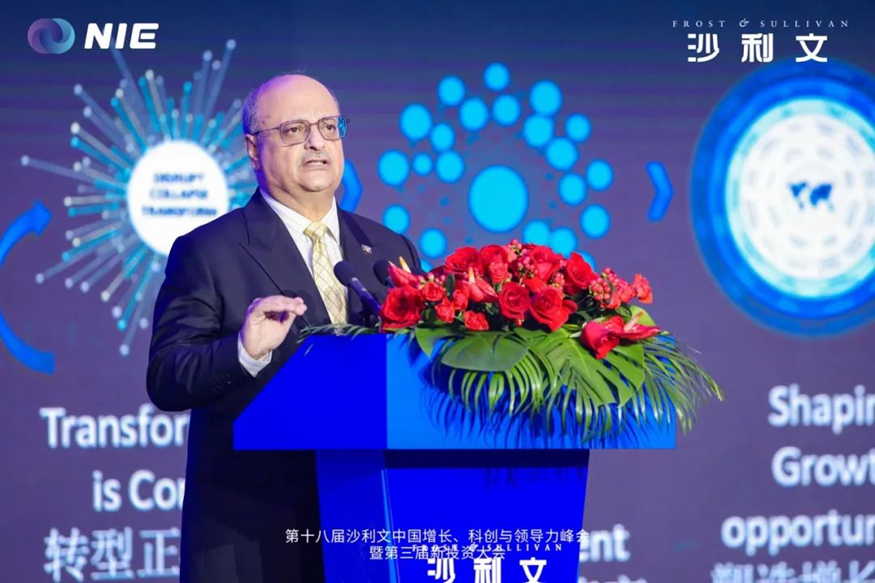
Global Partner and Executive Director of the Board at Frost & Sullivan Mr. Zou YaruAroop Zutshi)
The following is Mr. Zu Yaru (Aroop Zutshi)Key points of the speech:
Ni Hao, a very nice morning to all of you. Thank you so much for coming. On behalf of the Board of Directors of Frost & Sullivan, my fellow partners, some of whom are in this esteemed audience,
Neil Wang, who oversees all of our Greater China operations and is also involved in helping us with global board-level discussions on direction and strategy. I am also with me
Mr. Shivaji Das, who manages our Asia Pacific operations: Australia, New Zealand and some parts of South Asia. I have with me Mr. Robin Joffe who manages our Middle East, Africa, and our European businesses. Of course, I'm based in California, so I can also say that I represent the US and Latin American markets. We have a solid team of people, including my team here in China, who can help you navigate through what I consider to be the most transitive and transformative elements in our business world today.
Hello everyone! Good morning! On behalf of the board of directors and partners at Frost & Sullivan, I would like to thank you all for coming. Please allow me to introduce our Frost & Sullivan partner present today: Dr. Wang Xin, who serves as a global partner at Frost & Sullivan and Chairman of the Greater China region, leading the global development direction and strategy of Frost & Sullivan;Shivaji DasMr. Frost & Sullivan Partner and Managing Director for Asia-Pacific;Robin JoffeMr. Frost & Sullivan partner and President of the Middle East, South Asia, and North Africa region. As I am based in California, I canI would like to say that I represent the US and Latin American markets. In summary, we have a strong team here to help you navigate the ever-changing global business environment.
So, you've heard from David who talked about transformation. It's now becoming very important that every company in the world needs to understand what this transformation means. My focus today is to help you all understand how to navigate this transformation, how to survive and thrive in this transformative world that we are living in today. Before we started this meeting, I met with some of the senior leaders from China, and everyone talked about how things are changing, and how businesses are being impacted. And as I travel around this world, I see this happening in every geography, no matter what sector you're in - healthcare, ICT, energy, environment, mobility - every industry is going through some type of transformation.
As Chairman Fu Dawei just mentioned, transformation is very important, and businesses around the world need to understand what this transformation means. The focus of my speech today is to help everyone understand how to navigate this transformation and how to seek survival and development in today's world of constant change. Before the start of this meeting, I met with some local Chinese business executives, each of whom was talking about changes and their impact on the market. I have traveled around the world and found that every industry and region in the world is experiencing change, whether it is healthcare, information and communication technology, energy, environment, or mobile fields.
And what will happen is, if companies, regardless of their size, do not understand that transformation, the ability to grow, survive, and thrive will not be easy. And you know, in today's day and age, if CEOs of companies do not make their companies grow, they find it difficult to survive, and the most recent casualty of that lack of growth was what we saw with the Starbucks CEO just about a week ago; he was let go, he was removed from his position as the CEO of one of the largest, most effective companies and brands in the world. So it can happen to anyone. So that's where you have to understand what this whole process is all about. And I view growth as a journey.
Regardless of the size of the enterprise, if it cannot cope with transformation, then it will find it difficult to achieve growth, survival, and development. As is well known, if a company's CEO cannot enable the company to grow, theyIt's difficult to survive. About a week ago, the CEO of one of the world's largest and most influential brands, Starbucks, was fired due to declining sales. Similar scenarios may occur to every executive, so we need to understand the entire process of growth realization. I believe there are steps in achieving growth.
So today, I'm going to share with you some ideas about how and what you can do to survive this transformation. The first thing you have to understand is transformation itself: what are the strategic imperatives that are likely to impact your specific industry, your specific region of the world, or even a technology that is likely to impact you. You have to understand the scale of the transformation, you have to understand the duration of the transformation, and you also have to understand the impact of the transformation.
So today, I will share with you some methods on how to cope with change. First and foremost, it is important to understand the change itself: which strategic decisions and technologies will affect your industry and region. It is also essential to grasp the scale of the change, its duration, and the impact it brings.
Therefore, if you understand what these strategic imperatives are, which range from what I like to call transformative megatrends, they look at all disruptive technologies, they consider changes in customer profiles and purchasing behaviors. We have seen this even in the Starbucks situation. Nowadays, young people do not want to buy coffee the way their parents did; middle-aged people used to buy it this way. Similarly, Generation Z and Generation Y people no longer want to buy assets but prefer to operate in an assured economy. This is why organizations like DiDi, or for that matter Uber/Ola, and many other companies providing shared services are doing extremely well worldwide.
If you understand what these strategic highlights are: covering the big trends of change, disruptive technologies, shifts in customer demographics, and changes in purchasing patterns. Take Starbucks as an example; we see that today's young people do not buy coffee like the middle-aged did in the past. In addition,ZGenerations andYGenerations of people prefer to operate in a secure economy over purchasing assets. This is why companies like Didi ChuxingUber,OlaThe company, along with many other shared service providers, has performed extremely well globally.
So, these are trends that you have to understand before you figure out what you are going to do when you enter global markets. So, the first thing you have to figure out is what those strategic imperatives are, as well as economic imperatives. For example, in some regions of the world, you are seeing economic growth. We believe that regions like Africa, for instance, and I know we have two guests who have flown in from Congo, there is incredible opportunity for growth. Similarly, there are growth opportunities in emerging markets such as South Asia, including countries in Latin America, where we are seeing some massive growth. Of course, the big Western economies of the US and Europe will always remain strong, they are the drivers. The economic drivers mean that the US will not disappear, nor will the European region, but growth rates may slow down over time. However, in emerging markets where populations are extremely high and their ability to afford products and services is on the rise, you will see massive economic activity.
Before you decide to enter the global market, you must first understand these trends. This is what I mean by strategic points and regional economic considerations that you need to clarify first. For example, in some regions of the world, we see economic growth. Today, we have two guests flying from the Congo. Taking Africa as an example, we believe there are incredible growth opportunities there. In addition, emerging markets such as South Asia and Latin America also present tremendous growth opportunities. Of course, Western economies such as the United States and Europe remain strong, serving as economic drivers. Therefore, the US market will not disappear, nor will the European market, but growth rates may slow down over time. However, in emerging markets, with a large population and continuously increasing purchasing power, there is massive economic activity.
The second part of this framework that you need to understand is what I call the ecosystem. You must comprehend who are the participants in this ecosystem. In addition to direct competitors, which most companies consider and focus on, you also need to understand who else participates in that ecosystem, what impact they have, how they shape your strategy, what kind of products and services you can develop by leveraging the ecosystem, what R&D labs you can collaborate with, and what investment communities you can engage with. These are very important factors that you must consider when trying to understand the ecosystem. How ecosystems within one sector may apply to ecosystems in another sector.
Understanding becomes very important, and that's when growth happens Not by accident but by a plan and by a journey.
The second part that needs to be understood is what I call the ecosystem. It involves understanding who the participants in the entire ecosystem are, not only the direct competitors that most companies focus on, but also other participants. What roles they play in the system, how they influence it, and how they affect your strategy. What products and services you can develop within the ecosystem, with which R&D laboratories you can collaborate, and with which investment teams you can partner with are all very important factors that you must consider. When trying to understand the ecosystem, it is crucial to consider how the ecosystem of one industry applies to that of another. This understanding is very important because only in this way can growth not be accidental but planned and step-by-step.
The next thing is, of course, to look at the growth generator. In other words, you look at data. Decisions have to be made based on data, not on gut feeling. Many, many businesses worldwide, including companies in the Middle East and in the United States, in Europe make decisions based on gut feeling. I wish that gut feeling were the way to make decisions, but in today's day and age, with so much data available and so much technology around AI, you can actually make very informed decisions. Therefore, understanding how to leverage AI to generate and evaluate the decision-making process will be very important. Collecting the right data, timely data, insightful data, and AI-ready data are very important in the growth generator phase. So, if you can do that successfully, you are in very good shape, because every decision you will make will be in the right direction.
The next step is to focus on the growth engine, in other words, on data. Decision-making cannot rely solely on intuition but on data. Many businesses around the world, including those in the Middle East, America, and Europe, make decisions based on intuition. I hope that intuition can also lead to correct decisions, but in today's era, very wise decisions can be made through a large amount of data and advanced artificial intelligence technology. Therefore, it is now very important to understand how to use artificial intelligence to generate and evaluate decision-making processes. In the process of achieving growth, it is crucial to collect correct, timely, insightful artificial intelligence data. If you can successfully do this, you are in a very advantageous position because every decision you make will move in the right direction.
Obviously, as our chairman mentioned, the most important part is that due to this transformation, there are incredible opportunities for growth. Many traditional companies are being disrupted, and this is happening across the world regardless of size. At the same time, many new opportunities are emerging, coming up the system, and you have to understand what those new opportunities are. One way to do that is to look at it from six different perspectives.
As you have just heard from President Fugawa, the most important thing is that this transformation has brought about tremendous growth opportunities. Many traditional companies, regardless of size, are undergoing disruption, a phenomenon that is happening around the world. At the same time, many new opportunities are emerging. To understand what these new opportunities are, they can be analyzed from six different perspectives.
You look at mega trends, you have to understand what are those big transformative trends that are going to change and shape the world. You have to understand technologies, there are too many technologies not just AI, it can be AR, VR, it can be quantum, it can be technologies related to data analytics analysis. You have to make sure that you are ready for all of that technology that is coming your way, whether you like it or not it will impact your business, it will impact your region, and this is something that's being felt with both private sector companies as well as governments worldwide. So you have to be prepared to understand these technologies. Then like I said, you have to understand what the economical, geopolitical issues are in each of the regions of the world so You can better prepare yourself and ensure that your supply chains are resilient for what can become a long-term issue in the marketplace. So based on that, and to the prism of these strategic comparisons, you identify these growth opportunities. And I can tell you there are many, many new opportunities out there, which is one of the reasons why you look at the startup ecosystem. The startup ecosystem is very vibrant in all parts of the world because there are so many different opportunities that are opening up that typically large companies don't work on but smaller startup-type companies try to capture those opportunities. We're getting unicorns emerging from almost every part of the world today, unlike in the past. So in our opinion, there are incredible growth opportunities, and you have to keep track of it and make sure you build a pipeline of these opportunities, okay, and only if you have a pipeline, growth becomes continuous and notad-hoc, which is what most companies suffer from.
Pay attention to major trends and understand what significant transformative trends will change and shape the world. Understand technology; there are many new technical means currently, not just artificial intelligence.AR,VRQuantum technology, as well as data analysis-related technologies. You must ensure that you are prepared for all the new technologies coming ahead, whether you like them or not; they will affect your business and your region, which is something private businesses and governments around the world are experiencing. Therefore, you must be prepared to understand these technologies. You also need to understand the economic and geopolitical issues in every region of the world so that you can better prepare and ensure your supply chain can withstand factors that may become long-term market problems. Based on this, from the perspective of strategic comparison, you can identify these growth opportunities, and there are many new ones. The entrepreneurial environment is very active around the world, so you also need to pay attention to it. In the face of new opportunities, large companies usually do not try, but smaller startups will try to seize these opportunities. Unlike in the past, today we have almost unicorns emerging from all over the world. So in our view, there are indeed incredible growth opportunities, and we need to track these opportunities and establish effective channels. And growth will only be sustainable, not temporary, when you have channels.
In my work with companies around the world, one question I ask them all the time is, "Do you have a growth pipeline system?" And you'll be surprised even the largest multinational companies in the US, Europe, and other parts of the world do not have a growth pipeline system. And this is very important to build a growth pipeline. So, I encourage everyone here as you go back to your offices to build a team of people who can focus on how to identify these growth opportunities and therefore build a pipeline. Of course, you have to prioritize those because you can't go after every opportunity.
When I collaborate with companies around the world, I often ask one question: "Do you have a growth channel system?" You'll be surprised to find that even the largest multinational companies in the United States, Europe, and other parts of the world do not have a growth channel system. However, building growth channels is very important, and I hope that after everyone returns to the office, they will form a team focused on identifying these growth opportunities and thus building channels. Of course, you must consider priorities because you cannot chase every opportunity.
So the most important one is understanding your competition, and one way to do that is to look at a framework like the Frost Radar, which evaluates companies both on innovation, as well as on growth implementation. So it's not just about listing what products and services are available, but rather evaluating based on that and then positioning yourself in the market vis-à-vis your competitors. This puts you in a very powerful position not only to grow, but to grow faster than your closest competitor. And one thing we all saw in the Olympics, there's only one gold winner. You saw the level of competition year after year, rising higher and higher. Gymnastics used to be scored on a scale of one to ten, now gymnastics is on a scale of one to sixteen, because the level of competition has gone up and up and up. So, there's only one gold medal winner, and that's what will happen in our organizations as well. There will only be one winner in the future, there is no number two, there is no number three. Because if you don't end up becoming number one, you will end up losing market share, which means being completely destroyed as a whole.
Another very important aspect is understanding your competitors. One way to do this is to use systems like the 'Frost & Sullivan Radar' to assess a company's innovation capabilities and execution of growth strategies. It doesn't just look at what products or services there are, but rather evaluates on this basis, determining your positioning through comparisons with competitors in the market. In this way, you are in a very advantageous position; not only can you develop, but you can also grow faster than your closest competitors. As we saw at the Olympics, there was only one gold medal. It can be seen that the level of competition is constantly improving every year. The scores in gymnastics competitions used to be1than10Now, it is1than16Because the competition level is constantly improving. There will be only one gold medalist, and this will also happen in the business market. In the future, there will be only one winner, with no second or third place. If you ultimately do not become the first, you will eventually lose market share and be defeated as a whole.
Finally, you must look at best practices, which means how do I go to market, what are the different growth processes I have to consider, whether it's a merger and acquisition or looking at ways to introduce new products or services into the market. And finally, identify companies that you can take action on with, which are those companies with whom you can partner, buy their products from, and supply them with your own products. Understanding your ecosystem is therefore very important as you embark on a global journey.
Finally, it is also necessary to study the optimal implementation path, which refers to how to enter the market, what different growth strategies can be adopted, whether to choose mergers and acquisitions or introduce new products and services. It is also essential to identify which companies can cooperate with and whether they can purchase products from these cooperative enterprises or sell them to them. Therefore, in the process of globalization, understanding the industry ecosystem and determining the actions a company should take are very important.
From my experience, Chinese companies are very well-positioned to be a major participant and take advantage of these global opportunities that are emerging. However, they need to follow a process. What I have shared with you today is a process that will ensure that as you embark on this journey, which I think you should do, because there is so much more that can be done in all parts of the world. Some of my colleagues who are here have expertise in those regions, so please reach out to them. They will be more than happy to work with you and help you build a robust strategy to operate in these various geographies. Then we can ensure that you are successful and avoid costly mistakes.
In my view, Chinese enterprises are fully capable of making full use of these global opportunities to become an important part of the world economy. However, they still need to follow a development process, and what I am sharing today is such a process for achieving growth. I hope you can do the same, as there are many more opportunities globally. My colleagues are very professional in their fields and can be contacted; they will help you build a strong strategy for development in different regions to ensure success without high costs. We are very willing to cooperate with you.
So once again, I would like to thank you very much for coming. I wish you a very successful day. Please engage with your audience, please engage with people, which is why we are here together in the first place. And as I met some senior executives, what will ultimately happen is that when we work together, we will succeed together. So with that, thank you again. Xie Xie.
I would like to thank you all once again for coming today. I wish you a pleasant day. I hope that through this opportunity, we can gather together, interact with other audiences, and with those around us, to increase communication and cooperation. May we move forward hand in hand towards success. Thank you all once again, thank you.