With industry4.0With the advancement of the times, industrial software has become a key force driving manufacturing towards intelligent and digital transformation. In China, one of the world's largest manufacturing bases, the pace of industrial upgrading isIn the acceleration phase, the application and development of industrial software have become an undeniable driving force. In response to this trend, not only international giants such as Dassault Systèmes and Siemens have increased their investment in China, but also local software companies have risen rapidly with policy support, striving to make breakthroughs in the high-end market. Which foreign industrial software companies have seen the most significant growth in investment in China? What are their main investment areas? What are the main challenges and obstacles that Chinese enterprises face when using foreign industrial software?
Frost & SullivanFrost & SullivanJia Pang, Partner and Managing Director of Frost & Sullivan's Greater China Region, was interviewed by Business School magazine to discuss the competition and cooperation between foreign and domestic industrial software enterprises.
Business School Magazine
*Click at the end of the article Read the original text View the full report
Q: Which foreign industrial software companies have seen the most significant investment growth in China? What are their main investment areas?
Currently, foreign industrial software giants include Dassault in France, Siemens in Germany, andPTCIn fact, they have all recognized the huge development opportunities in China's industrial digitalization and green transformation process and have been continuously increasing their investment in China. Among them, advanced manufacturing fields that are key areas of development for China, such as semiconductors, automobiles, aerospace, etc., are important development areas.
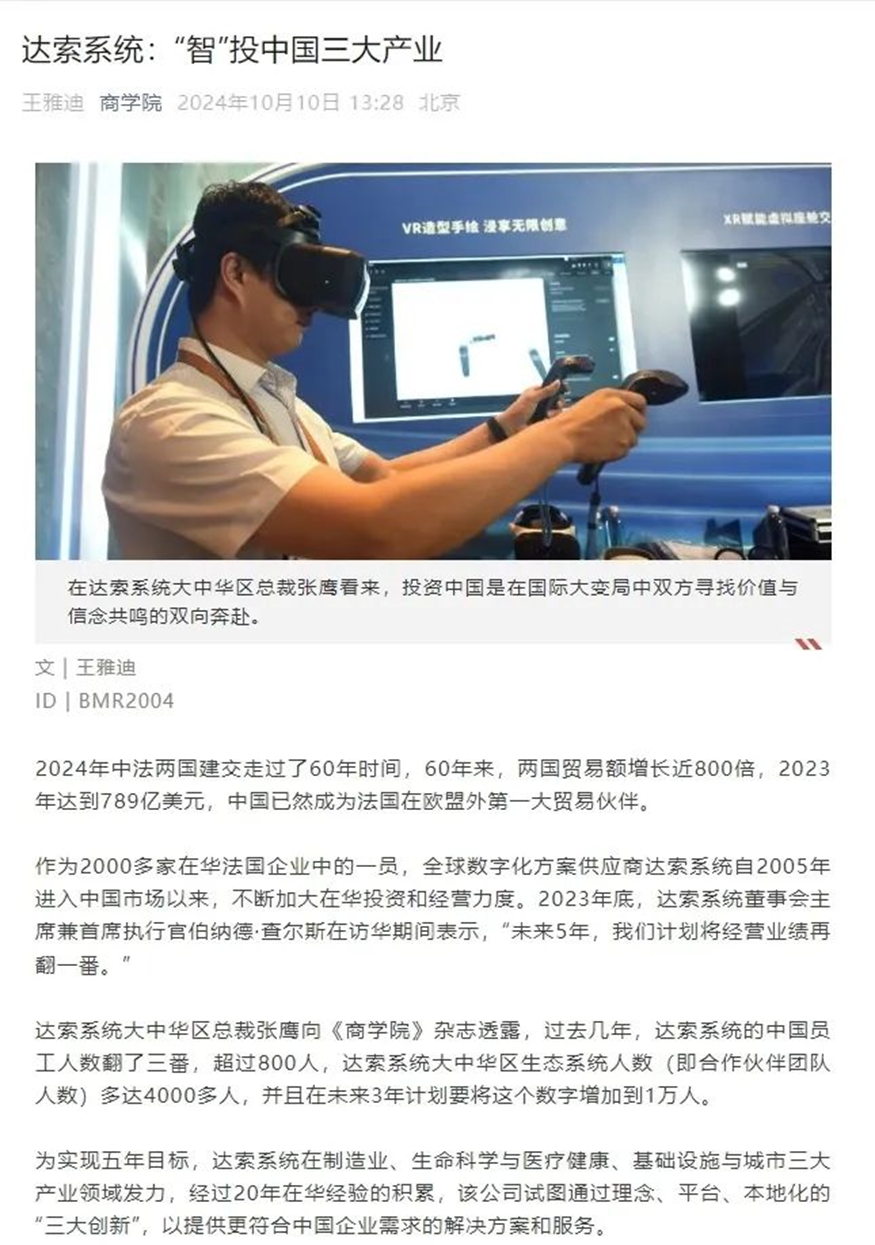
Dassault from2020The year saw the launch of the development strategy to layout across China - the Himalaya Plan, which strengthens business penetration in China through vertical industry penetration and regional ecological cooperation systems. It is expected that the Himalaya Plan2026Will reach in10euro billion.
2023year6In January, Siemens also announced an investment1.4Euros are earmarked for expanding its digital factory in Chengdu, China, to serve the growth opportunities in the Chinese market. In addition, Siemens also plans to invest in building a new digital R&D and innovation center in Shenzhen to accelerate the digitization of motion control systems and power electronics technology.
Q: What are the main challenges and obstacles that Chinese enterprises face when using foreign industrial software?
When Chinese enterprises use foreign industrial software, they first face the issue of relatively high costs. Foreign industrial software is usually expensive, and many of them hold a monopolistic market position in their respective fields. In terms of price negotiation, user enterprises lack bargaining power.
Secondly, when using foreign industrial software, Chinese enterprises may face certain issues such as technical compatibility and insufficient localization.
Furthermore, in terms of technical support and after-sales service, foreign software providers may not be able to provide timely and effective support. Consequently, user enterprises also need to invest resources in talent cultivation and skill enhancement.
Finally, using foreign industrial software also faces risks related to policies, regulations, data security, and privacy. In some cases, Chinese policies and regulations may restrict the use of foreign software, requiring enterprises to operate within compliance frameworks. Using foreign software may involve issues with data storage and processing, and enterprises may worry about data leakage and non-compliance with domestic data protection regulations.
Q: What is the competitive landscape or trend between foreign industrial software and domestic software?
Overall, foreign industrial software usually has an advantage in high-end markets, especially in areas requiring complex calculations and high-precision simulations, as well as computational design assistance (CAD),Electronic Design AutomationEDA),Production process execution managementMES) and other industrial software for R&D design, production control, etc. Domestic software enterprises are involved in Enterprise Resource Planning (ERP), Supply Chain ManagementSCMThey are gradually occupying a major market share in business management software such as (CRM, ERP, etc.). Domestic software companies are making technological breakthroughs in the high-end market.
Local software often offers more competitive prices and can provide cost-effective solutions for small and medium-sized enterprises.
The Chinese government encourages and supports the development of domestic industrial software industries to reduce dependence on foreign technology and enhance the independent innovation capabilities of domestic industries. Policy preferences may provide more market opportunities and resources for local software enterprises.
There is a complex relationship between foreign and domestic industrial software enterprises, involving both cooperation and competition. Some domestic enterprises obtain technology and market resources through cooperation with foreign companies.
Q: For the Chinese industrial software market, what impacts will increased foreign investment bring? How should competition and cooperation between domestic and foreign enterprises be balanced?
Foreign-funded enterprises often possess advanced technology and management experience. Increasing investment may promote technology transfer and innovation, thereby enhancing the overall technical level of China's industrial software industry. At the same time, market competition will become more intense, which may drive improvements in product and service quality as well as rationalization of prices. With the introduction of foreign software and services, data security and privacy protection issues may become more prominent, requiring the strengthening of relevant laws and regulations and their implementation.
Industrial software is vital to the nation's development. The government needs to formulate reasonable industrial policies to encourage domestic and foreign enterprises to compete in a fair market environment, while also promoting cooperation and exchanges.
It is necessary to reasonably set market access thresholds to ensure that domestic and foreign enterprises compete under equal conditions, enjoy fair treatment in terms of taxation, financing, market supervision, etc., and protect the domestic market from monopolies.
It is necessary to strengthen intellectual property protection to ensure that the innovative achievements of domestic and foreign enterprises are respected and protected, and to stimulate innovation vitality.
Cooperation platform construction is required: Establish a cooperation platform to promote collaboration among domestic and foreign enterprises in technology research and development, market expansion, etc., achieving resource sharing and complementary advantages.
Data security supervision is required: Strengthen the supervision of data security and privacy protection to ensure that domestic and foreign enterprises comply with relevant laws and regulations when providing services and safeguard user information security.
Q: In recent years, with the development of digital transformation and artificial intelligence technologies, domestic industrial software in China has also been in a stage of rapid development. In the face of the rise of domestic industrial software enterprises, what are the key points that foreign enterprises need to pay attention to if they want to gain a broader market space in China?
To expand their business in the Chinese market, foreign companies need to implement more localized competitive strategies. For example, understanding and respecting China's business culture and user habits, providing localized products and solutions, establishing local R&D teams to better adapt to the needs and changes of the Chinese market;
Establish partnerships with local Chinese enterprises, enter the market through cooperation, and share resources and channels;
Strengthen customer service by providing high-quality customer services and technical support to meet the special needs of Chinese customers. Establish a localized customer service system to improve response speed and service quality;
Attach importance to the cultivation and introduction of talents, especially those with international perspectives and local experience. Provide career development opportunities and training for Chinese employees to enhance the overall capabilities of the team;
Establish more flexible business models, adopting flexible business practices and pricing strategies based on the characteristics of the Chinese market. Explore new models for cooperation with local Chinese enterprises, such as joint development and technology licensing.
Of course, the above strategies need to be based on legality and compliance. Enterprises must strictly adhere to China's laws and regulations, including data security, privacy protection, intellectual property rights, etc. Understand and comply with China's special regulations and requirements for foreign-funded enterprises.
*This interview has been published in the Business School magazine, authored by Wang Yadi, with the original title: Dassault Systèmes: 'Intelligence' Invests in China's Three Major Industries.