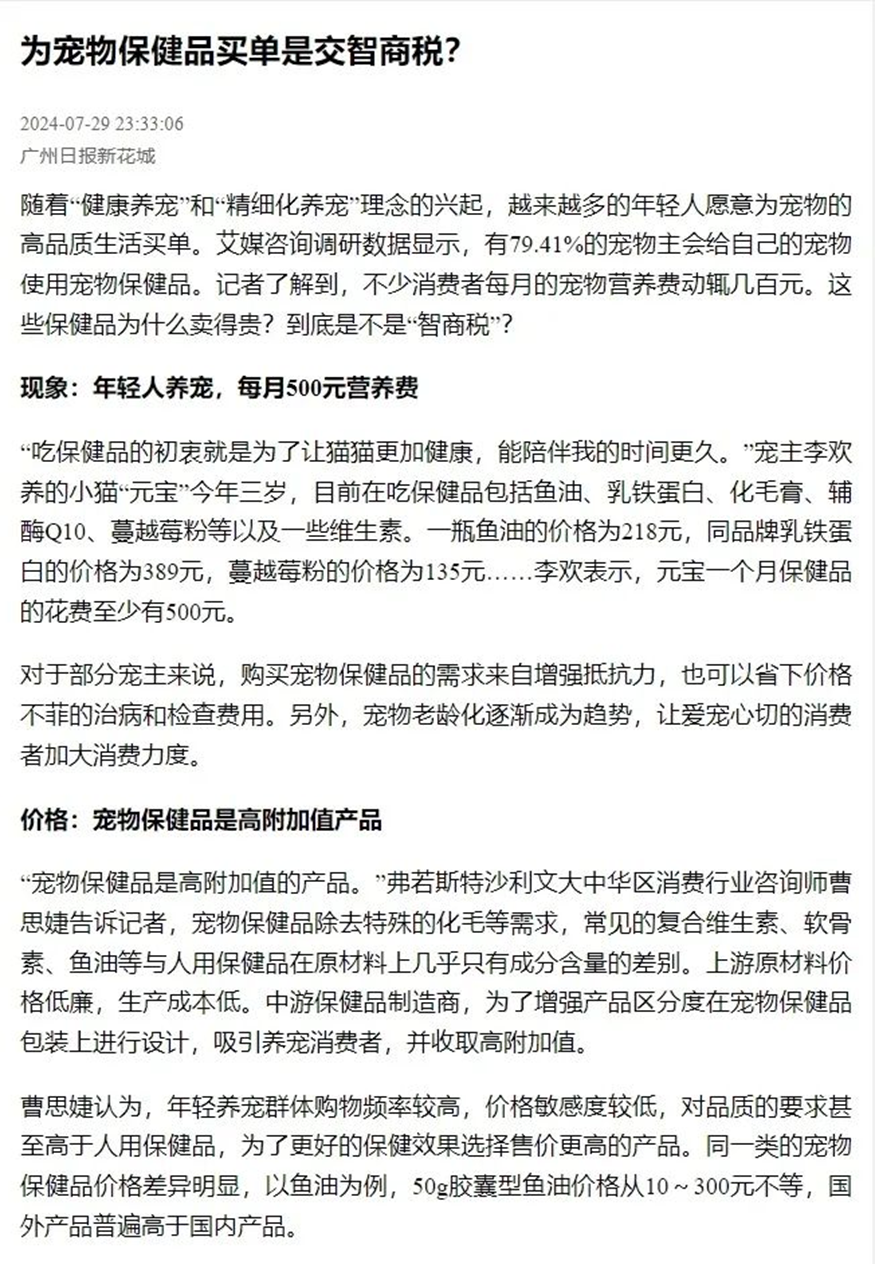
The younger pet-owning group has a higher shopping frequency and lower price sensitivity. Their requirements for quality are even higher than those of human health products, leading them to choose products with higher prices for better health benefits. There are significant price differences among pet health products of the same category. For example, in the case of fish oil:50gThe price of capsule-type fish oil ranges from10 - 300The price is not comparable; foreign products are generally more expensive than domestic ones. Why are pet health supplements so profitable? What are the main trends in the domestic pet health supplement market over the past two years? Are there any new development trends? What development problems are currently facing this industry in China?
Frost & SullivanFrost & Sullivan,Cao Sijie, a consulting advisor at Frost & Sullivan in Greater China, was interviewed by Guangzhou Daily New Flower City to discuss the current situation and challenges of the pet health product industry.
Guangzhou Daily Xinhua City
*Click at the end of the article Read the original text View the full report
Q: Why are pet health supplements so profitable?
From the perspective of the industrial chain, pet health supplements, except for special needs such as grooming, are similar to human health supplements in terms of raw materials, with only differences in component content. For example, the raw materials for nutritional paste generally consist of maltose, oil, yeast powder, etc., with low upstream raw material prices and low production costs. Midstream health supplement manufacturers design their packaging to enhance product differentiation, attract pet owners, and charge high added value.
In terms of consumers, with the continuous popularization of the concept of pet health products and the expansion of market size, the market share of health product consumption has steadily increased. Most people who purchase pet health products are young pet owners who worry about the aesthetics, health, and lifespan of their pets. They have a higher shopping frequency and lower price sensitivity. Their requirements for quality are even higher than those of human health products. They are willing to choose products with higher prices for better health care effects. At the same time, the main reference groups for purchasing health products are pet bloggers on social media, veterinarians at pet hospitals, brand online live streaming rooms, etc., with a high consumption conversion rate.
Q: What is the current price of pet health products? Are there significant price differences among similar health products on the market? How does the price compare between domestic and foreign products?
Taking fish oil as an example, the common types of fish oil available on the market are capsule and liquid forms.50gCalculated for standard sales units, the price of capsule-type fish oil is from10 - 300The price gap is quite significant, with foreign products generally priced higher than domestic ones. For products targeting the mid- to low-end market, foreign prices are higher than domestic ones. In the mid- to high-end market, the prices of domestic brands gradually converge with foreign products, but in the high-end market (prices greater than180yuan/50g), foreign brands still dominate. However, in terms of fixed sales units, domestic high-end brands such as Vissi and Tail Life have a certain number of sales units36g/Bottles, packaged and sold in small grams, have an overall low price point. However, the actual price per gram exceeds that of most high-end market fish oil products, such asVetwish,magwait.
Q: How are the types of domestic pet health products compared to those abroad?
In terms of types, both domestic and international health products cover common health care needs such as joint calcium supplementation, gastrointestinal regulation, hair care and skin care, vitamin and trace element supplementation, and immune enhancement. There are a large number of products available on the market targeting these functions. Common ingredients includeomega-3coenzymeQ10Lecithin, taurine, etc. However, companies in different markets have different product focuses. The leading domestic pet health product company 'Xiaocong' focuses on probiotics as its main promotional point and research product, while 'Gudeng' specializes in goat milk powder. Foreign American brandsVet hospital’s BestThe green cross catnip tablets,jarrowLactoferrin often becomes the top choice among Chinese consumers for category purchases.
Overseas brands are entering the niche market of pet health products focusing on emotional stability, such as American brands.Zesty PawsWe have launched the high-end pet nutritional product, Cat Calm, to help maintain emotional balance, promote calmness, and reduce stress.
Q: What are the main trends in the domestic pet health product market over the past two years? Are there any new development trends?
The demand for 'humanization' has driven continuous product segmentation, enriching the product matrix. Products are launched based on different body shapes, breeds, growth cycles, activity levels, and physical functions of pets. For example, separate product tracks are created for special stages such as puppy development, delivery, and old age, as well as for promoting pet appetite and increasing water intake through daily health supplements. Expanding the scope of pet healthcare includes pet fitness and weight loss, daily nourishment, disease prevention, and more. In addition to pet health needs, pet owners' interaction with their pets has led to the development of products such as toothpaste, breath fresheners, and nutritional supplements to enhance pet aesthetics.
Consumption rationalization has occurred. With the economic downturn, the exposure of similar ingredients in human and pet health supplements on social media, and concerns about the physical burden on pets from health supplements, consumers are choosing health supplements with higher cost-effectiveness and reducing their consumption frequency.
The demand for the safety of health products continues to rise, with natural ingredients and stimulants/With fewer additives, consumers also do not want to lose taste. Plant extracts with mild effects and clean ingredients with special health benefits have become new keywords. The impact of Japan's nuclear sewage discharge on the sea area and seafood has also increased consumers' concerns about health products made from seafood.
Q: What development issues are currently facing the domestic industry in this sector?
Industry supervision issues of products. Internationally, the regulatory authorities for pet health products generally includeFDA(Food and Drug Administration),NAS(National Animal Supplement Council) and so on, but currently in China, pet health products are still classified under feed processing, lacking clear industry production and management standards. They are in a gray area of supervision, with enterprises lacking standardized management at the supply chain and quality control levels, leading to low consumer confidence.
The industry concentration is low, lacking industry leaders. Currently, pet health products are still mainly imported from foreign brands. Domestic brands have low market recognition, fragmented market share, and fierce competition. Most companies devote more energy to marketing, lacking product innovation capabilities and resulting in homogeneous products.
*This interview has been published in Guangzhou Daily Xinhua City Reporter: Lv Hui, original title: 'Is Paying for Pet Health Supplements a Tax on Intelligence?'