Frost & Sullivan insights
As more and more modern people choose to 'raise a furry child', the pet economy has risen rapidly, and the demand for pet insurance has also seen a surge. However, in the face of many problems in the pet insurance market, it has become an urgent task to promote the unification and standardization of industry standards. At present, what level is the development of pet insurance in China? What problems exist in the development process? Some consumers complain about difficulties in claims settlement, opaque compensation standards, and challenges in renewing policies for older pets. What are the main reasons for these problems? What is the current payout rate for pet insurance? What are the main reasons for the high payout rate? Is this also the reason why many insurance companies are cautious about entering the market?
Zhao Yuna, a research and consulting analyst at Frost & Sullivan (hereinafter referred to as 'Frost & Sullivan') Greater China, was interviewed by CBN to discuss the underlying logic behind the low penetration rate of pet insurance.
*Click at the end of the articleRead the original textView the full report
Q:At present, what level is the development of pet insurance in China? What problems exist in the development process?
Zhao Yuna
Research and Consulting Analyst, Greater China, Frost & Sullivan
Although the current pet insurance market is growing rapidly, industry chaos frequently occurs, hindering its healthy development. Overall, we believe that pet insurance is currently in a relatively early stage of industry development, and there is still much to be done in the future.
On one hand, insurance companies set many restrictions on product design to control risks, such as a single payout cap, a 365-day waiting period for chronic diseases, and refusal of insurance for elderly pets. As a result, consumers actually receive far less protection than advertised.
On the other hand, due to the lack of unified standards for pet healthcare, insurance companies are skeptical about treatment costs and have strict review procedures, even refusing compensation on the grounds of 'congenital diseases' or 'non-veterinary drug labels'.
Meanwhile, some consumers engage in adverse selection behaviors (such as insuring with pre-existing conditions) or collude with pet hospitals to defraud insurance companies, further increasing the risk control pressure on insurers.
This vicious cycle has led to a decline in market trust: consumers complain about difficult claims processing, insurance companies reduce coverage due to high payment rates, and pet hospitals fall into disputes over costs.
In summary, in recent years, with changes in China's economic structure, population aging, and the development of atomized families, the number of pets kept has risen rapidly; China's pet market has also grown into one of the largest single markets in the world, leading to a corresponding rapid increase in insurance demand. However, at present, an effective trust relationship has not been established between the supply and demand sides of pet insurance, and the industry's development is not standardized. These factors have restricted the development of the industry.
Q:Some consumers complain about difficulties in claim settlement, opaque compensation standards, and challenges in renewing pet insurance policies for older pets. What are the main reasons for these issues?
Zhao Yuna
Research and Consulting Analyst, Greater China, Frost & Sullivan
The current pet insurance market is in a vicious cycle and urgently needs industry regulation to break the deadlock. This predicament presents three contradictions:
Firstly, some irregular medical institutions engage in excessive diagnosis and treatment practices. There are also cases where users tamper with medical records to obtain insurance benefits, forcing insurance companies to set a single compensation limit to control risks;
Secondly, pet insurance faces serious adverse selection issues, with some individuals 'insuring while sick'. Coupled with the lack of pet health data and regular check-up mechanisms, this further drives up the payout rate.
These chaotic phenomena lead to a mutual loss for all parties: consumers pay high premiums but struggle to obtain high-quality services, medical institutions over-develop customer value for survival, and insurance companies weaken product competitiveness to prevent fraud. The key to breaking this deadlock lies in establishing a standardized pet diagnosis and treatment system, and by transparentizing medical practices and health data, reconstructing the market trust mechanism.
Q:Currently, what is the payout ratio of pet insurance? What are the main reasons for the high payout ratio? Is this also a reason why many insurance companies are cautious about entering this field?
Zhao Yuna
Research and Consulting Analyst, Greater China, Frost & Sullivan
The current pet insurance industry is falling into a vicious cycle caused by dual non-standardization at the medical and insurance ends, becoming one of the types with the highest payout rates in the property insurance sector.
Data shows that additional compensation costs due to diagnostic and treatment chaos and user fraud account for more than 20%, causing some insurance companies to continue incurring losses. In the medical sector, the lack of unified standards during the diagnosis and treatment process has led to pet healthcare being like "opening a blind box," with large arbitrariness in treatment plans and dosages. Coupled with a chaotic medical pricing system, there are significant differences in the cost of diagnosing and treating the same condition, and there are even cases of insurance fraud where doctors collude with patients to prescribe high-dose medications to obtain compensation.
On the insurance side, traditional methods struggle to accurately identify the risk of similar pet breeds. Although some institutions have introduced nose print recognition technology, overall risk control remains weak. Additionally, most products adopt a uniform pricing mechanism for pets of different breeds, ages, and sizes, which not only violates the principles of actuarial science but also indirectly encourages high-risk groups to purchase insurance. Moreover, the information disclosure defect of insufficient disclosure of key terms in internet sales scenarios leads to a significant gap between consumers' expected protection and actual terms.
This medical chaos is driving up insurance costs, insurers tightening coverage, reducing consumer experience, and intensifying adverse selection, creating a chain reaction that is eroding the industry's development foundation. There is an urgent need to break this deadlock through measures such as establishing a standardized medical system, improving insurance actuarial models, and strengthening the disclosure of sales information.
Q:How can we avoid many problems emerging in the pet insurance market in terms of product design in the future?
Zhao Yuna
Research and Consulting Analyst, Greater China, Frost & Sullivan
The healthy development of the pet insurance market in the future requires systematic optimization from two aspects: product design and service system. In terms of product design, efforts should be made to construct more transparent and precise protection plans: First, it is necessary to clearly define insurance clauses, especially by refining the criteria for defining vague concepts such as 'genetic diseases'. At the same time, the scope of coverage should be reasonably expanded to reduce unnecessary exclusions; secondly, big data analysis and AI technology can be considered to comprehensively assess risk factors such as pet breed, age, and past medical history, establishing a scientific differential pricing model to achieve precise risk pricing.
In terms of supporting service systems, it is necessary to establish a multi-party collaborative guarantee mechanism: Firstly, promote the formulation of unified pet medical industry standards to regulate diagnostic and treatment practices and charging rates, thereby reducing excessive medical care and fraud risks at the source; secondly, introduce third-party professional evaluation institutions to independently and fairly assess difficult claim cases, effectively resolving insurance disputes; furthermore, carry out insurance knowledge popularization education through online and offline channels to help consumers fully understand key terms such as waiting periods and compensation scopes, avoiding disputes due to cognitive biases.
For example, Ping An Property & Casualty Insurance has signed a cooperation agreement with the Shenzhen Institutes of Advanced Technology (Suzhou Branch) of the Chinese Academy of Sciences on nose print recognition technology. This collaboration aims to apply this technology to pet insurance, realizing commercial application of pet nose print recognition technology.
Q:The '2023 Pet Digital Insurance Industry Development Insights and Trends White Paper' shows that the domestic pet insurance market is still in its early stages of development, with an overall penetration rate of less than 1%. What is the outlook for the future development of pet insurance? What is the key to breaking through the next barrier?
Zhao Yuna
Research and Consulting Analyst, Greater China, Frost & Sullivan
The pet insurance market in China is embracing unprecedented development opportunities. With the booming development of the pet economy and the continuous expansion of pet owners, this emerging market shows tremendous growth potential. However, compared with developed countries, the current penetration rate of pet insurance in China is still at a relatively low level, and market cultivation and consumer education urgently need to be strengthened.
In terms of channel transformation, internet platforms have rapidly risen to become the primary sales channel, leveraging their massive user base, precise big data analysis, and intelligent algorithm recommendations. This online trend has provided insurance companies with an efficient path to reach young pet owners, but it also poses higher demands on product design and customer service.
To achieve sustainable development of the industry, it is necessary to build a multi-party collaborative development system: Firstly, insurance companies should continuously optimize their product structure, improving user experience by simplifying claims processes and enhancing service response speed;
Secondly, it is necessary to deepen strategic cooperation with pet medical institutions and industry associations, jointly establishing standardized diagnostic and treatment standards and transparent pricing systems;
Finally, it is necessary to intensify market education efforts, combining online and offline methods to enhance consumers' awareness and acceptance of pet insurance value. Only through a multi-pronged approach including product innovation, channel optimization, and ecological co-construction can the development potential of the pet insurance market be fully unleashed, providing more comprehensive protection for pet owners and promoting the healthy and orderly development of the industry.
Q:Is industry standardization the key to future industry development? How should standardization be constructed?
Zhao Yuna
Research and Consulting Analyst, Greater China, Frost & Sullivan
The innovation of products, technologies, and models is accelerating the improvement of service quality in the pet insurance industry. By establishing a sustainable cooperation model between insurance companies and pet hospitals and fully leveraging the connecting role of pet insurance, a virtuous cooperation chain can be formed: insurance cooperates with designated hospitals to attract patients; hospitals provide reasonable diagnostic and treatment services; insurance companies make timely payouts; pet owners obtain high-quality diagnostic and treatment experiences. Currently, the standardization work of pet insurance and pet healthcare in the market is gradually advancing. Recently, some insurance platforms have cooperated with pet hospitals and academia to jointly establish application norms for the pet insurance industry in terms of medical concepts and diagnostic standards, promoting the standardized development of the industry.
To establish a standardized pet healthcare industry, efforts need to be made in multiple aspects: first, standardizing the medical consultation process to ensure transparency; second, unifying procurement channel standards; third, standardizing disease classification and treatment plans. By integrating diagnostic and treatment data with insurance data, mining past data, and formulating more scientific standards, a basis can be provided for the pricing and design of insurance products. This will solve the problems of expensive and difficult pet healthcare, and build a higher-quality and suitable industry ecosystem.
Through industry collaboration, a system has been established from diagnosis and treatment norms to insurance industry standards. This includes the creation of a pet disease atlas, disease grading, definitions, treatment plans, medication dosages, and fee reference standards. These standards will provide strong support for the design of insurance products, actuarial models, and pricing systems. They will also precipitate platform claims review standards and hospital rating hierarchies, enabling users to experience more standardized, transparent, and certain services during the claims process.
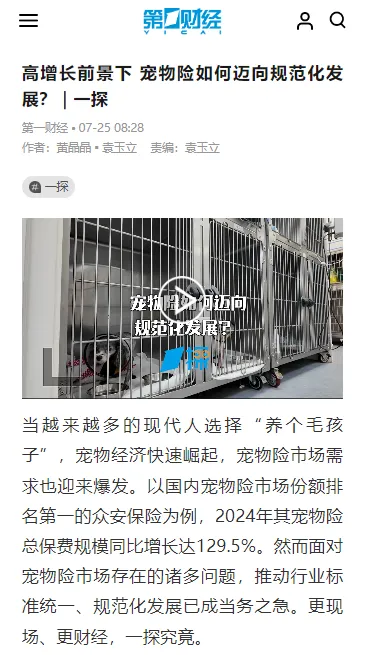
*This interview has been published inCBNReporters: Huang Jingjing, Yuan Yuli. Original title: How is pet insurance moving towards standardized development under the backdrop of high growth prospects? | An exploration
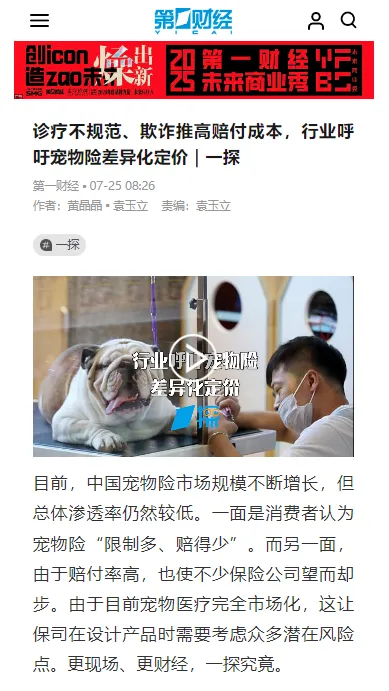
Standardized diagnosis and treatment are lacking, and fraud drives up compensation costs. The industry calls for differentiated pricing of pet insurance | A look
Contact number: 021-5407-5836
Contact email: PR@frostchina.com