Insights from Frost & Sullivan
Several PCB industry chain companies such as Shanghai Electronics Group Co., Ltd., Pengding Holdings, and Shengyi Technology are expected to see increased performance in the first half of the year. The reasons mentioned in the attribution statements include structural demand driven by emerging scenarios such as high-speed computing servers and AI, an increase in the proportion of high-value-added products, and process improvements. What industry signals are being released behind this? Market reports indicate that the demand for high-end PCBs due to AI computing power is growing rapidly, and there is an obvious supply-demand gap this year. Leading manufacturers are accelerating production expansion. What is the current market supply and demand situation for related PCB products? It is reported that relevant departments have issued notices on implementing "window guidance" for computing power infrastructure and carried out preliminary surveys this year, aiming to avoid redundant construction. Will manufacturers in the PCB industry face challenges such as overcapacity after expanding production?
Xie Shuqin, Executive Director of Frost & Sullivan Greater China, was interviewed by Cailian News to discuss the new structural cycle of the PCB industry chain under the AI wave.
*Click at the end of the articleRead the original articleView the complete report
Q:Several PCB industry chain companies such as Shanghai Electronics Group Co., Ltd., Pengding Holdings, and Shengyi Technology are expected to see increased performance in the first half of the year. The reasons mentioned in the attribution statements include structural demand driven by emerging scenarios such as high-speed computing servers and AI, an increase in the proportion of high-value-added products, and process improvements. What industry signals are being released behind this?
Xie Shuqin
Executive Director of Frost & Sullivan Greater China
The PCB industry has entered a period of profound structural transformation. The core of this phenomenon lies in the reshaping of the industrial value chain by the computing power revolution - the explosive growth in the demand for AI large model training and inference directly drives the surge in demand for high-speed computing server PCBs. Such equipment requires high multi-layer boards with more than 18 layers to support the PCIe 5.0/6.0 high-speed transmission protocol, which is the essence of the "increase in the proportion of high-value-added products" by enterprises. With the acceleration of AI hardware iteration, the technical barriers for high-end PCBs continue to rise, and the industry concentration has significantly increased.
Coating board companies such as Shengyi Technology are accelerating the domestic substitution of high-frequency and high-speed substrates, breaking through the overseas monopoly of ultra-low-loss materials for AI servers and 6G high-frequency boards; Pengding Holdings, etc., are upgrading high-end HDI through micro-hole stacking technology to meet the miniaturization requirements of AIPC/AI mobile phones. Chinese policies are promoting the migration to high-end fields such as computing power, and local enterprises have made breakthroughs in the high-end field. The shortened technical iteration cycle further raises the competition threshold.
Q:Market reports indicate that the demand for high-end PCBs due to AI computing power is growing rapidly, and there is an obvious supply-demand gap this year. Leading manufacturers are accelerating production expansion. What is the current market supply and demand situation for related PCB products?
Xie Shuqin
Executive Director of Frost & Sullivan Greater China
The hardware upgrade of AI servers drives a surge in demand for high-end PCBs. Taking NVIDIA's AI servers as an example, their core modules (such as UBB, OAM acceleration boards) require high multi-layer boards, and the value of a single PCBA is significantly higher than that of traditional servers. The global shipments of AI servers increased from 500,000 units in 2020 to 2 million units in 2024, with an annual compound growth rate of 45.2%, directly driving up the demand for high-layer boards and HDI boards. At the same time, the PCIe 6.0 protocol requires PCBs to support high-speed transmission rates and use ultra-low-loss materials, further raising the technical threshold and cost. On the supply side, there is a capacity bottleneck. First, technical barriers restrict production. High-end products require processes such as high-precision lamination and laser drilling, and only a few manufacturers globally can provide them. There is a short-term supply-demand gap for high-end products.
Currently, leading manufacturers are tilting their new production capacity towards products with more than 18 layers. In the medium and long term, with the release of production capacity in Southeast Asia and the commissioning of new high-frequency coating board production lines, the supply-demand contradiction may be alleviated. However, continuous technological iteration creates new demands. For example, Intel's next-generation Birch Stream platform requires more advanced PCB products, and the R & D reserve and capacity elasticity of manufacturers will become the key to competition.
Q:It is reported that relevant departments have issued notices on implementing "window guidance" for computing power infrastructure and carried out preliminary surveys this year, aiming to avoid redundant construction. Will manufacturers in the PCB industry face challenges such as overcapacity after expanding production?
Xie Shuqin
Executive Director of Frost & Sullivan Greater China
Currently, AI computing power drives an explosive growth in demand for high-end PCBs, but there are significant structural contradictions between supply and demand, forming a dual pattern of "high-end shortage and low-end pressure". The hardware upgrade of AI servers and high-speed switches drives an annual growth rate of 16.7% in the demand for high multi-layer boards with more than 18 layers. The market scale increased from $1.3 billion in 2020 to $2.5 billion in 2024, but only a few manufacturers globally have stable mass production capabilities. Technical barriers make it difficult to fill the demand gap in the short term. Policy regulation is guiding production capacity to tilt towards high-quality fields, strictly controlling the expansion of inefficient production capacity, and strengthening technical thresholds. New projects are required to support the PCIe 6.0 protocol and advanced heat dissipation design, and the energy consumption per unit output value is included in the audit to promote green manufacturing. This precise regulation makes leading manufacturers' production expansion more rational.
The policy aims to shift the industry from "scale expansion" to "technology anchoring", building a new ecosystem with AI computing power as the engine and high-end manufacturing as the cornerstone. Only enterprises that accurately position themselves at the technological high ground can reap long-term dividends during the production expansion cycle.
Q:From the perspective of the PCB application market, which sectors currently have the greatest growth potential and why? Which PCB sub-categories and manufacturers are expected to benefit?
Xie Shuqin
Executive Director of Frost & Sullivan Greater China
In the PCB application market, computing power scenarios (such as servers/data centers) and industrial scenarios (such as automotive electronics/communication equipment) have become the most growth potential areas due to technological explosion and demand expansion. The growth rate of computing power scenarios leads the way. Its PCB market scale is expected to increase from $12.5 billion in 2024 to $21 billion in 2029, mainly driven by the popularization of AI and big data upgrades. The training of large models drives up the demand for AI servers, and the growth of data center cabinets drives a surge in PCB usage.
At the manufacturer level, leading companies in computing power server PCBs such as King Kong Electronics, Kingtech, and Guanghe Technology are significantly benefiting from their technical advantages in high multi-layer boards; in the industrial scenario, Shanghai Electronics Group Co., Ltd. and Shenzhen Nan Circuit are leading in the fields of automotive electronics high-frequency PCBs and communication base station boards, while coating board supplier Shengyi Technology captures the dividends from high-frequency demand from the material side.
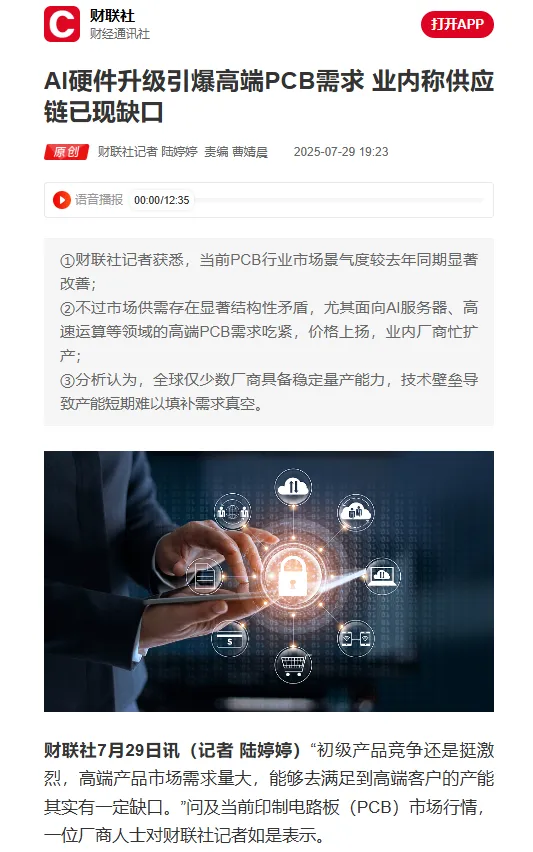
*This interview has been published inCailian NewsThe reporter is Lu Tingting, and the original title was: AI Hardware Upgrade Spurs High-End PCB Demand, Industry Says Supply Chain Already Shows a Gap
Contact phone: 021-5407-5836
Contact email: PR@frostchina.com