Frost & Sullivan insights
In the face of physical obstacles, the ability to re-establish a bridge between "brainpower" and the torso or facial features, and to achieve the control of expression or mechanical limbs through "thought," is accelerating its integration into reality. Recently, China's first prospective clinical trial of an invasive brain-computer interface was successfully conducted, marking China as the second country in the world after the United States to enter the clinical trial phase in invasive brain-computer interface technology. What is the significance of invasive brain-computer interfaces entering the clinical phase? What were the previous difficulties that hindered their entry into the clinical phase? From the current company layout, it seems that the US market has chosen the invasive route more frequently. What are the reasons? In terms of both the number of brain-computer interface companies and the technology of some companies in the US, what are the relative advantages over Chinese companies? Currently, brain-computer interfaces are divided into three routes: invasive, semi-invasive, and non-invasive. What are the significant differences in the implementation scenarios of these three technical routes? Does this mean that the commercial progress of the three routes will also vary significantly?
Zhou Mingzi, Executive Director of Frost & Sullivan Greater China, was interviewed by the 21st Century Business Herald to discuss the technological leaps behind the clinical breakthroughs of invasive brain-computer interfaces.
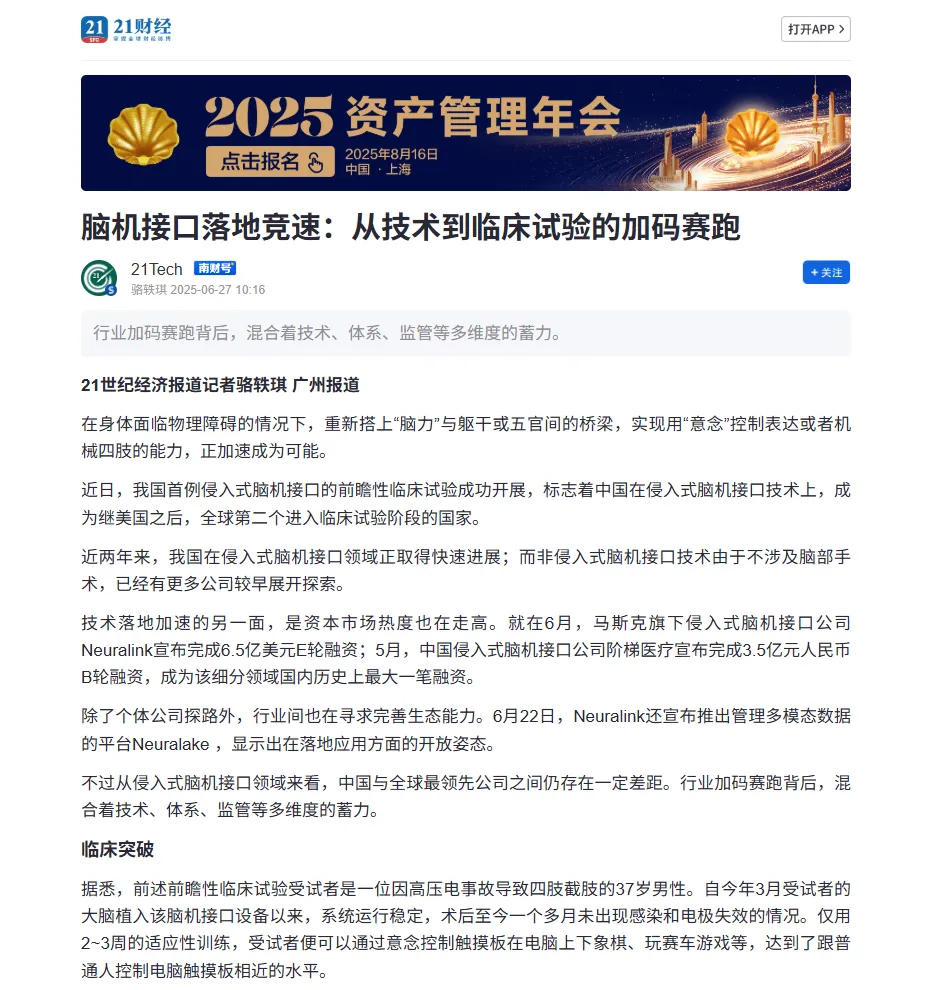
21st Century Economic Report
Q:Recently, our country successfully conducted the first prospective clinical trial of an invasive brain-computer interface, becoming the second country in the world to advance to this stage. What is the significance of the entry of invasive brain-computer interfaces into clinical trials? What were the previous difficulties hindering their clinical advancement?
Zhou Mingzi
Executive Director, Greater China, Frost & Sullivan
The entry of invasive brain-computer interface technology into clinical trials in China is of great significance, marking a breakthrough in this field. From three dimensions: scientific research attitude, technical assurance, and future development: Firstly, China's scientific research attitude towards invasive brain-computer interfaces has shifted from cautious to proactive. In the early stages, due to technical risks, research efforts mainly focused on non-invasive technologies. However, in recent years, there has been a significant increase in investment in invasive technologies, with industry and other sectors listing them as a key technical direction since 2023. Secondly, the successful conduct of this clinical trial proves that China has the capability to ensure clinical application of invasive technologies, reaching international leading levels in key indicators such as biocompatibility and signal stability, laying a solid technical foundation for subsequent medical applications. Frost & Sullivan believes that this breakthrough will greatly boost scientific research enthusiasm and promote the formation of a development pattern that equally emphasizes invasive and non-invasive technologies. Invasive technologies will develop deeply in professional fields such as medical rehabilitation, while non-invasive technologies will target broader consumer applications. The two complement each other's advantages to jointly promote the industrialization process of brain-computer interface technology. In the future, China is expected to achieve more original breakthroughs in this frontier field.
Historically, brain-computer interface (BCI) technology has encountered numerous challenges in clinical applications: Technically, long-term implantation issues such as biocompatibility (e.g., inflammation caused by electrode materials) and signal stability (signal weakening after implantation) are major obstacles that urgently require the development of softer electrode materials and anti-interference algorithms; ethically, there are disputes involving the protection of thought privacy and the definition of the boundaries of autonomous consciousness; clinically, it is necessary to establish standardized surgical procedures (e.g., precise implant positioning) and establish long-term postoperative monitoring systems; from the patient's perspective, it is essential to weigh the risks and benefits of surgery. Currently, this technology mainly serves specific groups such as those with severe disabilities and faces expensive costs. These factors collectively hinder the progression of BCI technology from laboratory to clinical application.
Q:Judging from the current company's layout, it seems that the US market prefers an invasive approach. What are the reasons for this?
Zhou Mingzi
Executive Director, Greater China, Frost & Sullivan
American medical innovation companies are advancing invasive brain-computer interface technology, mainly relying on three significant advantages.
Firstly, at the technical level, the United States has a profound accumulation and innovation in key core technologies such as microelectrode materials and neural decoding algorithms. For example, the flexible electrode technology developed by Neuralink is a typical representative of this technological advantage. This technology can achieve efficient connection with brain neurons, greatly improving the accuracy and stability of signal transmission. In addition, the US Food and Drug Administration has a relatively open approval process for high-risk medical innovations, which provides convenient conditions for the clinical application of new technologies. The flexibility of the approval process allows medical innovation companies to transform research findings into actual medical solutions more quickly, thereby accelerating the commercialization process of technology.
Secondly, in terms of the selection of application scenarios, American medical innovation companies tend to focus on severe medical fields such as Parkinson's disease and spinal cord injury, which require extremely high precision in treatment. Invasive brain-computer interface technology, due to its high-precision characteristics, can better meet these clinical needs and has therefore been widely applied in these fields. For example, through brain-computer interface technology, patients can use their mental activities to control external devices such as wheelchairs or prosthetics, providing them with unprecedented autonomy and improved quality of life.
Finally, in terms of patient acceptance, American citizens have a high level of acceptance of innovative medical technologies, and they are more willing to try and adopt new technologies. This open attitude provides a favorable social environment for the promotion and application of new technologies. At the same time, America's comprehensive insurance system can cover to a certain extent the costs of these high-risk, high-reward invasive treatment options, which undoubtedly reduces the economic burden on patients to adopt these new technologies and makes it easier for these options to be promoted and applied. In summary, the technology route chosen by American medical innovation companies not only reflects their technical strength in cutting-edge medical fields but also demonstrates their careful consideration of differentiated competitive strategies. By combining these advantages, America maintains a leading position in the field of invasive brain-computer interfaces and is expected to bring good news to more patients in the future.
Q:In terms of the number of brain-computer interface companies and the technology of some of these companies, what are the relative advantages that the United States currently has over Chinese enterprises?
Zhou Mingzi
Executive Director, Greater China, Frost & Sullivan
Compared to other regions around the world, the United States exhibits a variety of advantages in the field of brain-computer interface (BCI) medical innovation. Firstly, in terms of talent supply, the US has established a comprehensive interdisciplinary talent training system for neuroscience and engineering through top institutions such as Stanford University and MIT, as well as the ecosystem of Silicon Valley, capable of continuously providing talents with composite R&D capabilities. In terms of commercialization, the mature venture capital mechanism and flexible FDA approval process (including the breakthrough device designation program) in the US have promoted rapid technology transformation. Industrially, this is due to the advantages of healthcare industry giants in supply chain support and clinical resource integration. Additionally, American patients have a higher acceptance of innovative therapies, and medical insurance coverage is more extensive. Finally, driven by the demand from government and military agencies represented by NASA, these factors together create a unique advantage in the innovative ecosystem.
Q:Currently, brain-computer interfaces are divided into three routes: invasive, semi-invasive, and non-invasive. What are the significant differences in the implementation scenarios of these three technical routes? Does this mean that there will also be significant differences in the commercial progress of the three routes?
Zhou Mingzi
Executive Director, Greater China, Frost & Sullivan
Currently, invasive brain-computer interface technology has been applied in many clinical fields, especially in the following three main areas: First, the technology is widely used for treating severe motor dysfunction. For example, for amputation patients with limb disabilities, through brain-computer interface technology, they can control external robotic arms with their thoughts alone, performing a series of complex actions such as grasping objects and eating. In addition, for patients with spinal cord injuries, invasive brain-computer interface technology enables them to control exoskeletons, thereby partially restoring their mobility. Second, invasive brain-computer interface technology shows great potential in the treatment of neurological diseases. It is used for deep brain stimulation therapy for Parkinson's disease patients and neuroregulation for patients with refractory epilepsy to alleviate symptoms or control seizures. Finally, for patients with impaired language function, invasive brain-computer interface technology provides the possibility of reconstructing language function, helping them regain their communication ability with the outside world.
Semi-invasive neural monitoring techniques, such as ECoG (Electroencephalogram), are widely used in neurosurgical operations that require high signal quality, especially playing a key role in locating epileptic foci. This technique monitors brain electrical activity by placing electrodes on the surface of the brain, providing surgeons with precise guidance to help them more accurately identify and handle abnormal brain tissue, with the aim of controlling or eradicating epileptic seizures.
Non-invasive brain-computer interface technology has found applications in multiple clinical fields, mainly focusing on the following three important scenarios: Firstly, it shows great potential in neurorehabilitation therapy. For example, stroke patients can control external robotic hands by wearing electroencephalogram (EEG) caps to perform rehabilitation training actions such as grasping. In addition, non-invasive brain-computer interface technology also demonstrates unique value in the intervention treatment of mental illnesses. By regulating the patient's brain state, non-invasive brain-computer interface technology has been used to treat mental illnesses such as depression and attention deficit hyperactivity disorder (ADHD), providing patients with new treatment options.
Due to different clinical application scenarios, the commercial progress of invasive, semi-invasive, and non-invasive brain-computer interfaces will inevitably vary, but there is no superiority or inferiority among them. Although invasive brain-computer interfaces can obtain the most accurate neural signals, providing strong support for the treatment of some severe neurological diseases and in-depth research on neural functions, factors such as high surgical risks and expensive costs limit their large-scale commercialization. Currently, they are mainly concentrated in some high-end scientific research and specific clinical treatment projects. Semi-invasive brain-computer interfaces have achieved a certain balance between signal quality and safety and have a stable market demand in specific fields such as neurosurgery. With continuous technological maturity and gradual cost reduction, their commercial scope is expected to gradually expand. Non-invasive brain-computer interfaces, with their non-invasive and convenient features, have been widely used in multiple clinical fields such as neurorehabilitation and mental illness intervention, and also have great development potential in the consumer market, such as in scenarios like gaming and smart home control, with a very broad commercial prospect. Different types of brain-computer interfaces play unique roles in their respective suitable fields, jointly promoting the development and application of brain-computer interface technology.
Q:One view is that brain-computer interfaces will be the ultimate method of human-computer interaction. What catalysis or assistance will the trend of large AI models bring to the development of the brain-computer interface industry?
Zhou Mingzi
Executive Director, Greater China, Frost & Sullivan
Frost & Sullivan has pointed out that digital innovation technologies such as artificial intelligence will drive the rapid development of brain-computer interfaces (BCI) at three levels:
Breakthroughs in clinical treatment: Large models can construct personalized disease prediction models by analyzing large amounts of neural signal data (such as EEGs from epilepsy patients), thereby improving the accuracy of treatments such as deep brain stimulation (DBS). Metaverse technology can provide virtual rehabilitation training environments to accelerate the recovery of neural functions.
Leap in Interaction Capabilities: Large models' powerful capabilities in natural language understanding enable them to decode more complex brain signals and intentions, elevating BCI from simple command control to semantic-level interaction (for example, allowing paralyzed patients to generate coherent text directly). In the metaverse, digital twins can provide real-time feedback on BCI operation effects, thereby optimizing the training process.
Enhanced innovation in the human body: Combining cognitive enhancement algorithms with large models, BCI may achieve memory reinforcement (such as rapid learning of foreign language vocabulary), while the immersive environment of the metaverse will expand the application scope of BCI in spatial perception and multimodal fusion.
Currently, the integration of technologies is beginning to show signs of progress. For example, Neuralink's implantable BCI is exploring voice synthesis solutions that work in conjunction with large models, while a leading international AI company has integrated non-invasive BCI technology into its metaverse innovation research, enabling the control of virtual objects with thoughts. Frost & Sullivan believes that this cross-disciplinary innovation will reshape the new paradigm of human-machine coexistence over the next five to ten years.
*This interview has been published in21st Century Economic ReportReporter: Luo Yiqi, original title: Brain-computer interface implementation race: From technology to clinical trials