Compared to consumer-grade chips, automotive-grade chips have higher requirements for safety and reliability, longer chip development and certification cycles, making it more difficult to meet the demand for automotive chips.
Automotive-grade MCUs have higher process requirements, higher customer certification standards, and longer supply cycles, with a recovery period expected to be around 2 years; the recovery time required for driver chips is shorter than that of MCUs, about 1 year.
The "chip shortage" problem in the automotive industry continues, affecting many automakers with reduced production, tight supplies, and severe losses. However, crises breed new opportunities, and while they bring troubles to the automotive industry, the chip shortage has also shown capital investors more investment opportunities, driving a chip investment boom on the capital side. On July 12th, Chen Chen, consulting director at Frost & Sullivan, analyzed in an interview with Securities Daily: "In the current global chip shortage environment, domestic semiconductor manufacturers will have more development opportunities, and the localization process of automotive chips will accelerate." He also predicted that the "chip shortage wave" would start to improve in the second half of this year but will remain in a shortage state for the next 1 to 2 years.
Recently, relevant reports show that the "chip shortage" problem continues to affect the automotive industry. The report predicts that the semiconductor shortage in 2021 will reduce global automaker production by 3.9 million vehicles and cause industry revenue losses of up to $110 billion.
Behind the risks are also opportunities. The "chip shortage wave" commonly faced by semiconductor companies upstream of the industrial chain to vehicle manufacturers downstream has also driven a chip investment boom on the capital side. According to Tianyancha data, in the past 5 years, the number of registered enterprises related to chip research and development and manufacturing in China has been increasing year by year, with an annual growth rate of over 20%. Among them, the registered number increased by as much as 61% year-on-year in 2020, the highest in 5 years, with nearly 22,000 new enterprises added.
"In the global 'chip shortage wave', chips in the automotive and MCU (microcontroller unit) fields are in the most urgent need." Wu Quan, founding partner of Huaxin Jintong (Beijing) Investment Fund Management Co., Ltd., said in an interview with a Securities Daily reporter that this is mainly because the automotive industry is in a period of oil-electric conversion and upgrading. The degree of automotive intelligence, electrification, and networking is accelerating continuously, and the demand for new energy vehicles is also increasing, resulting in a doubling of the demand for MCU chips with conversion and upgrading functions.
Chen Chen, consulting director at Frost & Sullivan, told a Securities Daily reporter that compared to consumer-grade chips, automotive-grade chips have higher requirements for safety and reliability, longer chip development and certification cycles, making it more difficult to meet the demand for automotive chips.
Chip shortage restricts automotive production
High-priced joint-venture models are greatly affected
On July 2nd, luxury car brand BMW issued a warning saying that there are no signs that chip supply has eased, and supply will remain tight in the second half of the year. So far, BMW has reduced production this year by about 30,000 vehicles due to "chip shortage."
At the beginning of July, Mr. Zhang, a car buyer, told a Securities Daily reporter that when purchasing the Chevrolet Traverse under SAIC-GM, the 4S store staff informed him that due to the current shortage of chips for SAIC-GM, the model's chips are preferentially supplied to Cadillac models. There are no additional discounts for the Chevrolet series, and the existing cars are very scarce.
It is not just SAIC-GM Chevrolet that is affected by the shortage of cars due to the chip shortage and delivery delays. Recently, a staff member from a popular domestic independent new energy car brand told reporters: "In the context of chip shortage, manufacturers will prefer to supply chips to mid- to high-end models. It takes at least one and a half months to pick up a low-premium model if you want it."
In response, the China Association of Automobile Circulation stated that the new car purchase demand in the fourth quarter of this year will not be released until 2022, which will affect the annual sales volume. The chip shortage problem is temporarily difficult to improve, and the hot-selling models of joint-venture brands and luxury brands are relatively more affected by the chip shortage, with production rhythms slowing down.
Currently, popular models on the sales side almost all require queuing up to pick up cars, with delivery cycles ranging from 3 weeks to 4 weeks at the shortest, and even exceeding 3 months at the longest. It can be seen that the chip shortage has already affected the automotive production and sales links. Joint-venture brand models priced over 200,000 yuan use more chips and are relatively more affected by the chip shortage.
Last year, China added nearly 22,000 chip-related enterprises
For the chip shortage problem, semiconductor manufacturers upstream of the automotive industrial chain seem to have more say.
"Previously, our chip department leaders would go out 'running orders' themselves, but since the second half of last year, it has become customers who come to us actively, asking us 'how many chips do you have, and we'll arrange them for you.' " A domestic automotive-grade chip supplier told a Securities Daily reporter that in the past, many car factories used Qualcomm chips and were reluctant to adjust. But now, as long as there are good-performing chips, they will use them because the chips are so scarce, and getting one is already a good thing.
As one of the main representative enterprises in China's automotive-grade chip industry, a relevant person in charge of Jiefa Technology said that the company is accelerating the research and development and mass production progress of new products, and the second-generation MCU chips have achieved large-scale mass production and shipment.
"In the face of capacity shortage, the company will coordinate with wafer factories in advance for subsequent chip production capacity." Another chip design company's person in charge also revealed to reporters: "In the context of chip shortage, the company coordinated with next year's production capacity at the beginning of this year. As we all know, we need to prepare several more foundries because supply problems will at least affect next year."
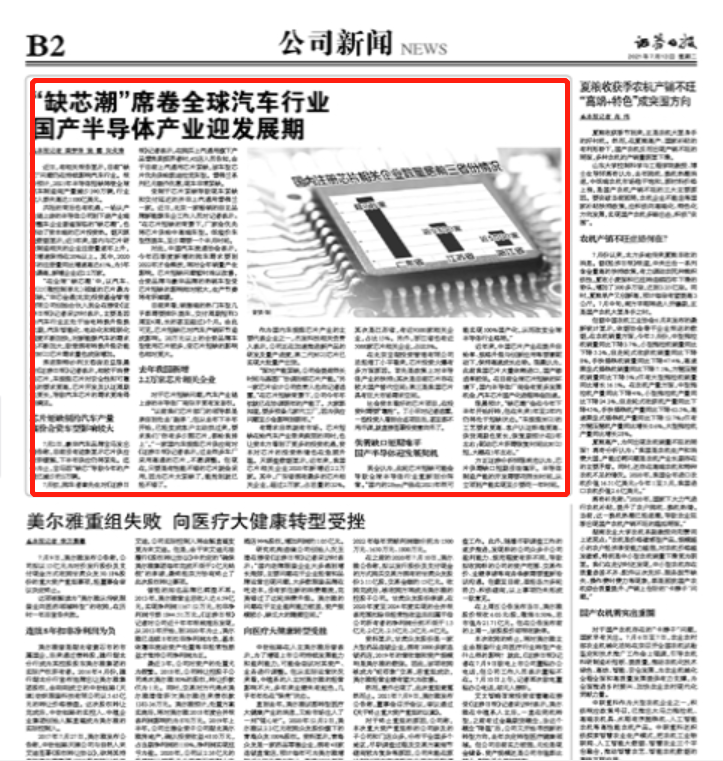
Where there is demand, there is naturally a market. While the chip shortage brings troubles to the automotive industry, it also shows capital investors more investment opportunities, and the enthusiasm of capital for chip investment is also heating up rapidly. Tianyancha data shows that in recent years, nearly 22,000 new chip-related enterprises were added in China in 2020. Among them, Guangdong Province has the largest number of chip-related enterprises, over 20,000, accounting for 32% of the total. Jiangsu Province comes second, with nearly 9,300 related enterprises,
accounting for 15%. In addition, Zhejiang Province also has nearly 5,000 chip-related enterprises, accounting for 8%.
In the view of Ding Xiaoping, general manager of Beijing Baohu Investment Management Co., Ltd., there are several reasons for the booming chip investment. First is the policy support for the semiconductor industry; second is the significant domestic substitution space currently available for chips; third is the huge market demand for chips in China.
Semiconductor projects favored by social capital need to be "grabbed" when investing. Ding Xiaoping revealed to reporters that some investors, after seeing suitable projects, even don't need to make full inquiries and directly sign investment intention letters.
The supply-demand gap is difficult to fill in the short term
Domestic semiconductors welcome development opportunities
Wu Quan believes that this round of chip shortage may lead to a realignment of the global semiconductor industry camps. "Domestic 28nm production lines are likely to achieve 100% localization in 2021, thus changing the global semiconductor industry pattern."
In recent years, China's chip industry has maintained a high growth momentum driven by factors such as improving self-sufficiency rates, specification upgrades, and innovative applications.
Chen Chen believes that previously, China's chips relied heavily on imports, and the domestic penetration rate was relatively low. In the current global chip shortage environment, domestic semiconductor manufacturers will have more development opportunities, and the localization process of automotive chips will accelerate.
Chen Chen predicts that the "chip shortage wave" will start to improve in the second half of this year but will remain in a shortage state for the next 1 to 2 years. "Automotive-grade MCUs have higher process requirements, higher customer certification standards, and longer supply cycles, with a recovery period expected to be around 2 years; the recovery time required for driver chips is shorter than that of MCUs, about 1 year."
Chen Hang, an analyst at Founder Securities, also believes that the chip supply-demand gap cannot be filled in the short term. The development of semiconductor manufacturing capacity takes a long time, and it takes at least one year from project approval to capacity realization.
*This article is reprinted from Securities Daily, authored by Gong Mengze, Shi Lu, and Xiang Yantao, click on the bottomTo read the original article, you can view the report.