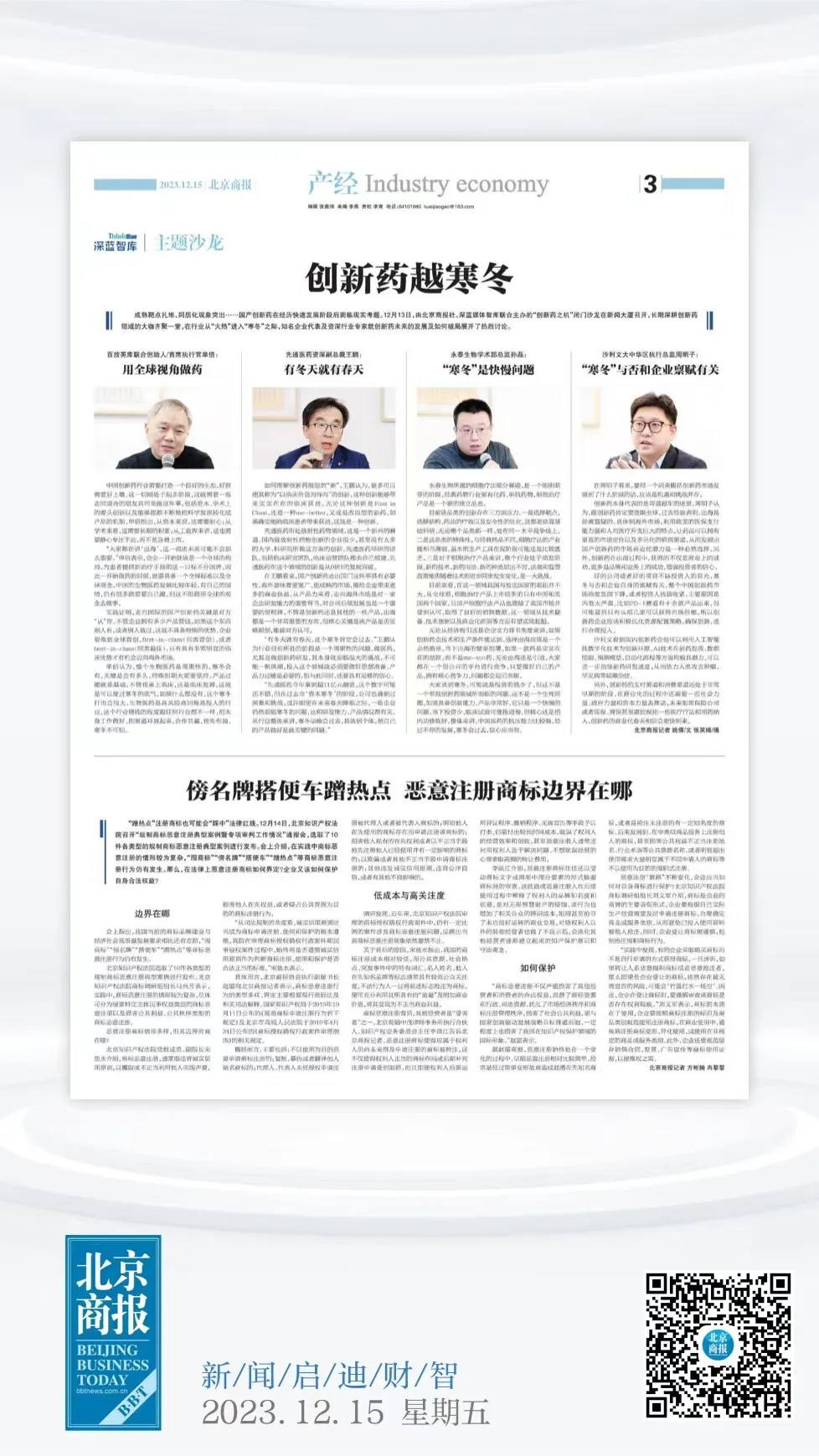
Mature targets are flocking to each other, and homogenization is a prominent issue... After experiencing a rapid development phase, domestic innovative drugs are facing practical challenges. On December 13th, a closed-door salon titled 'The Opportunities of Innovative Drugs' was held at the News Building, co-hosted by Beijing Business Daily and Shenzhen Blue Media Think Tank. Industry leaders who have long been deeply involved in the field of innovative drugs gathered together.Zhou Mingzi, the consulting director of Frost & Sullivan Greater China, was invited to attend the meeting. Together with guests such as Shan Biao, co-founder/executive director of Baidu Medicine, Wang Peng, senior vice president of Xiantong Medicine, and Sun Lei, director of the academic department of Yongtai Biology, they engaged in a lively discussion on the future development of innovative drugs and how to break through bottlenecks.
The topic of innovative drugs has been particularly hot in recent years. In Zhou Mingzi's view, if we want to summarize the stage of development with one word, it should be that opportunities and challenges coexist. Innovative drugs themselves represent a scenario of overtaking on a curve, and many Chinese innovative drugs can export value globally. Whether from the perspective of market depth or breadth, the commercial space and imagination are very rich. However, at the same time, the challenges are also very significant. From a domestic perspective, there are certain differences between China's healthcare service system and the global one, such as strict medical insurance cost control and relatively few diverse insurance payment channels. Therefore, the construction of China's healthcare service system requires innovative ideas with Chinese characteristics. Additionally, the research and development (R&D) time for innovative drugs is very long, accompanied by high R&D and commercial risks. Compared to overseas Biotech companies, which usually have strong capital support, the R&D 'ammunition' for domestic Biotech companies is more limited. Against this backdrop, how to ensure commercial investment returns is one of the core issues that general investors will ask companies, and it is also an important topic that the innovative drug track needs us to discuss and research together in the future.
Zhou Mingzi believes that developing innovative drugs necessarily requires a global perspective, while Frost & Sullivan views it more from an investor's standpoint. Whether innovative drugs should go global or when they should do so is a question that has been answered by past experience, which shows that going global is undoubtedly necessary. Specifically for overseas markets, taking advantage of the strong healthcare insurance payment capabilities in Europe and America and the huge per capita healthcare expenditure allows drugs to have higher market pricing and diversified sales channels. Therefore, it is an inevitable choice to explore the market commercialization potential of domestic innovative drugs. Moreover, during the process of going global, innovative drugs not only achieve commercial success but also gain more brand and business success, thereby enhancing investors' confidence.
Currently, there are relatively few multi-site clinical trials and multi-center trials conducted by Chinese innovative pharmaceutical companies, which is the most prominent risk for domestic innovative drugs going global. For a drug with a global layout, if there are no good clinical trials or clinical service guarantees in the United States, Europe, or the Middle East, the reliability and sustainability of the drug during final approval or regulatory processes will be in question. Additionally, there is the issue of the ability to export sales channels overseas. One option is to do it independently, while the other is to cooperate with multinational pharmaceutical companies (MNCs). The former requires particularly high capabilities or capital from the pharmaceutical company itself, while the latter relies on the sales network and channels of MNCs. To some extent, the distribution of benefits may not be as favorable as those of MNCs, which is a rather regrettable point.
Zhou Mingzi stated that good companies or projects are not lacking in investors' attention; whether it is a cold winter or not is related to the company's own endowment.The entire Chinese innovative drug market has seen a sharp decline in popularity, or investors have tightened their pursestrings, mainly due to severe competition. For example, there are more than a dozen products in the PD-1 track, but perhaps only a few leading companies can ultimately gain market share. The remaining companies and production lines face the direct problem of having drugs approved but with meager profits or particularly high risks, which makes investors highly sensitive to these companies. Therefore, innovative drug enterprises should actively optimize resource allocation strategies to ensure innovation and make reasonable investments. Frost & Sullivan has seen that domestic innovative drug companies can also use artificial intelligence and digital technology to open-source innovation. AI technology has great potential in new drug discovery, data mining, predictive models, automated processes, etc., which can further accelerate the speed of new drug research and development, thereby working together with humanity to overcome difficult and complicated diseases such as tumors and rare diseases.
Finally, Zhou Mingzi pointed out that the payment and consumption channels for innovative drugs are still in very early stages. During the commercialization process, some social, government, and capital forces are needed to drive progress. In the future, if insurance companies, medical insurance, commercial insurance, or even public welfare insurance include certain medical therapies and medications in their coverage, the commercial spring for innovative drugs is believed to come faster!