Foodaily FBIC
"Entering the industrial belt" isFoodaily FBICCentered on 'Breaking Through the Industrial Chain' The annual series of activities planned under the annual theme 'Co-creating a New Future'.
Foodaily FBICSort out the development overview of key industries in food and beverages, select10As the main front, the cities visit different urban industrial belts, collaborating with upstream and downstream core resources such as governments, associations, and benchmark enterprises in the industrial belt. Through multiple sessions including visits, keynote speeches, global innovation tastings, and open discussions, they lead brand entrepreneurs to conduct in-depth discussions on strengthening industry chains such as industry changes, product innovation and brand reshaping, deep channel cultivation, and supply chain ecosystems. They re-examine the challenges, problems, and gaps in the growth of the food industry under changing circumstances, analyze the dilemmas and solutions for industrial development, and quickly seek new opportunities by pooling value resources.

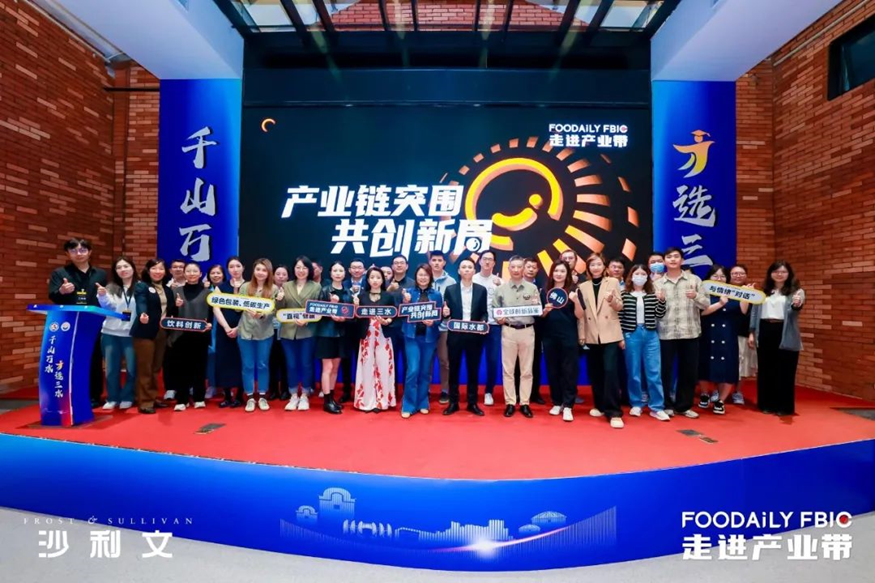
2023year12month13On the same day, the 'Into the Industrial Belt' series of events visited the Foshan Water Town Beverage and Food Industrial Park, focusing on how beverage companies embrace industrial thinking, Frost & Sullivan (Frost & SullivanZhang Jian, Partner and Managing Director of Frost & Sullivan's Greater China Region, was invited to participate in the event and delivered a speech titled 'New and Existing Players in the Bubble Water Industry Enter the Market One After Another. Who Can Stand Out?'

Partner and Managing Director of Frost & Sullivan Greater China Region Zhang Jian
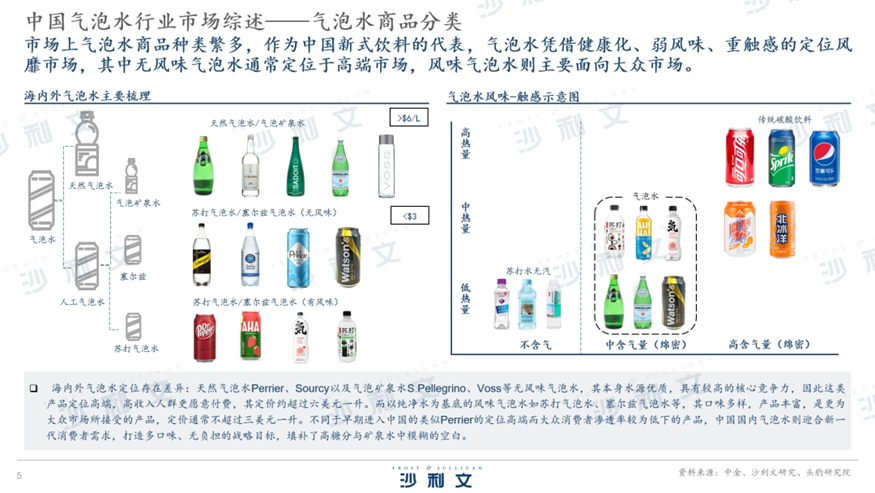
Zhang Jian pointed out that there are a wide variety of bubble water products available on the market. As a representative of new-style beverages in China, bubble water has become popular in the market due to its health-conscious positioning, mild flavor, and tactile appeal. Non-flavored bubble water is usually targeted at the high-end market, while flavored bubble water is mainly aimed at the mass market.
In terms of the growth rate of the soft drink market size, the market sizes of Chinese tea beverages and carbonated beverages have approached saturation. The market for sugar-free tea beverages is2014year653RMB billion grew slowly to2020year792Yuan, with an annual compound growth rate of3.2%, while the carbonated drink market is from2014year788RMB billion growth to2020year885Yuan, with an annual compound growth rate of only1.9%Driven by the demand for healthier and lighter-flavored products, sparkling water is set to become the most growth potential sub-market.
At present, there is still significant room for development in the proportion of flavored sparkling water in China compared to developed countries. Flavored sparkling water in China only accounts for a small portion of flavored packaged water.1%Market share, while in the same period, developed countries in Western Europe, the United States, and Japan accounted for41%,7%and21%. Zhang Jian believes that bubble water without flavor, as a representative beverage product for weak-flavored and health-conscious market demands, has a low market share that presents tremendous potential for growth in the Chinese bubble water market. The development trend towards sugar-free and low-flavor beverages is one of the directions for the development of Chinese beverages.
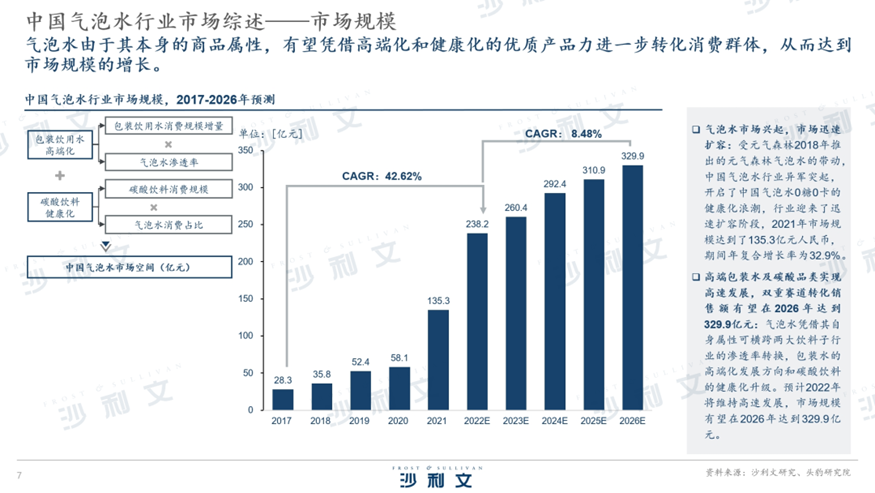
According to a study by Frost & Sullivan, affected by Yuanqi Forest2018Driven by the launch of NIO's VIVE Water in 2021, China's bubble water industry has emerged as a new force, ushering in a new era for bubble water in China0sugar0With the wave of card healthization, the industry has entered a period of rapid expansion.2021In China, the market scale of the bubble water industry reached135.3RMB 10 billion, with a compound annual growth rate during that period of32.9%Bubbling water can leverage its own attributes to penetrate across two major beverage sub-industries: penetration rate transformation, the high-end development direction of packaged water, and the health-conscious upgrade of carbonated beverages. It is expected to maintain rapid development in the future, with the market size potentially reaching2026Annual achievement329.9100 million yuan.
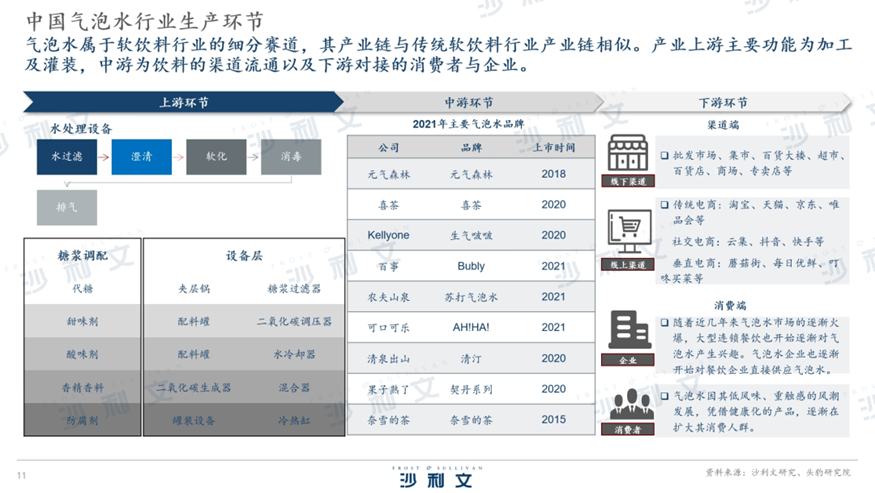
"Bubble water belongs to a niche segment within the soft drink industry, and its industrial chain is similar to that of traditional soft drink industries," Zhang Jian further explained. The upstream of the bubble water industry mainly involves processing and filling, while the midstream includes beverage distribution through channels and the downstream connects with consumers and businesses.
The common production process of sparkling water is similar to that of carbonated beverages, with the core focus on the selection of sweeteners. Sparkling water has more stringent requirements for sugar materials to bring about a differentiated advantage. In the blending step with sweeteners, sparkling water often uses artificial sweeteners and functional sweeteners to replace natural ones with filtered pure water or mineral water to achieve a similar sweetness but lower sugar content. For example, the main sweetener used by the representative brand Yuanqi Forest is erythritol.
Each large bubble water company hopes to create a major product entry point into the market. Traditional flavorless bubble waters (such as Paris Water and San Pellegrino) have become representatives of high-priced flavorless bubble waters due to their natural high-quality water sources. However, due to their high-end positioning, their consumer base is still relatively niche. Flavorful bubble waters offer a richer taste that better suits the preferences of mainstream consumers. At present, the consumer market in China is more receptive to flavored bubble waters, with sugar-free beverage products represented by erythritol occupying the market.

Subsequently, Zhang Jianjian briefly analyzed the driving factors and development trends of China's bubble water industry. He pointed out that under the long-term unhealthy dietary habits of high sugar intake, China's consumer obesity rate and diabetes prevalence continue to rise. In recent years, consumers' awareness of health has been increasing, and the 'sugar reduction campaign' has rapidly unfolded in China. The demand for healthy concepts has made sugar reduction a significant driving force for the beverage industry's development, making consumers more cautious about their sugar intake.

"In the future, the bubble water industry will develop towards diversified functions, sugar-free options, and high-end products," said Zhang Jian.
On one hand, the national income level has accompanied an increase in consumption levels, further diversifying beverage scenarios. The demands in different scenarios have become more detailed, and beverages are no longer limited to simply satisfying the need for thirst relief. Consumer demands change with scenario changes, and their forms have also become diverse. Bubble water has a natural advantage in form shaping due to its low-calorie and non-greasy product attributes, and it can innovatively add different components such as hyaluronic acid, lactic acid bacteria, probiotics, dietary fiber, and other elements to meet the needs of consumers in different beverage scenarios. As functional bubble water expands into more consumer scenarios, the industry market size is expected to further grow and expand.

On the other hand, as Chinese consumers' demand for health improves, their control over sugar intake will become more stringent. Under the trend of consumer health awareness, consumers' attention to sugar-free beverages continues to rise, and the sugar-free beverage industry in China is in a stage of ultra-high-speed development. In recent years, consumers' acceptance of sugar-free beverages has been continuously increasing. At the same time, major manufacturers are actively developing sucrose substitutes that balance taste and health, which will significantly increase the penetration rate of sugar-free beverages. The use of artificial sweeteners in flavored sparkling water and the development of sugar-free, flavorless sparkling water categories have accurately captured the trend of sugar-free beverage development. The trend towards sugar reduction will be further strengthened.

In addition, leveraging the gaseous nature of sparkling water, it can endow high-end water with new value points for promotion. There is a certain consumer conversion potential in the high-end water market, providing new value points for this segment. Drawing on the development experience of overseas sparkling water markets, flavorless sparkling water is more likely to move towards a high-end development path compared to flavored sparkling water. Taking Paris Water as an example, its market scale has developed rapidly since its entry into the Chinese market.2015Year-end2020The market scale grew at an average annual rate46.9%The growth rate has increased by seven times in five years, indicating that the growth potential of high-end bubble water in the Chinese market is astonishing. expected to2025The scale of high-end sparkling water can reach100Yuan, and high-end development will become one of the development directions for the bubble water industry in China.

Finally, Zhang Jian stated that the bubble water industry in China is still in its early stages of development, with multiple brands entering the market, and there is hope for further integration of the industry.