To further deepen the service model that supports scientific and technological innovation, taking investment and financing matchmaking services as a starting point to promote close interaction between capital and industries, on December 22, 2021, the fourth phase of the “Intelligent Cloud, Seeing the Future” - 2021 Municipal High-tech Zone's Plan for Supporting Scientific and Technological Innovation - “Precise Investment and Financing Roadshow Matching Session ” - Special Session on Intelligent Cloud Services, hosted by Shanghai North High-tech Service Park and organized by the Municipal High-tech Zone's Alliance for Supporting Scientific and Technological Innovation, was successfully held. Frost & Sullivan (hereinafter referred to as “Frost & Sullivan&rdquo) consulting analyst Zhang Shouyu was invited to participate in the event and delivered a speech on enterprise intelligent cloud services.
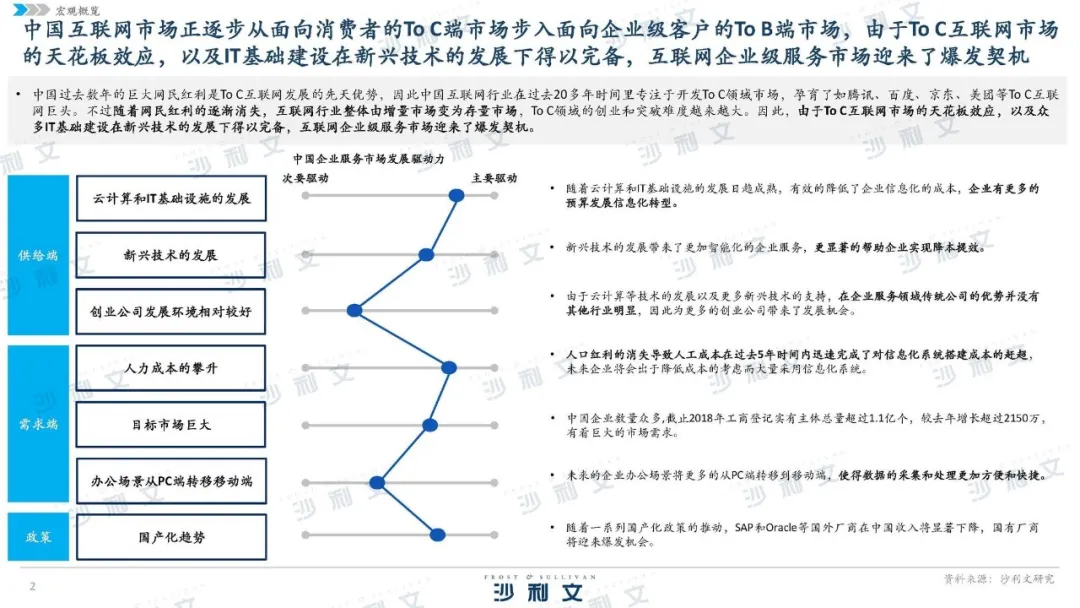
Zhang Shouyu stated that the Chinese internet market is gradually transitioning from a consumer-oriented To C end market to an enterprise-level B end market. China's huge netizen dividend over the past few years has been an inherent advantage for the development of To C internet, leading to the emergence of giants such as Tencent, Baidu, JD.com, and Meituan in the To C internet sector over the past 20+ years. However, with the gradual disappearance of the netizen dividend, the internet industry has shifted from an incremental market to a stock market, making it increasingly difficult to start and break through in the To C field. Therefore, due to the ceiling effect of the To C internet market and the completion of many IT infrastructure under the development of emerging technologies, the enterprise-level service market has seen an opportunity for explosive growth.
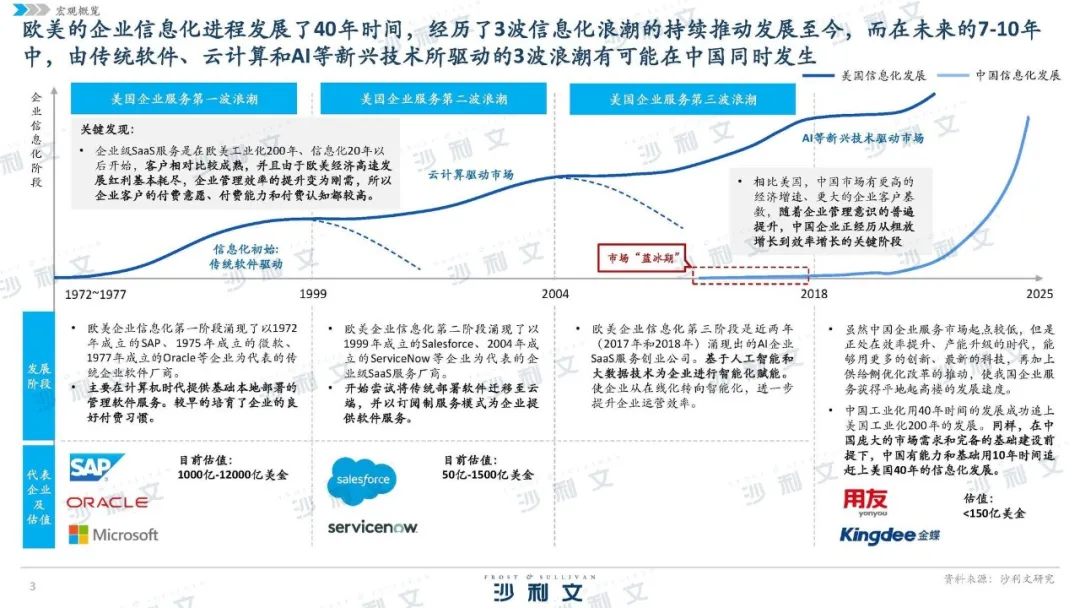
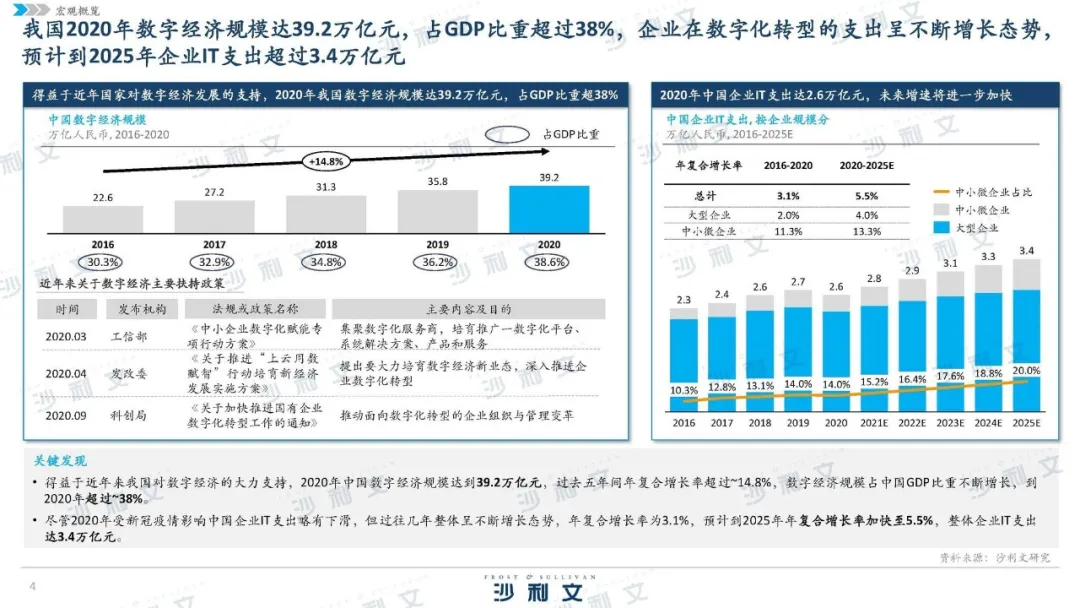
Frost & Sullivan research found that enterprise-level SaaS services began after 200 years of industrialization and 20 years of informatization in Europe and America. Customers are relatively mature, and since the dividends from rapid economic development in Europe and America have largely run out, improving management efficiency has become a necessity. As a result, enterprise customers have a higher willingness, ability, and awareness to pay. Compared to the United States, although the starting point of the Chinese enterprise service market is lower, the Chinese market has a higher economic growth rate, a larger base of enterprise customers, and is in an era of efficiency improvement and capacity upgrade. Coupled with the promotion of supply-side optimization reform policies, Chinese enterprise services have achieved a development speed that allows them to build from scratch. Data shows that China's digital economy reached 39.2 trillion yuan in 2020, accounting for more than 38% of GDP, and enterprises' expenditures on digital transformation are continuously increasing, with IT spending expected to reach 3.4 trillion yuan by 2025.“China's industrialization took 40 years to catch up with the 200-year development of American industrialization. We believe that under the premise of China's huge market demand and complete infrastructure, China has the ability to catch up with the 40-year informatization development of the United States in just 10 years,” said Zhang Shouyu.
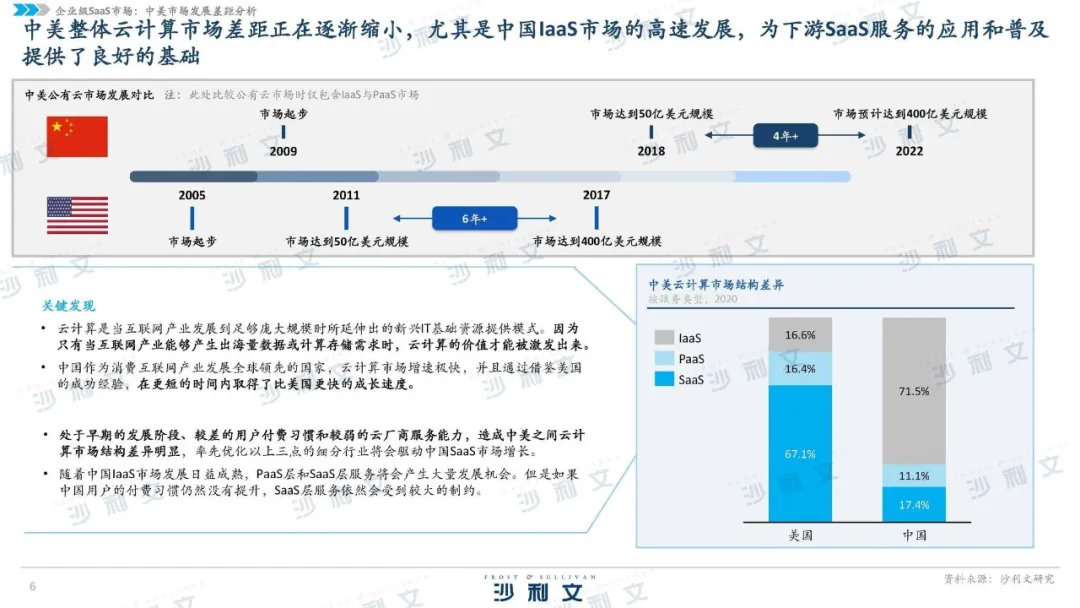
In addition, looking at the overall development of public cloud markets in China and the United States, the US market started in 2005, reaching a scale of $5 billion in 2011. In just six years, the entire market size experienced explosive growth, reaching $40 billion in 2017. The Chinese public cloud market started in 2009, developing to $5 billion in 2018, and is expected to reach $400 billion by 2022.The gap between the overall cloud computing markets in China and the United States is gradually narrowing, especially the rapid development of China's IaaS market, which provides a good foundation for the application and popularization of downstream SaaS services.
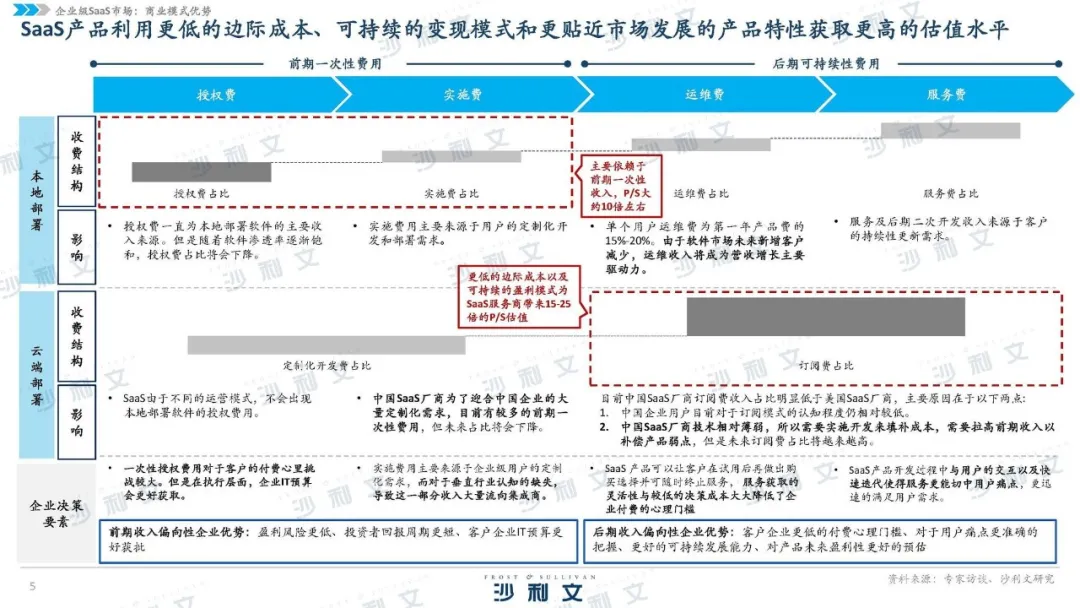
Zhang Shouyu pointed out that in the enterprise-level SaaS market, SaaS products can achieve higher valuation levels by using lower marginal costs, sustainable monetization models, and product characteristics closer to market development. SaaS products include upfront one-time fees and subsequent recurring fees. Enterprises with an upfront revenue bias have lower profit risks, shorter investor return cycles, and better approval of IT budgets for their customers. Enterprises with a later revenue bias have lower payment psychological thresholds for their customers, more accurate grasp of user pain points, better sustainable development capabilities, and better estimates of future profitability for their products.
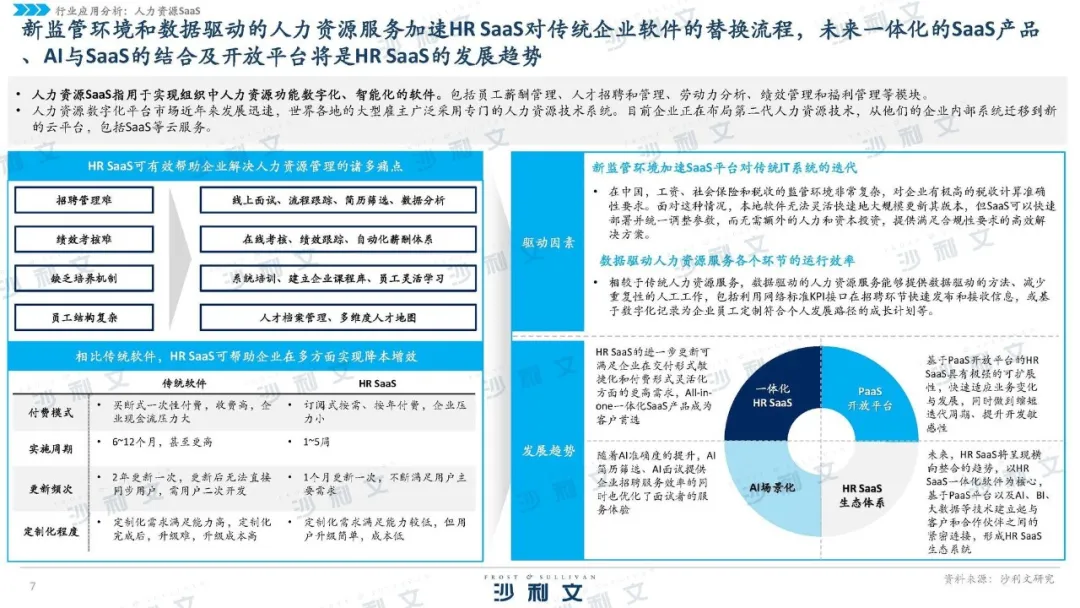
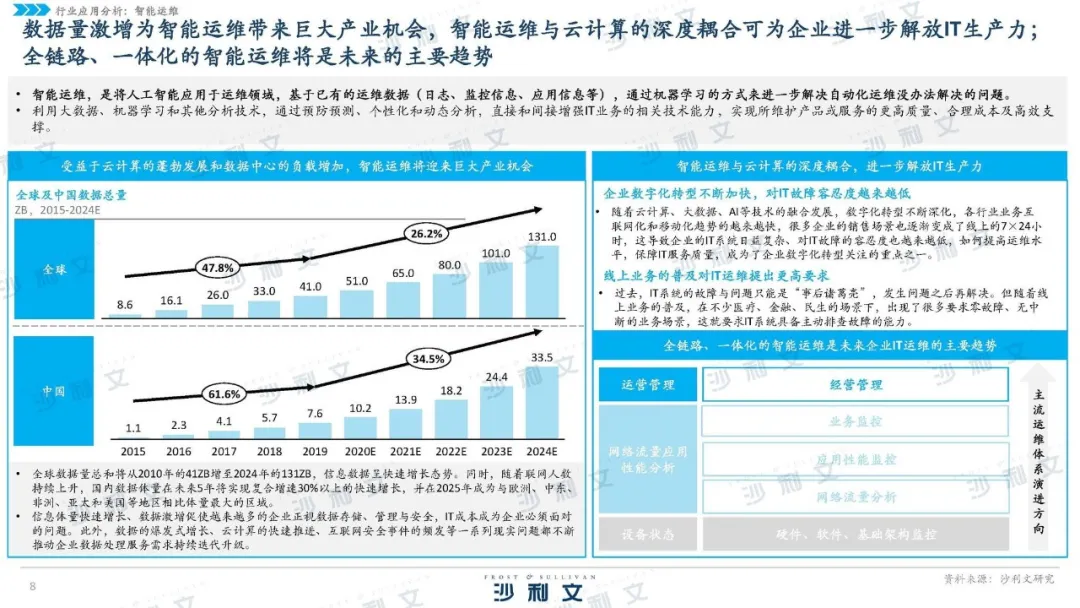
Finally, in terms of industry applications, Zhang Shouyu made brief analyses using human resource SaaS (HR SaaS) and intelligent operations as examples. HR SaaS refers to software used to digitize and automate human resource functions within organizations. Compared to traditional software, HR SaaS can effectively help enterprises solve many pain points in human resource management and improve efficiency.In the future, HR SaaS will show a trend of horizontal integration, centered around integrated HR SaaS software, establishing close connections with customers and partners based on PaaS platforms and technologies such as AI, BI, and big data, forming an HR SaaS ecosystem.Another application - intelligent operations - refers to the application of artificial intelligence in the field of operations. Based on existing operation data (logs, monitoring information, application information, etc.), it further solves problems that automation operations cannot solve through machine learning.The surge in data volume brings huge industrial opportunities for intelligent operations. The deep coupling between intelligent operations and cloud computing can further liberate IT productivity for enterprises, and full-linkage, integrated intelligent operations will be the main trend in the future.
To accelerate the listing process of scientific and technological innovation enterprises and create a good capital service ecosystem that supports enterprise innovation, Municipal High-tech Zone, in collaboration with several leading financial institutions, established the “Municipal High-tech Zone's Plan for Supporting Scientific and Technological Innovation” in January 2019, aiming to build an IPO cultivation system for technology innovation enterprises through multi-dimensional capital empowerment and help them enter the capital market.
The COVID-19 pandemic has confirmed the value of cloudification, and enterprises and institutions have affirmed the cost-effectiveness and business continuity brought about by cloudification, accelerating their own digital business transformation. At the same time, cloud service enterprises are also paying more attention to providing diversified services, combining artificial intelligence and big data to provide efficient and comprehensive services for customers. Against this backdrop, the fourth phase of the “Precise Investment and Financing Roadshow Matching Session” of the Municipal High-tech Zone's Plan for Supporting Scientific and Technological Innovation focuses on intelligent cloud services. At the event site, Jingzhi Technology, Shenzhou Lingyun, and Cai Dao Cloud participated in project roadshows.