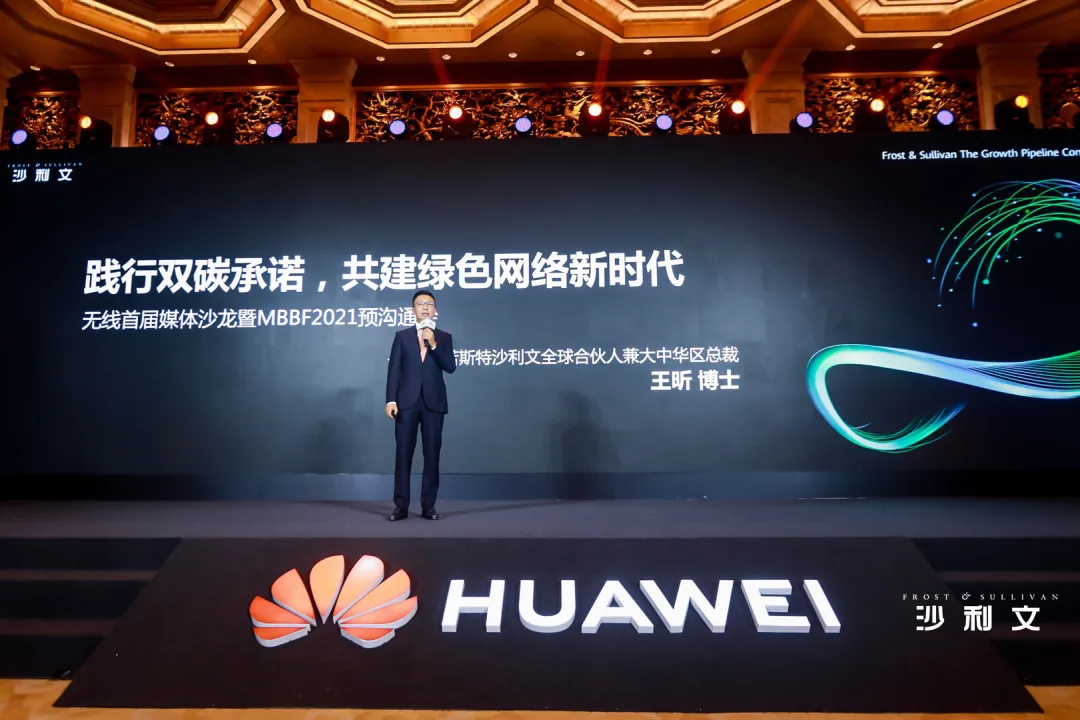
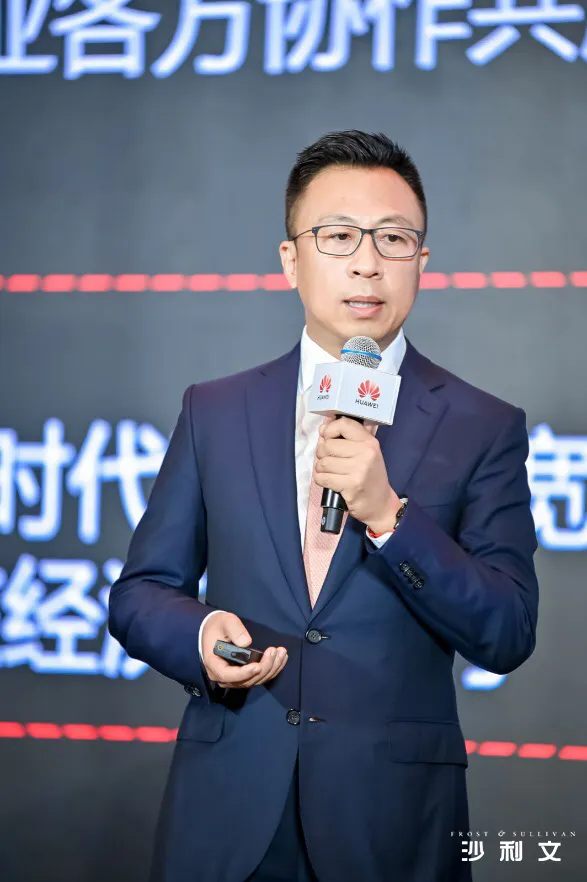
Dr. Wang Xin, Global Partner and President of Frost & Sullivan Greater China, delivered a keynote speech
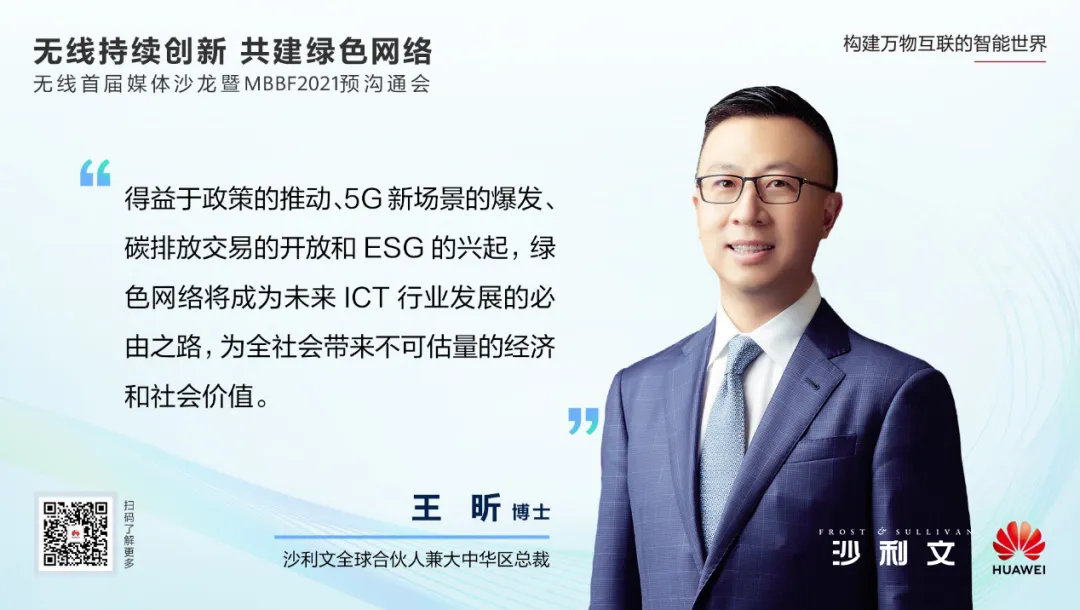
Dr. Wang Xin said:"Thanks to policy promotion, the explosion of new 5G scenarios, the opening up of carbon emission trading, and the rise of ESG, green networks will become an inevitable path for the future development of the ICT industry, bringing immeasurable economic and social value to society as a whole."In addition, he also solemnly called for the joint construction of green networks and green 5G, which is an important practice in fulfilling the dual carbon commitment."Hopefully, colleagues from various industries will join hands as soon as possible to contribute their part to the cause of carbon neutrality."
The realization of "carbon peak and carbon neutrality" has four major significances.
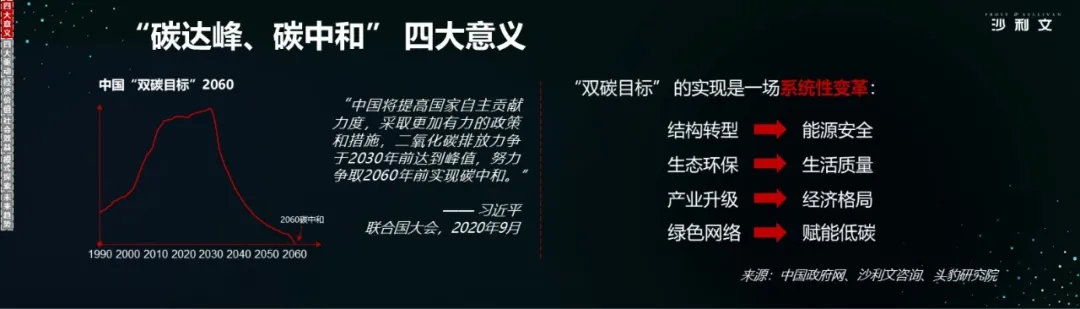
1. Promote the rapid and sustainable development of new energy sources, reduce the proportion of fossil energy in China's energy consumption, facilitate the transformation of the energy structure, and ensure our country's energy security.
2. It is closely related to everyone's life; it will significantly improve the ecological environment and enhance our quality of life.
3. It forces China's industrial upgrading and changes the existing economic pattern; in order to achieve carbon neutrality, many industries with significant scale will undergo a complete reshuffle from raw materials, production manufacturing to the consumer end. For example, the rise of new energy electric vehicles in recent years has reshaped the traditional automotive industry chain and pattern.
4. Green technology in China and even globally will accelerate development and empower the entire society towards low-carbonization. Dr. Wang Xin believes that in the future process of low-carbonization across various industries, the most core part is the greening and decarbonization of communication networks. Green networks can not only significantly reduce the energy consumption and carbon emissions of the ICT industry itself, but more importantly, they can be widely applied to all sectors of society to help them reduce costs, increase efficiency, and achieve the dual carbon goals at an early date.
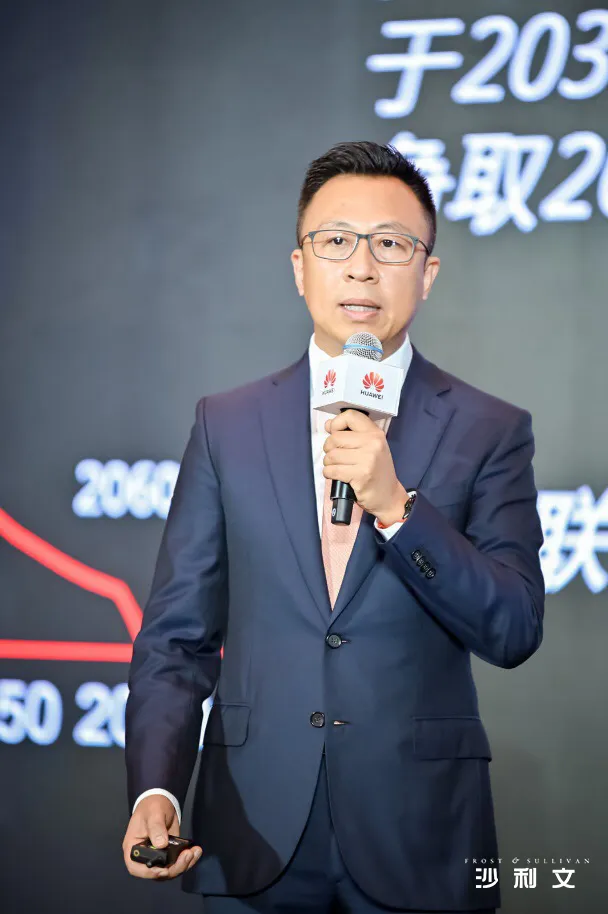
The green network is the inevitable path for the future development of the ICT industry.
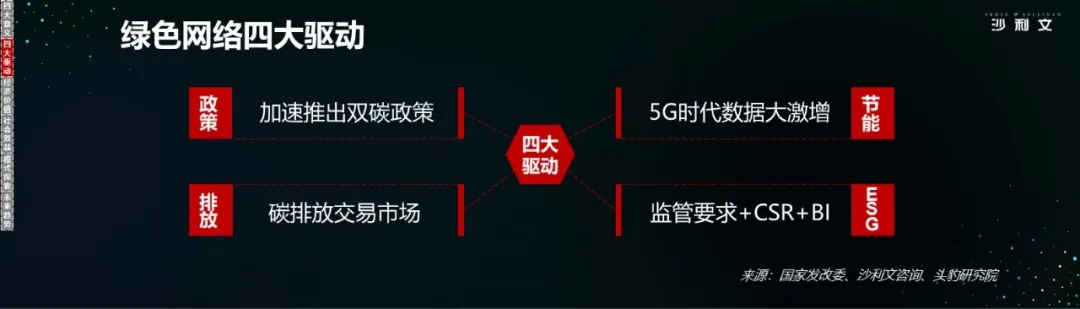
The future development of the green network mainly benefits from four major driving forces:
First,Governments of major countries around the world have introduced clear timelines and corresponding support policies for carbon neutrality.
For example, Europe is at the forefront of global climate policy. In 2020, the EU passed the 'European Green Deal' and the 'European Climate Law', setting the goal for the EU to achieve carbon neutrality by 2050, and has been working on designing a carbon tariff system to force industrial upgrading within the EU. After China proposed its dual carbon goals, both central and local governments have successively introduced a series of supportive policies. In addition, an overall timeline and roadmap for carbon peak and carbon neutrality are about to be announced, as well as implementation plans for different fields and industries before 2030, constructing a 1+N policy system and improving fiscal, tax, price, and other incentive economic measures.
Second,The large-scale deployment of 5G networks, as well as the surge in data volume for new 5G application scenarios.
As of June this year, the total number of 5G base stations in China has reached 961,000, accounting for more than 70% of the global total. Although the energy consumption per bit of data transmitted over a 5G network is only one-tenth that of a 4G network.
However, as 5G networks rapidly expand into emerging application areas such as VRAR, autonomous driving, intelligent manufacturing, and smart cities, the amount of network data transmission across society will increase significantly by dozens or even hundreds of times in the future. This objectively creates a huge demand for energy conservation and emission reduction.
Third,With the official launch of the national unified carbon emission trading market this year, it is expected that in addition to electricity, high-energy-consuming industries such as metallurgy, manufacturing, chemical engineering, and computing will also be gradually incorporated into the carbon emission trading system.Energy-saving enterprises can obtain substantial economic benefits, which also promotes the implementation of green networks.
Finally,In recent years, ESG standards have risen in popularity:On one hand, current regulatory authorities require all listed companies to disclose their ESG status and strategies; on the other hand, more and more entrepreneurs are placing greater emphasis on their corporate social responsibility and brand image, and are willing to proactively adopt green communication networks.
Green networks can help enterprises realize economic value at three levels
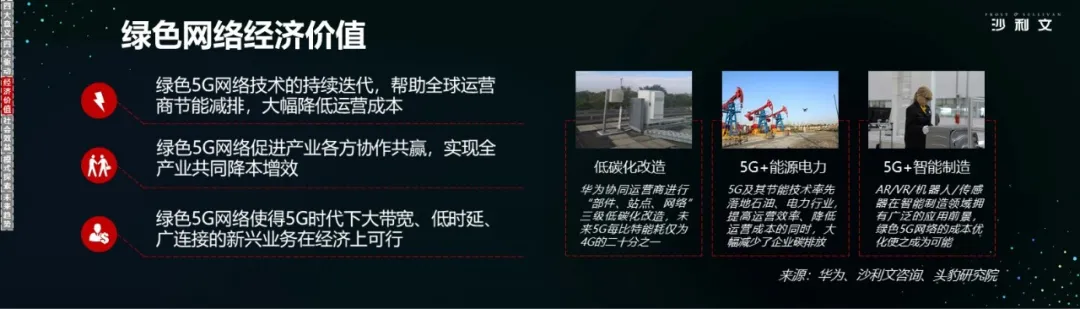
Operators, equipment manufacturers, and other ecosystem partners are continuously iterating green network technologies and products together, which will significantly reduce the electricity costs and carbon emissions across the entire industrial chain.
For example, Huawei has collaborated with the three major operators to carry out low-carbon renovations of wireless networks from the perspectives of 'components, sites, and networks'. New products such as new MIMO power supplies, a new generation of AAU products, AI site management systems, and cloud-based intelligent network management have greatly improved operational efficiency. For instance, after China Mobile carried out low-carbon renovations of its network, it saved over 1 billion kWh of electricity in 2020 alone, while also saving a significant amount on electricity costs.
The second level is the collaboration between 5G and other industries.
All industries can save a significant amount of energy through new technologies and applications based on 5G networks. Currently, the most widespread and common application is 5G combined with the energy and power industry.
For example, Jiangxi State Grid has established an integrated management platform for smart power, supporting various smart power-related application scenarios, including: 5G intelligent distributed energy, 5G+ distribution automation with remote sensing, 5G+ intelligent inspection, 5G+ energy consumption monitoring, and so on.
At a deeper level, the popularization of green networks has made emerging services with large bandwidth, low latency, and wide connectivity economically viable in the 5G era.
For example, in the future, a 5G smart factory that realizes the interconnection of all things will require an enormous amount of data transmission every day, reaching the TB or even EB level. This means extremely high electricity and data flow costs. In manufacturing industries where cost is very sensitive, this high-cost model cannot be sustained in the long term. The continuous energy-saving and cost-reduction efforts of green 5G make this emerging manufacturing model possible. Similar economic logic applies equally to VR/AR, autonomous driving, smart cities, and other fields with high future data consumption.
In addition to its economic value, the widespread adoption of green networks will also bring immeasurable social value.
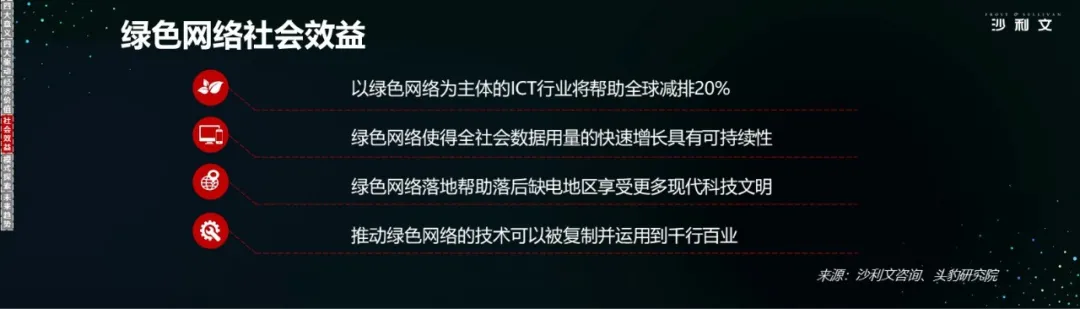
Firstly, the most direct social value of green networks is to reduce carbon emissions.
Currently, the carbon footprint of the ICT industry accounts for only about 2% of total emissions, but ICT technology can help reduce global total emissions by 20%.
For example, since last year, Shanghai's natural gas company has started using 5G drones for pipeline inspections. This new approach has replaced the traditional practice of fuel vehicles with inspectors. According to calculations, in terms of working time per inspection, the efficiency of 5G drone inspections is six times that of manual inspections. Moreover, the greenhouse gas emissions reduction achieved by the 5G drone scheme is about 40% compared to manual inspections.
The second major social value is green 5G, which makes new applications that will emerge in the 5G era ecologically sustainable.
It is well known that the data scale of new applications in the 5G era is growing exponentially. According to a study by Frost & Sullivan, under equivalent conditions, the amount of data for an 8K VR video is about 160 times that of current high-definition mobile videos. For instance, if all the video data generated by public cameras in Shenzhen throughout 2020 were connected to a 5G smart city, the amount of data required for transmission could reach 7.5 EB. In traditional communication scenarios, these new services will generate dozens or even hundreds of times more carbon emissions. By deploying green networks, these new services can become ecologically sustainable.
Thirdly, the implementation of green 5G networks can help users in backward and power-deficient areas enjoy more modern technological advancements.
Most emerging markets in Asia, Africa, and Latin America face difficulties such as inadequate infrastructure, lack of stable power supply and reliable feedback, and high difficulty in facility installation and maintenance. Green 5G solutions have a low overall power consumption and significantly simplified device structures, reducing the requirements for supporting infrastructure, allowing local people to access affordable and stable networks.
Finally, the energy conservation and emission reduction of green 5G networks require the support of a large amount of AI, new equipment, and new materials.These new technologies and products are highly replicable and can be applied across various industries to help them achieve carbon neutrality goals.
Three exploration directions for green 5G network modes

First is the co-construction and sharing of 5G base stations.
The most typical example is the base station cooperation project between China Telecom and China Unicom. It is understood that as of June 2021, China Unicom and China Telecom have jointly built and shared a total of 460,000 5G base stations, saving both parties over a hundred billion yuan in infrastructure investment. This project can save more than 11.7 billion kWh of electricity annually. Calculated at an industrial electricity rate of 0.07 yuan per kWh, it can save at least 8 billion yuan or more in electricity costs, achieving significant energy conservation and emission reduction effects.
Secondly, there is the integration of 5G with new energy power generation and battery energy storage industries.
Setting up solar power stations near 5G base stations can greatly supplement the consumption of electricity. For example, Hunan Mobile has launched an integrated operation plan of 'MIMO power supply + solar energy', which uses solar resources to power and charge the base station batteries, saving on direct municipal power usage for the base station; by introducing MIMO power supply technology, it enables the connection of multiple energy sources such as solar, municipal, and generator sets, ensuring secure and stable network operations.
Finally, there is the integration of 5G and intelligent platforms.
There are two sub-topics involved here. The first is how to leverage the powerful analysis, judgment, and prediction capabilities provided by AI algorithms to empower network elements, networks, and business systems. The second is how to integrate AI with the planning, construction, maintenance, operation, and optimization of telecommunications networks.
For example, Shanghai alone currently has nearly 60,000 5G base stations. If resource allocation, operation and maintenance, and network effect optimization rely on manual labor, it is inevitable that there will be a huge waste of resources.
It is reported that the industry has made many explorations into these challenges. Operators in Guangxi, Henan, and Inner Mongolia have respectively adopted AI intelligent platforms to achieve energy-saving effects of over 12% across the entire network.
There are four major challenges to the future development of green networksKey trend
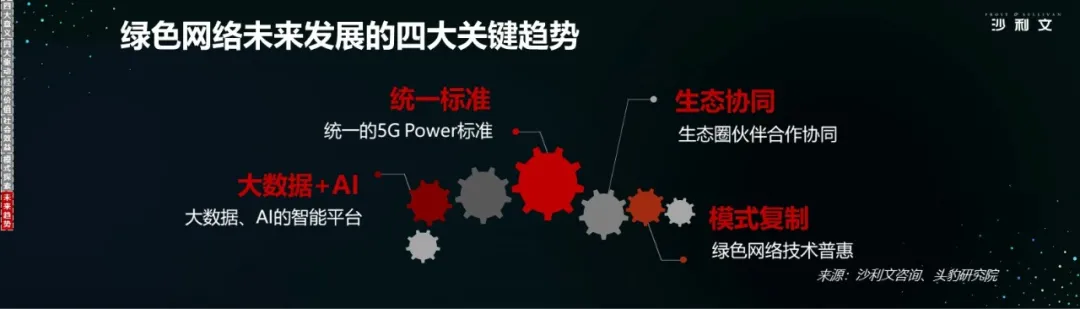
Firstly, unify standards.
At the beginning of 2020, the International Telecommunication Union (ITU) organized the release of the global 5G Power international standard (among which Chinese manufacturers are also among the main standard-setting participants). As of last year, more than 80 countries around the world have adopted solutions that comply with the 5G Power standard. In the future, to enable better carbon peak and carbon neutrality in the global communication industry chain upstream and downstream, accelerating the construction of standardization is a crucial link.
Second, ecological coordination.
Due to the long communication industry chain, which involves a large number of technical departments, from different component suppliers to equipment manufacturers, operators, and end-users, everyone is deeply involved in this chain. Therefore, strengthening the integration and coordination of the entire industry chain in the future is also very important for the overall energy conservation and emission reduction of the industry.
Thirdly, the large-scale use of AI+big data across the entire industrial chain is an important method in achieving the dual carbon goals through a green network.
Fourth, the technologies and models for achieving the dual carbon goals through green networks will be replicated on a large scale across various industries such as grid energy, intelligent manufacturing, and healthcare.On the one hand, it can achieve energy conservation and emission reduction. On the other hand, it can also serve as a product to realize commercial value, achieving a win-win outcome.
Subsequently, Ma Hongbo, President of Huawei's Wireless Network SRAN Product Line, delivered a keynote speech titled 'Green 5G: E2 Four Modernizations and Eight Directions for Win-Win Carbon Neutral Future', and released the 'Green 5G White Paper'. This white paper is the first in the industry to publish an energy efficiency evaluation system for green 5G networks—E2 (Energy Efficiency), and it also took the lead in defining the technical trends of green 5G networks—four modernizations and eight directions. Gan Bin, Chief Marketing Officer of Huawei Wireless, delivered a keynote speech titled 'Huawei Continues to Lead, Opening up a New Green Track for Massive MIMO in 5G', sharing the next breakthrough innovation direction of Massive MIMO and leading the construction of green 5G networks.
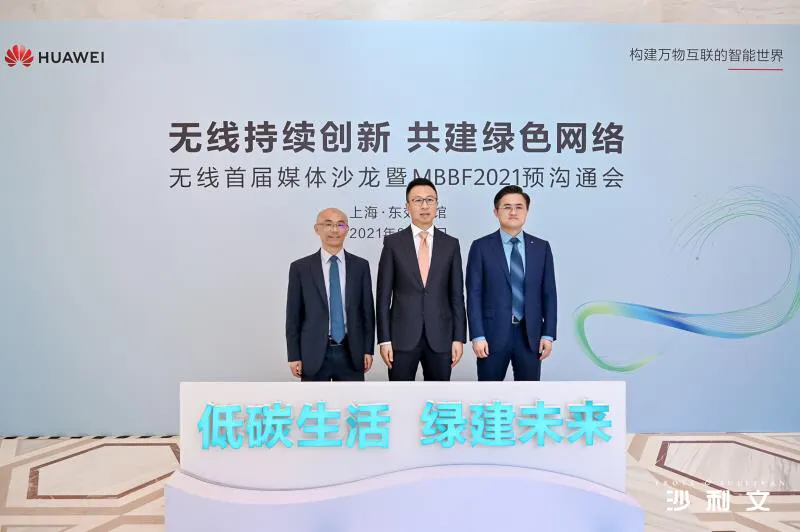
Dr. Wang Xin, photographed with Ma Hongbo (right), President of Huawei's Wireless Network SRAN Product Line, and Gan Bin (left), Chief Marketing Officer of Huawei Wireless