“Shencheng·Data Gathering & Finance” Investment and Financing Theme Forum
To thoroughly implement the national digital economy development strategy, break through the financing bottlenecks of core digital economy enterprises, and promote the deep integration of industrial innovation and capital elements, the 2025 Global Data Merchants Conference &“Shencheng·Data Gathering & Finance” Investment and Financing Theme Forum, guided by the Shanghai Data Bureau, co-hosted by the Huangpu District Data Bureau, Shanghai Smart City Development Research Institute, Shanghai Data Merchants Association, and Shanghai Jiao Tong University Cost Management Center, was held at the Shanghai International Convention Center on November 26th. With the theme of “Digital Intelligence Innovation for Win-Win in Industry and Finance” and centered around “precise docking, practical efficiency, and long-term service,” the event constructs an innovative digital docking model, strengthens government-enterprise-bank collaboration, empowers the financing needs of more data merchants, and aims to create a benchmark platform for digital economy industry-finance cooperation with city-wide influence.
Wang Chenhui, the managing partner and president of Frost & Sullivan (Frost & Sullivan, abbreviated as “Frost & Sullivan”) in Greater China, was invited to participate in a roundtable discussion, engaging in dialogue with representatives from the business and academia such as Zhao Chunyan, chairman of Shanghai Jiao Tong University High-tech Co., Ltd., Luo Japan, general manager of the business department of Shanghai Branch of Bank of Communications, Peng Juan, associate professor at the Antai School of Economics and Management at Shanghai Jiao Tong University, and Xiong Zijing, vice president of Jingwei Venture Capital.
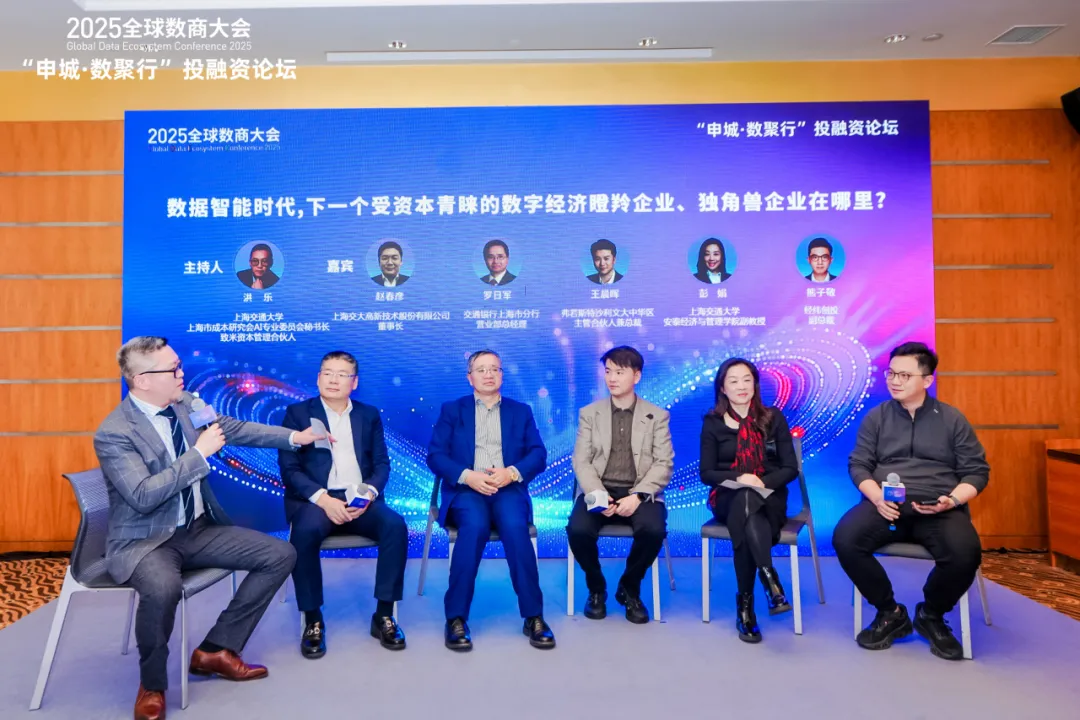
Roundtable Discussion

Wang Chenhui, managing partner and president of Frost & Sullivan Greater China
During the roundtable discussion, Wang Chenhui shared his insights on key topics such as digital economy transformation, data element markets, and innovation and entrepreneurship trends. Based on his practical experience in serving enterprises going public in Hong Kong and overseas for a long time, he brought systematic and forward-looking insights to the guests present.
When discussing how to judge the core criteria for “gazelle enterprises” and “unicorn enterprises,” Wang Chenhui pointed out that as a consulting firm that has been assisting enterprises in going public in Hong Kong and overseas for many years, Frost & Sullivan does not only evaluate enterprises based on valuation but also places more emphasis on the verifiable growth logic behind them. He emphasized that the evaluation system in the digital economy era has been upgraded from traditional scale expansion to three core dimensions: market ceiling (TAM) and penetration rate, differentiated technology commercialization capabilities, and the scarcity of data assets held by enterprises. “Today, having unique data sources is itself a huge valuation premium. Does the enterprise possess an irreplaceable dynamic data flow within the industry? This is a new core asset in the eyes of capital.” Wang Chenhui further explained.
When sharing the current market demand pattern for data products, he analyzed that data demand has accelerated its shift from the internet era to the deep-water area of traditional industry digitization. Financial institutions, local governments and urban investment platforms, and major central state-owned enterprise industrial chain leaders are becoming the main buyers of data products. “They are not buying raw data but decision certainty.” Wang Chenhui clearly pointed out. At the same time, he also identified structural pain points in the industry, including difficulties in data rights confirmation, pricing, transaction friction costs, etc., and emphasized that the construction of a credible data space and a third-party evaluation system are the key foundations for future industry development.
He further summarized the three characteristics of high-value data: authenticity, reusability, and ability to solve practical problems. He specifically explained that high-value data can be divided into business core data, scenario-related data, and high-dimensional multimodal data, and the realization of data value must go through four steps: “business dataization - data resourceization - data productization - data capitalization.” “Data value is not built up by technology but through systematic engineering.” Wang Chenhui added.
When discussing the strategic choices of technology-based startups, he bluntly stated that many technology founders have the typical problem of “looking for nails with a hammer.” Wang Chenhui pointed out that if startups want to enter the field of top-tier capital, they must complete a strategic leap from technology provider to industry enabler. “They must spare no expense to acquire a lighthouse customer and use industry benchmarks to leverage the entire industrial chain.” He emphasized this point. At the same time, he highlighted the importance of deep vertical integration and suggested that technology teams actively introduce industrial capital to make up for the shortcomings in cross-industry resources.
“Technology determines the lower limit of an enterprise, but governance structure determines its upper limit.” Wang Chenhui offered advice that founders with a technical background should complete the top-level design of their equity structure as soon as possible, form a complementary “iron triangle team,” and solidify the enterprise's mission, vision, and values. “From a ten-person organization to a thousand-person one, it ultimately depends on culture, not on managing people.” He added.
Finally, looking ahead to future entrepreneurial opportunities in the data track, Wang Chenhui concluded that entrepreneurs' opportunities do not lie in “bigness and comprehensiveness,” but in “niceness and specialization” and “cross-domain integration.” He believes that professional data vertical deep cultivation, multimodal data services, 3D data scenario applications, enterprise-level GEO tools, and data compliance and security services will become the most certain entrepreneurial directions in the next few years. “The core value of data lies in solving problems, and the core opportunity for entrepreneurs lies in filling gaps.” Wang Chenhui emphasized again.